

B2B ambassador programs get cut when they can’t connect results to revenue. The companies that keep theirs run ambassadors as a partner type inside the existing program, so every link, deal, and payout shows up where revenue is tracked. The rest comes down to picking people your buyers actually trust, paying for the outcome you want, and setting up attribution before launch.
Ambassador programs are everywhere in B2B software right now, but many of them won’t last. B2B ambassadors aren’t necessarily doing a bad job, but the companies running the programs are struggling to connect the results to revenue. So when budget reviews come around, there’s no proof the program works, and it gets cut.
Often the company already has an affiliate or partner program, and the ambassador program was started separately, so the two have no connection to each other or to revenue. The same person might be an ambassador and an affiliate at once, and nobody notices because there isn’t a cohesive system.
The programs that are surviving have tracked referral links, attribution into the CRM, and a payout process that doesn’t require a spreadsheet. This guide covers how to build one, how to measure it, and why it belongs inside your partner program rather than beside it.
What is a B2B ambassador program?
A B2B ambassador program formalizes a relationship with individuals who authentically advocate for your product to an audience they own, with agreed expectations and usually some form of compensation. Ambassador programs are popular with D2C brands, and though B2B ambassador programs share some similarities they also differ in ways that matter for how you run them.
How B2B differs from consumer ambassador programs
In B2B, the ambassador is usually a practitioner, consultant, or community figure whose audience is professional. They’re not chasing reach for its own sake. They’re lending credibility with a buying committee, and that’s a different kind of value than a consumer brand ambassador brings.
The consumer version of an ambassador program deals with figures like college students, beauty creators, or fitness influencers. Something like a student ambassador program is built for reach and volume. These types of brand ambassador programs usually measure success in impressions and engagement.
Why B2B ambassador programs are growing now
A few things have shifted that make this the right moment for B2B ambassador programs.
- Buyers trust practitioners over vendors: A study of 938 IT decision-makers found 63% are more likely to trust peer-recommended information, and 72% say vendor reputation is a top purchase factor.
- Buying committees are bigger: 54% of buyers now have five or more stakeholders involved, and 46% say due diligence has increased in the past three years.
- Expertise beats the “safe choice”: Businesses want a vendor who understands their challenges (85%), and 74% want a leading expert, while only 41% prioritize “safest choice.”
- Partner ecosystems are a growth engine: Forrester’s 2025 report found 67% of B2B leaders expect indirect revenue to grow more than 30% year over year, and two-thirds expect partner-influenced revenue to grow at the same rate. That ecosystem includes ambassadors.
As B2B ambassador programs grow, the vocabulary around them gets messier. The terms ambassador, influencer, advocate, and affiliate get tossed around like they mean the same thing, and they don’t.
Ambassador, influencer, advocate or affiliate?
Every row in the table is a person or company promoting you in exchange for something, tracked and paid on agreed terms. The compensation model makes more of a difference between these roles than the name alone. Get that wrong and you end up paying the wrong person for the wrong thing.
| Type | Relationship | Typically paid | What you get |
|---|---|---|---|
| Advocate | Informal, usually a customer | Nothing, or recognition and access | References, reviews, word of mouth |
| Ambassador | Formal and ongoing | Retainer, perks, or commission | Sustained visibility and credibility |
| Influencer | Campaign by campaign | Fee per deliverable | Reach into a defined audience |
| Affiliate | Transactional and ongoing | Commission on tracked conversions | Measurable pipeline |
| Referral partner | Formal, often a company | Fee per closed deal | Warm, qualified introductions |
Real people can occupy several rows at once, which is exactly why separate tools break. A consultant could be an ambassador, an affiliate and a referral partner simultaneously. If this isn’t tracked in the same system then they have three unconnected records.
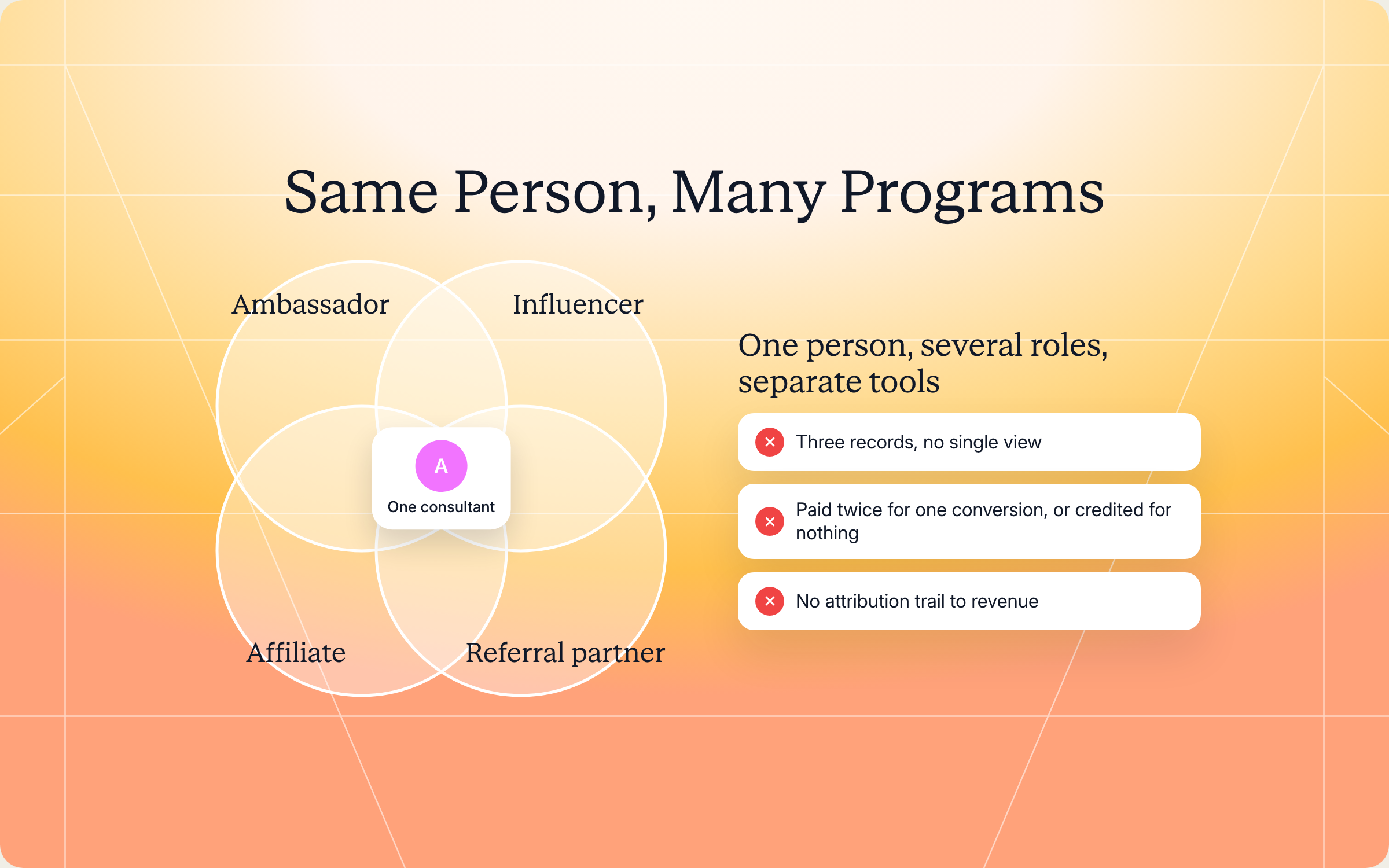
The overlap problem gets worse at enterprise scale, where a single B2B influencer might touch five or more partner programs across regions and business units. Nobody has a single view of what that person is doing, what they’re owed, or what they’ve produced.
Why B2B ambassador programs get cut

Ambassador programs get cut for six predictable reasons. All of them have the same root cause: The program lives outside the system where revenue is tracked. Here’s what happens when that’s the case:
- Measured on the wrong thing: Programs default to impressions and engagement because those numbers are easy to pull. But a CFO won’t fund a line item twice because a post got likes.
- No link to pipeline: An ambassador’s audience converts somewhere, but without partner attribution connecting the activity to the deal, the program gets no credit for the pipeline it helped create.
- Run in a separate tool by a separate team: When ambassadors live in a B2B creator program platform owned by marketing, and partners live in a PRM owned by partnerships, the ambassador motion never appears in a revenue review.
- Unclear expectations: When nobody documented what the ambassador would do, how often, or what success looked like, six months in there’s no way to say whether the program is working.
- Payment friction: Cross-border payouts to individuals take country-specific tax and payment processes, and if the tool can’t handle them, the program manager ends up running partner payouts on a spreadsheet.
- Overlap nobody manages: An ambassador who’s also in the affiliate and referral programs might get accidentally paid twice for the same conversion or credited for nothing.
You can see this everywhere ambassador programs exist. 47% of B2B marketers ranked measuring and reporting results as a top challenge. Engagement (54%) and ROI (52%) remain the most-cited metrics, while only 16% track MQLs or SQLs. Programs get measured on what’s easy instead of what matters. This gets worse at the enterprise level because a program measured on engagement won’t ever survive a quarterly revenue review.
How to build a B2B ambassador program
If you want your B2B ambassador program to survive a budget review, you need to make eight specific decisions before launching. Take the time to do it right or else you risk wasting months on an unsuccessful program.

Step 1: Decide what you actually want
A vague goal like “build awareness” can’t connect to a revenue metric, which is what you need from the start. Better goal examples include:
- Credibility with a buying committee: Measure by influenced pipeline from accounts where an ambassador touched the deal
- Reach into a new segment: Measure by sourced pipeline from net-new accounts in that segment
- Content you couldn't produce yourself: Measure by content-attributed leads or engagement-to-pipeline conversion
- Measurable pipeline: Measure by attributed revenue tied to specific ambassador links
Each one of these leads you to a different program with different people, so get specific before you recruit anyone. If the program works, awareness takes care of itself.
Step 2: Choose people by audience fit, not follower count
If you want to reach practitioners, a practitioner ambassador with 2,000 relevant followers will routinely outperform someone with 50,000 general ones. Look for people who already reach your buying committee, whether that’s through a newsletter, a community, a podcast, or regular speaking work. Audience relevance beats audience size every time.
When monday.com opened applications for its ambassador program, Matthew Kaisaris applied and got in. He’d spent nine years as a project manager before launching his own consultancy that helps trades companies run their operations on monday.com, so his audience is exactly the buyers monday.com wants to reach.

Step 3: Set explicit expectations
Document what the ambassador will produce, how often, and what is off limits before the relationship starts. Will they post twice a month? Speak at one webinar per quarter? Write one co-authored piece? Are there topics, competitors, or claims they should avoid? A vague agreement is the easiest kind to quietly fall short.
Step 4: Pick a compensation model
Compensation depends on what you’re asking for, and each model has real trade-offs:
- A retainer buys predictability, but you pay whether or not anything comes of it.
- Commission aligns incentives and suits people who already reach a buying audience, since they only earn when deals move.
- Exclusive access and free products cost little, but they attract fewer serious participants.
- Hybrids are common, combining a small retainer with performance bonuses.

The compensation structure you pick signals what you value. Pay for impressions, and ambassadors will chase reach. Pay for attributed revenue, and they’ll chase deals.
Step 5: Give them something to say
New ambassadors need more than a logo and a welcome email. Provide clear onboarding and training so ambassadors can understand the brand they represent. Give them early access to product, data they can cite, and a point of view on where the category is going. Co-branded content and shareable assets like referral links and social graphics give them something to work with. Ambassadors can take that material and apply their own marketing skills to it.
The best programs connect ambassadors to each other through a shared ambassador community, where they can swap what’s working and learn from people doing the same job at other companies.
Step 6: Track everything properly from day one
If you don’t track attribution from the start, you’ll quickly discover it’s painful to try and do it retroactively. Track links per ambassador and make sure partner attribution is set up in your CRM. This way, you can see which ambassador touched which deal, and the data lives where revenue lives.
Step 7: Handle disclosure correctly
Paid endorsements carry disclosure obligations, and rules vary by jurisdiction. In the US, the FTC’s Endorsement Guides require that material connections between an endorser and a seller be disclosed clearly and conspicuously, with the disclosure proximate to the endorsement. Burying it in a hashtag or a bio doesn’t count, and advertisers are responsible for monitoring their endorsers' compliance.
Similar rules apply in the UK, EU member states, and elsewhere. Remember that it’s the ambassador’s credibility at stake as much as yours, so getting this right protects both sides.
Step 8: Pay ambassadors reliably
Individuals are harder to pay than companies, especially across borders. An ambassador in Germany requires a different process than a reseller in Texas, so if your tool can’t handle tax forms and international partner payouts, the program manager ends up doing it by hand. And individuals feel late payment far more acutely than companies do. Reliable payment is what keeps ambassadors engaged.
Running ambassadors inside your partner program
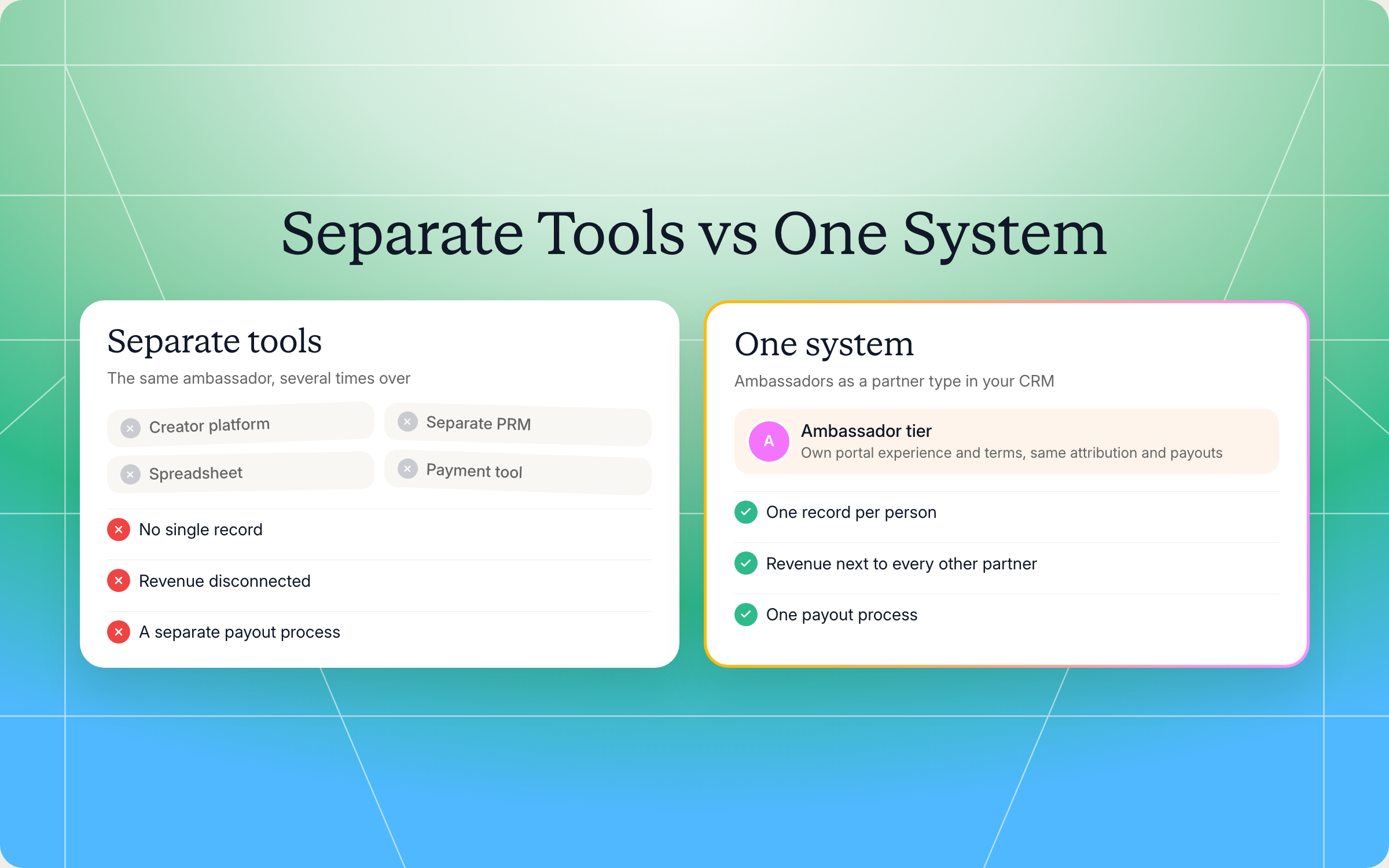
Ambassadors promote you to an audience, are paid on terms you set, and their impact is tracked. That’s the same as any other channel partner type, so they should be treated as such. If you run your ambassador program in a separate tool, you create three headaches for yourself:
- 1. No single record: The same person appears in multiple programs with no unified profile
- 2. Disconnected revenue: Their contribution never appears next to other partner-sourced revenue
- 3. Payment friction: They’re paid through a different process with different paperwork
Treat ambassadors as a segment or ambassador tier within the partner program, give them their own portal experience and terms, and let the attribution and payout machinery do the same job it already does for everyone else. For companies running a large consumer-style creator program with heavy content workflow management, a separate tool might make sense. But for almost all B2B brands, a consolidated approach is the right move.
When ambassadors can work headless

A headless PRM means nobody has to log into a portal to get work done. An ambassador can register a deal, check their attribution, or pull a payout status from their CRM, Slack, Teams, or an AI assistant like Claude, ChatGPT, or Gemini. MCP (Model Context Protocol) is becoming the standard that makes this possible, with Microsoft, Salesforce, HubSpot, Google, and OpenAI all adopting it. For a partner manager running dozens of ambassadors, asking an AI assistant for a status update is faster than opening another tab.
How Introw supports ambassador and influencer programs
Introw is a CRM-native PRM platform for HubSpot and Salesforce that runs every partner type, from resellers to ambassadors, in one system. It also does so headlessly so partners and ambassadors don’t need to access a portal. Introw doesn’t have a dedicated ambassador module, and it doesn’t need one. An ambassador needs the same machinery as any other partner, which Introw does support: a tracked link, attribution into the CRM, visible earnings, and reliable payment under agreed terms.
When ambassadors run in Introw, their revenue sits next to every other channel in your partner management dashboard. Links and payouts run themselves, so adding ambassadors doesn’t add admin. Fraud checks run before you pay. Credit goes to the right person, even when someone is also an affiliate or a referral partner. And because everything lives in your CRM, the program can answer what it produced when the budget review comes around.
Introw is built for enterprise and large partner teams, which means the overlap problem, multi-region payouts, and program governance all stay manageable as the program scales.
The ambassador programs that survive are the ones that can answer what they produced. That answer lives in the CRM, which is where the program should have been run from the start. Book a demo to see how Introw runs ambassadors alongside every other partner type.
Still curious? Here are some quick answers to help clear things up
An ambassador has an ongoing, formal relationship with your brand, while an influencer is hired campaign by campaign for specific deliverables. Ambassadors build authentic relationships with your audience over time, whereas B2B influencer partnerships are brought in for social media reach into a defined audience for a set period.
Yes, when influencer management picks an audience that is genuinely practitioner-level and the content gives something they couldn’t get from a vendor blog. It falls flat when many marketing teams chase reach and pick the wrong voices. Done right, B2B influencer marketing builds long-term relationships that generate word-of-mouth.
Use tracked links and referral links tied to attributed pipeline, so the program connects to revenue from the start. Programs that measure on high engagement instead of pipeline get cut. The programs that last tie efforts and rewards to deals, not impressions.
Start with existing customers and loyal customers who already talk about your category, whether in a community, a newsletter, or at industry events. Look for practitioners who are passionate about the space and have the knowledge to represent your product credibly. Many programs start with open applications and gifted products before adding commissions as the relationship matures.





See AI-Native PRM in Action
Book a demo with one of our partner program experts, or explore Introw on your own time.