

An affiliate manager recruits, activates, and manages the affiliates who promote your product for commission. Signing affiliates up is the easy part. The hard part is getting them to actually share a link, because most affiliates who join a program never send a single click. This playbook covers what an affiliate manager does day to day, the three types of affiliates you'll manage (superaffiliates included), how to recruit and onboard them, how to keep them active, and how to read metrics like EPC so you know whether the program is working.
US advertisers will spend $13.81 billion on affiliate marketing in 2026, up 11.3% from 2025, according to EMARKETER. That's faster growth than ecommerce itself. And affiliate marketing isn't just a consumer channel for physical products anymore. B2B SaaS companies are building programs too, with consultants, newsletter writers, creators, and review sites recommending software they actually use.

Here's the part nobody puts in the launch announcement, though. You open the program, 200 affiliates sign up in the first quarter, and a few months later you notice something. A dozen of them drive almost all of your affiliate driven revenue. The other 188 logged in once, copied nothing, and disappeared.

Sound familiar? That's not an affiliate problem. It's an affiliate management problem.
This guide is for the person who owns that gap. Whether your title is affiliate manager, affiliate marketing manager, or "the partnerships person who also inherited the affiliate program," it covers how to recruit the right affiliates, get them to their first conversion fast, and run a growing program without spending your whole week answering the same five emails.
What does an affiliate manager actually do?
On paper, an affiliate manager is responsible for growing and running an affiliate program. In practice, the job is about getting other people to sell for you, consistently, without you having to chase them.
You'll see the role under a few names. The affiliate marketing manager title is common in ecommerce and consumer brands. Affiliate program manager shows up more in SaaS, where the job sits closer to the partnerships team. Some companies outsource the whole thing to an agency. The titles vary depending on the company, but the core responsibilities don't:
- Recruitment: Finding potential affiliates whose audience looks like your buyers, and convincing them your program is worth their time.
- Onboarding and activation: Getting new affiliates from "approved" to "first click," and from first click to first conversion.
- Relationship management: Keeping your top affiliates close with exclusive offers, early access to product launches, and someone who actually answers their messages.
- Creative assets and campaigns: Supplying approved messaging, banners, and campaign kits so affiliates promote you accurately.
- Performance and data analysis: Tracking clicks, conversions, EPC, and revenue generated per affiliate, then using that data to optimize campaigns.
- Compliance and payouts: Enforcing program terms, spotting suspicious activity, and making sure commissions are reviewed and paid on time.

What a typical day looks like
A typical day splits between building relationships and working the numbers. Your morning might be outreach to three newsletter writers, plus a call with a top affiliate who's planning a product review and wants talking points. Your afternoon is reviewing last week's conversions, approving commissions, and flagging an affiliate whose traffic sources suddenly look very different.
That mix is why the best affiliate managers combine creative thinking with data driven discipline. You need enough tech savviness to work comfortably in affiliate tracking and data analytics tools, and enough people skills to make a creator feel like your program is the one they want to be in.
Affiliate manager vs partner manager
If you work in B2B SaaS, there's a good chance affiliates sit inside a broader partnerships team, next to channel and referral partner managers. The difference between the roles is depth versus scale.
A channel partner manager might run 30 reseller relationships, each with deal registration, co selling, and quarterly business reviews. An affiliate manager might run 500 affiliates, most of whom will never need a meeting. So the affiliate manager's real job is designing a program that runs itself for the long tail, freeing up time for the handful of affiliate partners who actually move revenue.
In many teams, affiliates, referral partners, and resellers end up in the same program anyway. That's worth planning for early, because it decides whether your affiliate data lives next to the rest of your partner data or in a separate tool nobody else looks at.
Why most affiliate programs stall after sign up
Before the playbook, let's name the problem. Most affiliate managers will recognize at least two of these:
- Affiliates sign up and disappear: The approval email lands, the affiliate logs in once, and never comes back. Nobody told them what to promote, or why now.
- Every request goes through you: Affiliates email for their link, the latest banner, the commission table, and their payout status. You become a help desk.
- The creative is stale: The assets in the portal still mention last year's pricing. Affiliates stop promoting what they can't trust.
- Payouts are a black box: Affiliates can't see what's pending, what's approved, or when they'll be paid. Uncertainty kills motivation faster than a low commission rate ever will.
- Nobody knows who's actually performing: Without clean data, every affiliate gets the same attention, so your best affiliates get treated like your inactive ones.
None of these are problems with affiliate marketing itself. They're problems with how the program is run. Every section below is about removing one of them, so you can spend your time on recruitment and the relationships that matter.
The three types of affiliates you'll manage
Here's the first mindset shift: stop treating your affiliates as one group. Most programs end up with three, and managing affiliates well means giving each one a different playbook.
| Who they are | What they need from you | How much of your time | |
|---|---|---|---|
| Superaffiliates | Established creators, review sites, and newsletters with large, trusting audiences | Custom terms, exclusive offers, early access, a named contact | High, they drive a large share of revenue |
| Niche content affiliates | Consultants, bloggers, and communities with a focused audience in your space | Strong creative assets, clear messaging, timely campaign kits | Medium, mostly through campaigns and newsletters |
| Long tail affiliates | Customers, fans, and small publishers who share occasionally | A link, a simple page, and automatic payouts | Low, the program should run itself |
What is a superaffiliate?
A superaffiliate is an affiliate who drives a disproportionate share of your program's revenue, usually because they own an audience that trusts their recommendations. In most programs, a small group of superaffiliates generates the majority of affiliate sales. Lose one, and you'll feel it in the quarter.

So they need a different deal. Negotiate custom commission terms or performance based bonuses. Give them early access to new features, so their content lands first. And make sure they have a named contact who replies within a day, not a shared inbox.
HubSpot is a good example of how to formalize this. Its affiliate program runs three tiers based on monthly sign ups. Starter affiliates earn 30% recurring commission for up to a year with a 180 day cookie window, and the top Elite tier gets custom commission based on performance. Affiliates have to hold their volume for three months to move up a tier, which gives everyone a clear, earnable path to superaffiliate terms.
You don't need HubSpot's scale to copy the idea. A simple tiered commission structure, backed by partner tiering that updates automatically, gives your growing affiliates something to aim for.
Superaffiliates also tend to want branded links that look like their own, not a string of tracking parameters. In Introw, you can give any affiliate a vanity link alias that keeps their tracking intact:
How to recruit affiliates
Partner recruitment for affiliates is about fit, not volume. Two hundred affiliates whose audience doesn't buy your product are worth less than ten who reach your exact buyer. The best affiliate marketing strategies start with a clear picture of who your buyers are and who they already listen to, so affiliates bring you new audiences instead of the ones you already reach.
Start with your own customers
Your happiest customers are your easiest affiliates. They already know the product, they already recommend it, and their audience often looks a lot like your next customer.
Add an affiliate invite to your post onboarding emails, your customer community, and your NPS follow ups for promoters. For a B2B business, the consultants and agencies who implement your product are a natural fit too. You can look to affiliate networks for volume, but in B2B SaaS, your own customers and partners usually send better leads.
Go where your buyers already read
Make a list of the newsletters, YouTube channels, podcasts, communities, and review sites your buyers trust. Then reach out with a specific reason they should care: what their audience gets, what the commission looks like, and what support you'll give them.
Generic "join our affiliate program" emails get ignored. A note that mentions a recent post they wrote, and offers a ready made campaign kit for their next one, gets replies.
Recruit superaffiliates differently
Superaffiliates get dozens of program invitations every month. A sign up link won't do it. Open with a conversation, a custom offer, and proof your product converts, like your trial to paid rate or a customer story. If they have a track record in your niche, a higher commission for the first quarter is often what earns you a spot in their content calendar.
Let the sign up page do the selling
Your affiliate page should answer every question before anyone has to ask it: who the product is for, the commission and cookie window, how and when payouts happen, and which creative assets they'll get. Then keep the application short, because every extra field loses applicants.
Use the approval step to check fit, not to collect paperwork. And make sure every affiliate accepts your terms through a clear affiliate partner agreement before they get a link.
Affiliate onboarding: get to the first click in week one
Affiliate onboarding has one job: get a new affiliate to share their link while they're still excited about it. The longer the gap between approval and first click, the less likely that click ever happens.
That's why your partner activation rate, the share of affiliates who have driven at least one conversion, is the number to watch. It tells you whether onboarding works far better than the number of sign ups does.

Approve fast
If your approval queue takes two weeks, your best applicants have already joined someone else's program. Auto approve affiliates who meet clear criteria, and save manual review for edge cases, like applicants whose only channel is paid search.
Hand over one link and one campaign
Don't send a new affiliate to a portal with 40 assets and a 12 page guide. Give them three things: their tracked link, one ready to use campaign with approved messaging, and one clear idea for their first post. A campaign kit with the link already embedded in every call to action removes the last excuse not to share.
Here's what launching an affiliate campaign looks like in Introw, from creating the campaign to showing it in the partner portal:
Set expectations in the welcome message
Tell affiliates exactly what happens next. How attribution works, how long the cookie window is, when conversions get approved, and when they'll be paid. Affiliates who understand the mechanics trust the program. Affiliates who trust the program promote it.
Follow up on day seven
Check who has shared a link in their first week and who hasn't. A short, personal nudge to the quiet ones, ideally with a timely campaign they can use right away, brings back more affiliates than any amount of documentation. This is also one of the easiest things to automate, and good onboarding automation means no affiliate slips through just because you had a busy week.
If you're evaluating tools for this stage, our roundup of partner onboarding software covers what to look for.
How to manage affiliates once they're live
Once affiliates are active, your job shifts from activation to momentum. Keep the top affiliates growing, move the middle up, and let the long tail run on autopilot.
Segment by performance, not by sign up date
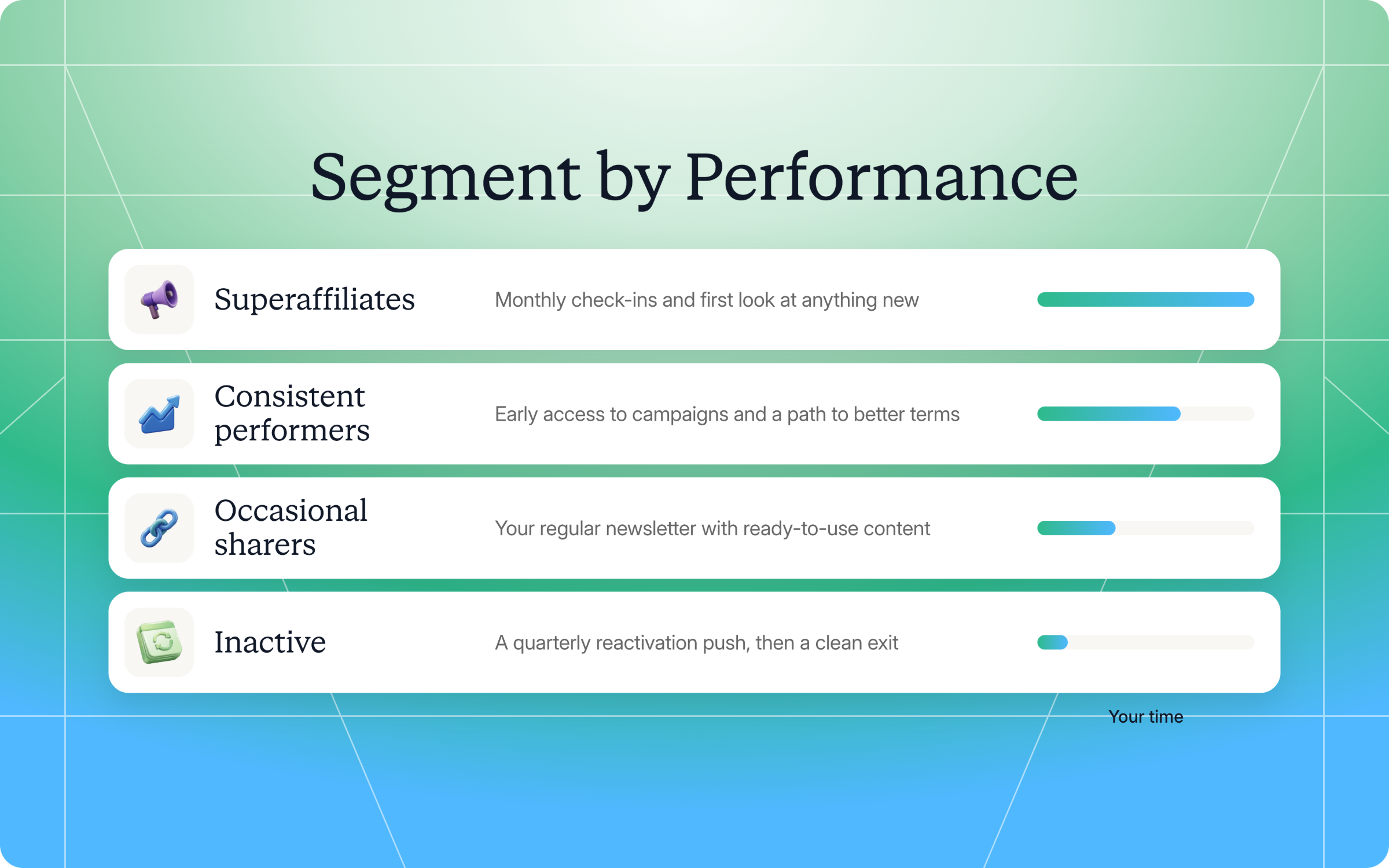
Group affiliates by what they actually do: superaffiliates, consistent performers, occasional sharers, and inactive. Then give each group its own cadence.
- Superaffiliates: Monthly check ins and first look at anything new.
- Consistent performers: Early access to campaigns and a path to better terms.
- Occasional sharers: Your regular affiliate newsletter with ready to use content.
- Inactive affiliates: A quarterly reactivation push, and after that, a clean exit.
Keep campaigns and creative fresh
Affiliate campaigns work best when they're timely. Every product launch, pricing change, seasonal offer, or new case study is a reason to send affiliates a new campaign kit with updated creative assets.
Just as important, retire old assets, so nobody promotes a feature you've sunset or a discount that expired in March. Keep one resources page with the latest messaging, screenshots, and FAQs, so affiliates get expert guidance without waiting on your team. If you want to go further, the same enablement content you build for resellers often works for affiliates with light edits.
Make earnings visible
Affiliates should never have to email you to ask what they've earned. Give them a view of clicks, conversions, pending and approved commissions, and payout dates. Pay on a predictable schedule, and when a commission is declined, say why.
Clear commission tracking does more for motivation than a higher rate nobody can verify. And if you want more ideas on what keeps people promoting, our guide on how to motivate referral partners covers incentives that work just as well for affiliates.
Protect the program
As the program grows, so does the temptation to game it. Self referrals, fake leads, cookie stuffing, and affiliates bidding on your brand name all inflate payouts without adding a single new customer. Write the rules into your agreement, use tracking that can't be faked, and review commissions before they're paid.
Here's how fraud protection is set up for an affiliate campaign in Introw:
Protecting your brand's reputation and your budget isn't an extra. It's part of the affiliate manager role.
Measuring success: the affiliate metrics that matter
You can't manage what you can't measure, and affiliate programs generate a lot of numbers. These are the five worth reviewing every month.
| Metric | What it tells you | How to use it |
|---|---|---|
| EPC (earnings per click) | How much an affiliate earns, on average, for every click they send | Compare offers and campaigns, and show affiliates why your program is worth promoting |
| Conversion rate | The share of affiliate clicks that become customers | Spot weak landing pages, or traffic that's suspiciously good |
| Activation rate | The share of affiliates who have driven at least one conversion | Check whether recruitment and onboarding are working |
| Revenue per affiliate | How revenue is spread across your affiliates | Find your superaffiliates and rising performers |
| Time to first conversion | How long a new affiliate takes to drive their first customer | Diagnose onboarding friction |
What is EPC in affiliate marketing?
EPC, or earnings per click, is the average commission an affiliate earns for every click they send. You calculate it by dividing total commissions paid by total clicks. If your affiliates earned $1,500 from 3,000 clicks last month, your program's EPC is $0.50.

Why do affiliates care? Because EPC tells them how well their traffic converts on your offer compared to every other program competing for their attention. When you see "30 day EPC" quoted, it's simply EPC calculated over the last 30 days. For you, a rising EPC is one of the best recruitment tools you have. It proves the program pays, without you having to promise anything.
Look at EPC per affiliate, too. A sudden spike can mean a great new piece of affiliate content. It can also mean an affiliate is capturing traffic that was already yours. Either way, check it against your wider partner performance data, and make sure every affiliate conversion feeds your partner attribution reporting, so affiliate revenue is measured the same way as every other partner channel. Tracking revenue generated per affiliate over time shows you where to focus your investment.
The affiliate manager career path: hiring for the role, or becoming one
If you're hiring, look for hands on experience running a program, a track record of building relationships with creators or publishers, and comfort with data analysis. The best candidates can tell you which affiliates they recruited and which numbers they moved, not just which tools they've used.
If you're on the other side of the table, the career path usually starts in a broader marketing role like content, partnerships, or performance marketing. From there, affiliate managers move into senior affiliate management, head of partnerships, or wider growth leadership. Affiliate management is one of the few marketing roles where your impact shows up directly in revenue and sales, which makes it a strong foundation for anyone who wants to build a career in the affiliate world.
How Introw helps affiliate managers
Introw is a CRM first partner relationship management platform, which means it builds on top of your existing HubSpot or Salesforce setup rather than replacing it. Affiliates run in the same program as your referral, reseller, and other partner types, so affiliate data sits next to the rest of your pipeline instead of in a separate tool.
Introw Affiliate Campaigns is built around one idea: you shouldn't be the middleman for links, briefs, commission tables, or payout status.
- Self serve sign up: Affiliates can sign themselves up, or you can import an existing list.
- Campaigns they're eligible for: Each affiliate sees only the campaigns they can promote, with approved messaging, payout terms, and their live tracked link.
- Links and creative on tap: Affiliates create vanity aliases and pull approved creative from the asset library and campaign kits themselves.
- Fraud rules before payout: Self referrals, disposable emails, duplicate conversions, and conversions from existing customers are blocked or flagged before commission is earned.
- Earnings affiliates can see: Affiliates check approved earnings, pending conversions, declined lines, and payout timing without contacting you or finance.
- Payouts that reconcile: You batch approved earnings into payouts with statements that tie back to your CRM.
Getting a working affiliate program live in Introw takes about half a day, from connecting your CRM to issuing the first tracked links. If you're comparing options, our guides to the best affiliate management software and PartnerStack alternatives cover the wider market.
That's what good affiliate management looks like: affiliates who serve themselves, a team that focuses on the relationships that matter, and affiliate marketing that shows up in pipeline. See how Introw takes the busywork out of managing affiliates. Book a demo or explore Affiliate Campaigns.
Still curious? Here are some quick answers to help clear things up
An affiliate manager recruits, onboards, and manages the affiliates who promote a product for commission. Day to day, that means outreach to potential affiliates, supplying creative assets and campaigns, tracking performance, enforcing program terms, and making sure commissions are reviewed and paid on time.
A superaffiliate is an affiliate who drives a disproportionate share of a program's revenue, usually because they own a large, trusting audience. Most programs only have a handful, and they deserve custom terms, early access, and a named contact.
EPC stands for earnings per click. It's total commissions divided by total clicks, so it shows how much an affiliate earns on average for each click they send. A 30 day EPC is the same calculation over the last 30 days.
Start with your own customers and implementation partners, then reach out to the newsletters, creators, communities, and review sites your buyers already trust. Make your affiliate page answer every question up front, keep the application short, and approve good fits quickly.
It depends on your model. Consumer brands selling physical products often use affiliate networks. B2B SaaS companies usually want software that tracks affiliates, blocks fraud, pays out, and syncs conversions to the CRM, ideally alongside their other partner programs. Our affiliate tracking software guide compares the main options.






See AI-Native PRM in Action
Book a demo with one of our partner program experts, or explore Introw on your own time.