Dealer Portal and Dealer Relationship Management: How Manufacturers Run Their Dealer Network in 2026
Dealer portal software only works when dealers actually use it, so this guide shows how manufacturers run dealer onboarding, deal registration and incentives from their CRM.


Dealer portals fail when they’re built around what the manufacturer needs instead of what the dealer’s business needs. The fix is a value exchange: Keep the portal for things dealers want, like pricing, incentives and deal registration, and push everything else to them where they already work. CRM-native platforms such as Introw run the whole network from your existing CRM, so dealers get answers from their own tools and your team works from one set of numbers.
Running a dealer network means managing dozens or hundreds of companies you don’t employ. Each dealer is an independent business with its own priorities, its own customers and often your competitors’ products on the same floor. You can’t issue instructions and expect them to be followed.
You can only make yourself the easiest and most profitable brand to sell, then do everything you can to keep that position. Unfortunately, the tools for this job have lagged the relationship itself. For years the standard answer was a login-required portal, and for years dealers treated it as optional. This article covers what dealer relationship management involves, why portals struggle to earn adoption, and what the current generation of CRM-native and AI-native platforms changes.
What is dealer relationship management?
Dealer relationship management is how a manufacturer recruits, onboards, enables, incentivizes and measures the independent businesses that sell its products. It’s the manufacturer side of the relationship, and it’s a different job from running a dealership, because a dealer is an independent company. They usually carry competing brands, they set their own priorities, and their business is their own. You can’t direct them.
A dealer sits somewhere between a distributor, who buys and resells stock, and a value-added reseller, who builds on the product, and the relationship you run reflects that.
Everything you do for the network follows from that, including:
- Recruiting and onboarding the right partners, and getting them selling fast
- Training their staff so they can actually demonstrate and sell your equipment
- Keeping marketing and brand assets current and ready to use locally
- Registering leads and deals, so two dealers never fight over the same customer
- Setting pricing and incentives that are visible and current enough to actually motivate
- Forecasting and tracking performance, without phoning every dealer to ask
- Handling day to day communication, which shouldn't depend on anyone opening a website
What a manufacturer needs is software for the network itself, and the tools for that job have changed. For years, the answer was a login-required portal. The current generation is CRM-native and AI-native. That means dealers work from their own tools, and the portal becomes a record rather than a requirement. This isn’t a niche shift either. 88% of organizations now use AI in at least one business function, and 62% are already experimenting with AI agents, according to McKinsey's 2025 global survey.
Dealer portal software vs dealer management systems
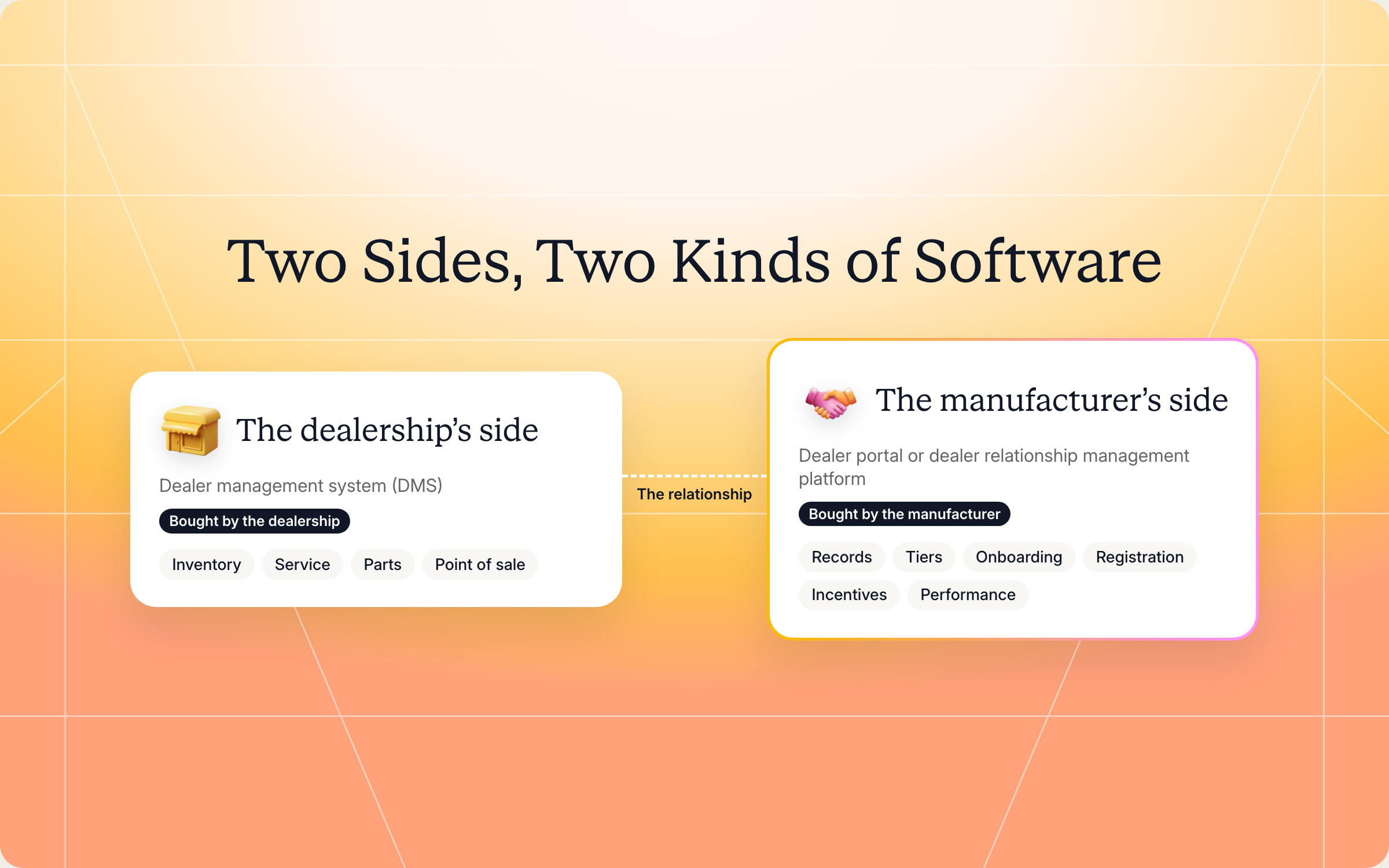
The names get confused because the words sound interchangeable, but each of these products works on opposite sides of the relationship. A dealer management system (DMS) runs inside a dealership. It handles inventory, service scheduling, parts and point of sale. It's most common in automotive, where the buyer is the dealership itself.
A dealer portal or dealer relationship management platform runs the manufacturer's side instead. Its buyer is the manufacturer, and dealer network management is its whole job. The confusion is also why searches for software to manage a dealer network keep surfacing DMS products built for the dealership, not for the brand. It’s also why a B2B dealer portal purchase made on a misread search result means starting the search over.
If you're still pinning down where dealers sit among the channel models, read franchising vs licensing vs channel partnerships to see how the relationships differ.
Why dealers don’t use your portal
You built the portal, and you designed it around your needs. That means you filled it with forecasts, training completions, and the paperwork of compliance management. But those are things you need. Dealers are running their own businesses, and your portal is one of a dozen logins competing for their attention. If your portal is filled with unnecessary items, they’ll ignore it.

And even if it has genuine value, it goes unseen because the people who’d benefit most from what’s inside don’t sit at a desk anyway. Sales staff on a forecourt or in the field aren’t logging into a web portal between customers. That’s why only a handful of dealers log in to the site each month and your deals still arrive by email.
Three smaller frictions keep dealers from coming back:
- Stale content: Price lists and spec sheets go out of date, dealers have been caught out before, and now they ask customer support instead of checking the portal.
- Password and access friction: It sounds trivial, but external users report login issues almost universally, and password resets eat the time the portal was supposed to save.
- Nothing happens when they use it: They submit a registration or a lead and hear nothing back, so they stop. Weak lead management is often the first aspect dealers notice, because a portal that can't create more leads for the dealer has nothing to offer their business.
Dealer portal adoption isn’t a user experience problem, it’s a value exchange problem. The portal has to be worth opening for the dealer’s own business, and everything you need from them has to arrive where they already are. That exchange is what turns efficiency for your team into profitability for theirs.
Gartner’s buying research found that 43% of customers regret moving to a self-service purchase, compared with 26% who regret a rep-led one. If you apply that to a dealer network and push everything into a portal, some dealers might feel abandoned rather than empowered. To keep that regret out of your network, make the portal worth opening for the dealer’s own business, and send everything you need from them where they already are.
What belongs in a dealer portal, and what does not
Not everything belongs in your portal, but plenty of valuable assets do. The portal should be a destination for things the dealer wants and a record of things you both need, which is why current pricing, co-branded assets and deal registration earn their place there. The rest, announcements, reminders, forecast requests, is information the dealer never asked for, and it travels to them directly.
Here’s what to put in the portal.
| Put in the portal | Why it works there |
|---|---|
| Current pricing and product information | They need it to quote, so they come for it |
| Marketing assets and co-branded materials | Immediately useful to their own business |
| Training and certification | Needs a structured, trackable environment |
| Their own earnings and incentive position | The single strongest reason a dealer logs in |
| Deal and lead registration | Protects their deal, so it is worth the effort |
And here’s what you should send directly to them instead.
| Send it to them | Why the portal doesn’t work |
|---|---|
| Announcements and product news | Nobody logs in to check for news |
| Status updates on their registrations | They want to be told, not to go looking |
| Reminders and nudges | A reminder behind a login is not a reminder |
| Requests for forecasts or information | Asking is your need, so you should do the reaching |
| Incentive and target progress | Pushed progress motivates, pulled progress is ignored |
Don’t take the division too far, though. McKinsey found what it calls the rule of thirds: At any stage of a buying journey, about one-third of customers want in-person interaction, one-third want remote contact, and one-third prefer digital self-service. The split holds across industries, geographies and purchase types.
This is a useful way to treat your dealer network. Some dealers will always want to talk to a person, some want everything in the portal, and most want a mix. The portal’s job is to be excellent at its third, not to be the whole relationship.
Building the dealer relationship, stage by stage

A dealer relationship isn’t a contract you sign and then revisit at renewal. It moves through stages, and each stage asks something different of you. The stages below are the ones that show up in every healthy program, in roughly this order.
- 1. Recruitment: Start by defining what a good dealer looks like for your product and territory, then qualify candidates against that definition instead of signing whoever shows interest.
- 2. Onboarding: This is the period that decides everything. A dealer who sells nothing in the first 90 days usually never does, so dealer onboarding should hand them a checklist with one clear next step.
- 3. Training and certification: Dealer staff turn over constantly, which makes training continuous rather than a launch event. Tying certification to something the dealer values, such as a tier or a margin band, keeps it alive long after launch week. A partner LMS gives that training a home dealers' staff can actually reach.
- 4. Enablement: Dealers need current pricing, product information and marketing assets they can use locally without filing a design request. Stale dealer enablement is how a dealer ends up quoting the wrong number to a customer.
- 5. Deal and lead registration: This is how you prevent two dealers from fighting over the same customer, and it’s also the reason dealers trust a program at all.
- 6. Incentives: Incentives have to be visible, current, and credible. A dealer who can’t see where they stand against a target can’t be motivated by it.
- 7. Performance management: Close the loop by knowing which dealers are growing, flat, or declining without having to ask them. Hold the conversation using the same numbers they can see, as that’s what makes dealer performance reviews worth having.
None of these stages requires a new system on its own. They simply need a shared picture, where the dealer and the manufacturer are looking at the same pricing, the same registrations and the same performance numbers at the same time.
How Introw runs a dealer network
The dealer portal problem has a CRM-native answer. Introw is a PRM that lives inside HubSpot and Salesforce, which means the manufacturer’s team works the network from the CRM they already run the business in. Dealer records, tiers and registrations sync two ways, so performance data and incentive calculations are grounded in the same numbers the sales team uses every day, with no separate database to keep current.

The dealer side works in reverse. Through Partner Connect, a dealer works from their own CRM, Slack, Teams or email, and the record of the relationship updates on both sides without anyone opening a portal. A deal registration submitted from a dealer’s CRM arrives with conflict detection already applied, and the answer comes back to the dealer where they asked the question.
Introw is also AI-native. A dealer can ask an AI assistant, through the Claude integration or any MCP-compatible tool, where their registration stands or which training is still outstanding, and get a current answer without logging into anything. The manufacturer’s team can ask the same questions of their own network, and the answers come from live data.
Introw doesn’t run inventory, order management, parts, warranty claims or service scheduling, and it isn't a substitute for the systems that do. What it does is connect to them, so the network layer and the operations layer stay in sync. For enterprise teams running large networks, that integration is what keeps the CRM, the ERP and the PRM telling the same story.
If your dealers are still chasing answers by phone, book a demo and see what the network looks like when it runs from your CRM.
Still curious? Here are some quick answers to help clear things up
A dealer portal runs the manufacturer’s side of the relationship: records, onboarding, training, deal registration, incentives and communication. A dealer management system runs the dealership’s own operations, like inventory management, service and invoicing. They serve different buyers, and one isn’t a substitute for the other.
Dealer management software keeps dealership operations running from a single platform: sales, service, parts and back office work like accounting and invoices. The best ones integrate inventory, sales, and accounting in one system, which cuts double entry and keeps real-time accounting accurate across multiple locations. It's built for the dealer's business, not the manufacturer's network.
The portal pushes updates to them instead of waiting for a login. Real-time visibility into registrations, incentive positions and training status reaches dealers by email, Slack, or Teams, so nobody works from a stale price list. Centralized resources like product manuals, pricing, and promotional materials stay current in one place.
Yes. A dealer is functionally an independent reseller, so partner management software handles the same jobs: onboarding, enablement, registration, incentives and performance visibility. It doesn’t replace the dealer’s operational systems, but modern platforms connect to them through their APIs, so both sides work from the same information.
Look for the key features that match your dealership needs as a manufacturer: CRM integration, deal and lead registration, training, and a user friendly experience for people who won't sit at a desk. Role-Based Access Control matters too, because different users need different views and permissions across your network. Most vendors offer a free demo, and it's worth using it to test the dealer’s side of the experience, not just yours.





See AI-Native PRM in Action
Book a demo with one of our partner program experts, or explore Introw on your own time.