

Co-branding and co-marketing fail in the same two places every time, whose logo goes where, and who gets the leads. Settle both once with a co-branded template and a standing attribution rule, and a campaign that took two months takes two weeks. Run it as a kit published to every partner instead of a bespoke build each time, and one partner marketer can run a program for hundreds. Report results quickly, tie them to the spend, and the second campaign gets approved on its own.
When two or more companies run a co-marketing campaign together, they each bring an audience the other could never reach alone. Both sides share resources, split the cost, and walk away with new customers they’d never have found through their own channels. That’s appealing enough for plenty of companies to enter co-marketing and co-branding partnerships, but they rush in without a plan. Then it turns into weeks of email about logo placement and lead splits.
Deals involving co-selling partners close 38% faster and are 24% more likely to close than single-vendor deals. However, if you want these competitive advantages, you need a system in place. This guide covers how to run joint marketing campaigns that turn a partner brand relationship into pipeline, without rebuilding the process every time.
Co-branding vs co-marketing: What’s the difference?
Co-branding and co-marketing are two different things. Co-branding involves two or more brands appearing together on something like an asset, page, product integration, or event. Co-marketing is when two companies run marketing activity together. That activity usually produces co-branded assets, but co-marketing is a campaign, not an asset.

In B2B SaaS partner marketing, co-branding typically means shared assets, joint content, and integration marketing. You'll also hear a few related terms:
- Cooperative marketing is when two or more companies share the cost and effort of marketing activity, often with vendor funds behind it.
- Cross branding is when two brands appear together on a single asset or co-branded product to enhance brand recognition and reach a broader audience.
- Joint marketing is the umbrella term for any co-marketing partnership where two companies align on a shared marketing strategy to reach new customers.
- Partner marketing covers the full set of marketing efforts a vendor runs with and through its partners, from co-branded content to joint marketing campaigns.
Each of these maps back to the two definitions above. Co-branding is the design and permissions question. Co-marketing is the campaign and attribution question.
Why joint campaigns stall
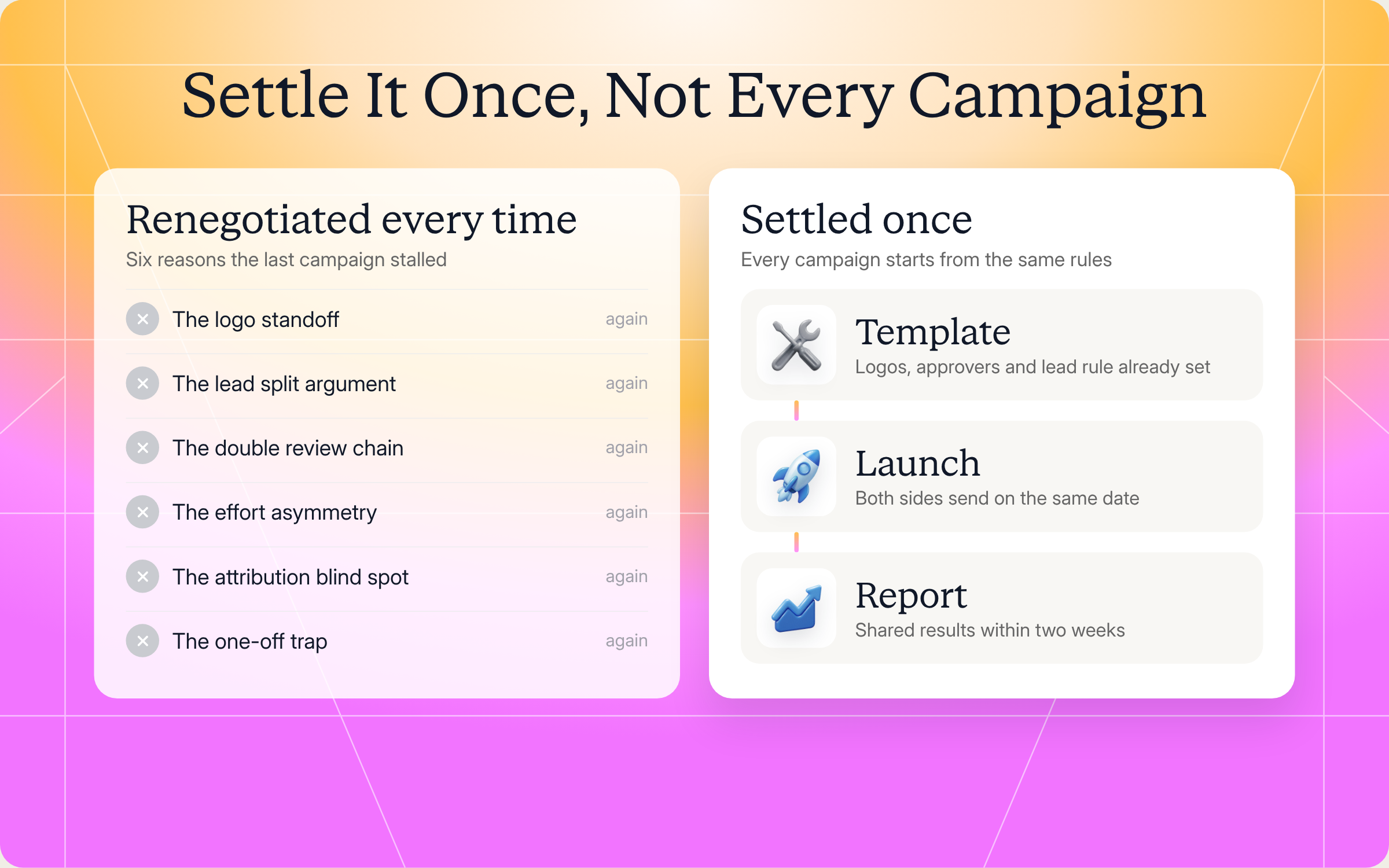
If you’ve felt friction in a joint campaign before, you’re not alone. Tension shows up when there’s no proven plan in place. If your last co-marketing campaign went sideways, it probably came down to one of these reasons:
- The logo standoff: It feels petty, which is why it keeps getting postponed until it's the only thing left blocking the launch. Whose brand sits left, whose sits right, how big each one is, which assets carry both, and who signs off.
- The lead split argument: Neither company wants to come forward and ask for the registration list. This results in the conversation happening after the co-marketing campaign when it’s already started producing leads. Then you’re negotiating over data you should have agreed on before the first email went out.
- The double review chain: A single marketing team's approval process is slow enough. Add a second organization’s brand guidelines, legal review, and stakeholder sign-offs, and every asset moves at the speed of the slower side.
- The effort asymmetry: One team builds the deck, writes the email, sets up the landing page, and follows up on leads. The other team says they’ll promote it, and then doesn’t, because they had no stake in building it. This gets worse at scale. 83% of partner marketing team members manage relationships with multiple partners, and comfort levels drop to single digits when the count exceeds 50.
- The attribution blind spot: If neither side can see what the campaign produced or trace leads back to it, there's no evidence to justify running another one. Without attribution tied to the specific send, the whole effort reads as a favor someone did instead of a pipeline event.
- The one-off trap: If you’re designing everything per partner, then a program with 20 partners is going to quickly get overwhelmed. The per-campaign model can’t hold at a scale of 10+ partners.
These might seem like a lot of problems, but they’re solvable as long as you address them in advance instead of renegotiating every time. Co-marketing problems are typically operational, not creative. The same two arguments repeat on every campaign, and both can be settled once, in advance.
Decide the logo and lead questions once
Nobody wants to have the logo or lead conversation. So have it once, then never again. The fix is a short set of standing decisions that carry across every campaign with every partner. Write them into a joint co-marketing agreement or a standing section in your partner agreement, and treat it as the default rather than something to revisit each time.
This isn’t legal advice, just a framework for the decisions that keep derailing co-marketing campaigns.
| Question | Decide it once, like this |
|---|---|
| Whose logo, where | A co-branded template with both logo positions already fixed. The layout is a given and doesn’t turn into a discussion. |
| Who approves creative | One named approver per side and a stated turnaround time, agreed before the first campaign. No approver means no bottleneck. |
| Who hosts the asset or page | Default to whoever owns the target audience, and say so up front. |
| Who gets the leads | Set a standing rule: Both sides receive them, the partner who sourced the contact owns follow-up, or the list splits by territory. Pick one and stop negotiating. |
| How credit is calculated | Set one attribution model and one window per campaign before launch. |
| Who pays for what | Either an even split, or MDF with a request form, an owner, and a deadline. |
| What counts as success | One shared metric agreed up front, usually qualified pipeline rather than raw registrations. |
Two of these rows deserve more context because they’re where campaigns break down the most. On attribution, 42% of B2B SaaS companies already use multi-touch attribution for partner revenue. It doesn’t matter as much which model you pick, it’s that you pick one before launch and stop arguing about it after.
On funding, 71% of marketers say getting partners to engage with MDF is challenging, and 74% struggle with partner funding timelines. A standing MDF process with a form, an owner, and a deadline exists because ad hoc funding decisions are slow and inconsistent, and partners stop asking when the answer takes six weeks.
Overall, none of these decisions are hard to make. They only become difficult because they get decided late and under time pressure. Make sure the answers live in a template and a standing rule, then the conversation won’t have to happen every campaign.
Joint campaign types that work in B2B
Not every co-marketing format produces the same thing. The formats that work in a B2B co-marketing partnership fall into three categories.
The ones that produce qualified demand
Joint webinars and integration launch campaigns tend to produce the most qualified pipeline. A webinar works because both sides are promoting to their own audience, the registration list is shared, and the attendees have self-selected by showing up. An integration launch works because the audience is already using one of your products, so there’s already a sense of customer loyalty.
The Avalara and BigCommerce co-branding campaign is a good example of a successful co-branding partnership. They built a joint campaign around curated content from both companies, used AI to help assemble drafts, and had a professional writer shape the final narrative. The result was an ungated hero asset that anchored the whole campaign.

The ones that produce reach and reusable assets
Co-branded content like a joint report or guide won’t close deals on its own, but it gives both sides an asset they can repurpose for months. Customer stories featuring both companies work the same way. The asset outlives the campaign, and every time a partner sends it to a prospect, it carries both brands.
Companies running co-marketing with partners report a 52% increase in audience reach, which is what this format is for. The report that stat comes from, the 2025 Future of Revenue by Crossbeam and Pavilion, is itself a co-sponsored research report, and the fact that you’re reading its findings here is the point. Co-sponsored research costs more to produce, but it positions both brands as authorities on a topic their buyers care about, and the findings can feed blog posts, webinars, and sales conversations for a full year.

The ones that produce almost nothing
Logo-swap press releases produce almost nothing. Two brands put out a joint announcement about a partnership that their customers don't care about yet, it gets picked up by nobody, and both sides move on. If the campaign doesn't give the audience a reason to act, the logos are decoration.
Two things to watch
Emailing each other’s lists is the format most likely to create a privacy problem. One partner typically owns the registration form and has access to sign-ups, and the other needs visibility into the data without taking ownership of it. To avoid this, use a shared landing page with explicit consent rather than handing over a list.
Start with the format that needs the least approval on both sides, prove the model works together, then attempt the bigger ones. A joint webinar is a better first campaign than a co-sponsored research report, because it takes less time to produce and you’ll learn whether the partnership is worth it before you’ve invested months in a deliverable.
How to run a joint campaign, step by step

Once you’ve settled the standing decisions from the previous section, you can start to create your joint campaign, which is the easier part. If you haven't, every step will take twice as long because you're negotiating while you’re designing.
Step 1: Agree on the audience and the one metric
Before anything gets designed, both sides need to agree on who you’re targeting and what success looks like. If one side wants brand awareness and the other wants qualified pipeline, you can address that mismatch now, instead of at the post-campaign review when nobody can agree on whether it worked.
Step 2: Confirm the standing rules apply
If you’ve run campaigns with this partner before, the decisions from the earlier table should already be settled. If this is the first campaign, set them now and use them in every future campaign:
- Whose logo goes where
- Who approves creative
- Who gets the leads
- How credit is calculated
- Who pays for what
Step 3: Build from a co-branded template
Start the creative from a template with both logos already positioned instead of a blank page. The template removes the logo debate from the production process entirely. Every asset starts with the layout already decided, so the team can spend time on the message, not on arguing about brand placement.
Step 4: Package it as a kit, not a folder
A partner needs more than a deck. They need the audience definition, the messaging, the proof points, the assets, and the timeline in one place. A kit gives them everything they need to run.
Step 5: Set up tracking before launch
If you skip this step to get a campaign live sooner, you’ll regret it. You need one attribution link per partner, one attribution window, and one model to accurately track leads.
Step 6: Launch from both sides on the same date
Each side sends to its own audience from its own tools on the same agreed upon date. The coordination is simple, but it matters. If you launch the campaign first and the other side doesn’t until weeks later, you lose the momentum of a joint launch. It also makes attribution harder because the two sends don’t overlap.
Step 7: Report jointly, and quickly
Share what the campaign produced within a week or two, while both sides still care. If the report takes a month, the momentum is gone, and the partner has likely moved on to other priorities. Include registrations, pipeline attributed to the campaign, and what worked. Skip vanity metrics that don’t connect to revenue.
Learn more about partner content syndication and what metrics matter.
Step 8: Turn it into a template
A campaign that worked should become the kit you hand to the next 10 partners. This is where co-marketing stops being bespoke and starts being a program. The average organization works with 25 technology partners, 23 system integrators, and 25 channel partners, with 15 to 20% managing 40 or more in each category. You can’t effectively rebuild a campaign that many times.
Scaling co-marketing past one partner
You can run a bespoke campaign with one partner or you can run a program. The first produces one campaign every few months. The second produces a system that you can apply to as many partners as necessary.
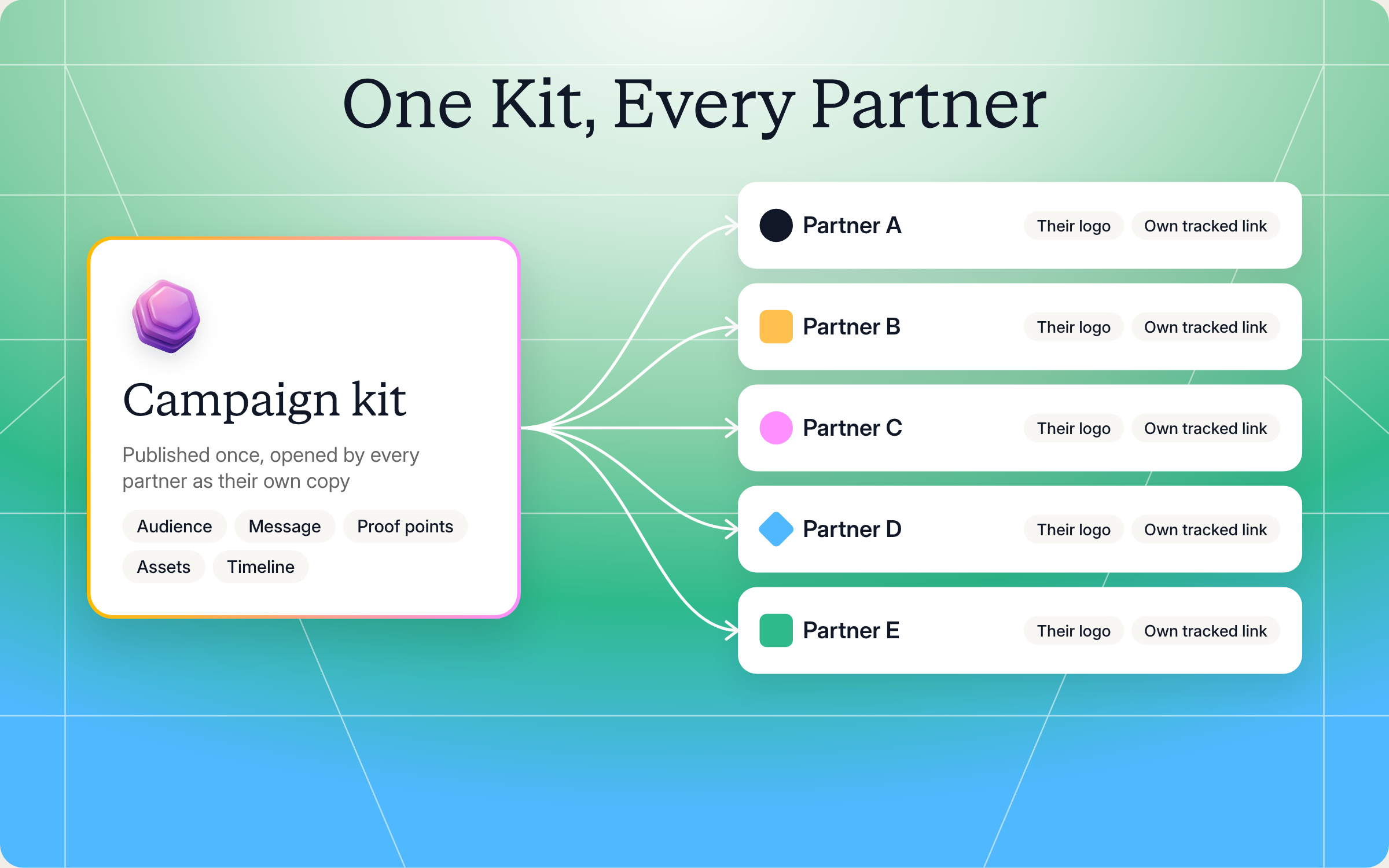
Each partner opens their own copy, puts their brand on it, and sends it to their audience. This way, you’re not producing a version per partner, you’re producing one kit that every partner adapts. At companies with $250M+ ARR, channel partners contribute roughly 30% of revenue on average. The teams running this are small. A public company could have thousands of partners and only one partner marketer. They can only handle volume if the kit does most of the work for each campaign setup.
Four conditions have to hold for this to work:
- The assets need to fill in each partner's brand automatically.
- The kit needs to live somewhere partners can find without scheduling a call.
- Each partner needs a unique tracked link so credit lands correctly.
- Both sides need to see what the campaign produced, broken out per partner.
Measuring joint campaigns
The number you agreed on before launch is the number you report. If that was qualified pipeline, you report qualified pipeline. If it was registrations, you report registrations and then you should probably explain why registrations won’t pay for the next one.
If the campaign runs, leads land somewhere, and neither side can say what came from it, then that silence gets read as failure even when the campaign worked. A report shared within the first two weeks, while both sides still remember the campaign exists, is what gets a second one approved.
The approval of that second campaign tells you more than any number in the report. Engagement metrics, open rates, and registration counts all describe the campaign. You might think it’s performed well, but if a partner doesn’t want to collaborate again, it wasn’t worth their time.
How Introw makes co-marketing repeatable
Everything that stalls a joint campaign is an operational problem. Introw, an AI-native partner relationship management software, is built to solve those problems in the system rather than in email. Here’s how:
- It runs inside your CRM: Introw lives in HubSpot and Salesforce, so every lead from a partner campaign lands as a CRM record with the partner attached, next to every other lead source.
- The logo debate disappears: You publish one co-branded template, and every partner opens their own copy with their name and logo filled in automatically. Both brands stay locked in the layout.
- Credit is settled by the system: Each partner gets their own tracked link. The attribution window and model are set before launch, so credit lands in the CRM without a quarter-end conversation.
- MDF has a process: Partners submit funding requests through a form with an owner and a deadline. Approvals run in sequence, and results are next to the spend so the next decision has evidence.
- It scales for enterprise teams: One campaign kit, published once, runs across every partner at once. Each co-branding partner sends from HubSpot, Mailchimp, or LinkedIn, whatever they already use.
- It’s headless and AI-native: Through Partner Connect, a partner’s AI assistant, whether that's Claude, ChatGPT, or Gemini, can read a kit, write a version in the partner’s voice, and register the campaign. Nobody logs into a portal and the kit stays co-branded.
Co-marketing stops being a series of one-off projects and becomes a repeatable program when the operational work is handled in the system. Book a demo with Introw to see how it works.
Still curious? Here are some quick answers to help clear things up
Co-branding involves putting two brand names on one product or service, asset, or event. It’s a design and permissions question. Co-marketing is when two companies run a campaign together, which may produce co-branding campaigns as output. Think of co-branding as the brand identity on the asset and co-marketing as the activity that drives it to a partner's audience.
Include logo placement and approvals, lead handling and ownership, the attribution model and window, how spend is split or funded through MDF, and the one shared metric you’ll measure success against. Getting all of this on the same page before launch prevents the arguments that derail campaigns. A joint marketing agreement makes those decisions permanent instead of per-campaign.
You build one campaign kit and publish it to every partner, so each can run it to their own audience under their own brand. Many businesses try to build a separate version for each partner, which holds for three and falls apart by 10. The kit model, with co-branding that fills itself in and one tracked link per partner, is how small teams run programs for hundreds.
The right partner shares your brand values and targets the same potential customers without competing directly. A trusted brand gives you instant credibility with their audience, and their core competencies should complement yours so both sides bring something the other can't build alone. Long-term collaborations start with one campaign that proves the relationship works before you commit to a program.
Joint webinars and integration launches produce the most qualified demand because both brands bring an audience that already cares about the product or service. Co-branded content like reports and customer stories extend your brand’s reach and create assets you can reuse across each other’s audiences. Event sponsorships and shared promotions cost more but put both brands in front of potential partners and buyers at the same time, which helps both sides gain market share in segments they couldn’t reach alone.





See AI-Native PRM in Action
Book a demo with one of our partner program experts, or explore Introw on your own time.