

One terminology point is worth clearing up first. Channel partner is a commercial term rather than a legal business structure. If you're looking at the different types of partners in a partnership business, terms such as general partnership, limited partnership and limited liability partnership describe how a business is legally structured, including how liability and responsibilities are shared between general partners and limited partners. Here, though, we're talking about the commercial role a partner plays in a sales process.
The 6 types of channel partners
There are six common types, but they don't all behave the same way. The easiest way to understand the difference is to look at what actually happens once a partner enters your sales process.
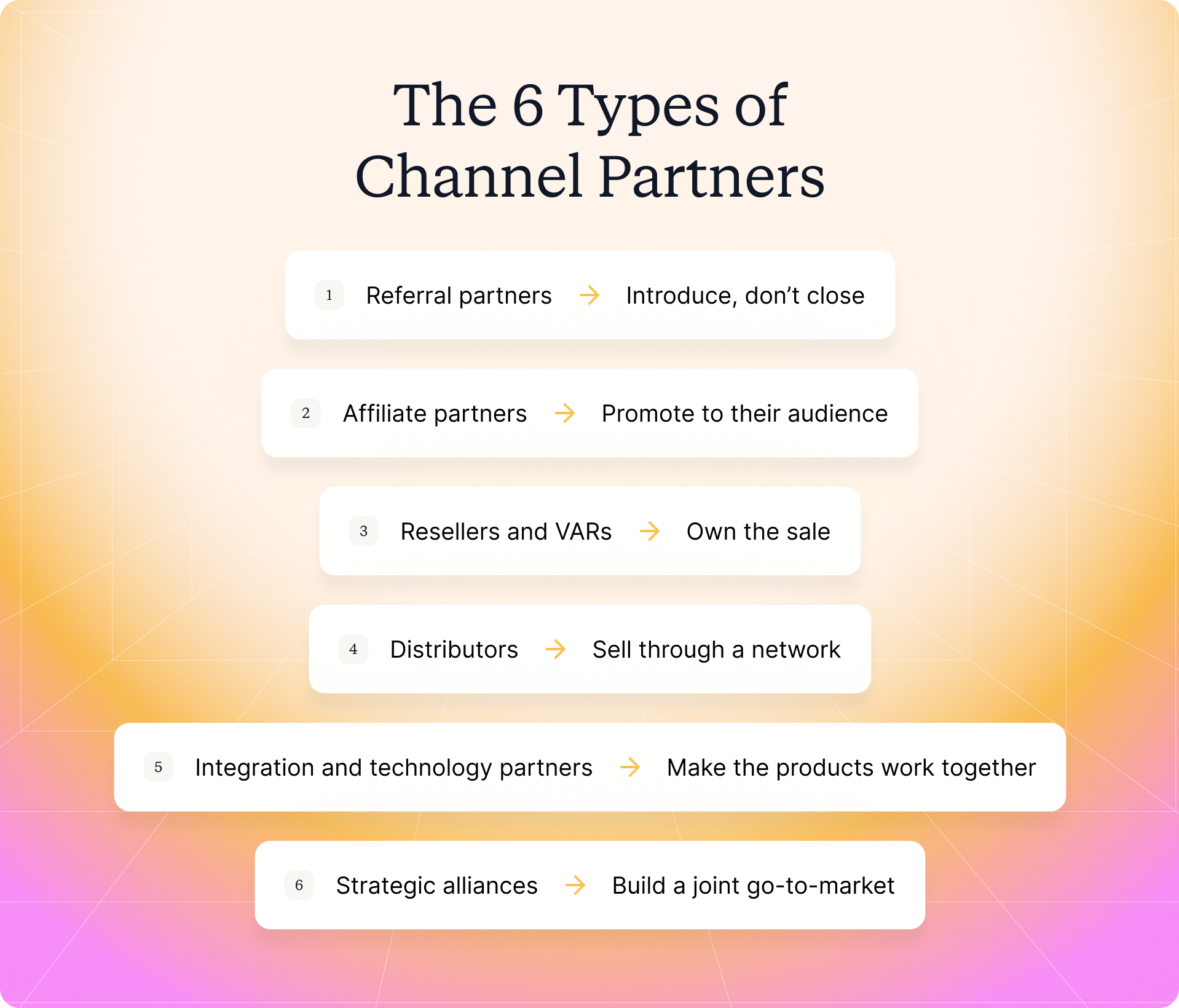
Referral partners: introduce, don't close
These are the bread and butter. Referral partners introduce your business to potential customers, either through a warm introduction or a submitted lead. Sales teams then take over the opportunity and close the deal, while the partner receives a commission or other agreed incentive. A partnership agreement should make the payment structure, referral terms and partnership rules clear from the start. The simpler the process, the less friction there is for the partner, and the more likely they are to keep sending referrals.
Learn more about referral partners
Affiliate partners: promote to their audience
Affiliate partners work slightly differently. They promote your product to an already established customer base or audience, usually in return for payment based on measurable actions such as signups, leads or sales, although some programs may also track things like clicks and impressions. That makes this much closer to a marketing motion than a sales partnership, which matters when deciding how to track the relationship and structure the partnership agreement.
Resellers and VARs: own the sale
This is where the relationship gets more involved. Resellers and value-added resellers sell your products or services directly to their customers, often taking a much more active role throughout the entire sales process. They can bring established relationships with target customer segments, specialized expertise in a particular industry, or an existing customer base that helps you reach new customers and markets. They also need software that helps partners manage registered deals, work alongside your sales team and access selected deal and customer information. The partnership agreement may also need to cover margins, customer ownership and how opportunities are handled.
Learn more about reseller partners
Distributors: sell through a network
Now things get a little more complicated. Resellers and distributors are easy to confuse. The simplest distinction? Distributors sit one step further from the end customer. Instead of selling directly to every customer, they supply and support a network of resellers and other partners. That gives you wider reach without requiring you to manage every relationship directly. This creates a multi-tier relationship, where the key is being able to track both the distributor and the reseller involved in a sale. A clear partnership agreement is particularly important here because two or more parties can be involved in the same transaction. A single transaction shouldn't always be attributed to one partner, so you need to be able to distinguish the contribution of each partner involved.
Learn more about software distributors
Integration and technology partners: make the products work together
Often undervalued, integration and technology partners bring complementary products together, creating benefits for both sides. This can mean combining multiple technologies into a bundled solution, giving customers a more complete product or service than either company could offer on its own. A partnership might start with an integration, then develop into referrals, co-selling or a broader commercial relationship. System integrators can also play a role here, particularly when they combine your technology with implementation or other services for the customer. The key distinction? These partners aren't necessarily there to resell your product. They're there to make it more valuable alongside their own.
Learn more about system integrators
Strategic alliances: build a joint go-to-market
These are often broader, longer-term relationships where two or more companies combine their individual strengths to pursue a shared commercial goal. Examples can include co-selling, co-marketing, attending industry events, working with industry associations, or combining products and services to reach new markets. Unlike a straightforward referral, the value here is in the relationship itself. Both companies bring their expertise and capabilities together to serve more customer needs.
In some cases, a strategic alliance can even develop into a joint venture involving capital investments, although that creates a different legal and commercial structure.
But even six categories don't tell the whole story. Not every partner relationship fits neatly into these six types. OEM and white-label partnerships, for example, involve embedding or selling your product under another company's brand, while managed service providers (MSPs) add an ongoing service layer around the product. They can look like channel partnerships on the surface, but they often create completely different operating requirements for professional service providers.
Which partners look like channel but aren't
Not every partner relationship is a sales channel. Two of the most commonly misclassified are affiliate partners and MSPs.
Affiliates are a marketing motion
Affiliates are usually paid for measurable marketing actions: signups, clicks, leads or sales. They may have a large audience and send plenty of traffic your way. But they don't necessarily generate quality opportunities, work with your sales team or stay involved once someone becomes a customer. They're generally not involved in the wider customer experience either, which is another reason to think of them as a marketing channel rather than a sales partner. Think of your average Instagram influencer or your favorite YouTuber's ad break.
Managed service providers (MSPs) are a service motion
These have a completely different relationship. They're usually wrapped inside an ongoing service they already provide to the customer. Your software may just be part of the products or services they're providing to the customer, alongside other resources they already offer, instead of something they're simply reselling.
This changes the relationship completely. And getting the model wrong can be expensive. Treat an MSP like a reseller and you could spend months building sales workflows, margin tables and targets around the wrong business model. Get it right, and you're investing in the things that actually make the relationship work: certification programs, technical support, implementation, customer retention and customer satisfaction.
How partner types change the way you operate
By this point, the pattern should be clear: the partner type isn't just a label. It determines how much work the relationship creates. A referral partner might only need a simple way to track and submit leads. A reseller needs a much closer connection to the entire sales process. That affects everything from onboarding and attribution to how you pay your partner and where that data actually lives.
This table makes the pattern pretty clear. Referral and affiliate relationships are relatively light. You mainly need a way to bring partners into the program, set out the terms in a partnership agreement, capture what they send you and make sure the right activity gets attributed to the right partner.
Resellers and distributors are a totally different ball game. Once one of these partners is actively involved in selling your product, you need much more structure around your business operations, from pipeline and margins to who gets credit for the eventual sale. Often, you also need to manage channel conflicts when multiple partners are working within the same account and don't have a clear partnership agreement around ownership and attribution.
Choosing a partner isn't just choosing who you work with. It's choosing the operating model behind the relationship. So the more useful question isn't how many types of partners you should have. It's which two or three actually fit your business.
How to choose which partner types to prioritize
Let's be blunt about this: more isn't always better. Running all six partner types at once is often a recipe for failure. The better approach is to focus on the types of partners that fit how your business operates. Look at your sales motion, your average contract value, your go-to-market maturity, how involved you need the partner to be, and how much operational complexity your team can realistically support. A reseller, for example, needs enough deal value and margin to make the cost of selling and supporting the customer worthwhile.
For most businesses, that means choosing between just two or three partner types and building those partnerships properly before expanding into other areas.
There are four questions to ask before you commit to a particular partner type:
- How much of the sales process do you want the partner to own? If they simply introduce opportunities, a referral model may be enough. If they prospect, sell, quote and manage the customer relationship, you're much closer to a reseller model.
- How valuable is each customer? A high-value B2B sale can justify a much more involved partner relationship, while a lower-value, high-volume product may make a lighter-touch model more practical.
- How much operational complexity can you support? It's super easy to underestimate this one. Every additional partner type can affect your business operations, from onboarding and incentives to attribution rules, reporting and support requirements, as well as the necessary resources to manage them properly.
- Where does the partner actually add value? They might bring leads, own the sale, provide implementation expertise, give you access to new customer segments or markets, or make your product more valuable alongside their own.
The overall goal, and it's worth stating again, should not be to collect as many types of partnerships as possible. It's to find a few that fit your existing business and build an operating model around them that helps the business grow.
How partners move between types over time
Another danger is treating partner types as fixed boxes and thinking, “that's it.” Partner types aren't necessarily permanent. As the relationship develops, one partner can move from one type to another. A referral partner might start sending you high-quality leads and eventually become a reseller, while still referring opportunities that they don't want to sell themselves. An integration partner might begin with a technical connection and then slowly develop into a broader strategic alliance. Other partnerships can develop around the same customer relationship, including implementation work from system integrators.
That also means the way partners manage opportunities and the way you onboard, track and pay them may need to change as their role expands.
This is where a flexible partner management setup becomes important. You shouldn't have to rebuild your entire partner program every time new partners come in or an existing relationship evolves. That's one of the key things Introw is designed to solve. More on that below.
Channel partner vs reseller vs distributor
The channel partner vs reseller distinction is easy to overlook. It's also easy to use ‘channel partner’, ‘reseller’ and ‘distributor’ as if they all mean roughly the same thing. They don't.

A reseller sells your product directly to its own customers through a more direct commercial relationship. A distributor sits one step further up the chain, selling your product through a network of resellers and other business entities. A channel partner is the umbrella term for both, so the reseller is usually much closer to the buyer, while the distributor gives you reach across a wider network of business entities.
Referral and affiliate relationships both sit further back from the sale, one introduces and the other markets, while resellers and distributors play a more direct role in the commercial transaction.
How Introw supports every channel partner type from your CRM
The challenge is that different partner types need different workflows. But that doesn't mean you need a separate system for each one. Introw gives you a single partner management layer connected directly to your HubSpot or Salesforce CRM, so you can manage different partner types without adding unnecessary complexity or losing the underlying customer and deal data.
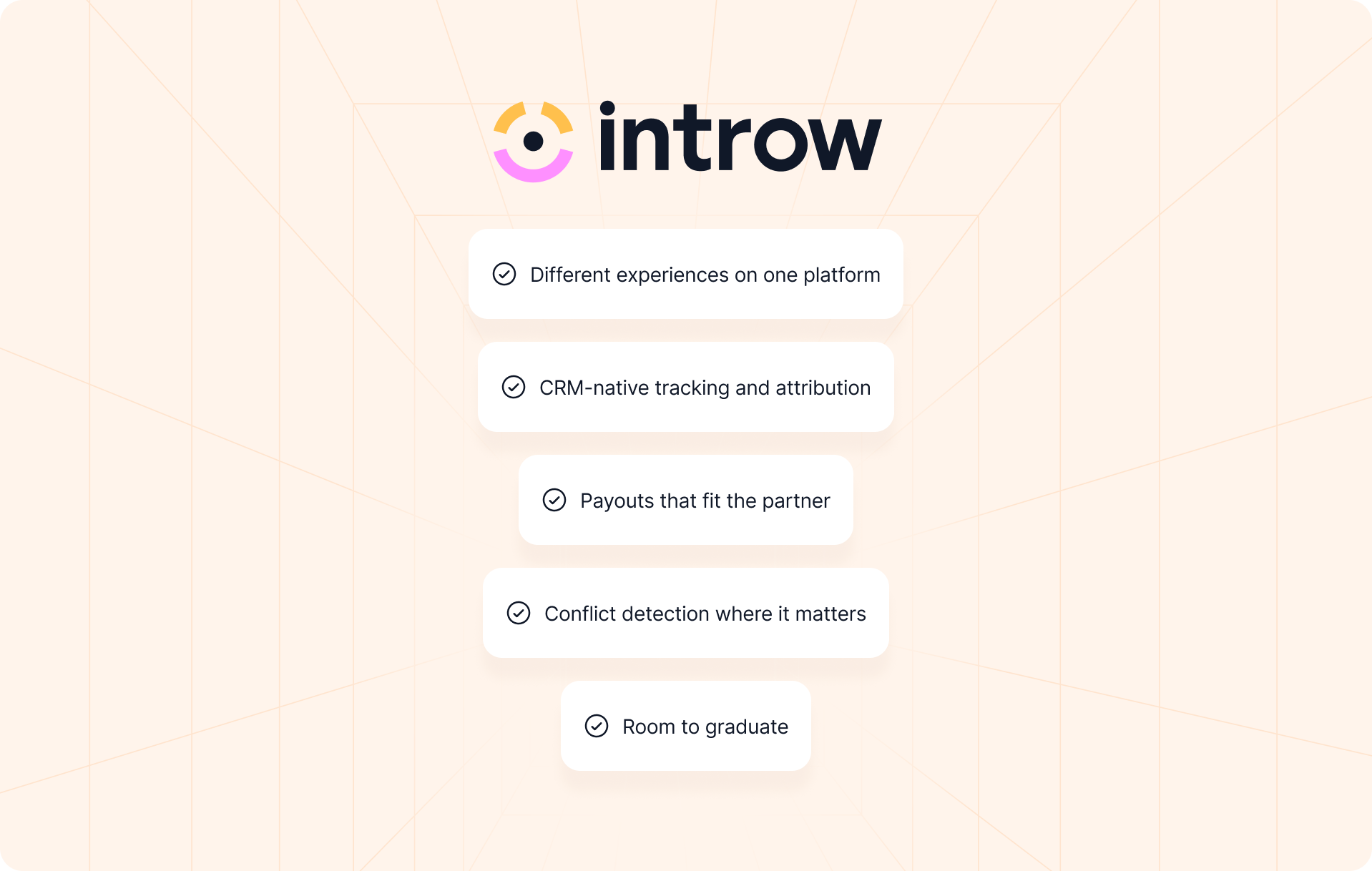
In the end, that's really the point of managing different partner types from one place. You can give different partners the workflows, visibility and incentives they need, while keeping your underlying customer and revenue data in your customer relationship management software for your teams to use whenever they need it.
See how Introw runs every partner type from inside your CRM. Book a demo or explore Introw's partner types.
Still curious? Here are some quick answers to help clear things up
Simply put, a channel partner is the umbrella term for business entities that help you sell, market, implement or distribute your products. A reseller is one specific type of partner that sells your product to its own customers, often earning a margin or commission in the process.
You don't need all six. That's the key takeaway here. For most businesses, it's better to start with two or three types that fit your existing business structure before expanding from there.
Affiliates are often included in broader lists, but they generally operate more like a marketing channel than a sales partnership. They help you reach customers and are usually paid for measurable actions such as clicks, signups, leads or sales, rather than being involved in the entire sales process.
An MSP can have channel relationships with software companies, but its primary role is usually as a service provider. Instead of simply reselling your software, an MSP usually bundles it into an ongoing service that includes implementation, management, support and other technical expertise.




See AI-Native PRM in Action
Book a demo with one of our partner program experts, or explore Introw on your own time.