
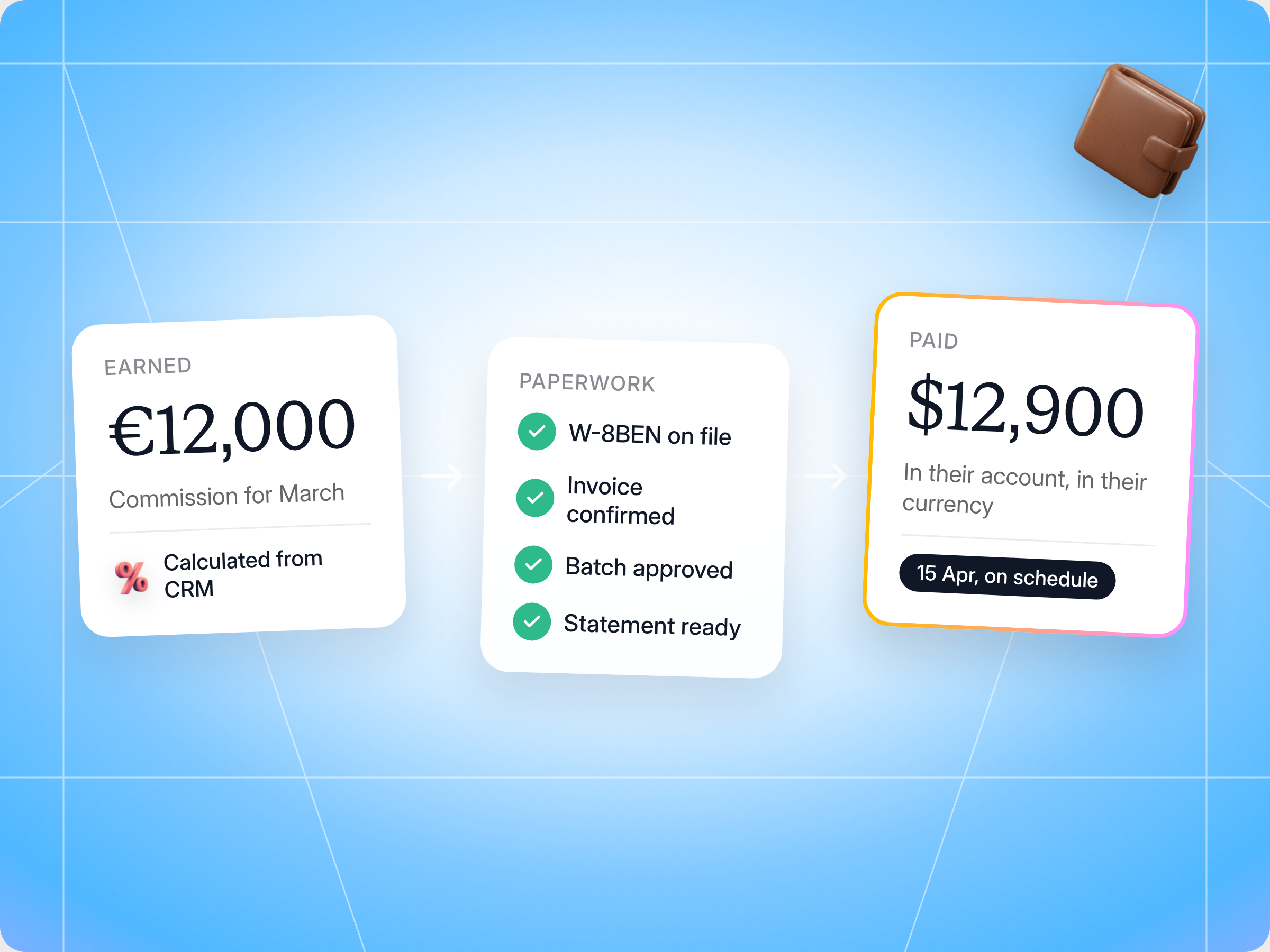
Partners who earn on time stay. Partners who wait on payouts leave, and they leave over delays, not rates. The work that keeps them is everything after the commission is calculated: collecting tax forms, issuing invoices, running global payment rails, reconciling in the finance stack, and giving partners a statement they can verify. That chain is where partner trust is built or broken, and it is the part few teams have built. Fixing it is what separates a program that retains partners from one that replaces them.
B2B software companies expect channel and partner revenue to reach 31% of total revenue in 2026, up from 21% just a year earlier. Direct sales are falling at the same time, from 73% to a projected 57%. More revenue generated through partners means more money flowing through the payout chain.
Teams have solved the first step. But the rest, they run by hand, and that’s where partners lose trust. 93% of independent earners would accept less pay in exchange for a guaranteed 24-hour payout, which tells you what partners actually value. They want certainty about when the money arrives. This article walks the full chain from commission to cash in a partner’s account, where each step breaks, and what it takes to get the whole thing working.
What is a partner payout?
A partner payout is the transfer of earned commission, referral fees, margin, or rewards from a vendor to a partner organization. It includes the tax documentation, invoicing, and reporting that have to happen around the payment. Different partnership structures use various formulas to determine payouts, including equal splits and performance-based distributions, but the sales generated through the partner channel is what every formula starts from.
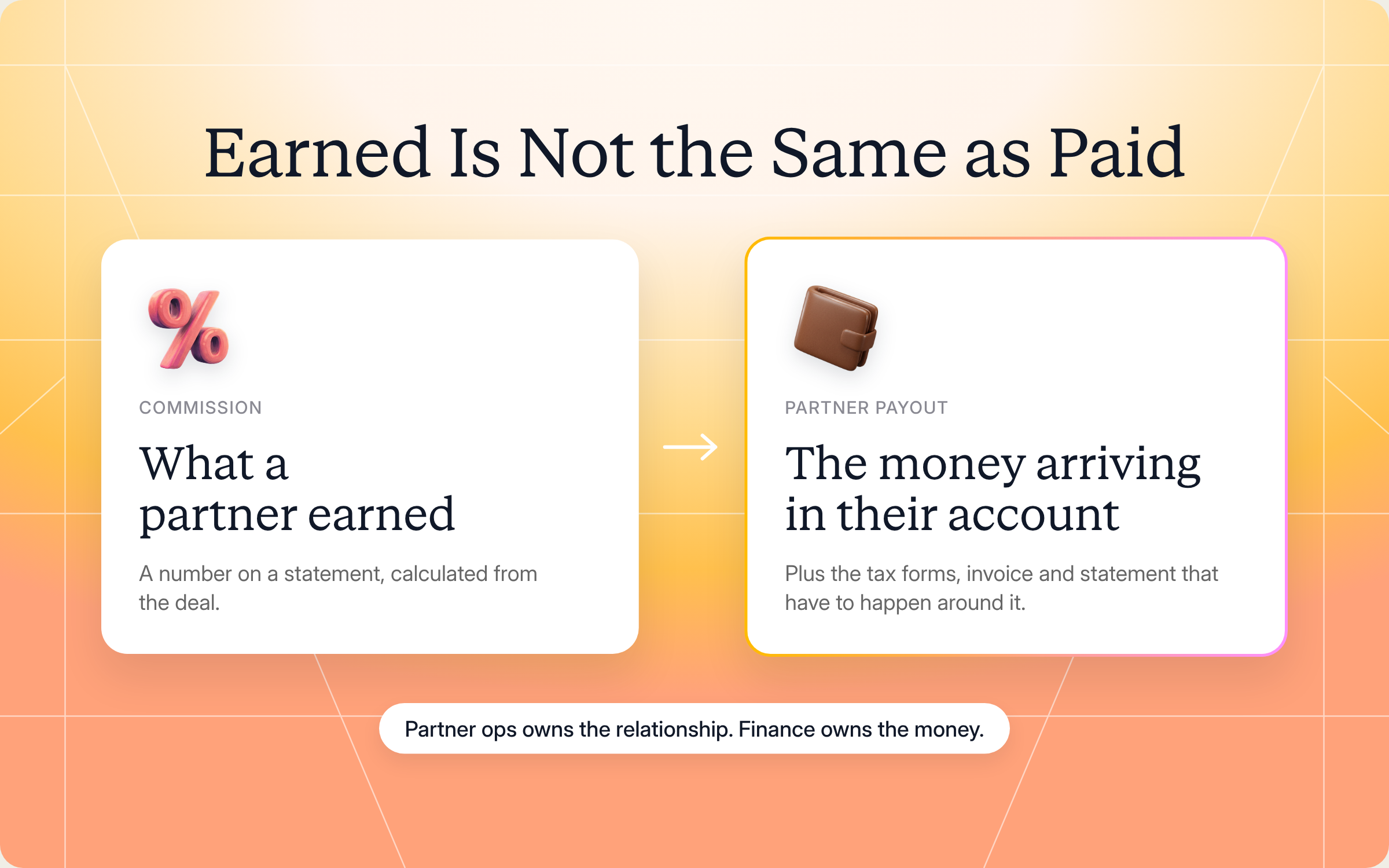
You can spend hours choosing the right payout model, but without a working engine to make the partner payments, none of it matters. The relationship runs on trust, and trust runs on getting paid. The issue is that partner ops owns the relationship and finance owns the money. Paying partners is a job that doesn’t have a clear owner.
Why partner payouts break
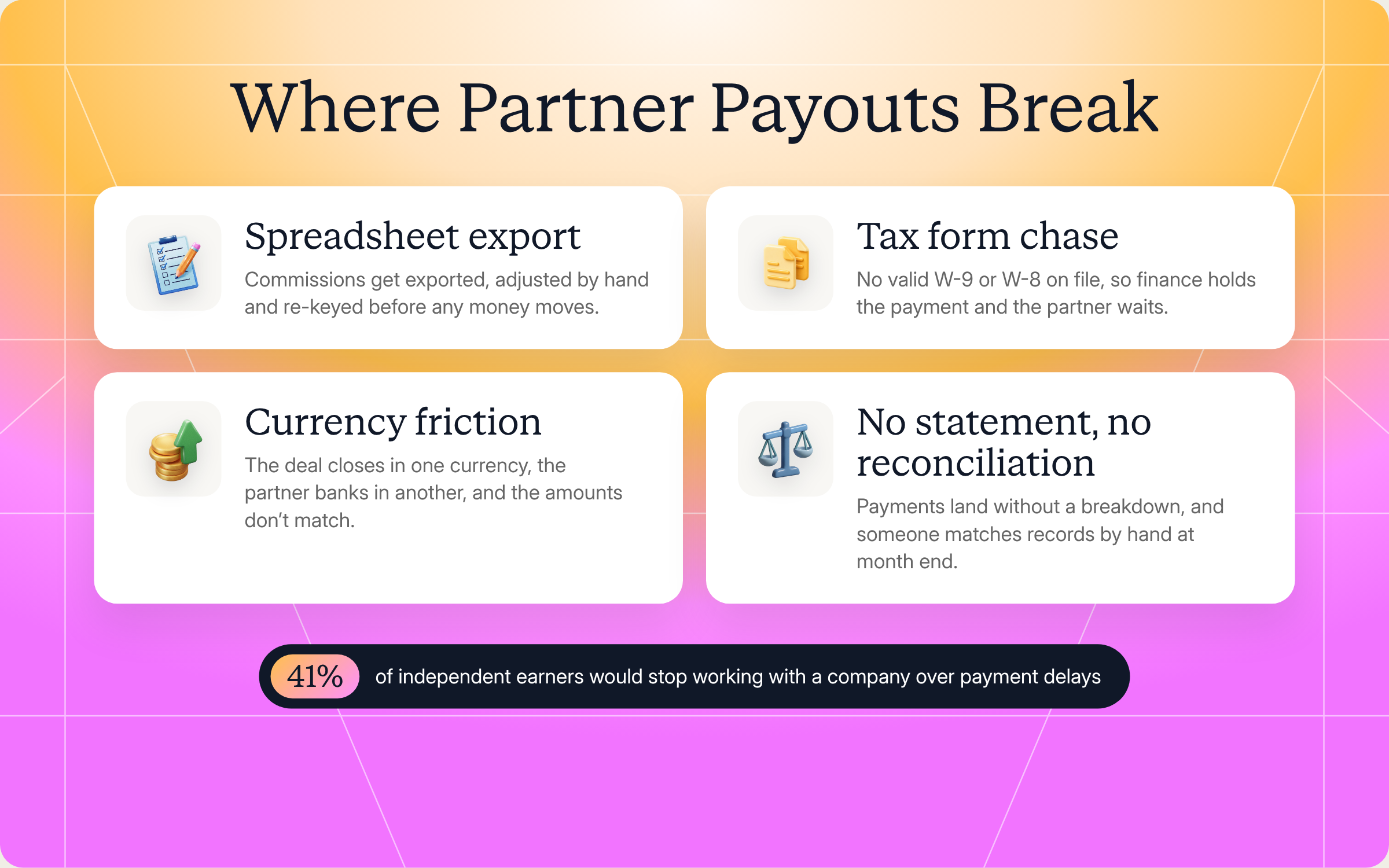
Paying third parties introduces new challenges at every handoff, and each one is a chance for the process to stall. Here’s where partner payouts most commonly break down:
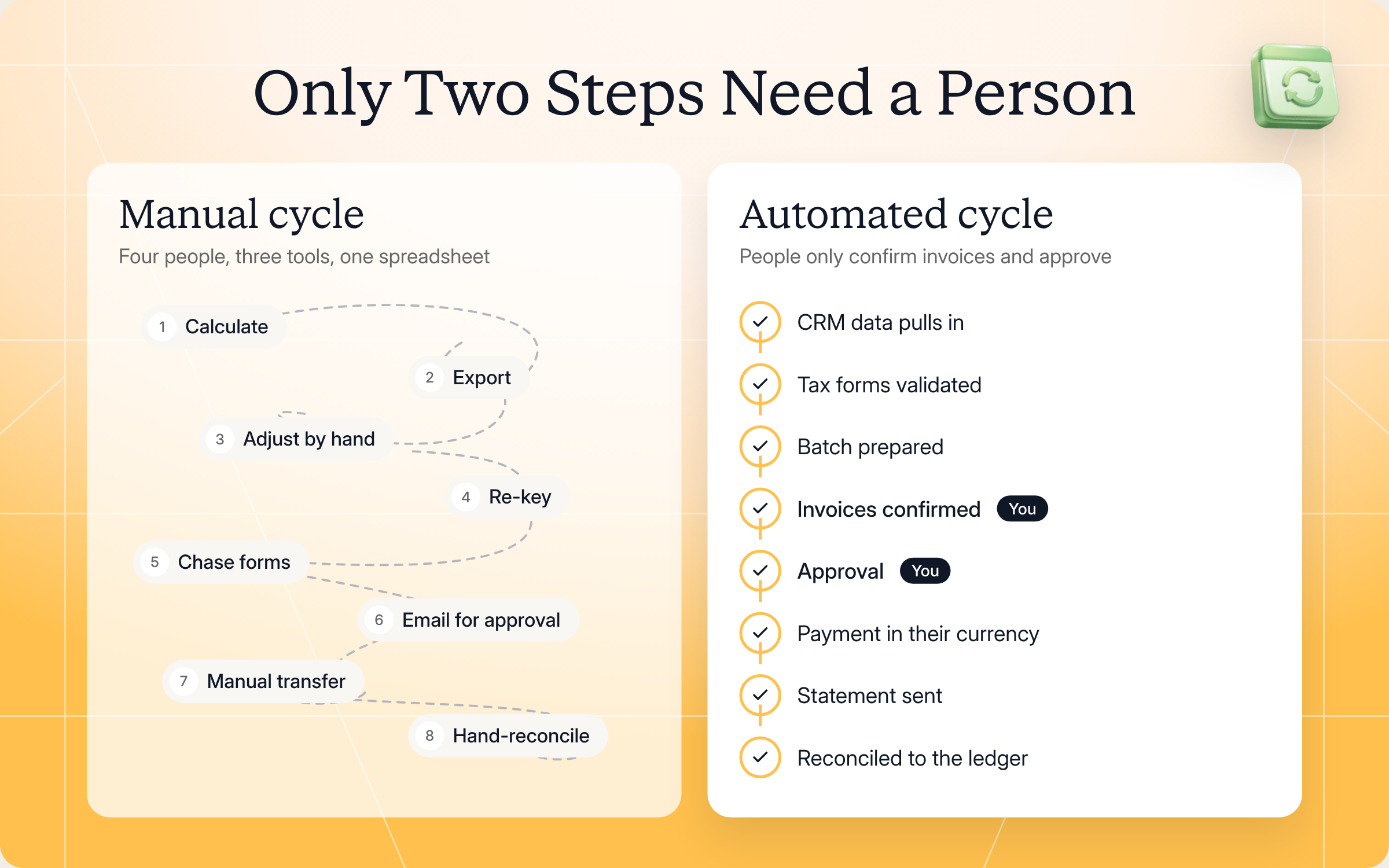
- The spreadsheet export: Without a centralized system, commissions get calculated in one tool, exported to a sheet, adjusted by hand, then re-keyed into a payment tool. You can’t pay partners correctly if the numbers have been touched by four people in three tools before the money moves.
- The tax form chase: Finance will not release payment without a valid W-9 or W-8 on file. If nobody collected the form at onboarding, the chase starts on payment day, and the partner waits. Tax compliance failures can also arise from incorrect withholding requirements.
- Currency and cross-border friction: The deal could close in euros, the partner might bank in dollars, and the amount that lands is not the amount on the statement. Affiliate payouts are especially exposed, since affiliates often work across more borders than resellers do.
- No statement and no reconciliation: A payment arrives with no breakdown, so the partner can’t tell which deals it covers and raises a dispute to find out. Meanwhile, finance has a bank transaction and partner ops has a commission record, and somebody matches them by hand at month end.
Partners complain about late and unpredictable payouts far more than they complain about rates. 41% of independent earners would stop working with a company over payment delays, and 72% consider two days the longest acceptable wait. Reliable partner payments are one of the simplest ways to keep a partner. They’re also one of the easiest ways to lose one. Different payout methods can incentivize various levels of partner performance, so the method you choose affects retention as much as the rate does.
The partner payout chain
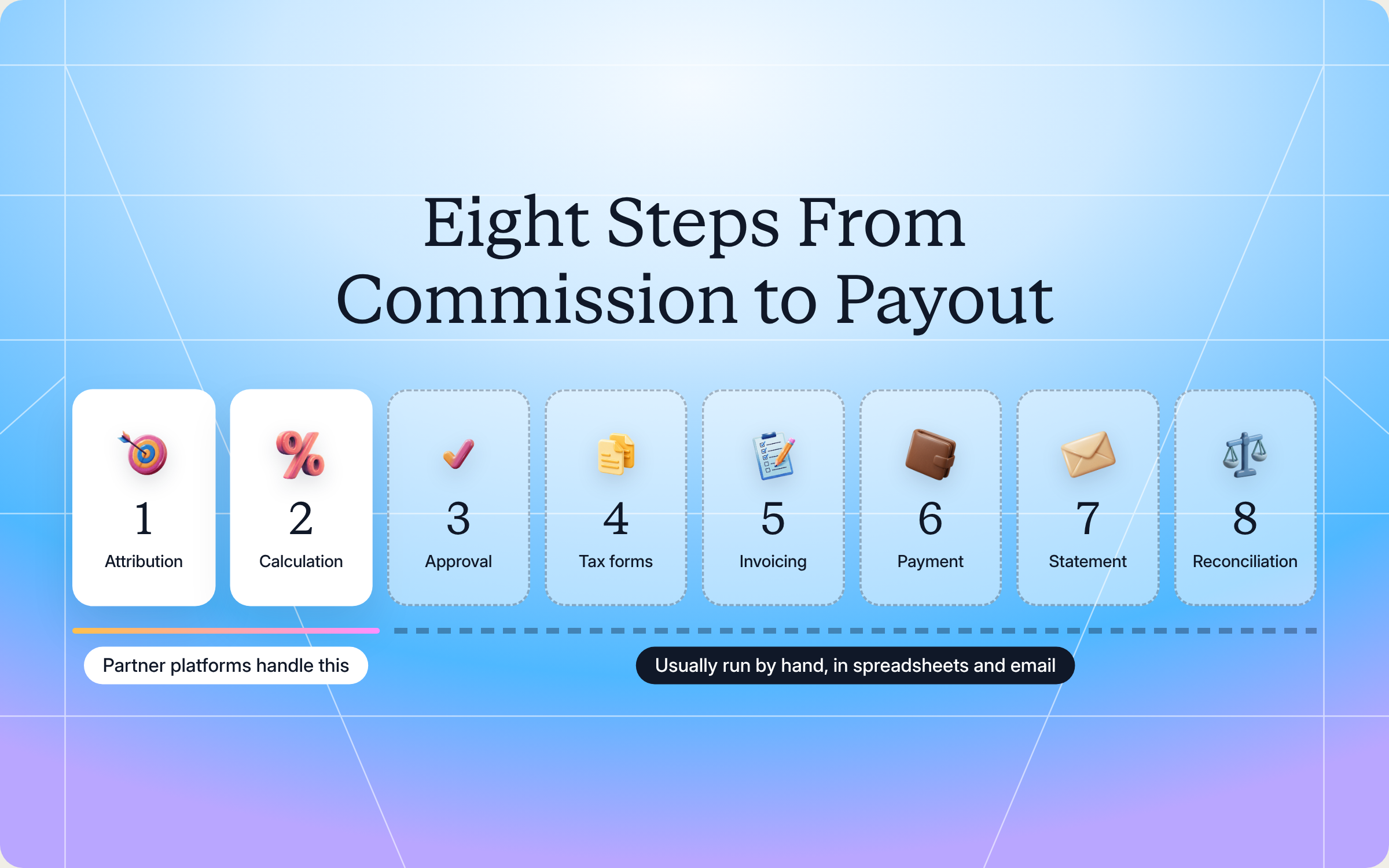
To a partner, partner payout seems like a single event. Money leaves your account and arrives in theirs. Behind the scenes, it’s a sequence of eight steps, and each one is a decision someone has to make or a document someone has to collect.
Here’s the chain, and where each link tends to break:
| Step | What has to happen | Where it usually breaks |
|---|---|---|
| 1. Attribution | The deal is credited to the right partner on the CRM record | Credit is reconstructed at payout time, months after the deal closed, and nobody can agree on who earned it |
| 2. Calculation | The commission plan turns the closed deal into an earned amount | Rates are applied by hand, or the base amount is defined ambiguously, so two people calculate two different numbers |
| 3. Approval | Someone with authority confirms the amount before money moves | No defined approver, so the cycle waits on one person who is on vacation or has moved to another team |
| 4. Tax documentation | A valid W-9 or W-8 is on file for that partner | The form is collected on payment day instead of at onboarding, and finance will not release money without it |
| 5. Invoicing | Either the partner invoices you, or you self-bill on their behalf | Nobody agreed which model applies, so both sides wait for the other to move first |
| 6. Payment | Money moves to the partner's account in their currency | Manual transfers, unclear exchange rates, and fees that eat into small payouts before they arrive |
| 7. Statement | The partner receives a breakdown they can verify against their own records | A payment lands with no explanation, so the partner raises a dispute to find out what it covers |
| 8. Reconciliation | The payment ties back to the CRM records and the general ledger | Matched by hand at month end, in a spreadsheet, by someone who was not part of the original transaction |
You can’t pay correctly if you can’t identify who earned it. If attribution lives in the CRM record at deal close, it’s far more reliable than attribution reconstructed from memory three months later. That’s what makes partner attribution step one, because everything downstream depends on it being right.
Partner platforms attribute the deal and calculate the commission. Everything after that, from approval to reconciliation, is where delays can happen. It’s almost always handled outside the platform in spreadsheets and email threads. Tax forms get chased, invoices get negotiated, approvals get bottlenecked, and reconciliation gets done by hand. A single partner payout can touch four people across two teams before the money moves. You can calculate what a partner earns, but the work that follows is how to automate partner payouts without manual spreadsheets. Partner commission software can handle the calculation, but the payout chain itself needs a different tool.
Tax forms: What you need before you can pay
Before a payout can leave your account, finance needs a tax form on file for the partner. The form depends on who the partner is and where they operate. Take this as general information, not tax advice. The forms you’ll encounter most often are:
- W-9: US partners, individuals and businesses. Captures the taxpayer identification details a US payer needs on file before releasing payment.
- W-8BEN: Non-US individuals. Establishes foreign status for a person receiving US-source income, so the payer knows how to treat the payment for reporting purposes.
- W-8BEN-E: Non-US entities. The entity equivalent of the W-8BEN, used by foreign companies rather than individuals.
- Local equivalents: Partners outside the US scope. VAT registration numbers and local tax identifiers, depending on the jurisdiction they operate in.
Collect tax documentation during partner onboarding. A partner who has just signed is motivated to complete paperwork. If you wait until payment time, it’ll most likely delay the payout time, frustrating the partner. Even a form collected at onboarding doesn’t stay valid forever. Forms expire, and a stale form holds up a payment just like a missing one.
Finance won’t release money if a form is out of date, so build a cadence for refreshing them, or let the system flag them before the next payout cycle. Once the form is collected, it should live against the partner record and get checked automatically every time a payout runs, not pulled out of a folder on payment day.
Invoices: Who issues them, and what self-billing invoices solve
Invoices take one of two shapes. Either they’re partner-issued, meaning the partner sends you an invoice for the commission they’re owed, and you pay against it. This puts the onus on the partner, which can result in inconsistent formats or chasing the partners down. Or you can go with a self-billing arrangement that eliminates those discrepancies.
Self-billing suits partner programs naturally, because you hold the data that determines the amount. But it has jurisdiction-specific requirements, particularly around VAT in the EU and UK. Confirm the rules for the countries you pay into before you adopt it.
You don’t have to pick one model or the other. Many programs land in the middle: they request the invoice from the partner, but generate the content for them so the amount, the period, and the references are correct before it comes back. That removes the ambiguity of partner-issued invoicing without taking on the compliance work of full self-billing.
Whatever model you choose, partners should be able to supply or confirm an invoice without logging into a portal. The partners who delay sending invoices are usually the same partners who never log in to your portal.
Commission statements: What partners need to see
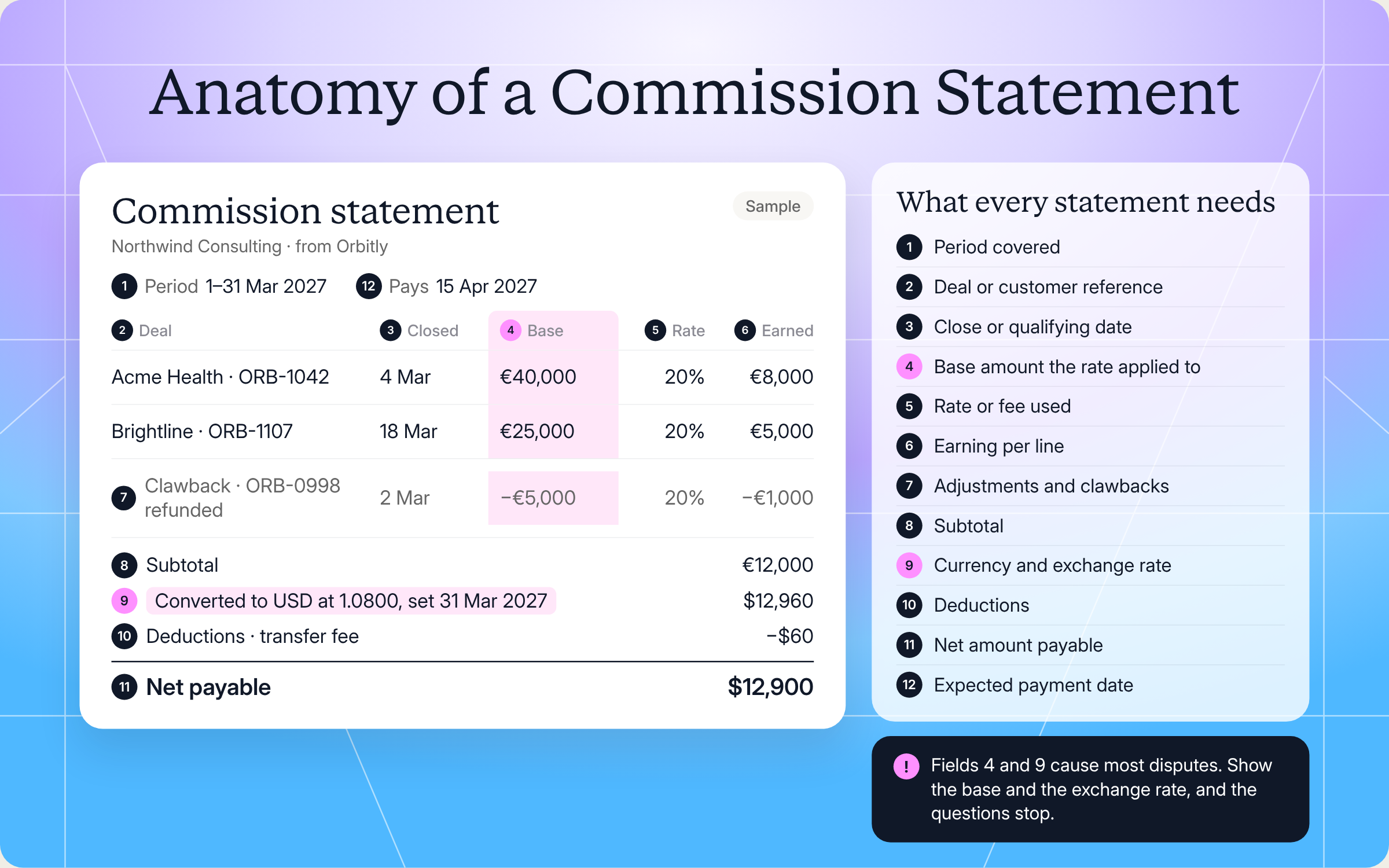
A commission statement is the breakdown that accompanies a payout. It shows the partner exactly which deals or conversions the money covers, and how the amount was calculated. Without one, a payment comes through with no context. The partner has to email someone and ask for the details. That email could easily turn into a dispute, and a dispute takes longer to resolve than the statement would have taken to produce.
A commission statement should include:
- The period covered
- Each earning line with the deal or customer reference
- The close or qualifying date for each line
- The base amount the rate applied to
- The rate or fee used
- The resulting earning for each line
- Any adjustments or clawbacks
- The subtotal
- Currency and exchange rate, if converted
- Deductions
- The net amount payable
- The expected payment date
Two fields on that list are responsible for most disputes: the base amount the percentage was applied to, and the exchange rate used. A partner who sees a commission rate of 20% and a payout that doesn’t match 20% of the deal value they remember will immediately question the payment.
If the statement doesn’t show the base amount, they can’t tell whether the base was net of discounts, or whether it was the gross deal value. If it doesn’t show the exchange rate, they can’t tell whether the conversion was fair. Both questions turn into emails that could’ve easily been answered by a number on the statement.
Paying partners globally
A partner program that works is by default international almost immediately. The moment you sign partners in multiple countries, you have to deal with a cross-border payments problem.
Currency and settlement
Cross-border payments reached an estimated $190 trillion in volume in 2025, and JP Morgan projects that figure to grow to $320 trillion by 2032. Each partner expects to be paid in their own currency, through rails that reach their country, with settlement fast enough that they’re not waiting weeks. A program with partners in 20 countries faces all of these variables in the same payout cycle, and a wrong answer on any single one means a partner receives the wrong amount.
Mass payouts and batch consolidation
US affiliate marketing spend alone reached $12.42 billion in 2025, up 11.3 percent year over year. At that volume, teams can no longer send payouts one transfer at a time. Minimum payout thresholds let small balances accrue until they’re worth sending, and once enough partners clear that floor, a mass payout cycle releases many partners' payments at once from one approved batch.
For finance, the consolidation point matters as much as the speed. Paying 50 partners in 12 countries can mean 50 reconciliation items across multiple currencies and rails, or one consolidated invoice with a batch that settles underneath it. Teams that want payouts triggered programmatically can use a mass payout API to start a batch from their own systems.
Running a payout cycle
A payout cycle is the repeatable sequence that pays partners their earned commissions. Before figuring out the mechanics, decide on the cadence. Monthly is the most common rhythm because it matches how finance closes the books. Quarterly reduces administrative load but can demotivate partners since they’re not seeing money come in regularly.
Faster cycles motivate affiliate partners most, since their earnings are smaller and more frequent, and a two-week cycle keeps them engaged in a way a quarterly one doesn’t. Match cadence to partner type rather than running one rhythm for everyone. Predictability is what partners care about most.
Once the cadence is set, the cycle itself should run with as little manual intervention as possible. Calculation pulls from CRM data, document validation catches missing or expired forms before the batch reaches approval, and statements generate from the same commission lines that built the batch. These steps don’t need human intervention. Approval does, and so does confirming that invoices are in place, but those are the only steps that should.
Adjustments are normal, not exceptional:
- Clawbacks on churned or refunded deals
- Manual line items for one-off agreements
- Corrections to earlier periods
The system should handle all three as negative line items in a later cycle, agreed in the partner terms before they happen, without someone rebuilding the batch by hand.
How Introw Pay handles partner payouts
Introw is a CRM-native PRM for HubSpot and Salesforce teams, and it calculates what partners earned from CRM data without anyone re-entering it. Introw Pay carries that calculation through the rest of the chain, so the approved number becomes money in the partner's account without leaving the platform. The same AI-powered attribution and deal-coaching tools that flagged the opportunity in the first place generated the commission line, which means payout starts from a source of truth the team already trusts.
Commission lines generate automatically from attributed CRM or billing data. Payout cycles include an explicit approval step: Finance reviews a prepared batch rather than assembling one. W-9 and W-8 tax forms are collected and held against the partner record, so the paperwork is done before payment day. The back-and-forth over who moves first on invoicing disappears when partners can request invoices through the platform.
Adding a partner in a new market doesn’t have to be a new payments project, because Introw Pay supports 119 countries. Finance reconciles a single consolidated invoice rather than dozens of transfers.
See how Introw Pay turns approved commission into paid partners. Book a demo or explore Introw Pay.
Still curious? Here are some quick answers to help clear things up
A partner payout is the actual transfer of money to a partner after a commission has been calculated and approved. The commission is the number on the statement, the payout is the money that lands in the partner’s bank account. Partner payouts are the second half of the chain, and they’re the half that determines whether a partner trusts the program enough to keep bringing deals.
You need a payout method that handles multiple currencies, reaches global networks, and settles fast enough that partners aren’t waiting weeks for funds. Bank transfers and ACH are the most common payout methods, PayPal is a popular choice for managing affiliate payments, and digital wallets are gaining traction for fast payouts in regions where traditional banking is slow. The administrative burden of managing payouts across borders, currencies, and tax requirements is why most programs batch payments into a single transaction rather than sending individual transfers.
Mass payouts release many partners’ payments at once from one approved batch instead of processing each transfer individually. When affiliates earn enough to clear the minimum payout threshold, a mass payout cycle releases all qualifying payments together, which keeps payment schedules predictable and transaction fees under control.
Offer the payment methods your partners actually use: Bank transfer or ACH for domestic partners, PayPal for affiliate networks who want fast access to funds, and digital wallets for partners in regions with limited banking infrastructure. Checks are still used in some markets, but they're slow and prone to payment errors when accounts are inactive or closed. The right mix reduces payment disputes and keeps top performers loyal, because reliable payouts are what partners remember about the affiliate experience.
Managing payouts means tracking payment status for every partner, catching compliance failures before the batch goes out, and making sure payment details like bank account information are current. Most programs run on bi-weekly cycles, which keeps the affiliate program moving without overwhelming the finance team with constant one-off transfers. The goal is to streamline operations so that moving money to partners feels routine, not like a project that restarts every cycle.






See AI-Native PRM in Action
Book a demo with one of our partner program experts, or explore Introw on your own time.