

Most sales commission software is built to pay your own reps, not the partners and channel companies that increasingly drive B2B SaaS revenue. This guide sorts 11 tools into three categories by who they pay: partner and affiliate platforms that calculate and pay external partners end to end, enterprise ICM platforms built for complex internal rep comp plans, and mid-market rep commission tools for growing teams.
Partner channels used to be the exception in B2B SaaS. Now they’re close to the rule. 96% of the tech industry does partner-assisted selling in some form and 70.1% of tech revenue was sold through partners in 2025. The tools buyers reach for haven’t kept up, though. Almost every sales commission platform is built to pay your own employees, quota, accelerators, comp plans, rep dashboards. Very few are designed for the different problem of paying companies outside your business: tax forms, invoices, multiple currencies, and payees with no seat in any of your systems.
This list sorts all 11 tools by who they pay, says openly which are rep-first, and which can handle partners end-to-end.

Rep commission vs partner commission: Why the distinction matters
You can group the tools in this list in a few different ways, but the most relevant is who is receiving money? Is it internal reps, or partners?
| Paying your reps | Paying your partners | |
|---|---|---|
| Who the payee is | An employee on payroll | A company outside your business |
| How money moves | Through payroll | Bank transfer, often cross-border and multi-currency |
| Paperwork first | Already on file from hiring | Tax form, then an invoice or a self-bill |
| Visibility | A rep dashboard behind your SSO | Someone with no account in any of your systems |
| Disputes | Settled internally | A commercial conversation that damages the relationship |
| What the plan runs on | Quota and accelerators | Tier, margin, referral fee or revenue share |
Your reps are already inside your systems before they close their first deal. They’re on payroll, they log in through your SSO, and a disagreement about a payout is an HR conversation. Your partners, on the other hand, are separate companies that need a tax form before their first payment, an invoice or self-bill before the next one, and a payout experience that works across currencies and borders.
That’s why the strongest rep commission platform can still be the wrong buy if you’re running a partner program. For finance leaders and revenue leaders, the split also shows up in the back office. Rep payouts reconcile through payroll and your accounting systems, while partner payouts land in accounting platforms as one consolidated invoice. And commission visibility looks nothing alike. A sales representative checks a dashboard behind your SSO, while a partner reaches a portal from anywhere, with no account in your systems.
How to choose commission software
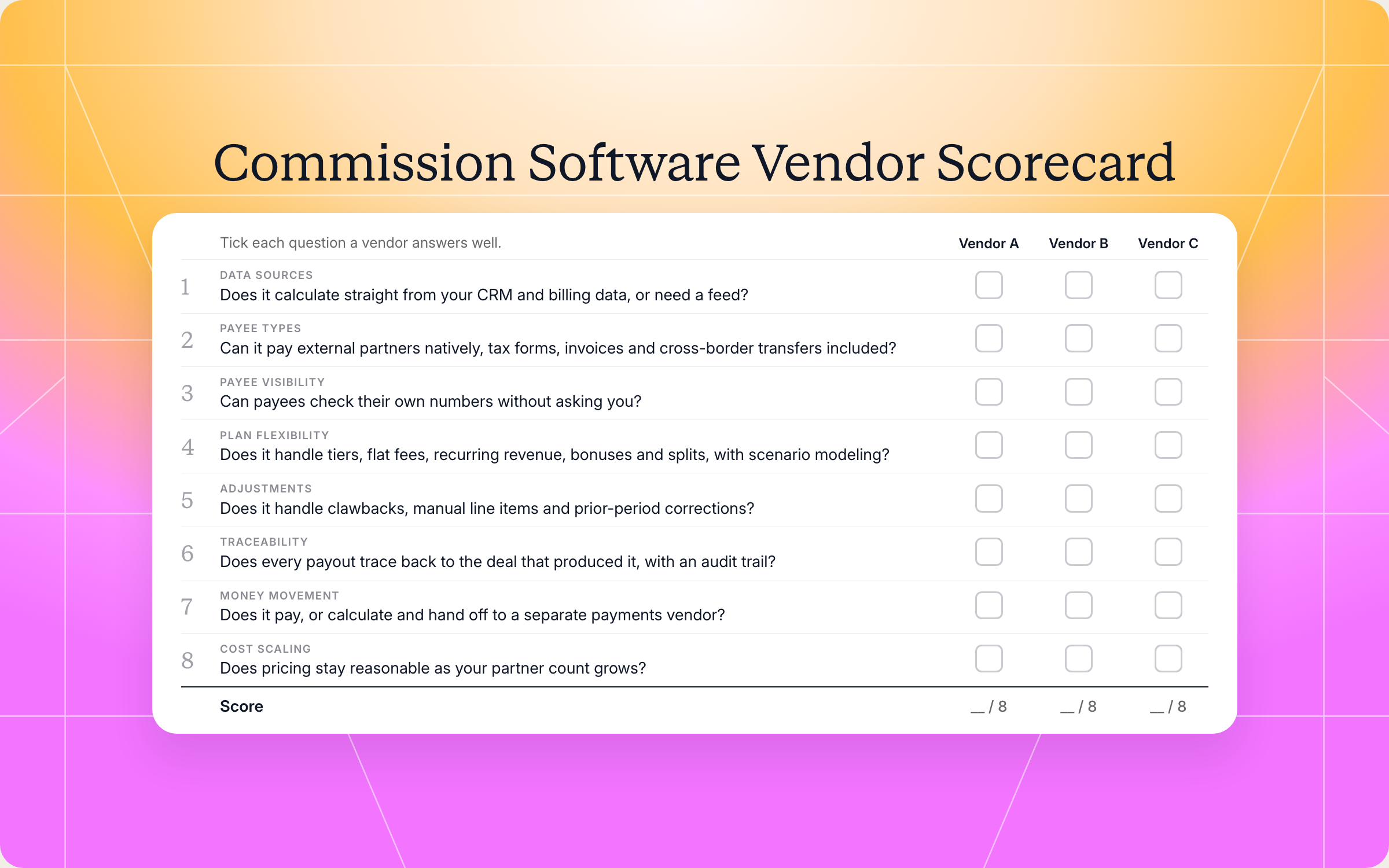
If you don’t know what to press vendors on, all their demos will look pretty similar. Take these questions with you into every call:
- Where the numbers come from: Ask whether the tool calculates straight from your CRM and billing data or needs a feed, whether it can pull performance data from data warehouses, and whether setup requires professional services or your own technical expertise.
- Who it can actually pay: If your program includes external partners, confirm the tool handles them natively, tax forms, invoices and cross-border transfers included.
- What the payee can see: The strongest dispute-prevention feature is a payee who can check their own numbers without asking you.
- How flexible the plans are: Tiers, flat fees, percentages, recurring revenue, one-off bonuses, and splits across roles. See if there’s scenario modeling to test complex plans before they go live and a structured plan builder instead of formula cells.
- What happens when things change: Every real program needs clawbacks, manual line items and corrections to prior periods because calculation errors and mid-quarter plan changes are routine.
- Whether a number can be traced: Any payout should trace back to the deal that produced it, with a full audit trail and advanced reporting that survives a finance review. Once commissions become a material line item, traceability is what keeps your financial governance intact.
- Who moves the money: Some tools calculate and pay, others calculate and hand off to a separate payments vendor. Either way, automated commission software saves hundreds of hours annually over running the process by hand.
- How cost scales: Pricing built around rep seats gets expensive fast when your partner count grows.
The 11 best sales commission software platforms
Here are the best commission tracking software platforms. They’re grouped into three different categories so you can quickly identify which applies to your compensation strategy. All pricing details were verified November 2026.
| Tool | Built for | Calculates from | Pays partners end to end | Best for |
|---|---|---|---|---|
| Introw | Partners | Your CRM and billing data | ✅ | Paying partners and channel straight from your CRM |
| PartnerStack | Partners | Its own deal tracking, plus CRM sync | ✅ | B2B SaaS affiliate and referral programs |
| Impact.com | Partners | Its own deal tracking, plus CRM sync | ✅ | Affiliate and creator programs at scale |
| CaptivateIQ | Reps (partners secondary) | Your CRM, billing and payroll data | ⚠️ | Enterprise rep comp plans |
| Xactly Incent | Reps | Your CRM, billing and payroll data | ❌ | Hundreds to 10,000+ payee enterprise ICM |
| Salesforce Spiff | Reps (partners via separate PEM product) | Your CRM and billing data | ⚠️ | Salesforce-native rep commissions |
| Performio | Reps, with productized channel capability | Your CRM, billing and payroll data | ⚠️ | Enterprise ICM for channel programs and external producers |
| Driven | Reps | Your CRM and billing data | ❌ | Lean teams that want an AI agent building their comp plans |
| Everstage | Reps | Your CRM, billing and payroll data | ❌ | AI-native mid-market SPM |
| QuotaPath | Reps | Your CRM, billing and payroll data | ❌ | Mid-market rep comp with MCP |
| Palette | Reps | Your CRM and billing data | ❌ | European teams that want published pricing and payroll-ready commissions |
⚠️ = some partner capabilities, but not end-to-end
Partner and affiliate platforms
These platforms calculate and pay commissions to external partners, affiliates, and referral sources, with tax forms and payouts built in. They’re best for B2B SaaS companies running partner programs where the people earning commissions aren't on payroll.
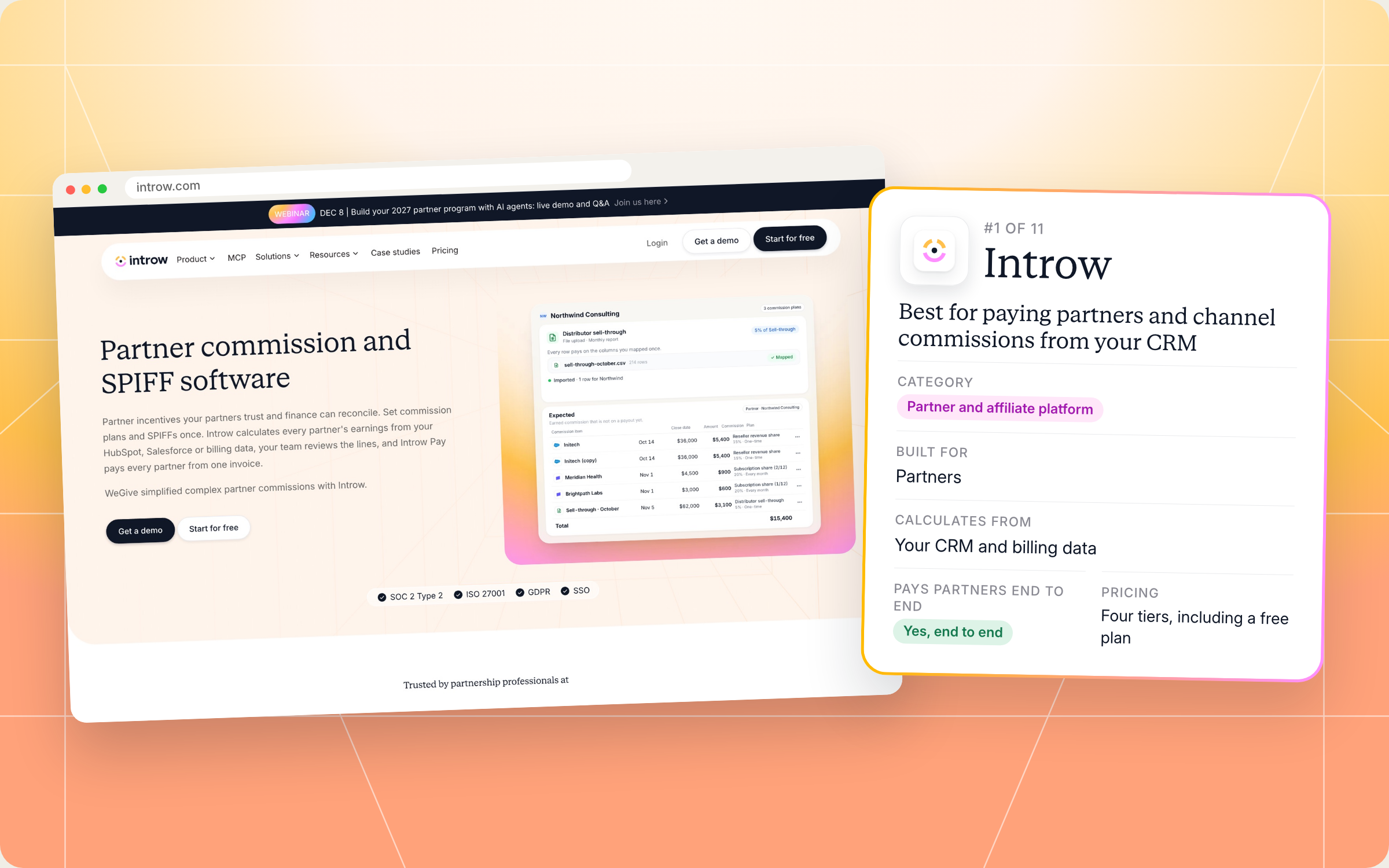
#1. Introw: Best for paying partners and channel commissions from your CRM
Introw is an AI-native PRM that calculates partner commissions and SPIFFs from your CRM and billing data and pays partners in the same platform. It’s built for RevOps and finance teams at B2B SaaS companies running partner and channel programs on HubSpot or Salesforce.
Key features:
- Reads deals from HubSpot or Salesforce, or subscriptions and invoices from Stripe or Chargebee. It calculates every commission line automatically as qualifying records appear.
- Deal attribution carries through from your CRM, so the partner who sourced the deal is the partner who gets paid, without anyone maintaining a separate attribution spreadsheet.
- Handles revenue share, fixed fee, tiered rate, and one-time SPIFF bonuses. Includes rates per tier, segment, or partner, and plan versioning so editing a plan never changes already-priced lines.
- Connects to Claude, ChatGPT, and other AI assistants through MCP, so you can run commission workflows in plain language. Every action is logged and written back to your CRM source of truth.
Partner handling: Introw Pay collects each partner’s W-9 or W-8 tax form, verifies their identity and bank account, and pays them in their own currency. Finance settles one consolidated invoice per cycle instead of hundreds of individual payments, and partners see every payout, its status, and a downloadable statement in the portal.
Commission controls: You can decline, restore, postpone, or edit commission lines with auditable reasons. Negative amounts reverse automatically so a clawback nets against what's already booked. Payout approvals let you name who approves, in what order, and which amounts skip review, giving finance a documented, auditable trail.
Limitations: Introw is built for partner and channel payouts, not internal rep comp, so it won’t model rep quotas and accelerators.
- Offers four tiers (including a free plan). Book a demo for tailored pricing.
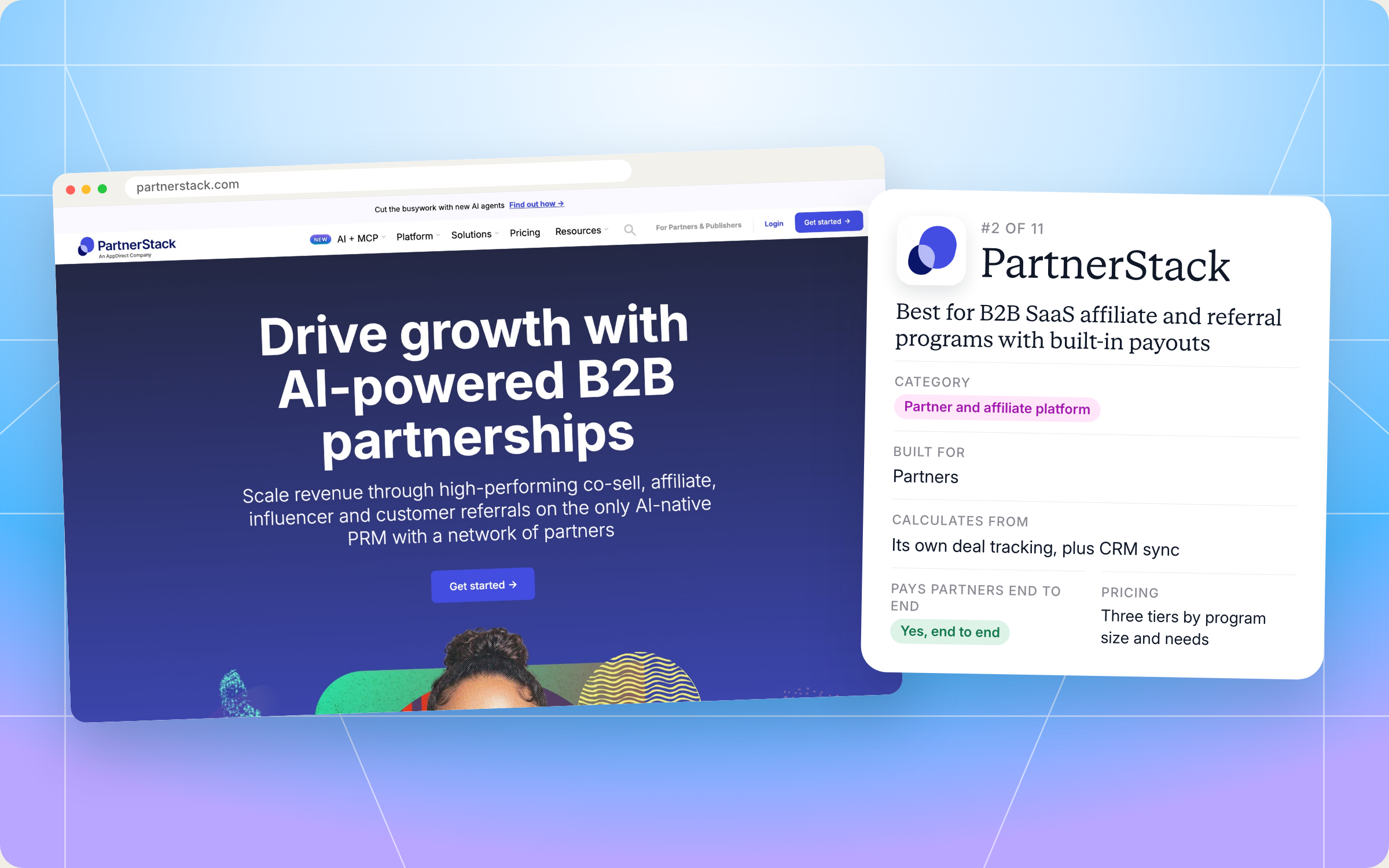
#2. PartnerStack: Best for B2B SaaS affiliate and referral programs with built-in payouts
PartnerStack is the only AI-native PRM with a network of partners, built to scale revenue through co-sell, affiliate, influencer, and customer referrals. It’s for B2B SaaS companies running external partner programs, and it’s partner-native the way the ICM tools are rep-native.
Key features:
- Calculates from its own deal tracking plus Salesforce and HubSpot sync, with payment tracking for Stripe, Recurly, Chargebee, and Chargify.
- Offers flat or percentage commissions triggered when a referred customer hits a lifecycle milestone, plus partner tiers that progressively unlock incentives, challenges, and MDF payments.
- Ships an official MCP server with OAuth and confirmation-gated writes, including AI auto-logging of leads from email and Slack.
Partner handling: Partners complete W-9 or W-8 forms in-dashboard, PartnerStack issues 1099-Ks when applicable, and vendors pay all partners with a single monthly invoice. Partners get a full self-service dashboard with available funds, decline reasons, and withdrawal history.
Commission controls: Clawbacks create negative commissions that offset against future earnings and appear on a later invoice, with the reason visible to the partner. Pre-payment adjustments support approve, decline, and hold with reasons and bulk actions.
Limitations: PartnerStack isn’t a rep commission calculator, and its calculation depth (tiered rate tables, accelerators) is thinner than the ICM tools.
Pricing:
- Has three tiers priced on partner program size, feature needs, and support level
#3. Impact.com: Best for affiliate and creator programs at scale
Impact.com is the all-in-one partnership management platform connecting brands with affiliate publishers, creators, and advocates. It’s designed for companies running large external partnership programs.

Key features:
- Calculates from its own full-funnel cross-device tracking, with Salesforce and HubSpot integrations feeding deal changes in as conversion events.
- Offers flexible commissions at the SKU, category, or customer level, with Dynamic Payouts adjusting by 100+ factors.
- Runs an MCP server and AI tooling, including a Recruitment Agent that discovers, invites, and evaluates partner applications autonomously.
Partner handling: Partners submit W-9 or W-8 forms electronically before payouts unlock. Impact issues 1099s to qualifying partners, and partners get auto-generated invoices and payouts in 70+ currencies.
Commission controls: Pending actions can be modified or reversed within a configurable locking period, with batch modifications for returns and checkout mistakes. The platform keeps audit trails of log-ins and report usage.
Limitations: Impact is tracking-and-payout shaped rather than comp-plan shaped. There’s no quota, no rep commissions, and calculation logic is conversion-event driven rather than plan-builder driven.
Pricing:
- Starter at $30/month plus 2.5% of revenue for ecommerce platforms
- Essentials at $500/month including up to $2,500/month in partner payouts
- Pro at $2,500/month
- Enterprise custom
- Setup and onboarding at $250/hour for Essentials and above
Enterprise ICM platforms
These platforms handle complex incentive compensation for internal sales teams, with the calculation depth, audit trails, and compliance controls enterprise finance teams need. They’re best for companies with large rep counts, intricate plan logic, and RevOps or finance teams owning commission administration.
#4. CaptivateIQ: Best for enterprise rep compensation with AI-assisted plan building
CaptivateIQ is an AI-infused incentive compensation platform that plans, calculates, and reports on complex rep commission programs. It’s built for RevOps and finance teams at enterprise companies running sophisticated internal comp plans.

Key features:
- Calculates from your existing stack, with native connectors plus a spreadsheet-like SmartGrid engine that ingests data from any source.
- Handles tiers, accelerators, bonuses, draws, splits, overlays, and partner commissions in a single modeling framework.
- Multiple AI agents and an MCP server that gives Claude and ChatGPT governed access to live compensation data.
Partner handling: CaptivateIQ supports partner commissions in its modeling engine, but internal reps are the primary payee. External partners typically view earnings through a portal your team builds and feeds with CaptivateIQ data.
Commission controls: The platform handles adjustments, clawbacks, and splits, with approval workflows and validation rules around every change. Every payout is traceable from source data through calculation logic.
Limitations: It doesn’t collect tax forms or issue invoices, and no payee gets paid directly, internal or external. Payouts still route through payroll or a separate payments vendor.
Pricing:
- Custom quote priced on admin and payee seat count, plan complexity, and integrations
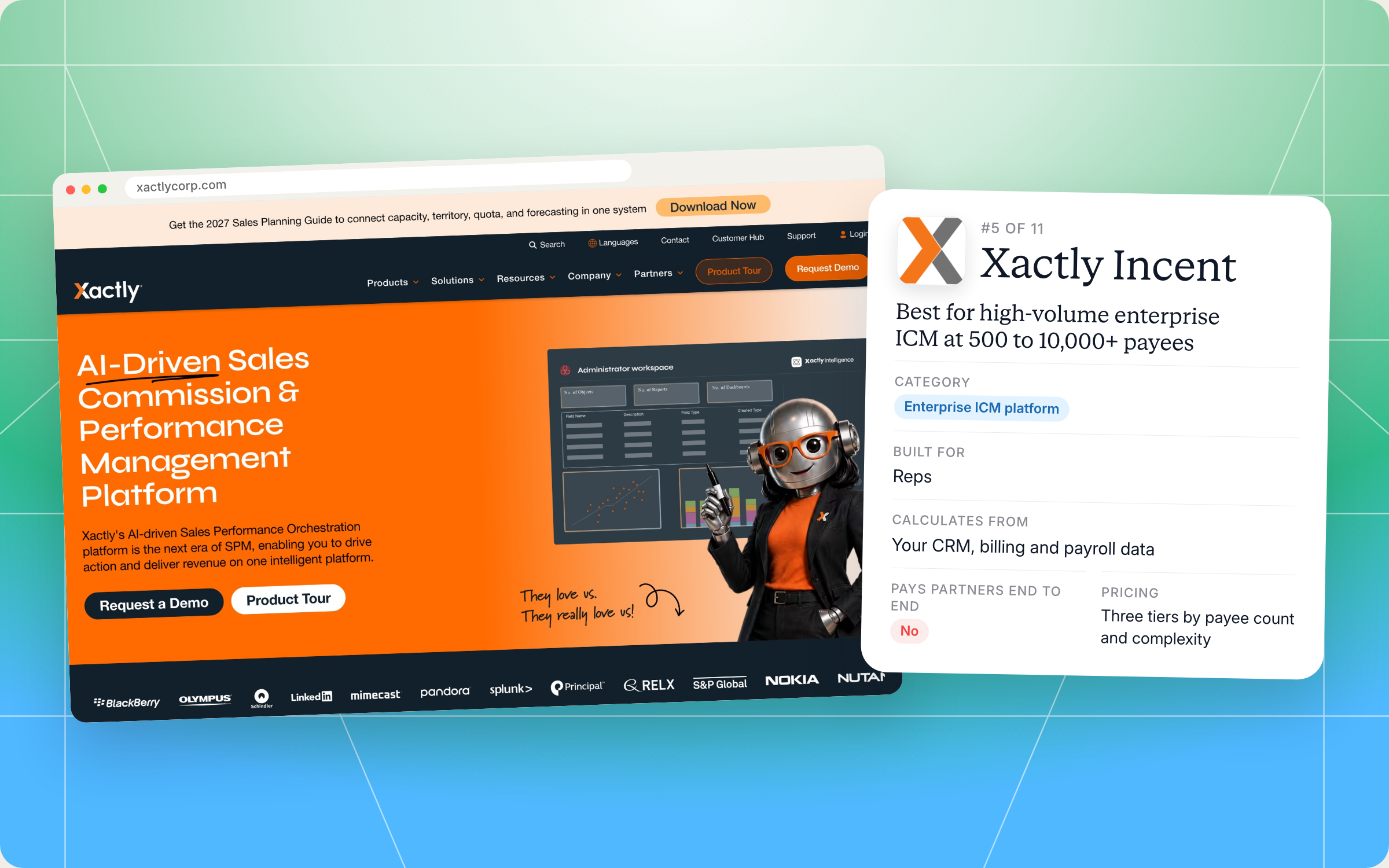
#5. Xactly Incent: Best for high-volume enterprise ICM at 500 to 10,000+ payees
Xactly Incent is enterprise incentive compensation management software that designs, automates, and manages comp programs from the simple to the complex. It’s designed for large organizations paying hundreds to tens of thousands of reps.
Key features:
- Calculates from CRM, ERP, and HCM data through the Xactly Connect API layer, with plenty of integrations.
- Handles any compensation plan type, with reusable rules, quotas, rate tables, MBOs, and on-demand earnings access for reps.
- Xactly Intelligence brings AI Assistants for natural-language data exploration and autonomous AI Agents that proactively build complex compensation plans (on the highest tier).
Partner handling: Xactly is built for your own employees. There’s no channel or partner compensation product marketed, meaning Xactly Incent calculates and hands off rather than paying.
Commission controls: Prior Period Processing lets you adjust locked prior periods up to five times a month with no limit on how far back you go, keeping up to 12 stored versions per pay period. The platform maintains a complete audit trail where every calculation, change, and approval gets logged.
Limitations: No clawback feature by name, so prior period processing is the closest mechanism. There’s also no W-9/W-8 collection, no invoicing, and no direct payment.
Pricing:
- Three tiers, priced on payee count and plan complexity
#6. Salesforce Spiff: Best for rep commissions that live natively inside Salesforce
Salesforce Spiff is Salesforce’s incentive compensation management product, natively connected to Salesforce and sold as a Sales Cloud add-on. It’s meant for Salesforce-centric revenue teams that want comp data sitting next to their CRM data.

Key features:
- Calculates from native Salesforce data, with manual imports and connections to CRM, ERP, HCM, and payroll systems.
- Handles accelerators, tiers, triggers, and exceptions at enterprise scale.
- Agentforce integration brings AI-powered performance trends, and Salesforce has announced an MCP to connect comp data to Slack and other surfaces.
Partner handling: Spiff standalone treats every payee like an employee, with employee-style user roles and per-user seat pricing. Partner commissions exist only through a separate product, which markets Spiff inside it for partner commissions and rebates.
Commission controls: Admins can make manual adjustments and draws on statements, run bulk adjustments via import, and overwrite calculations, all captured in detailed audit logs with dispute management and approval records.
Limitations: Partner payouts require the separate Partner Ecosystem Management product, so paying partners means buying a second Salesforce product. Tax forms and payment execution are out of scope.
Pricing:
- Salesforce Spiff at $75/user/month billed annually, with an additional connector at $250/connector/month
- Also available in the SPM Product Suite at $200/user/month or Agentforce 1 Sales Edition
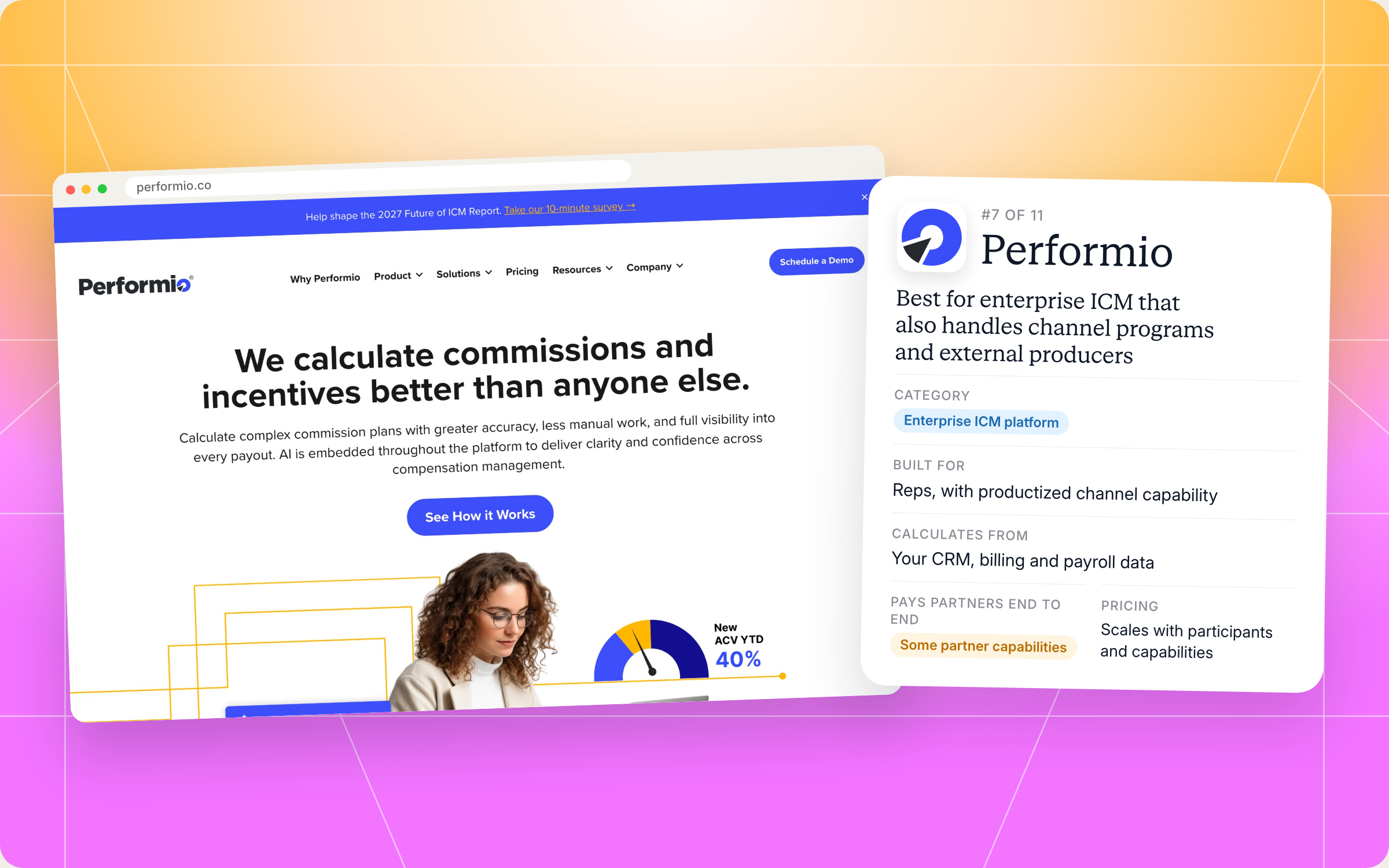
#7. Performio: Best for enterprise ICM that also handles channel programs and external producers
Performio is sales performance management software that calculates complex commission plans with full visibility into every payout. It’s for compensation teams at mid-market and enterprise companies, including those running channel programs alongside internal reps.
Key features:
- Accepts data from CRM, ERP, HRIS, and finance systems in any format, with popular integrations and a secure REST API.
- Handles hold and release, clawbacks, advanced payments, draws and guarantees, true-ups, spiffs, period adjustments, and exception overrides as native payout rules.
- AI Admin Assistant traces payouts, flags data errors, and processes commission adjustments.
Partner handling: Performio is the most partner-friendly of the enterprise ICM tools, with hierarchies purpose-built for channel programs, channel partner rebates, and transparent earnings visibility for external producers. But it still doesn’t pay them.
Commission controls: Clawbacks are a listed payout rule, and you can run calculations on prior-period data after it's been locked down to reconcile back to payroll. Every deal, payout, and dispute has an audit trail.
Limitations: It stops short of tax forms, invoicing and payment execution. The AI story is admin-focused, with Davo and an MCP server for internal teams rather than partner-facing AI.
Pricing:
- Subscription pricing scales with participants and selected capabilities. There’s also a one-time implementation cost.
Mid-market rep commission tools
These tools automate rep commission calculation without enterprise implementation timelines or pricing. They’re best for growing sales teams that want reps checking their own earnings in real time instead of auditing spreadsheets.
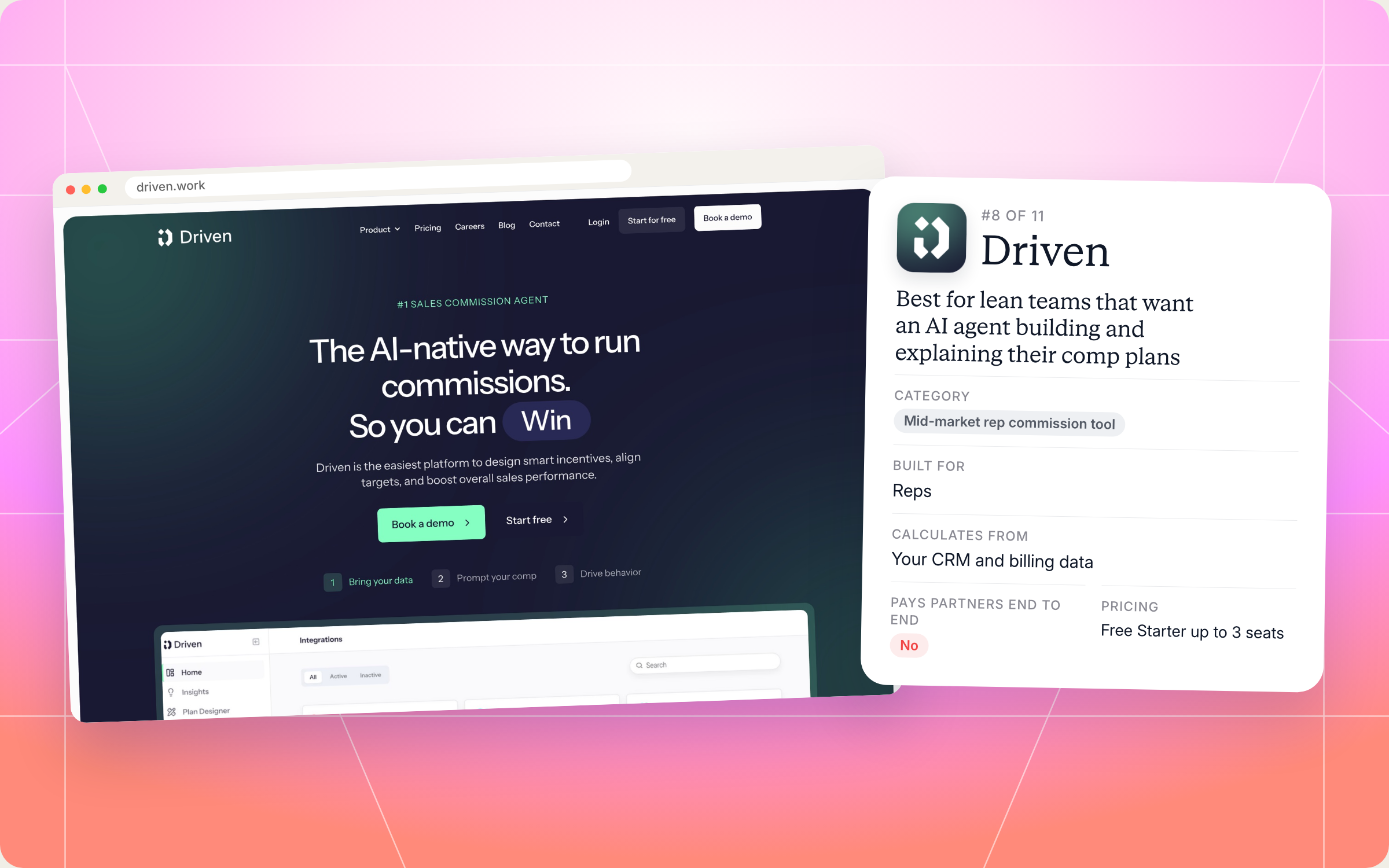
#8. Driven: Best for lean teams that want an AI agent building and explaining their comp plans
Driven is a sales performance and commission agent that replaces messy spreadsheets with a real-time source of truth for your sales incentives. It’s made for lean sales teams that want reps to see the math behind their number instead of auditing their paychecks.
Key features:
- Calculates in real time from HubSpot or Salesforce, reading deal data, owners, pipelines, stages, and custom properties as each deal moves.
- Handles tiered rates and accelerators that change the moment a rep crosses a threshold, quota- and OTE-derived rates, split commissions across BDR, AE, and CS, multi-currency conversion, and payout types.
- Runs AI agents that design plans, review disputes, and report performance on autopilot, with an AI Mode next to the plan builder and MCP.
Partner handling: Driven is rep-first, so payees are sales reps, with partner managers treated as internal roles who see their own plan and payouts. There’s no external-partner payee model or partner portal.
Commission controls: When a deal value changes after you’ve paid, clawback logic recalculates and the difference appears on the next statement, itemized, never as a silent edit to history. Approved payouts lock against further CRM changes, and there are full audit trails behind every approval.
Limitations: Driven isn’t payroll software, so it calculates and manages approvals while payroll or your finance system executes payment. It doesn’t collect tax forms or issue invoices.
Pricing:
- Starter is free up to 3 seats and 1 comp plan
- Pro at custom pricing for 3 seats minimum
- Enterprise at custom pricing for 35 seats minimum
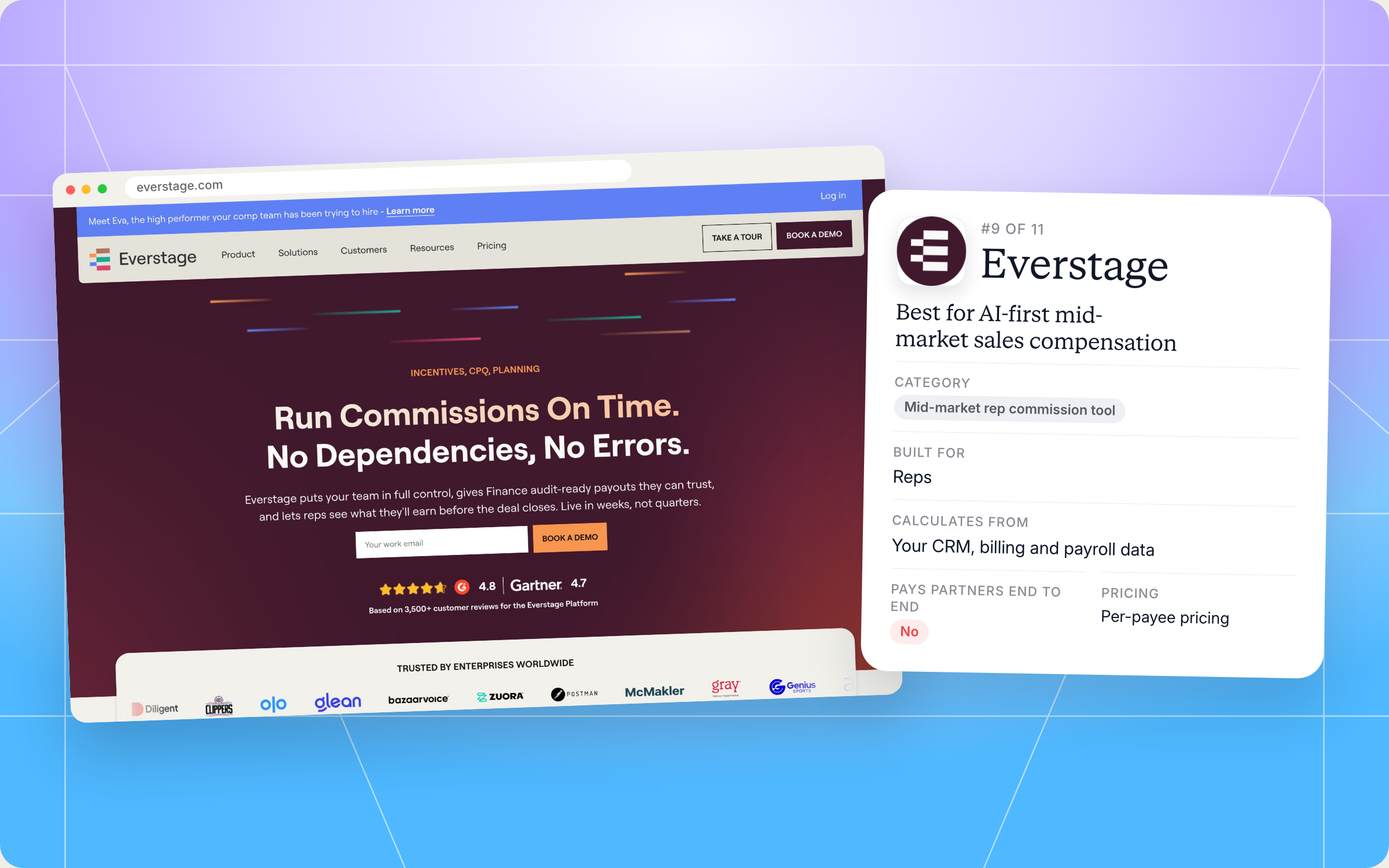
#9. Everstage: Best for AI-first mid-market sales compensation
Everstage is an AI-native sales performance management platform that runs commissions on time with no dependencies and no errors. It’s designed for teams managing 20 to 30+ payees at hyper-growth companies.
Key features:
- Calculates from CRMs, billing systems, and HRIS tools.
- Builds accelerators, tiers, cliffs, multi-role splits, and SPIFFs using if-then-else logic, with draw-against-commission and split credits.
- The AI teammate works on the web and in mobile through the Everstage MCP server.
Partner handling: Some channel marketing exists, but there’s no dedicated partner product page. External-payee support is implied, not productized, and there’s no tax form collection or payment execution.
Commission controls: Everstage automatically handles retroactive changes, clawbacks, and post-close adjustments across periods. The platform keeps a clean, timestamped audit trail ready for auditors.
Limitations: Partner capability isn’t product-level. Tax form collection, invoicing and payment execution aren’t part of the product.
Pricing:
- Per-payee model with platform license, enterprise support, and onboarding itemized before signing.
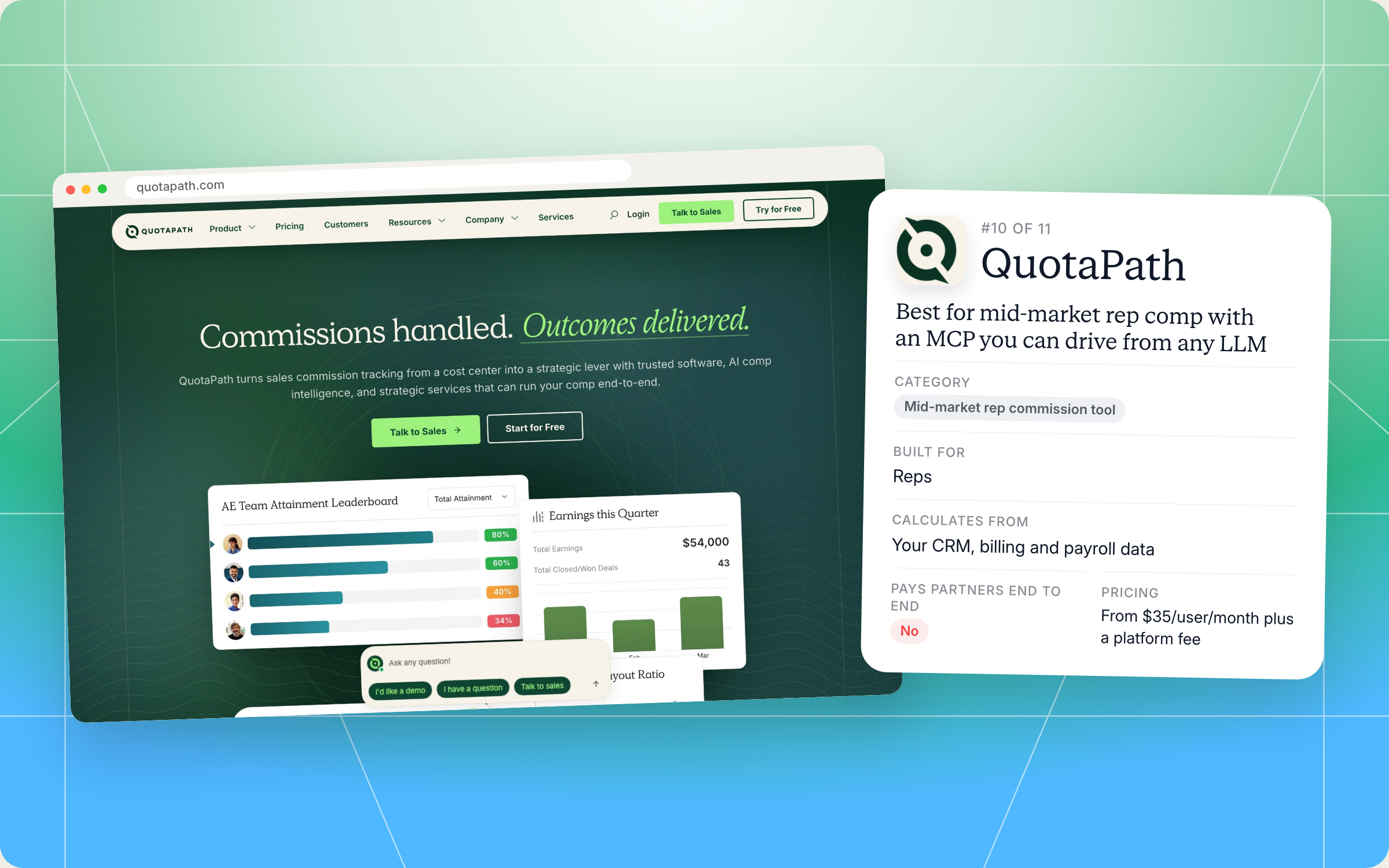
#10. QuotaPath: Best for mid-market rep comp with an MCP you can drive from any LLM
QuotaPath is an AI-native compensation solution that aligns RevOps, Finance, and Sales teams around performance-driving comp plans. It’s made for mid-market sales teams that want reps checking their own earnings without filing tickets.
Key features:
- Calculates from 40+ connectors, an open API, and Zapier.
- Handles percentage-based plans with accelerators, decelerators, caps, and cliffs, plus milestone bonuses and manual payouts for spiffs and spot awards.
- You can manage comp plans via the QuotaPath MCP from your LLM of choice.
Partner handling: QuotaPath is priced per user and built for employees. There's no partner onboarding, no partner portal, no tax forms, and no direct payment.
Commission controls: Admins can schedule manual clawbacks, republish corrected statements, and resolve discrepancies through deal flagging and overrides. Finance can trace every dollar back to the source with locked plan data.
Limitations: No external-payee story at all. Payouts end in a CSV export or a Rippling payroll send.
Pricing:
- Growth at $35/user/month plus a platform fee
- Premium at $50/user/month plus a platform fee
- Additional add-ons offered
#11. Palette: Best for European teams that want published pricing and payroll-ready commissions
Palette is sales commission automation software that calculates commissions in real time. It’s built for finance and RevOps teams at mid-market companies.

Key features:
- Calculates from 20+ native connectors, plus databases like Snowflake, Redshift, and BigQuery.
- Builds splits, quota and manager roll-up plans, ramps and draws, and conditional payout schedules.
- Keeps full history logs and backups on every calculation detail, with manual data overriding, comments on every change, and commission data history backup for later audits.
Partner handling: Like the other mid-market tools here, it’s rep-first. Payees are your sales team, AEs, SDRs, and managers, and there's no partner portal or external-payee model on their site.
Commission controls: Clawbacks are available on the Scale plan and up, alongside dispute handling and manual corrections. Every change is tracked in a history log, and the company states it’s SOC 2 Type II certified and audited every year.
Limitations: No AI, MCP, or public API claim, which puts it behind the AI-native tools in this list. Statements export to your payroll software.
Pricing:
- Offers three plans based on team size
Which one should you choose?

Start with who gets the money. If you only pay employees, a sales commission calculator from the rep-first tools in the middle of this list will serve you well, and the partner platforms will feel like overkill. One-off bonuses and short-term incentives are where rep tools get interesting, and Introw’s commission and SPIFF product handles those alongside partner payouts.
Check out Introw’s breakdown of the best SPIFF software.
If you pay both, decide which population is more painful today and solve that first, because the population you leave unsolved is where revenue growth stalls when payouts go late. Tools that genuinely do both well are rare and usually priced like it, so an honest look at where calculating payouts turns into manual work beats a feature checklist.
If you’re working with fewer than a handful of partners and simple terms, a spreadsheet will probably work just fine. The case for sales commission management software begins when the run takes more than a day, when disputes have started, or when you’re paying across borders.
If you’re paying partners and the chase is on for tax forms, bank details and payout status, then take a closer look at Introw. It calculates commission straight from your CRM and billing data, collects W-9s and W-8s, and pays every partner from one consolidated invoice. If that’s the workflow you're untangling, book a demo and see it live.
Still curious? Here are some quick answers to help clear things up
The payee is different. Rep commission tools pay employees on payroll, so they're built around quotas, accelerators and dashboards behind your SSO. Partner commission software pays companies outside your business, which means tax forms, invoices, multi currency support and payees with no account in your systems. A tool that nails the first column can still be the wrong purchase for the second.
Most of it just calculates. The majority of tools in this list produce a number and hand the actual money movement to payroll or a separate payouts vendor, which leaves you chasing tax forms and invoices by email. Only the partner-native platforms, Introw, PartnerStack and Impact.com, handle the entire process end to end, from calculation to tax documentation to payment. If payouts are your bottleneck, that distinction decides whether you need a second vendor.
Introw is the strongest choice for channel commission software because it's the only tool on this list built partner-first from the ground up: it calculates from your CRM and billing data, collects W-9s and W-8s automatically, and pays partners in their own currency without a seat in your systems. PartnerStack and Impact.com are worth a look if affiliate and marketplace-style programs are your core motion. If you pay reps as well as partners, run both populations through the comparison table above and solve the more painful one first.
Longer than vendors imply, and the data is usually the reason. A tool is only as good as the CRM and billing data flowing into it, and a broken data flow means payouts that are never paid accurately, no matter how good the calculation engine is at producing accurate payouts from clean inputs. Ask every vendor during the demo exactly what they read, what you maintain, and what happens when a field is missing.
More than an accounting problem. Delayed payments and disputed numbers are how reps and partners decide the program isn't worth their time, and a top performer who's been shortchanged twice won't wait for a third correction. Tools with real time visibility into earnings prevent most of this, since payees who can see their own numbers dispute far less, and organizations report higher satisfaction with transparent commission data.





See AI-Native PRM in Action
Book a demo with one of our partner program experts, or explore Introw on your own time.