

Revenue share and commission are the same mechanism wearing different labels. Profit share almost never works for channel partners because they can't verify your costs. What actually determines whether your payout program works isn’t the model you pick, it’s what you pay on, how often it pays, and whether partners can see the number without calling you. Get those mechanics right and the label takes care of itself. The partners who trust your process will stay. The ones who don’t will leave, no matter how generous the rate is.
If your partner program spends more time choosing what to call your payout model than designing how it works, you have a problem. What happens when a partner signs up, brings a deal, and then asks a question that should have a simple answer: When do I get paid, and on what number?
You should know the answer. You don’t if your agreement has a percentage but you never defined what it applies to, when it’s earned, or how long it recurs.
That scenario is where most payout friction starts. There’s likely nothing wrong with your model. The problem lies with the system running it. This guide covers the payout models you’ll encounter, why profit share rarely works for partners, and the two decisions that matter more than the label: what you pay on and how often.
What is revenue sharing?
Revenue sharing is an arrangement where one party pays another an agreed percentage-based reward of the income generated from a deal, product, or relationship, rather than a fixed amount. Revenue sharing in B2B SaaS covers partner and channel sales programs. A revenue sharing plan must define three things:
- What the percentage is calculated on
- When it’s earned
- How long it keeps paying
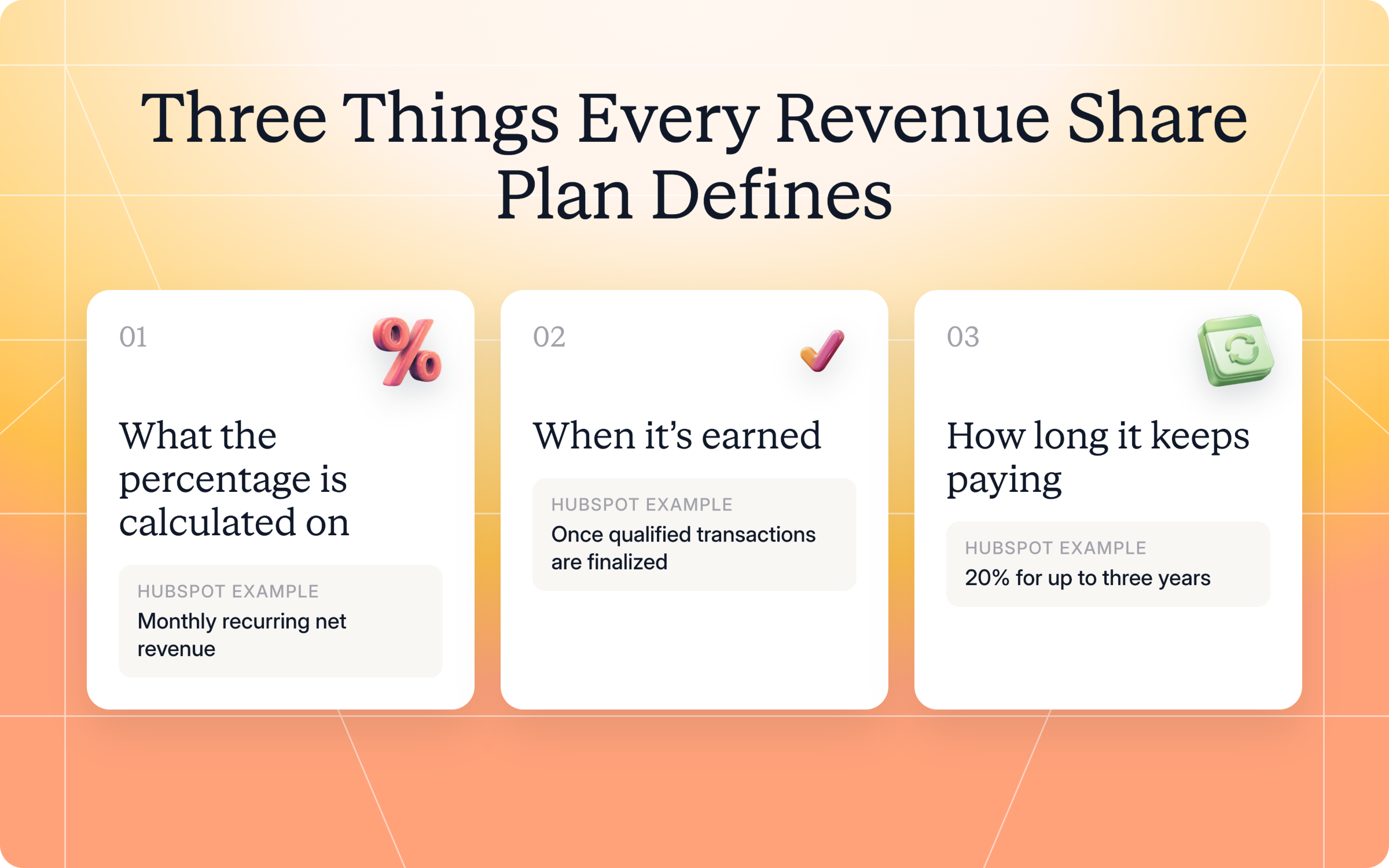
For example, HubSpot’s Solutions Partner Program pays partners 20% of monthly recurring net revenue once qualified transactions have been finalized, for up to three years. That’s a revenue sharing arrangement where the parties involved agree upfront on the base, rate, and duration. It's an incentive program that gives both sides a direct stake in shared success, whether the partner is company B or a global agency.
Types of revenue sharing extend well beyond SaaS:
- Professional sports leagues share ticket sales and broadcasting revenue among teams.
- Mutual funds and investment companies distribute returns from plan assets to investors.
- The federal government uses a revenue sharing program to distribute tax income to states.
- App stores take a cut from third party developers.
- Advertising revenue from online advertisement interaction is shared between platforms and affiliate marketers.
The mechanics differ, but the principle is the same. Two or more parties share generated revenue from a shared activity, and each party’s contribution determines their share.
Revenue sharing is an attractive option because it aligns the interests of both sides without saddling either with fixed costs. The partner earns more when they bring in more gross revenue, so their interests point the same direction as yours. You pay only when resulting revenue is actually generated, which means your cost of partner acquisition scales with results. A revenue share model pulls in the partners who can actually sell, and keeps them motivated, because their income grows with every deal they bring.
For partners, the appeal is a predictable, sustainable revenue stream tied to deals they helped close. They’re not burdened with the overhead of building or supporting the product themselves.
IDC forecasts the HubSpot ecosystem alone will reach $36 billion by 2029. Partners surveyed project their HubSpot-related work to rise from 57% of total partner revenue in 2023 to 64% by 2025. The HubSpot ecosystem is one of the clearest revenue sharing examples working at scale. It’s become a payout model that has grown the company and the partner ecosystem at the same time.
How partner payout models compare
There are different ways to pay partners. What matters most is that partners have the visibility they need.
| Model | Paid on | Partner can verify it | Typical use in partner programs |
|---|---|---|---|
| Revenue share | A percentage of deal or subscription revenue | Yes, they know the deal value | The default for referral and co-sell motions |
| Commission | A percentage of deal or subscription revenue | Yes, they know the deal value | Often just the other word used when the payout feels sales-like |
| Fixed fee or bounty | A flat amount per qualifying event | Yes, entirely predictable | Per-lead, per-registration or per-activation payouts |
| Margin | The gap between partner price and resale price | Yes, they set the resale price | Reseller and distributor models |
| Profit share | A percentage of profit after costs | No, not without opening your books | Rare. Mostly joint ventures and equity-like deals |
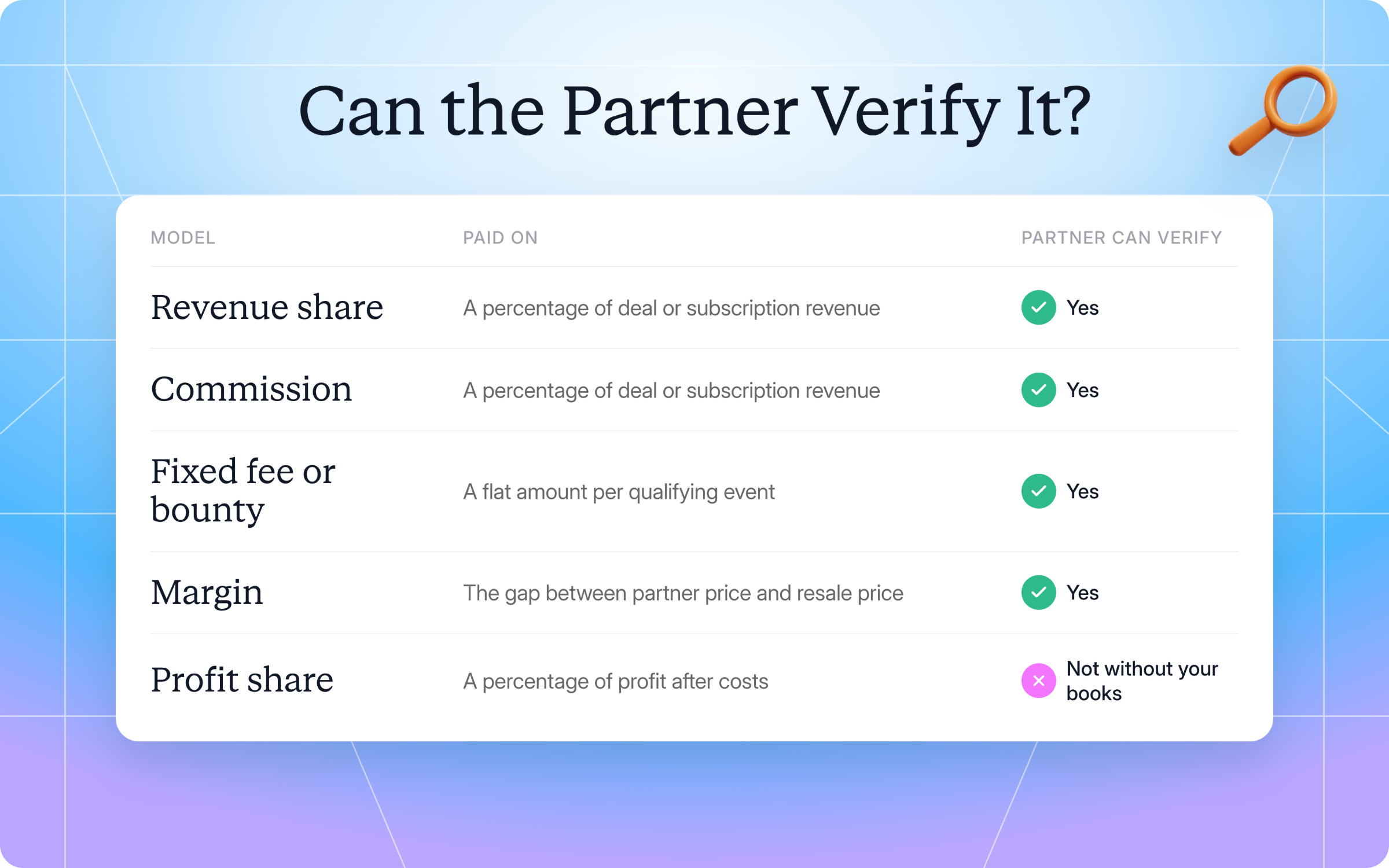
When you define revenue share, it might sound a lot like how sales commissions work. That’s because the two essentially share the same mechanism. In a revenue share model and in a commission-based structure, the partner is paid a percentage of a number they’re aware of. The only differences are what the percentage is applied to, whether it recurs, and whether the partner can verify it themselves without having to trust your accounting.
The revenue share vs profit share distinction is where most of the confusion sits. Profit sharing deals and a profit sharing system are fundamentally different. They pay on net profits or operating profits after costs. A revenue split between two or more companies maintains transparency but a profit split usually doesn’t.
Why profit share almost never works for partners
Profit share is the one model from the table that doesn’t allow your partners to verify their payment independently. That’s because partners can’t audit your profit, as they have no insight into your cost allocations. Revenue is observable, profit is not.

It’s not just a lack of visibility. Risk distribution in a profit sharing system is one-sided. The partner takes on all the risk of your cost decisions without any say in them. If you hold intellectual property that drives margins, the partner’s payout swings based on how you account for it, not on how well they performed.
To make the number trustworthy, you’d have to disclose your cost structure to external financial actors, agree on a definition of profit in the contract, and ultimately open yourself to audit rights. It’s not a practical route for working with a channel partner.
That’s not to say sharing profits is never an option. It makes sense for joint ventures with a shared legal entity, equity-like arrangements, or other strategic alliances where the parties responsible are genuinely co-invested. But in all of those cases, the partner is closer to a shareholder than a channel partner.
When setting up your partner arrangements, make your choice based on whether you’d rather pay a percentage of revenue, a fixed fee, or reseller margin. Unless your scenario is one of the ones above, it’s safe to rule out profit share.
The distinction that actually matters: What you pay on and how often
When you’re designing a payout, move your decision away from which model to choose. Instead, think strategically about what you want to pay on and how often. That’ll point you in the direction of which model is best for you.
What the payout is calculated on
Your payout is calculated on one of three things, and each one suits a different motion:
- A percentage of a revenue figure
- A flat fee per event
- The margin a reseller makes on resale
A percentage of revenue is the default for referral and co-sell motions. The partner brings a deal, you both know the deal value, and the payout is a clean percentage of that number.
A flat fee per event works for volume lead generation, where the partner’s job is to surface opportunities rather than close them. You pay per qualified lead, per registration, or per activation.
Margin is for resellers who buy your product at one price and sell it at another. Their payout is baked into the gap between those two prices.
The choice follows the motion. If the partner is influencing deals, pay on revenue. If the partner is generating leads, pay a flat fee. If the partner is buying and reselling, let them keep the margin.

How often it pays
The next thing to consider is whether the payout happens once on the initial deal, or whether it recurs for as long as the customer stays. Both have pros and cons.
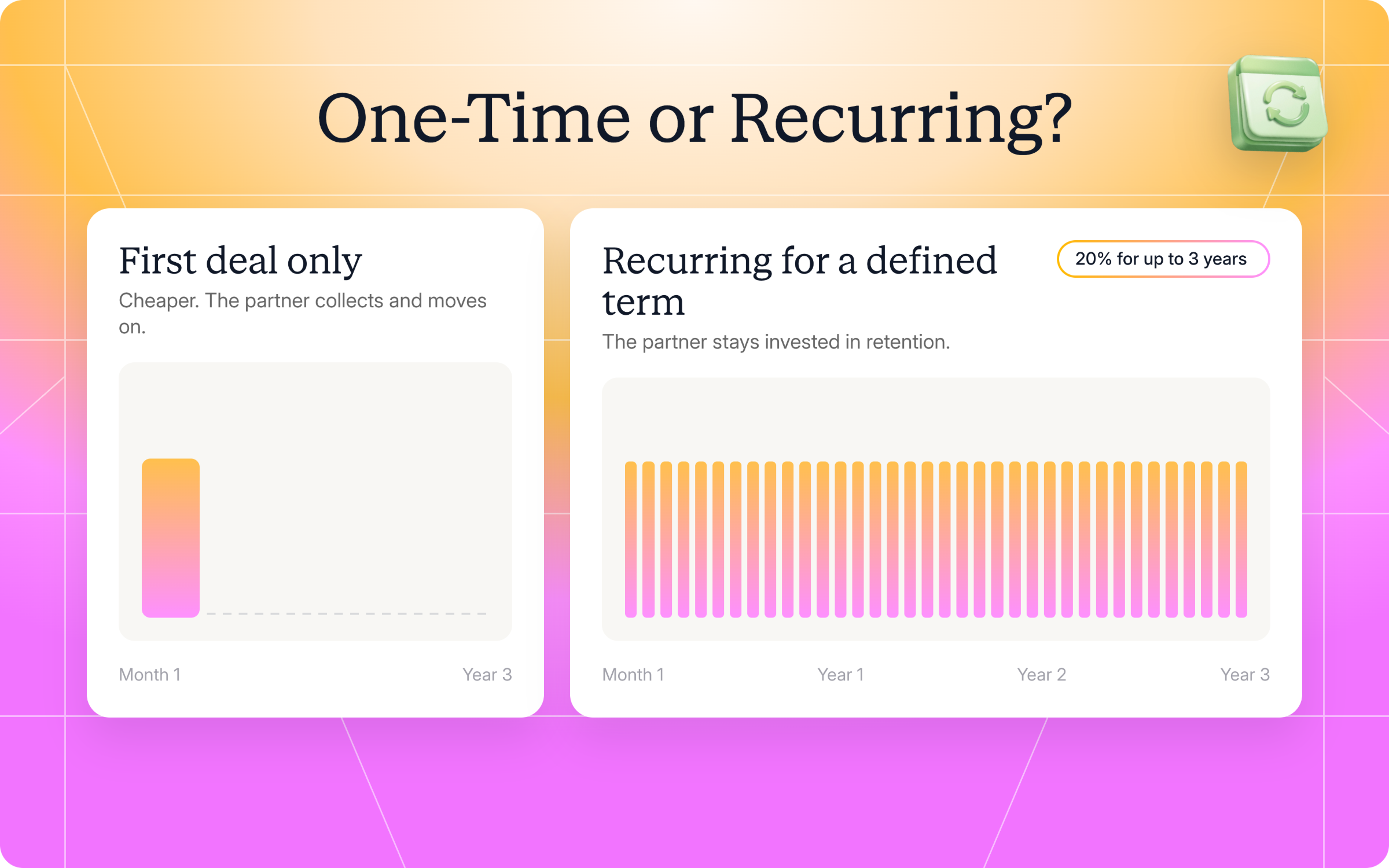
If you only pay on the first deal, partners aren’t incentivized to care whether a customer renews. They bring the deal, collect the payout, and move on. This method might be cheaper, but paying recurring makes partners invested in retention, as their income depends on the revenue generated over the customer’s lifetime.
Recurring in perpetuity, though, is expensive. Many programs pay recurring for a defined term, like the HubSpot example. They pay 20% for up to three years on partner-sourced deals. A well-structured payout gives partners a reason to collaborate and pursue continuous improvement, because their earnings scale with the results they produce together.
Gross versus net
When you pay a percentage, you have to define exactly what that percentage applies to. It could be the gross revenue, the net of discounts, the net of taxes and fees. It could include services and usage overage, or it could exclude them entirely.
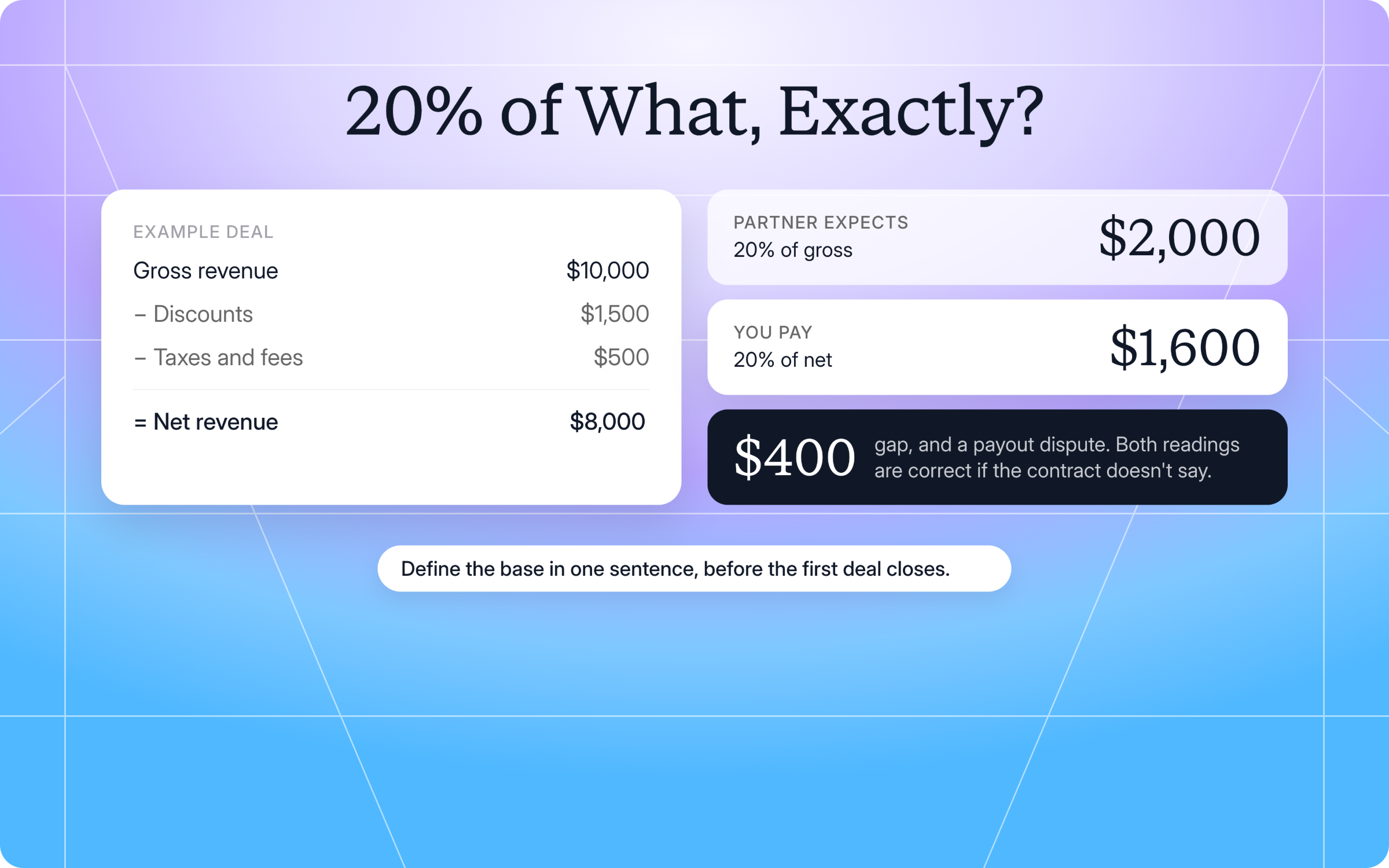
The point is to get rid of any ambiguity, as that will produce payout disputes. The partner may think they’re owed 20% of the gross, but you pay them 20% of net after discounts. If you didn’t specify your intended meaning in the contract, the partner is also correct with their interpretation.
Define the base in one sentence, before the first deal closes. This way, you’ll immediately eliminate the most common source of partner friction.
When it’s earned versus when it is paid
The last question to consider is timing. Is the payout earned when the deal is marked closed-won, when the invoice is sent, or when the cash is collected?
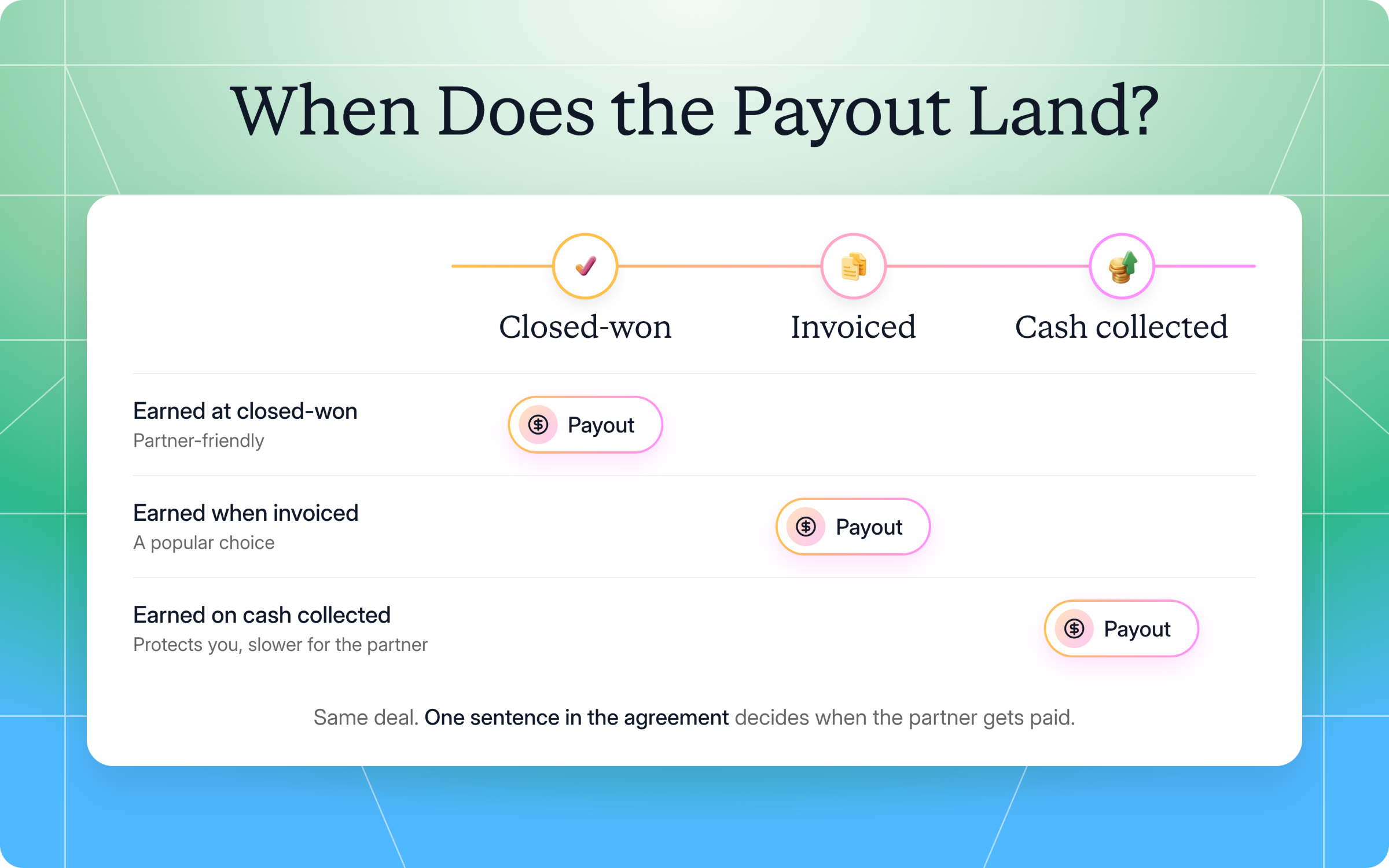
Paying on closed-won is partner-friendly. The partner gets credit as soon as the deal is done. But it exposes you to churn and non-payment, because in this scenario you’re paying out before you have the money.
Paying on cash collected protects you, because you only pay after the customer has paid you. If your payment cycles are long, this can harm the relationship as it slows the partner’s reward and creates financial strain on the partner’s cash flow.
The most popular decisions are to pay either when the deal is invoiced or when the payment is collected. Going back to HubSpot as an example, they pay quarterly, 45 days after the quarter closes. Whichever you choose, put it in the agreement in one unambiguous sentence.
Choosing a model by partner type
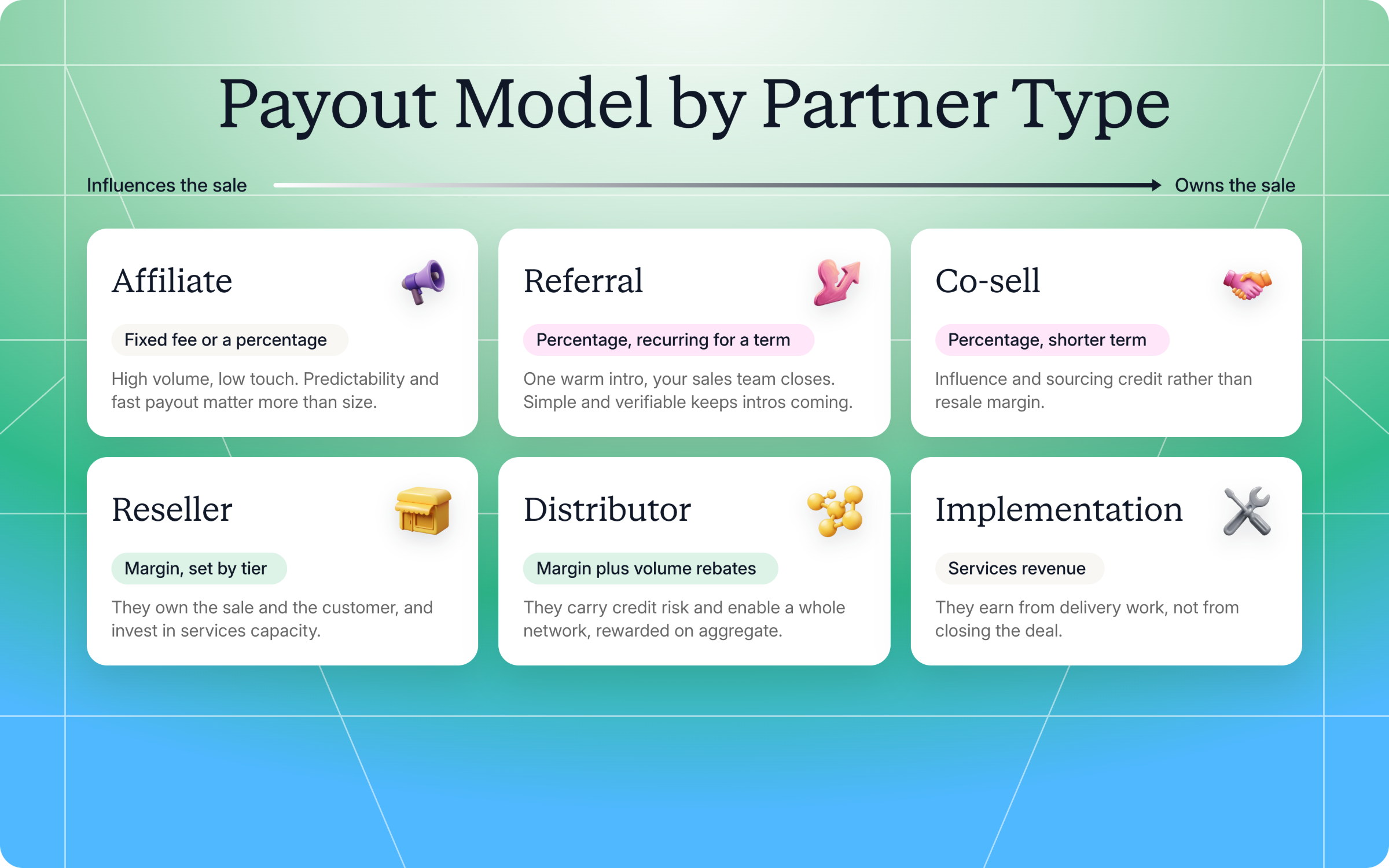
The more the partner owns the sale, the more their payout comes in the form of margin rather than a percentage. Affiliate marketing partners and referrals get a percentage because they influence the deal but don’t close it. Resellers and distributors keep the margin because they carry the sale end to end. Value-added resellers take it a step further by layering services, customization, or integration on top of the product, which is why their margin needs to cover both the resale and the delivery work. Implementation partners earn from the work they do after the deal closes.
Here’s how each payout model maps to each partner type.
| Partner motion | Usual payout model | Why it fits |
|---|---|---|
| Affiliate | Fixed fee per conversion, or a percentage | High volume, low touch. Predictability and fast payout matter more than size. |
| Referral | Percentage of deal value, often recurring for a defined term | One warm intro, your sales team closes. Simple and verifiable keeps intros coming. |
| Co-sell | Percentage, often with a shorter payout term | Influence and sourcing credit rather than resale margin. |
| Reseller | Margin, set by tier | They own the sale and the customer, and they invest in services capacity. |
| Distributor | Margin plus volume rebates | They carry credit risk and enable a whole network, rewarded on aggregate. |
| Implementation | Services revenue, sometimes a referral fee | They earn from delivery work, not from closing the deal. A referral fee may apply when they hand off a lead |
A partner can hold more than one reward type at the same time. A reseller might earn margin on the deals they close and a one-time bonus for a specific product push during a quarter. Referral management software might give referral partners a recurring percentage for deals they source and a flat fee for each qualified lead they pass through. That one-time bonus is a SPIFF, or sales performance incentive fund, a short-term payout layered on top of the base model to create urgency for a specific goal. Stacking rewards lets you align a partner across multiple motions without forcing every payout into one shape.
Keep in mind, whichever model you pick, rates usually vary by partner tier or segment. As partners cross higher revenue thresholds, their payout rate can step up, so the partners who generate the most volume earn a larger share over time.
For HubSpot’s Solutions Partner Program, every tier earns the same 20% rate, but untiered partners get payouts for 12 months while Gold through Elite partners get up to three years. Tiering works the same way across percentages, flat fees, and recurring rates. The structure is the same but the number changes.
How to get the mechanics right
You can pick the right model and still lose partners over bad execution. A 2024 survey of affiliate content creators found that product quality and brand reputation mattered more to them than commission rates and earning potential. Nearly seven in 10 said how often they get paid was extremely or very important to them.
Here’s a step-by-step on how to get the operational side right:
- 1. Put the calculation base in one sentence: Put it in the agreement, in language a non-finance person can read. Name the exact CRM or billing property the percentage applies to, and list what’s excluded. If the partner can read that sentence and know what they’re being paid on, you have effectively eliminated the most common source of payout disputes.
- 2. Decide the currency before you sign international partners: If the deal closes in one currency and the partner is paid in another, say which exchange rate applies and when it’s set. Flat fees are simpler here because they can be denominated in your own currency regardless of deal currency.
- 3. Let partners see what they’ve earned continuously: A partner who can see what they’ve earned while the deal progresses doesn’t need to ask, and won’t dispute the total later. When partners receive regular financial reports tied to their deals, trust follows without you having to sell it.
- 4. Automate the calculation from your source of truth: If commission is calculated by hand from a spreadsheet export, it’ll be late and occasionally wrong. Both damage the relationship more than the rate itself does.
- 5. Connect payouts to attribution: You can only pay correctly if you know which partner earned the deal, so the payout model is only as reliable as the attribution underneath it. Clean partner attribution is what makes every other mechanic work.
When partners walk, it’s usually because the check was late, the number was wrong, or they had no way to see what they'd earned. Forbes documented a case where a partner was owed over $8,000 and waited seven months past a signed NET30 agreement before payment. You can have the most ideal payout model, but if your system can’t get partners paid on time, none of it matters.
Want to skip the spreadsheet? See our guide to the best channel incentive software for partner programs.
How Introw handles partner payouts
Introw is a CRM-first partner relationship management platform that doesn’t treat these as separate payout systems. You build one commission plan and choose a reward type inside it. That’s what makes the conversation turn to what you pay on and how often, not which systems to adopt.
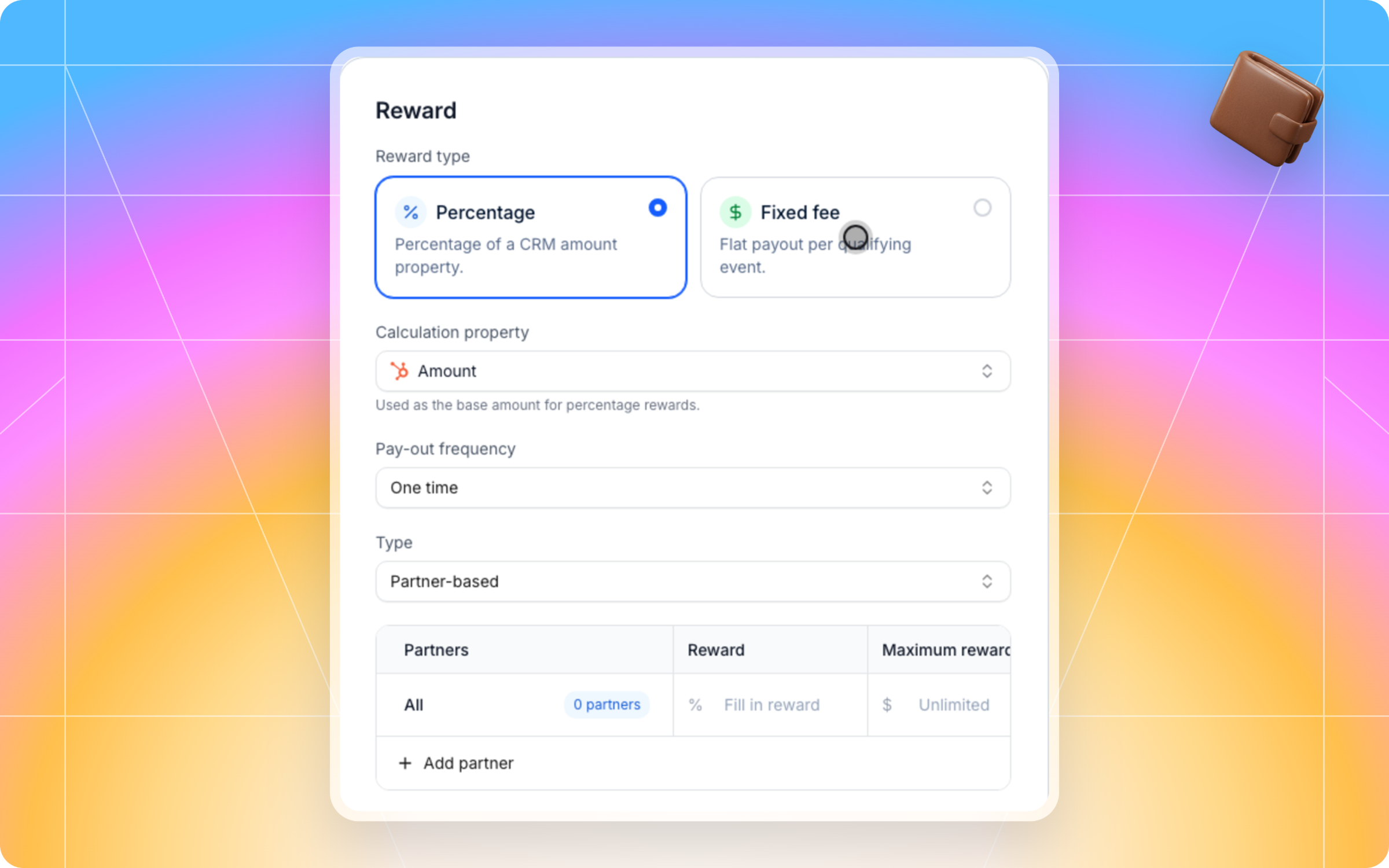
Once the rate is set, Introw calculates commission lines automatically from your CRM or billing source of truth. Nobody has to rebuild the math in a spreadsheet. Partners see what they have earned in the portal as deals progress, and every statement reconciles back to the CRM record that produced it.
Introw calculates rewards on CRM and billing amount properties such as deal value. So, if you’re still considering profit share, it might not be the right partner portal for you. Introw is built for B2B SaaS companies running partner programs on HubSpot or Salesforce, with partner managers and an existing program to scale.
A partner who trusts your payout process stays. A partner who’s waiting seven months for a check doesn't. See how Introw calculates partner payouts straight from your CRM and pays them on a schedule partners can see. Book a demo or explore commission SPIFFs.
Still curious? Here are some quick answers to help clear things up
Revenue share pays partners a percentage of the revenue from a deal. Profit share pays on what's left after operating costs are deducted, which means partners can't verify the number without seeing your books. For channel partners, revenue share works because the number is observable. Profit share doesn't, because it isn't.
The involved parties agree on four things: the calculation base, the rate, when the payout is earned, and how long it recurs. Put all four in the revenue sharing agreement in one sentence each. If a non-finance person can read the agreement and know what they're being paid on, you've done it right.
There's no universal benchmark. The percentage depends on the partner's motion, deal size, and what they contribute to the sale. A referral partner who hands off a lead gets less than a reseller who owns the customer relationship end to end. What drives the number is the partner's contribution, not an industry average.
Equity gives a partner ownership in the company, with upside if the company's valuation grows. Revenue share gives a partner a payment on sales, with no ownership and no say in the business. Equity is for investors and strategic partners you want embedded. Revenue share is for channel partners you want motivated to sell.
It's the contract that defines the calculation base, rate, timing, duration, and dispute terms for a partner payout. Every payout dispute traces back to something the agreement didn't specify. Note: this is not legal advice. Have a lawyer review any payout agreement before you sign it.






See AI-Native PRM in Action
Book a demo with one of our partner program experts, or explore Introw on your own time.