

A referral fee is what you pay a partner for sending you a lead that turns into a customer. A finder's fee is usually a one time payment to someone who makes a single introduction and steps away. In B2B SaaS, the two blur together, so what matters more is how you structure the payment: flat fee or percentage, first year or recurring, and what has to happen before anyone gets paid. This guide covers typical ranges (with honest caveats), a worked example comparing payout models, what a finders fee agreement should include, the legal traps to know about, and how to track referrals and pay out cleanly from your CRM.
Partners are carrying more of the revenue load every year. In Forrester's Partner Ecosystem Marketing Survey, 67% of B2B decision makers expect indirect revenue to grow above or significantly above last year's level, and two thirds say the same about partner influenced revenue. A lot of that growth starts with a simple introduction from someone who isn't on your payroll.

Here's how it usually goes. A consultant you've worked with mentions your product to one of their clients. The deal closes six weeks later. Then the email arrives: "So, what's my cut?" You check your files and realize nobody ever agreed on a number. Is it 10%? 20%? A flat thank you? Of the first year or forever?
Sound familiar? Paying for referrals isn't the hard part. Agreeing on the terms before the deal closes, and writing them down, is.
This guide covers what to pay referral partners and finders, how to choose between a flat fee and a percentage, what to put in a finders fee agreement, and how to run referral payouts without spreadsheets and awkward emails.
Referral fee vs finder's fee: what's the difference?
People use the two terms interchangeably, and in everyday business that's mostly fine. But there's a useful distinction, and it changes what you should pay.
A referral fee is a payment to a partner who sends you a qualified lead that converts into a customer. In short, the fee is a payment for bringing the right person to the table. Referral partners often stay involved: they warm up the introduction, vouch for you, and sometimes help the deal across the line. They also tend to keep referring people from their network, which is why referral fees are usually part of an ongoing program that keeps bringing in new clients.
A finder's fee is a payment to a person who identifies an opportunity or makes an introduction, then steps out. The finder isn't expected to sell, negotiate, or support the customer. The fee is a payment for making introductions, often a one off, and it's common in M&A, fundraising, real estate, and recruiting.
| Referral fee | Finder's fee | |
|---|---|---|
| Who gets it | A referral partner, often in an ongoing program | An individual or firm making a single introduction |
| Involvement | Warm introduction, sometimes light co selling | Introduction only, then steps away |
| How often | Repeated, one referral after another | Usually one time |
| Typical structure | Percentage of first year revenue, recurring share, or flat fee | Flat fee or small percentage of the deal size |
| Paper | Referral partnership agreement | Finders fee agreement for one deal or a short list of targets |
| Common in | B2B SaaS, agencies, consultants, MSPs | M&A, fundraising, real estate, recruiting, large one off deals |
For most B2B SaaS partner teams, the practical rule is simple. If someone will refer more than once, treat them as a referral partner and put them in a program. If it's a single introduction to a specific account, a finder's fee for that one deal is fine, as long as the terms are written down before the introduction happens.

Why referral fees go wrong and cost you new clients
Before we talk about rates, let's name the real problems. Most referral fee disputes don't come from the percentage. They come from everything around it:
- No written agreement: The fee was agreed on a call, and now the two parties remember it differently. One party thinks it was 20%, the other thinks it was a quick thank you.
- Unclear trigger: Is the fee earned when the lead is accepted, when the contract is signed, or when the customer pays their first invoice?
- Duplicate claims: Your direct team was already talking to the same client, or another partner referred them first.
- Undefined base: Ten percent of what? The first year? Total contract value? Including services and setup fees?
- Slow or invisible payouts: The referrer waits months and has to chase finance to get paid, so they stop sending referrals and send their clients to a business that pays on time.

Fix these five, and the exact percentage becomes far less important. Not everyone agrees on the right rate, but everyone agrees on the value of a clear agreement. Get them wrong, and even a generous fee will damage the relationship.
Typical finder's fee and referral fee percentages
What is a typical referral fee? Here's the honest answer: there is no standard referral fee percentage. No regulator or industry body sets one for B2B software, and published ranges vary a lot depending on who's writing them and what industry they're in. Treat any typical range you see, including the ones below, as a starting point for your own numbers rather than a benchmark you have to match. A typical finder's fee in one industry can be wildly off in another, so look at your specific situation first.
With that caveat, here's what you'll commonly see in practice.
| Typical range you'll see | What drives it | |
|---|---|---|
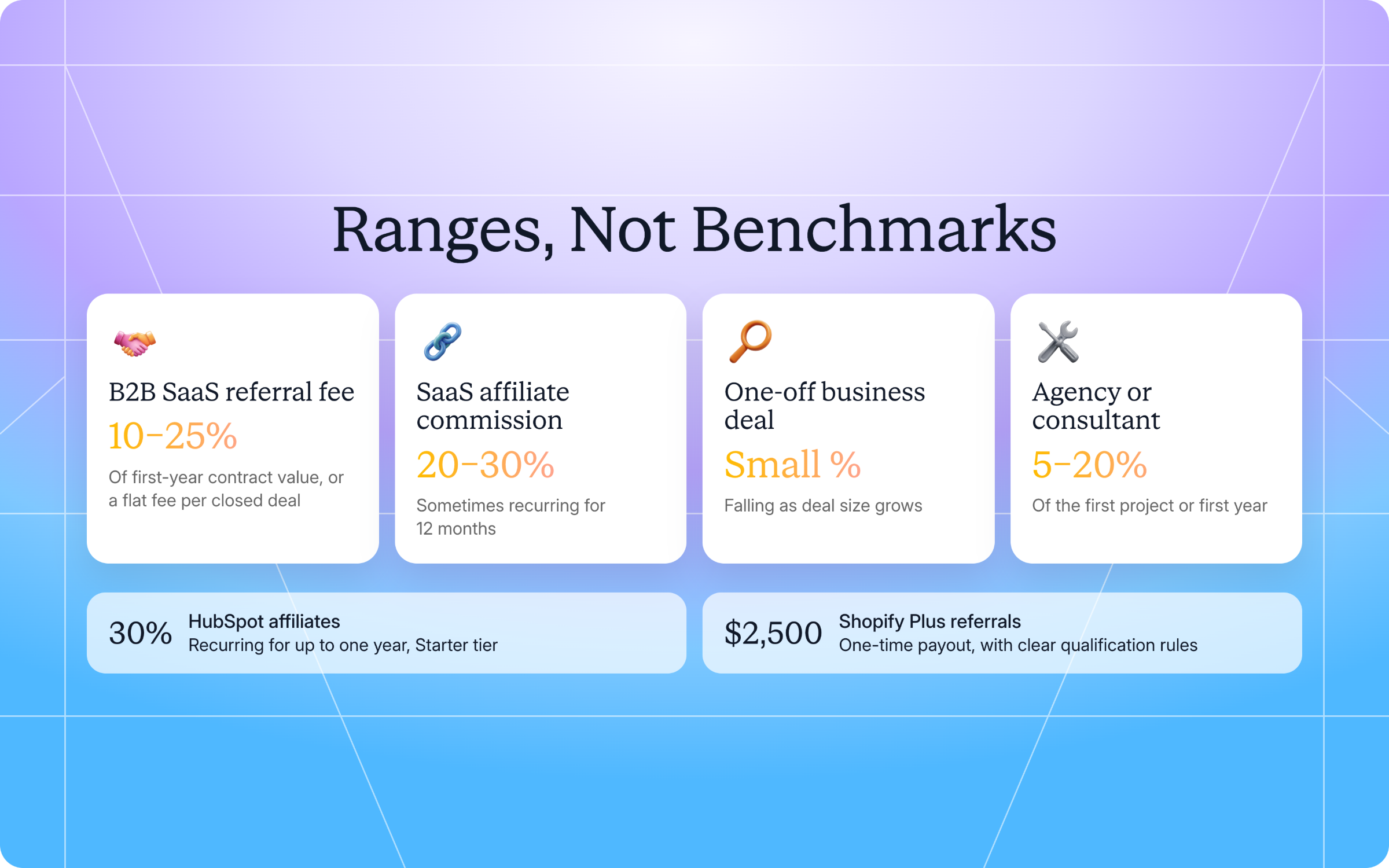
| B2B SaaS referral fee | Roughly 10% to 25% of first year contract value, or a flat fee per closed deal | Deal size, sales cycle length, how much the partner helps close |
| SaaS affiliate commission | Often 20% to 30%, sometimes recurring for 12 months | Self serve signups, low involvement, high volume |
| Finder's fee on a one off business deal | Often a small percentage, with the percentage falling as deal size grows | Absolute dollar value of the transaction |
| Agency or consultant referral | Often 5% to 20% of the first project or first year | Project revenue and margin |
Two real world examples show how differently big platforms approach it.
HubSpot's affiliate program pays 30% recurring commission for up to one year on the Starter tier, with a 180 day cookie window, and moves to custom commission for its top Elite tier. That's a percentage model built for volume.
Shopify takes the opposite approach for its partner referrals. According to its Partner earnings page, a partner who refers a new merchant to Shopify Plus or Enterprise earns a one time payout of $2,500, but only if the merchant hadn't already contacted Shopify Sales, generates more than $5,000 in GMV, and pays their first Plus invoice. That's a flat fee with very clear qualification rules.
Neither is wrong. They're designed for different partners and different deal sizes, which is the point.
How other industries handle referral fee percentages
It helps to know where the numbers you hear come from, because many of them aren't from software at all.
- Real estate agents: Real estate agents often pay each other a referral fee as a share of the commission on a sale, and the rules on who can receive it are strict.
- Recruiters: Agencies that help candidates find jobs usually charge the hiring company a percentage of first year salary, which is closer to a finder's fee than a referral fee.
- Consultants and marketing agencies: A consultant who refers a project to another firm often takes a share of the project fee, so the referral fee percentage tracks project revenue and profit, not recurring revenue.
- M&A and business brokers: A broker or finder who introduces a potential buyer to a seller is usually paid on the deal size, often on a sliding scale.
So when someone quotes "the typical referral fee," ask which industry it came from before you copy it into your own program.
What about the finders fee percentage on large deals?
For big one off transactions, a flat percentage gets expensive fast. That's why finder's fees in M&A and fundraising often use a sliding scale, where the percentage drops as the deal gets bigger. The old Lehman formula is the classic version: 5% of the first million, 4% of the second, 3% of the third, 2% of the fourth, and 1% of everything above that. You won't see it much in SaaS, but the idea is useful. A small percentage of a very large deal can still be more money than you meant to pay, so think in absolute dollars, not just percentages.
What moves the number up or down
When you're deciding what to pay, look at these factors before you look at anyone else's rates:
- Deal size: Larger deals can support a lower percentage and still feel generous.
- Partner involvement: A partner who joins calls and helps close earns more than one who sends a quick intro email.
- Your margins: Recurring revenue with high gross margin can absorb a bigger share than services revenue.
- Customer acquisition cost: Compare the fee to what it costs you to win the same customer through paid or outbound channels.
- Lead quality: If referred leads close faster and churn less, you can afford to pay more for them.
- Volume: A partner who sends more referrals can earn a better rate, because each new customer costs you less to support.
- Relationship: A partner with a strong network and a trusted relationship with your buyers is worth more than one who just passes on names.
Flat fee vs percentage: choosing your referral commission rate
The structure matters as much as the rate. There are four models you'll see in B2B partner programs.
| How it works | Best for | Watch out for | |
|---|---|---|---|
| Flat fee | A fixed amount per qualified lead or closed deal | Predictable deal sizes, simple programs, finders | Overpays on small deals, underpays on big ones |
| One time percentage | A percentage of first year or total contract value, paid once | Most B2B SaaS referral programs | Defining the base clearly |
| Recurring revenue share | A percentage of revenue for a set period, or for the life of the customer | Partners who influence retention and expansion | Long tail liabilities on your books |
| Tiered | The rate changes by year or by partner tier | Programs that want to reward top performers | Complexity, so keep tiers simple |
A flat fee is easy to explain and easy to budget. A percentage scales with the deal, which feels fairer to partners when deal sizes vary a lot. Recurring revenue share keeps partners invested in the customer's success, but it also creates a payout obligation that outlives most partner managers' tenure in the role.
If you want to go deeper on the mechanics, our guide to revenue share vs commission vs profit share covers the trade offs in detail, and our piece on partner commission structures walks through a framework you can launch in 30 days.
First year vs recurring
This is the decision most teams get stuck on. Here's a simple way to choose.
Pay on first year revenue when the partner's job ends at the introduction. They found the customer, you closed and kept them. Paying a percentage of the first year contract value rewards the introduction without creating an open ended liability.
Pay recurring when the partner keeps adding value after the sale. Implementation partners, consultants who manage the account, or agencies who run your product for their clients all affect retention. A recurring share, often capped at 12, 24 or 36 months, rewards that ongoing work.
Whatever you choose, set an end date for every commission paid on recurring revenue. "For the life of the customer" sounds generous at launch and becomes a finance problem three years later.
A worked example: one $40,000 deal, four payout models
Let's say a partner refers a customer who signs a $40,000 annual contract. The customer renews at the same price for two more years, so they're worth $120,000 over three years.
Here's what the partner earns under four common models:
- Flat fee of $2,500 per closed deal: The partner earns $2,500. That's about 6% of the first year, and about 2% of the three year value.
- 15% of first year contract value: The partner earns $6,000, paid once after the customer's first invoice is paid.
- 10% recurring for 36 months: The partner earns $4,000 a year, or $12,000 in total, as long as the customer stays.
- Tiered recurring, 20% in year one, 10% in year two, 5% in year three: The partner earns $8,000, then $4,000, then $2,000, for $14,000 in total.

Same deal, a payout range from $2,500 to $14,000. That's why "what percentage should we pay?" is the wrong first question. Start with "what do we want this partner to do, and for how long?" Then pick the model that rewards exactly that.
A quick sense check helps too. If your blended customer acquisition cost through paid channels is $10,000 for a customer like this, a $6,000 one time referral fee is a bargain. If your average deal is $5,000, a $2,500 flat fee is half the first year's revenue, which is probably too much.
What a finders fee agreement should include
Whatever you pay, put it in writing before the introduction, not after the deal closes. A clear agreement protects both parties, and a referral that starts with signed contracts rarely ends in an argument.
One important note before the checklist. This is not legal advice, and we're not going to give you a fill in the blanks finders fee agreement template here. Finder's fees and referral fees touch contract law, tax, and in some industries, licensing rules that vary by country and state. Use the outline below to brief your lawyer, and have them review any agreement before you sign it.
For B2B SaaS teams running an ongoing program, our referral partnership agreement template is the better starting point. It's built for repeated referrals, with sections for lead submission, acceptance, and commission mechanics. If you share revenue over time rather than paying per deal, look at the revenue sharing agreement template instead.
The clause checklist
A finders fee agreement, or the commission section of a referral agreement, should cover at least these points:
- Parties and relationship: The parties involved, who is paying, who is being paid, and a clear statement that the finder is an independent party, not an employee, agent, or reseller who can bind your company.
- Scope of the introduction: Which target companies, or which type of potential buyer, the agreement covers. For a one off finder's fee, name the specific company.
- What counts as a qualified referral: Required lead details, consent to be contacted, and how and when you accept or reject a submission.
- Existing relationships and duplicates: What happens if your team was already talking to the same client, or another partner registered them first. First touch, first registered, or something else?
- The fee: Flat fee or percentage, the exact base (first year subscription, total contract value, excluding services and taxes), any cap, and whether it's one time or recurring.
- The trigger: When the fee is earned (signed contract, first invoice paid, end of a trial or refund period) and when it's paid (for example, 30 days after the customer pays).
- Tail period: How long after the introduction a closed deal still earns the fee. Six or twelve months is common.
- Clawbacks: What happens if the customer cancels or gets a refund within an agreed period.
- Conduct: No misleading claims, no promises on pricing, compliance with applicable laws and your brand guidelines.
- Confidentiality and data protection: How lead data and deal information can be used.
- Tax and payment details: Who's responsible for taxes, which forms you need before payment, and the payment method and currency.
- Term and termination: How either party can end the agreement, and what happens to referrals that are already in the pipeline.
- Governing law and disputes: Which jurisdiction applies and how disagreements get resolved.
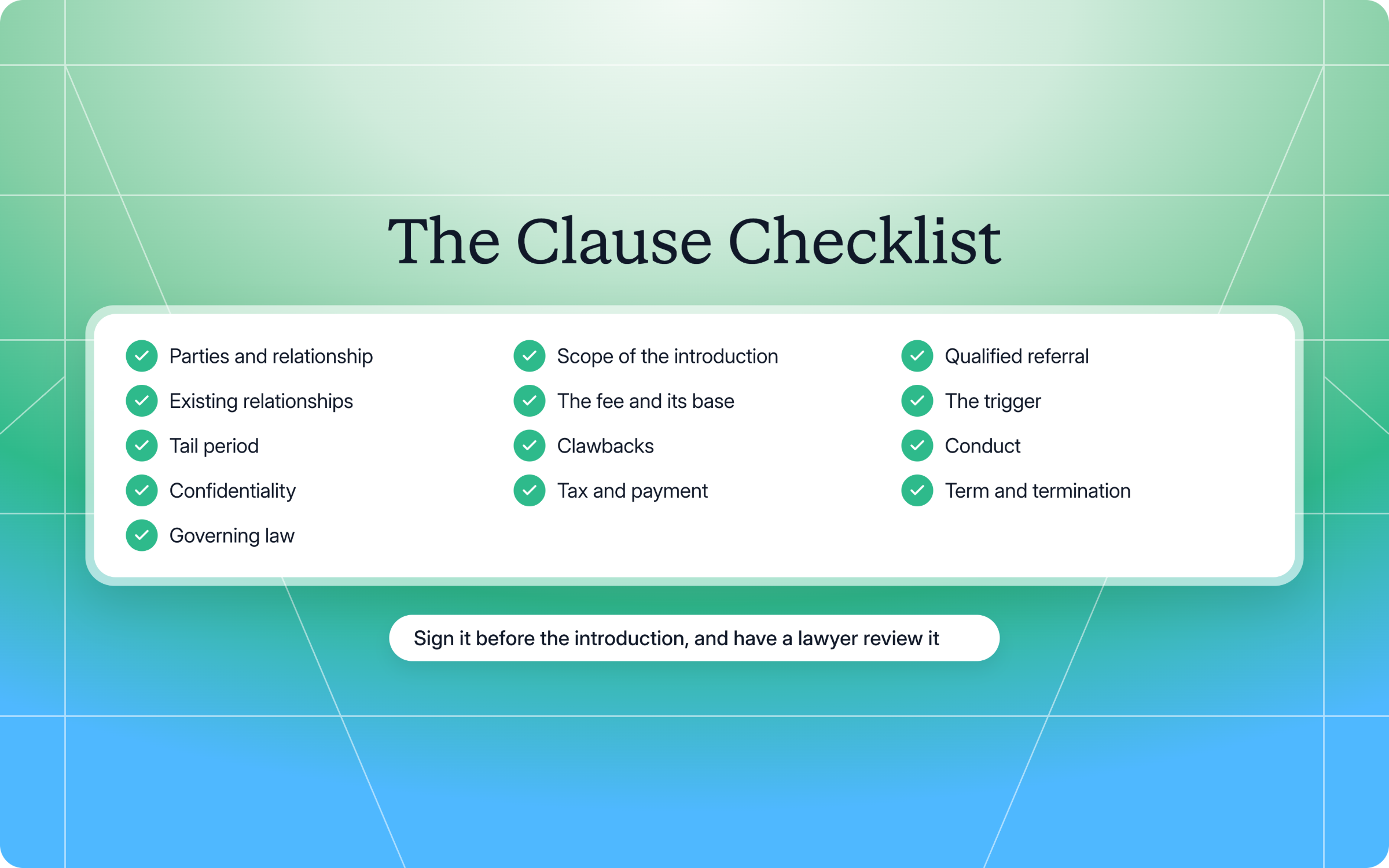
If someone asks "can you provide an example of a finder's fee agreement?", that list is a good example of what a solid one covers. The exact wording is a job for your lawyer.
Legal and tax caveats: securities, real estate, law firms and more
Most B2B software referral fees are ordinary commercial payments, whether paid in cash or as account credit, and perfectly legal. But there are a few areas where a finder's fee can get you, or the finder, into trouble. Is a finder's fee illegal? Usually not. But in some situations it can be.
- Securities and fundraising: In the US, paying someone a percentage of capital they help raise can make them an unregistered broker. When the SEC proposed an exemptive order for finders in October 2020, law firm Sidley noted that soliciting investors for compensation "historically has been considered a core activity that requires registration as a broker dealer" under the Exchange Act. If a finder's fee touches investors or capital raising, get securities counsel involved.
- Real estate: Many US states only let a real estate brokerage or licensed real estate agent receive a referral fee on a property transaction, so real estate agents generally can't pay a finder's fee to an unlicensed person. If your deal touches real estate, check the state rules.
- Law firms and other licensed professions: Professional conduct rules restrict how law firms share fees with nonlawyers, and similar rules exist for accountants, financial advisers, and others. Ask before you pay.
- Healthcare and government buyers: Anti kickback rules can apply when payments are tied to referrals of business paid for by government programs or public budgets.
- Customer side employees: Paying someone who works at the buying company to steer the deal your way can look like a bribe, not a referral fee. Your agreement should rule it out.
- Tax reporting: For the finder, a referral fee is income. In the US, payments to non employees for services generally need a 1099 once they cross the reporting threshold, which rose from $600 to $2,000 for payments made after December 31, 2025. Collect tax forms before the first payout, not after.
Outside the US, rules differ again. Some countries treat certain referral payments as agency relationships with their own protections, and VAT or withholding tax can apply. If your partners are international, budget for a quick legal and tax review per country.
How to pay referral fees in your program
If you're building a program rather than paying a single finder, here's a simple process.
Start from the economics
Work out what a new customer is worth to you over the first year and over their lifetime, and what it costs you to acquire one through other channels. Your referral fee should sit comfortably below your other acquisition costs, but high enough that partners notice it. A standard referral fee percentage that ignores your margins is just a guess. For many B2B SaaS companies, that lands somewhere between 10% and 20% of first year revenue, but your numbers should decide, not someone else's.
Pick one default model
Choose one commission structure as the default, and make exceptions rare and written. A program with a different deal for every partner is impossible to manage, and partners talk to each other.
Reward your best referrers
Once you have more referrals coming in, a tiered commission structure gives your top partners something to aim for. For example, 10% of first year revenue by default, rising to 15% for partners who close three or more deals a year. Our guide on how to motivate referral partners covers non cash incentives too, from co marketing to a gift for a first referral.
Publish the rules
Partners should know exactly what qualifies, what they'll earn, and when they'll be paid before they send their first referral. That's how building relationships with referrers turns into new business and new opportunities, instead of arguments about money. For a full program blueprint, see our guides to B2B referral programs and launching a referral partner program.
How to track referrals and pay referral fees cleanly in your CRM
Here's where most programs actually break. The agreement is fine, the rate is fair, but the referral lives in an email thread, the deal closes in the CRM, and finance pays from a spreadsheet. Nobody can connect the three.

To pay referral fees cleanly, you need four things.
One way in for every referral
Give partners a single referral form, with a partner specific link, so every submission is attributed to the right referrer from the start. Then make the form write straight into your CRM as a lead or deal. If referrals can arrive by email, Slack, and phone calls, credit will always be disputed.
Here's how to build and share a referral form in Introw, including partner links, CRM mapping, and conflict checks:
Conflict checks before credit
Check every referral against your existing pipeline before anyone is credited. If your direct team already has an open deal with the same client, the referrer should know at submission, not at payout. Our guide to channel conflict covers how to set rules that both sales and partners accept, and deal and lead registration is how you enforce them.
Attribution on the deal record
The referral fee should be calculated from the closed deal in your CRM, using the deal value and the partner attribution on that record. That's what makes your partner attribution reporting and your payouts agree with each other.
A payout process partners can see
Approved fees should roll into a regular payout cycle, with a statement per partner, and partners should see what's pending, approved, and paid without emailing you. If you're comparing tools, our roundup of referral management software covers the main options.
Here's what setting up referral rewards looks like in Introw, from choosing a fixed fee or revenue share template to paying out approved lines:
Key takeaways
- No universal standard: A typical referral fee in B2B SaaS is often 10% to 25% of first year revenue, but your margins and acquisition costs should set the number.
- Structure beats rate: Flat fee, one time percentage, recurring share, or tiered, pick the model that rewards what you want the partner to do.
- Paper it first: Sign a written agreement before anyone starts making introductions, not after money is on the table.
- Know the legal traps: Securities, real estate, law firms, and healthcare have their own rules, so get legal review.
- Run it from the CRM: Attribution, conflict checks, and payouts should all come from the same deal record.
How Introw handles referral fees and payouts
Introw is a CRM first partner relationship management platform, which means it builds on top of your existing HubSpot or Salesforce setup rather than replacing it. Referral partners, affiliates, and resellers run in the same program, so referral fees sit next to the rest of your partner revenue, not in a separate spreadsheet.
Introw Partner Referrals and Commissions cover the full path from introduction to payment:
- Referrals without a login: Partners refer through a partner specific link, an embedded form, email, or an AI assistant, and every route feeds the same referral form with attribution set at the source.
- Conflict screening before credit: Each referral is checked against your direct and partner pipeline before anyone is credited, and overlaps are flagged with who's involved and which claim came first.
- Lead to opportunity in your CRM: Once a referral is qualified, Introw creates the opportunity, account, and contact in your CRM.
- Referrer updates: Referrers are notified as your team moves the deal, so they don't have to ask for status.
- Flexible reward plans: Choose a fixed fee, a one time revenue share, or a tiered recurring rate, with rates by partner, segment, or tier, optional caps, and an optional end date.
- Reviewed payouts: When a referred deal closes, Introw generates a commission line. You review, decline, postpone, or adjust lines, then batch approved ones into one payout per partner per period, with a statement and up to six approval steps.
- Payment handled: Introw Pay settles a whole batch from one consolidated invoice, handling partner verification, tax forms and 1099s, and pays partners in their own currency. Or export to your own finance stack.
- Earnings partners can see: Partners see forecasted, expected, upcoming, and paid earnings in the portal.
Here's how a commission plan is built and launched in Introw, from choosing the data source to enrolling partners:
The result is a referral program where the terms are clear up front, the credit holds, and nobody waits months to get paid. See how Introw takes the spreadsheets out of referral fees. Book a demo or explore Partner Referrals.
Still curious? Here are some quick answers to help clear things up
There's no official standard. For B2B software referrals, you'll commonly see 10% to 25% of first year contract value or a flat fee per closed deal. For large one off transactions like M&A, finder's fees are often a small percentage on a sliding scale that drops as the deal size grows.
A finder's fee usually pays someone for a single introduction, after which they step away. A referral fee usually pays a partner who refers customers repeatedly and may help warm up or close the deal. In practice the terms overlap, so the written agreement matters more than the label.
In most ordinary B2B deals, yes. But some areas have specific rules, including securities and fundraising, real estate, legal and other licensed professions, and healthcare. Check with a lawyer before paying a finder's fee in any regulated industry.
Pay on first year revenue when the partner's role ends at the introduction. Pay a recurring share, with an end date, when the partner keeps influencing retention and expansion after the sale.
Yes. A written agreement signed before the introduction should define the fee, the base, the trigger, the tail period, duplicates, and clawbacks. For ongoing programs, start from a referral partnership agreement template and have a lawyer review it.




See AI-Native PRM in Action
Book a demo with one of our partner program experts, or explore Introw on your own time.