
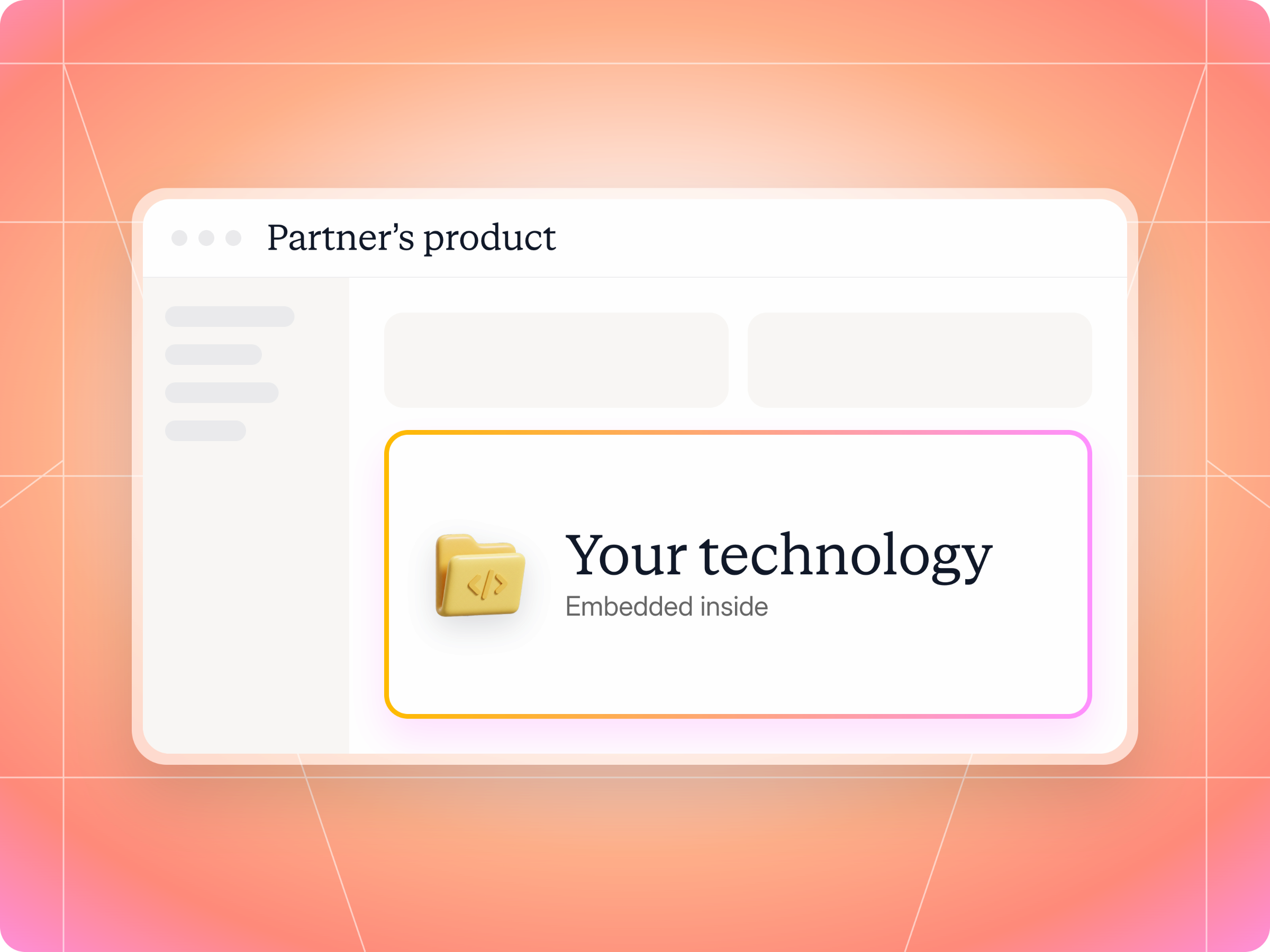
An OEM partnership in software is an agreement where another company embeds your technology inside their product and sells it as part of their own offering. It gives you distribution into markets you can’t reach directly, but you sacrifice customer visibility and pricing leverage in return. The economics run on royalties, revenue share, or license fees with minimum commitments, and the deals take longer to close than any other partner type. Building a program that works means treating it as a product partnership first, staffing it with technical account managers, and planning for renewals from the start.
If you sell B2B SaaS, you’ve probably had the conversation. A larger platform wants to embed your technology inside their product, sell it under their brand, and pay you per unit. It sounds like a distribution dream. Someone else carries the sales cost, the support overhead, and the customer relationship, and you collect revenue on every sale. And it can be exactly that.
But OEM partnerships in software don’t work like reseller deals or referral arrangements. They’re deeper, slower, and more technical. Your code ships inside someone else’s product. Your engineers support an integration you can’t fully see. Your pricing sits inside a product you don’t control. The economics, the contracts, and the program structure are all different, and getting any of them wrong is expensive.
This article breaks down what an OEM partnership in software actually is, how it differs from white label and reseller models, why companies build them, how the economics work, and how to build a program that doesn’t fall apart after the contract signs.
What is an OEM partnership in software?
OEM stands for original equipment manufacturer. It’s a term that comes from hardware, where one company makes parts or systems used in another company's final product and sells under its own brand. Like how a chipmaker supplies the processor inside a laptop. In hardware industries like manufacturing, those components have to meet strict required specifications, regulatory standards, and quality standards. The customer buys the finished product, not this specific component on its own.
But in software, an OEM partnership is something different. It’s an agreement where another company embeds your technology inside their product and sells it as part of their own offering, usually under their brand. Your code, your API, your model, or your data set ships inside their application.

Security vendors have run technology OEM programs for years, licensing their detection engines to be embedded inside other vendors’ products, whether those products run in the cloud or on premises. A CRM embeds a mapping service. An analytics platform embeds a charting library. In each of these cases, the buyer sees one product and one brand, but the supplier still earns revenue for every unit the host sells.
Whether in the context of software or hardware, in an OEM deal, your product isn’t what the customer buys. It’s part of what the customer buys. That difference shapes the contracts, the economics, the timelines, and the kind of program you need to run.
Learn more about other technology and integration partner programs.
OEM vs white label vs reseller
OEM, white label, and reseller are three different models. However, they get used interchangeably, and if you make that same mistake, the confusion can be expensive. Choose the wrong one and you will build the wrong program, sign the wrong contract, and staff the wrong team.
The table below is the disambiguation. If you take one thing from it, take this: reselling is about distribution, white label is about branding, and OEM is about embedding.
| OEM | White label | Reseller | |
|---|---|---|---|
| What the customer buys | The partner’s product, with your tech inside it | Your product, rebranded as the partner’s | Your product, under your brand |
| Your product is | A component or capability within something larger | The whole product, renamed | The whole product, unchanged |
| Does the customer know you exist | Usually no, unless you require attribution | Usually no | Yes |
| Integration depth | Deep: APIs, SDKs, embedded UI, shared data model | Shallow: Branding and configuration | None required |
| Who is involved internally | Product, engineering, BD, legal | Partnerships and marketing | Channel and sales |
| Typical commercial model | Royalties, per-unit or per-seat fees, minimum commitments | Wholesale pricing, partner sets retail | Margin off list price |
| Number of partners | Few: Often under 20 | Tens | Tens to hundreds |
| Time to first revenue | Long: Often 12 to 18 months | Medium | Short |
Here are a few easy rules you can go by. If the partner’s engineers have to build something for the partnership to work, you’re in OEM territory. If the partner only rebrands what you already ship, you’re in white label territory. And if the partner sells what you ship under your own name, you’re reselling.

Why companies build OEM partnerships
As the vendor, the appeal of OEM for you is distribution. Your technology reaches customers in markets, verticals, and regions you could never sell to directly. And unlike normal channel sales, you receive your revenue per contract. This makes it much easier to forecast, staff, and build a business plan.
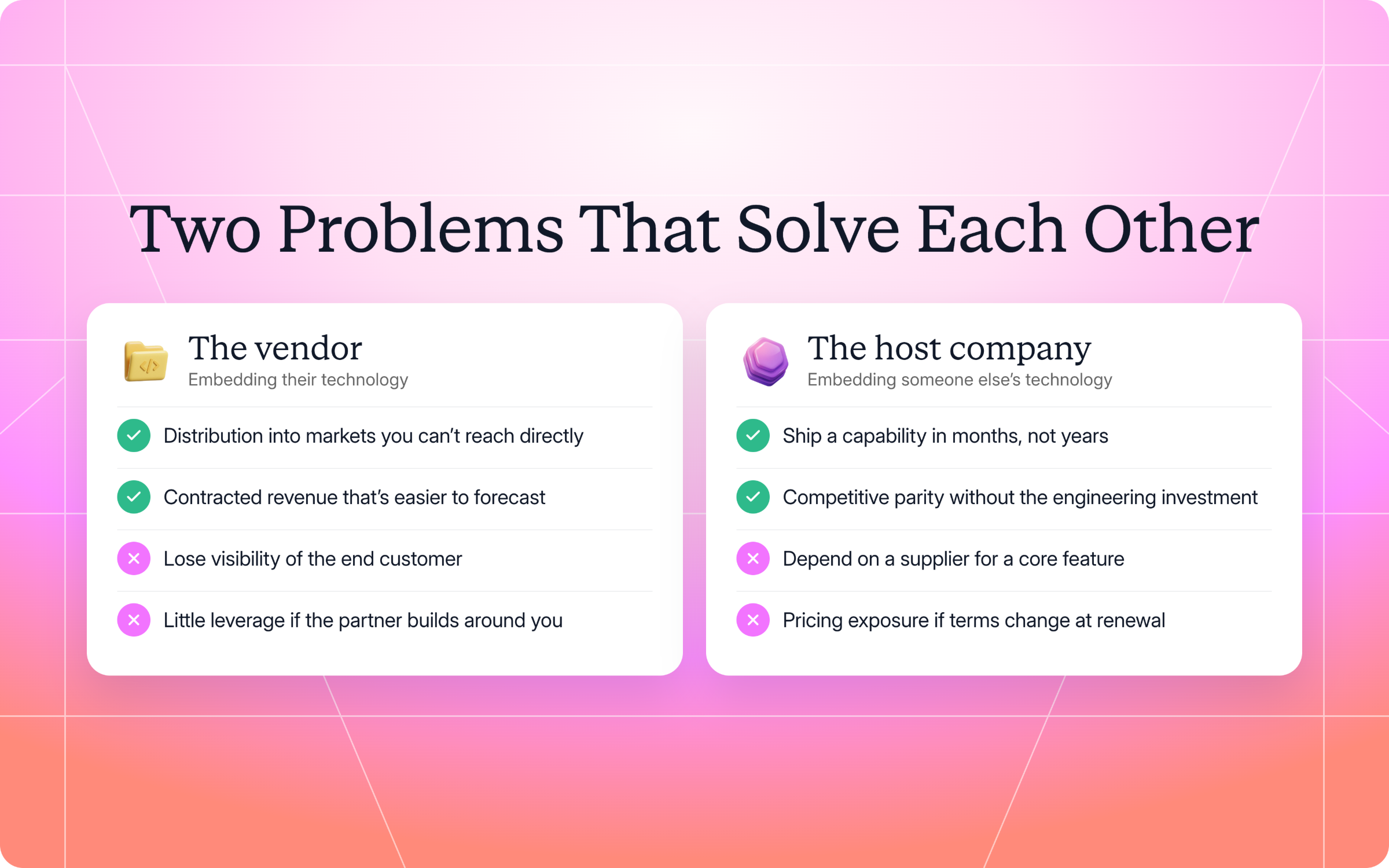
Where you gain volume, though, you sacrifice visibility. Since the end customer belongs to your partner, you lose the ability to market to them and upsell them. You also can’t reach them when they churn. If the partner decides to build around you or replace you, you have little leverage.
Of course, the other company in this deal has their own reasons, the main one being speed. They ship a capability in months that could take years to build. They’re able to offer enhanced product offerings without the engineering investment, and they reach competitive parity on features their customers now expect as standard.
For the host, outsourcing production to OEMs lowers R&D expenses, enabling companies to cut costs and save money by focusing their engineering teams on their core product instead of rebuilding capabilities that already exist. Strong OEM relationships deliver cost reduction for both sides.
For a lot of SaaS companies, that math is getting harder to argue against. Per Forrester, technology partners are among the fastest-growing categories in B2B partner ecosystems, and 67% of decision-makers expect indirect revenue to grow more than 30% year over year. As products converge on expected feature sets, buying and embedding a capability is increasingly faster than building it from scratch.
The company carries risk too. They depend on you for a feature their product now needs. They also carry pricing exposure if you change terms at renewal.
When you bring both sides together, the obvious shape of every OEM deal materializes. A SaaS company needs a capability their customers expect, and building it from scratch will take a year and a team they do not have. Another company has that capability already built and wants distribution they cannot reach on their own. It’s not a partnership born from strategy decks or alliance frameworks. It’s two problems that solve each other, and the OEM deal is the handshake between them.
How OEM economics work
If you’re running a partner program, the commercial models in the OEM deal are going to be structurally different from anything else. There’s no splitting margin on a resold product. You’re licensing your technology to be built into someone else’s, so the pricing has to reflect that.
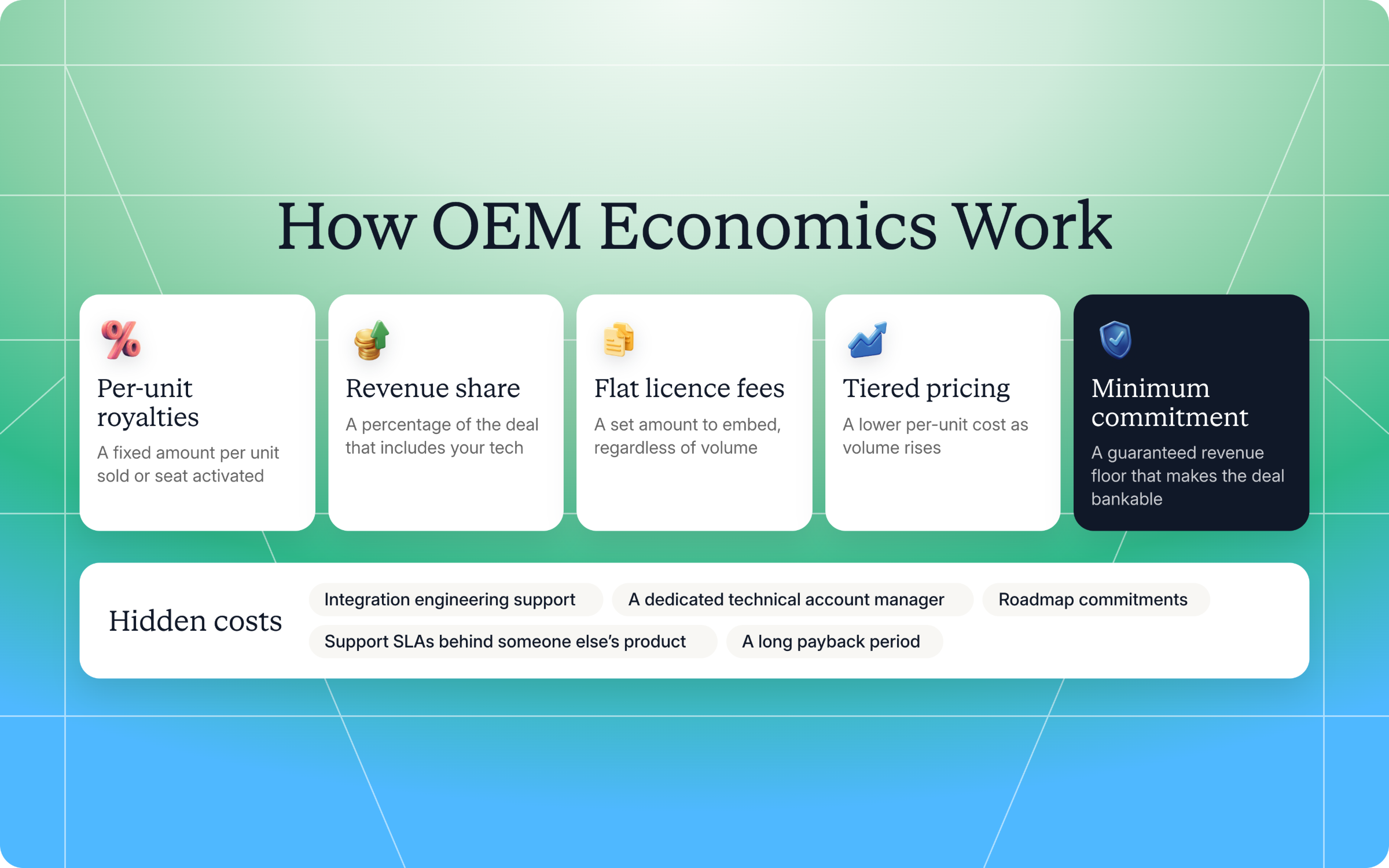
The common models are:
- Per-unit or per-seat royalties: You earn a fixed amount for each unit sold or each seat activated
- Revenue share on the host product’s sales: You take a percentage of the deal that includes your technology
- Flat platform or license fees: The partner pays a set amount for the right to embed your technology regardless of volume
- Tiered pricing that falls as volume rises: Rewards the partner for scale with a lower per-unit cost
- Minimum annual commitments: Guarantees a floor of revenue whether or not the partner sells
The pricing tension
Most OEM contracts include a minimum annual commitment. That makes the whole deal worthwhile. The partner guarantees a floor of revenue, whether or not they sell. That’s what lets you justify your engineering investment.
The part that catches most vendors off guard, though, is the price itself. OEM pricing is usually well below your direct list price. That’s because the partner is buying volume and carrying the sales and support cost. They’re pricing your technology into a product they sell to their customers. If your price pushed their margin out of line, they would simply build around you instead. The discount is how you come to a deal.
Then come the hidden costs. They don’t show up in the contract, but they do eat margin away. This includes:
- Engineering support for the integration
- A dedicated technical account manager
- Roadmap commitments you now have to keep
- Support SLAs that sit behind someone else’s product
- Long sales cycle before any of it pays back
When OEM makes economic sense
OEM makes sense when the volume is large enough that a low per-unit price still beats what you could sell directly with the same engineering effort. The significant cost savings come from not having to build and maintain a sales motion for every market the partner already serves. If the deal is small, though, the integration cost will exceed the revenue. You’ll have built a custom integration for a company that isn’t really your customer.
This is also why OEM revenue behaves differently from every other partner type, and why treating it like channel revenue gets you into trouble. Growth comes from volume increases, new product lines the partner launches that include your technology, and renegotiation at renewal.
90% of companies are transforming or expanding their partner programs for recurring-revenue models, and vendors who engage partners across the full lifecycle, from initial sale through adoption and expansion, see substantially higher partner-sold revenue. An OEM deal that’s signed and then left to run is an OEM deal that won’t expand. You track consumption against commitments from the beginning, and you plan for the renewal conversation before the first contract term ends.
How to build an OEM partner program
An OEM program is a product partnership first and a commercial arrangement second, and the steps to build one reflect that. Here’s how to do it, in order.
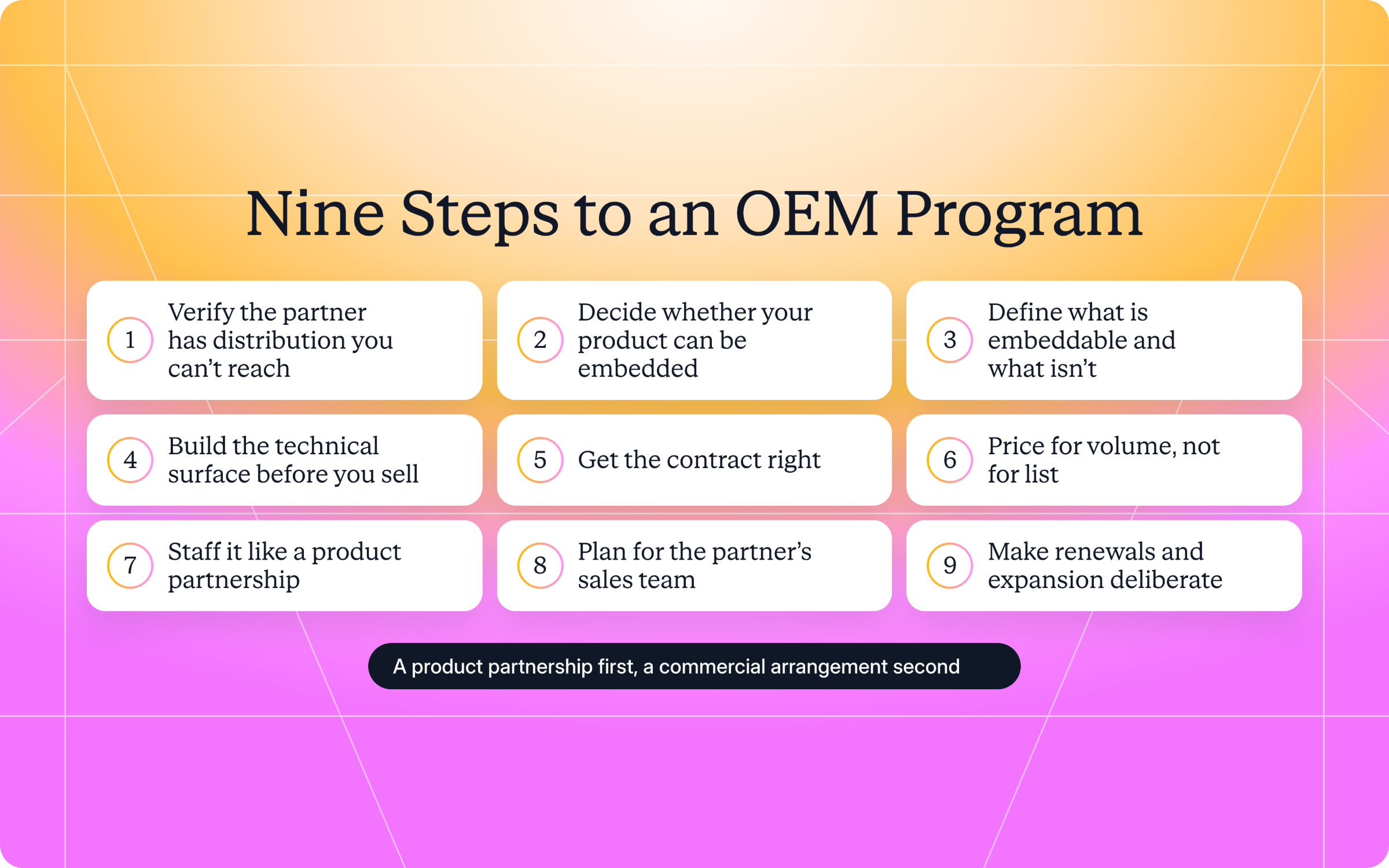
Step 1: Verify the partner has distribution you can’t reach
One question can disqualify most OEM conversations, so it’s important you ask it first: Does this partner have distribution you genuinely can’t get on your own? If you could eventually sell to their customers directly, an OEM deal is the wrong structure.
You’re giving up margin and customer ownership for distribution you could build yourself. OEM only makes sense when the partner’s reach is structural. They serve a vertical, a region, or a buyer you’re not equipped to sell to. If that’s not true, stop here and look at a reseller or referral model instead.
Step 2: Decide whether your product can actually be embedded
Not every SaaS product can be OEM’d. Yours needs a clean API or SDK, the ability to run invisibly inside someone else’s interface, and a licensing model that works per-unit rather than per-account.
If your product assumes a single tenant, a branded login screen, or a per-company pricing model, you’ve got engineering work to do before any BD conversation is worth having. That assessment comes next, and it should come from product and engineering.
Step 3: Define what is embeddable and what isn’t
Decide which capabilities are available to OEM partners and which stay exclusive to your direct product. If you give partners everything, you undercut your own roadmap. If you give them too little, the integration isn’t worth their engineering investment.
A good middle ground is usually a defined subset, meaning the core capability they need, without the features that differentiate your direct offering. Write it down, share it with product, and assume the partner will ask for more.
Step 4: Build the technical surface before you sell
An OEM prospect’s engineering team evaluates you before their BD team signs anything. If they open your documentation and find a half-finished API reference, a sandbox that requires a sales call to access, or no reference integration to study, the deal dies quietly.
You need documentation, sandbox access, SDKs, and at least one working reference integration before you start pitching. Think of this as the front door of the partnership. The people walking through it are engineers, and they’ll judge what they find.
Step 5: Get the contract right
OEM agreements are heavier than any other partner contract. They need to cover:
- IP ownership
- License scope
- Permitted use
- Exclusivity or the absence of it
- Minimum commitments
- Support obligations
- SLAs
- Roadmap and versioning commitments
- Audit rights
- Branding and attribution requirements
- Liability
- What happens to end customers if the partnership ends
This document governs a relationship where your technology lives inside someone else’s product, and getting it wrong at the start is expensive to fix later. This isn’t legal advice, and OEM agreements need specialist counsel.
Step 6: Price for volume, not for list
OEM pricing is well below your direct list price, which is intentional. Use the commercial models that fit: per-unit royalties, revenue share, flat license fees, tiered pricing, minimum commitments, or a combination. The right model depends on what you can measure, what the partner will expose, and what both sides can audit at renewal.
Step 7: Staff it like a product partnership, not a channel
OEM partners need a technical account manager, roadmap visibility, and an escalation path into your engineering team. A channel manager running a tier program is the wrong support model. This partnership is technical from day one and stays technical for the life of the contract. If the partner’s engineers can’t reach yours when something breaks, the relationship degrades fast, and the renewal is at risk before the commercial conversation even starts.
Step 8: Plan for the partner’s sales team
This is the step that connects OEM to everything else in your program. Once the integration ships, the partner’s reps have to sell a product that now contains your technology, and they usually don’t understand it. They need enablement, battlecards, and co-sell support. Without it, the integration ships, the partner’s sales team ignores it, and attach rates stall.
Step 9: Make renewals and expansion deliberate
OEM revenue is contracted. That means your revenue will grow according to volume increases, new product lines the partner launches that include your technology, and renegotiation at renewal. Track consumption against the commitment from the start. And begin the renewal conversation before the first contract term ends.
Where OEM programs go wrong
The hard part of OEM isn’t closing the deal. It’s what happens after. Here’s where these programs break down, and what to watch for:
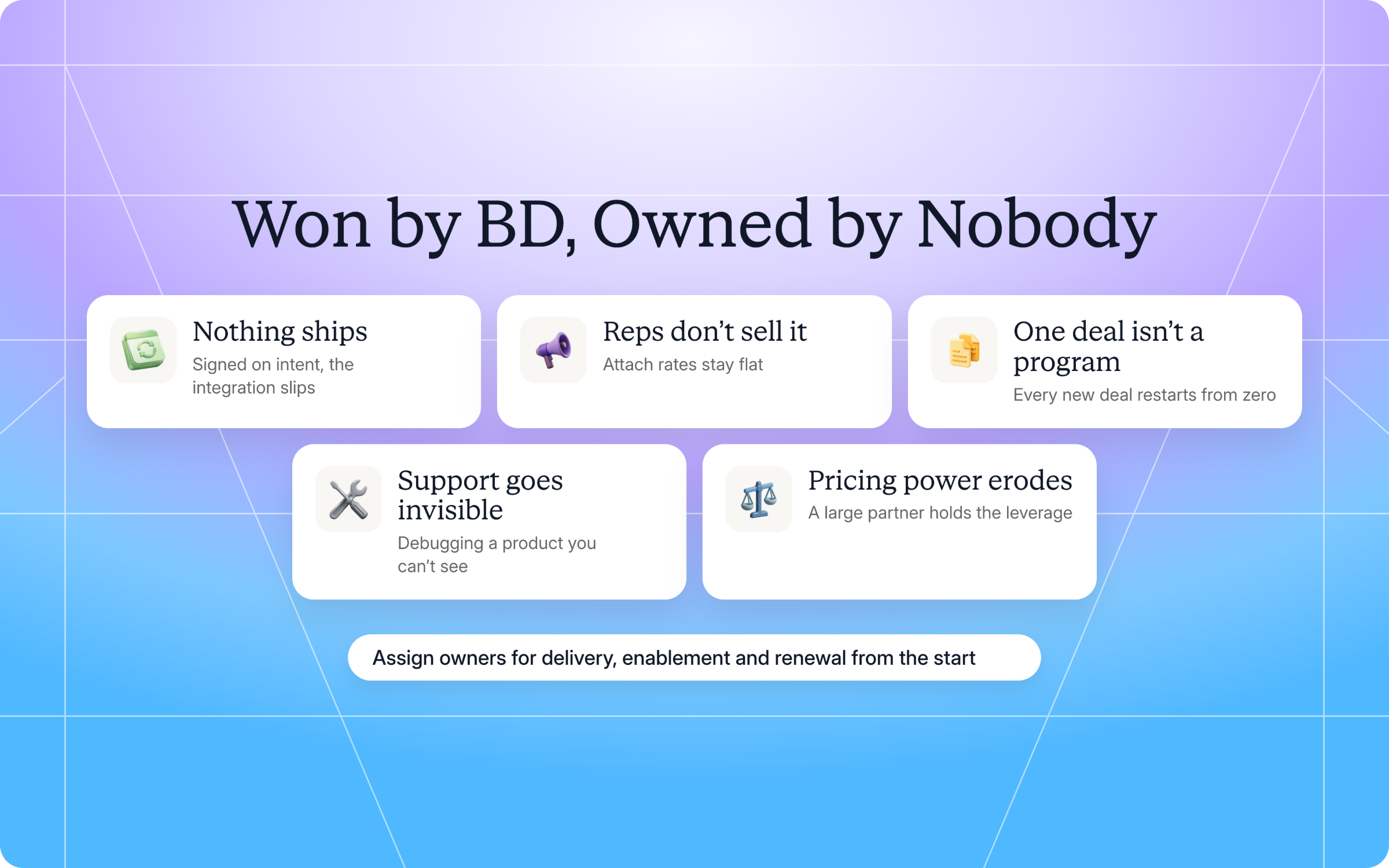
- The deal signs and nothing ships: OEM contracts are signed on intent. Integrations slip if no one is assigned to own the technical delivery. Then revenue forecast on signature arrives quarters later, if at all.
- The partner’s reps don’t sell it: Your technology lives in their product, but their sales team can’t explain it. Attach rates stay flat, and both sides blame the other.
- One deal isn’t a program: Without a standard commercial framework, every new partner restarts legal and engineering from zero. The second deal takes as long as the first.
- Support becomes invisible and expensive: End customers raise issues with the partner, the partner escalates to you, and you’re debugging problems in a product you can’t see.
- You lose pricing power: A large partner that becomes a significant share of your revenue has leverage at every renewal, and that leverage only moves one direction.
Every one of these traces back to the same root cause where the OEM deal is won but then nobody owns it. The programs that work assign ownership for technical delivery, partner sales enablement, and commercial renewal from the start, with names attached.
Where a partner platform fits in an OEM program
An OEM program needs less partner tooling than any other partner type. With a handful of partners, deep contracts, and engineering-led delivery, the contract and the integration do most of the work that a PRM would do elsewhere.
Tooling earns its place at the point where the partner’s sales team starts selling a product containing your technology. Now you have external sellers who need enablement, joint pipeline worth tracking, and revenue worth attributing. That work needs to be CRM-native, living in HubSpot or Salesforce rather than a second database to reconcile.
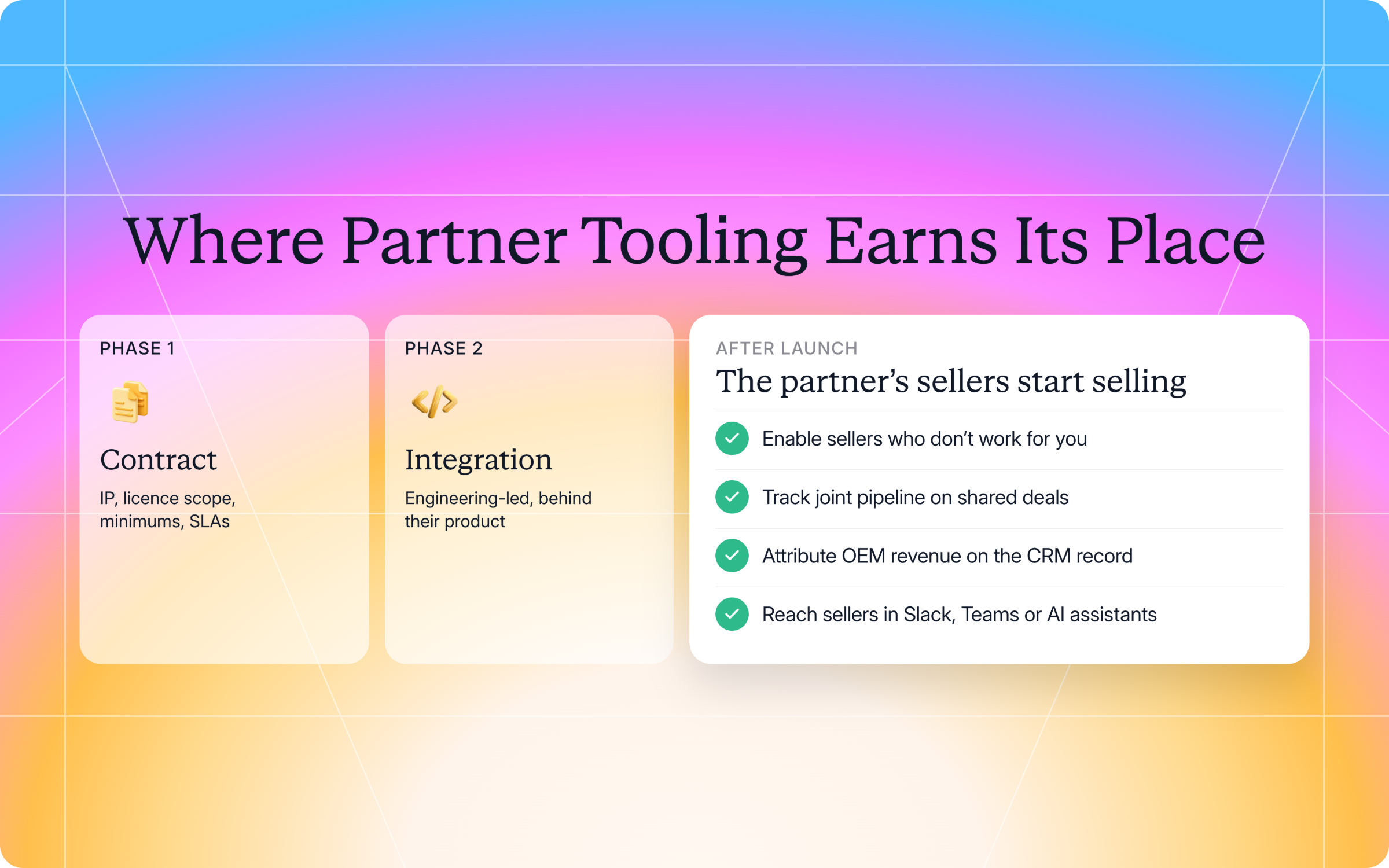
An AI-native, CRM-native PRM like Introw helps you:
- Enable the partner’s sellers with co-branded assets and content pushed to sellers who don't work for you and won’t attend your training.
- Track joint pipeline through shared pipelines and deal tracking, so OEM-influenced opportunities are visible rather than reported quarterly by the partner.
- Attribute OEM revenue with partner-sourced and partner-influenced revenue on the CRM record, so OEM contribution sits alongside direct and reseller revenue.
- Reach sellers where they already work, so partners get enablement, deal updates, and coaching from their own CRM, Slack, Teams, or an AI assistant like Claude, ChatGPT, or Gemini via MCP, not a portal they won't log into.
These are general partner-program capabilities. Introw doesn’t list OEM as a dedicated partner type and has no OEM-specific module. The value is in running the CRM-native relationship, the enterprise-grade program structure, and the AI-native, headless enablement and attribution around an OEM deal, not in the contracting or the integration itself.
The right partner platform makes OEM revenue visible alongside every other partner type. Book a demo or explore by partner type today.
Still curious? Here are some quick answers to help clear things up
The clearest pattern is security vendors licensing detection engines to be embedded inside other products, where the end user never knows the OEM components exist. Similar patterns show up in analytics SDKs, payment processing modules, and communication APIs embedded into larger platforms. The defining characteristic is the same in every case: Your technology runs inside someone else’s product, and the customer buys their product, not yours.
Only if your product can run embedded inside another interface, licenses per unit rather than per account, and the volume justifies the engineering resources you'll commit to support the integration. And if the deal is small, the integration cost will eat the revenue before it ever pays back.
OEM partners need a dedicated technical account manager, roadmap visibility, and an escalation path into your engineering team, because the integration runs behind someone else's product where your team can't see what's happening. Technical support is critical. If the partner's engineers can't reach yours when something breaks, the relationship degrades fast and the renewal is at risk before the commercial conversation starts.
OEM partnerships let you reach new markets and potential customers through a partner who already has the relationships, the distribution, and the local operations you'd have to build from scratch. You get global reach without hiring a sales team in every region, because the partner's existing footprint becomes your channel. This is how small solutions providers compete with large vendors. They deliver specialized expertise through partners who already serve the industries and critical accounts they can't reach alone.
OEM partnerships are strategic alliances where your technology is embedded inside another product, which makes them deeper and more technical than reseller or referral arrangements. Other strategic alliances might involve co-selling or co-marketing without any embedding, meaning neither side's engineering team has to build anything. The test is whether the partnership requires engineering work on both sides, which is what sets an OEM alliance apart from every other alliance type.






See AI-Native PRM in Action
Book a demo with one of our partner program experts, or explore Introw on your own time.