Outsourced Sales vs Channel Partners: When to Use External Sales Teams and When to Build a Partner Channel in 2027
Outsourced sales rents capacity while a channel borrows relationships, and this guide explains how the two models differ, what each costs, and how to decide which fits your B2B SaaS.


Both outsourced sales teams and channel partners put people outside your company in front of customers, and that is where the similarity ends. Outsourced sales rents you capacity, so an external team sells your product, under your brand, to your target list, usually on a retainer. A channel borrows you relationships, so independent companies sell to customers they already have, their way, paid on results. One scales your existing motion.
You’ve reached the point where you need more pipeline than your internal sales team can realistically produce. Every CRO and VP of Sales encounters this situation after Series A. The direct motion works, the board wants it scaled, and hiring takes too long. There are two different models that can address this gap. You can either outsource sales to run prospecting under your brand, or you can build a channel where independent companies sell your product to customers they already have.
Don’t mistake these as interchangeable options, though. Sales outsourcing means hiring for capacity when your reach exceeds your headcount. A channel means borrowing relationships when your headcount exceeds your reach. This guide helps you figure out which one best fits your situation.
What is outsourced sales?
Outsourced sales is hiring an external team to run part or all of your sales process. They work under your brand, follow your playbook, and sell to the targets you give them. You’re essentially renting sales capacity rather than buying relationships.
The most common shape is where the outsourced sales team focuses on SDR work. An outsourcing company provides sales representatives who handle lead generation, cold outreach, and cold calling into your target list, book qualified meetings, and hand qualified leads to your account executives.
Other shapes include full-cycle teams that prospect and close, fractional sales professionals who run the entire cycle for a specific segment, inside sales teams that handle qualification and appointment setting for products with shorter cycles, and offshore or nearshore teams that provide coverage in lower-cost regions. Most agencies serve multiple clients, and the good ones bring specialized expertise in a specific segment or motion.
The commercial models vary:
- Monthly retainers: The default, where you pay a fixed fee for a fixed scope of work, whether or not pipeline results.
- Retainer plus commission: Adds a performance layer on top of the base retainer.
- Per-meeting or per-qualified-lead pricing: Ties cost directly to output.
- Commission-only: Arrangements exist, and they blur the line into something closer to a partner program, which we’ll get to.
The external team sells to your targets, under your name, using your materials. They don’t bring their own customer relationships. They’re an extension of your in-house team that you don’t have to hire. And usually, the customer believes they’re talking to your company.
These are all forms of B2B sales outsourcing. Most early stage companies start with outsourced SaaS sales, usually an outsource sales team for SDR work. The internal vs external sales line is about ownership. Your internal sales teams own the customer whereas the external team owns the activity.
What are channel partners?
Channel sales partners are independent companies that sell your product to customers they already have. They range from affiliates and referral partners at the light end, to resellers and distributors at the heavy end, with co-sell arrangements in between.
The key distinction: a partner is not representing you. They are representing themselves. They sell your product because it helps them serve customer relationships they already have. A partner is a third party company with its own sales staff, its own revenue targets, and its own incentives.
That difference matters more than it sounds. In 2025, 70.1% of tech was sold through partners, and 96% of the industry does partner-assisted selling in some form. An average mid-market or enterprise deal now involves seven partners. The question is not whether your buyers are talking to partners. They are. The question is whether those partners are talking to you.
Why this decision is harder in 2027
A working direct motion isn’t enough anymore. The board wants it scaled, hiring takes too long, and the pressure has only gotten sharper since 2024.
Win rates have fallen to 19% in 2025, down from 29% in 2024. B2B SaaS sales cycles have lengthened 22% since 2022, driven by larger buying committees and more security due diligence. And 57% of sellers report their cycle is getting longer.
At the same time, more revenue flows through partners. Nearly 60% of B2B organizations now report that over 40% of their revenue is attributable to partners and indirect routes to market, and 70% say optimizing a partner ecosystem is essential to their organization. 67% plan for their indirect revenue to grow above or significantly above last year’s.
The cost of doing nothing is rising too. Cost per opportunity nearly doubled for sub-$25M ARR companies. You need more pipeline than your internal teams can produce, and the old answers, hire faster or outsource more, are getting more expensive.
The core difference: Renting capacity vs borrowing relationships
Ask whose customers you are selling to. Outsourced teams work your target market under your name. A partner brings their own customers, relationships you could not reach on your own.

Capacity scales a motion that already works. If your direct sales engine isn’t producing yet, then outsourcing or adding partners won’t fix it. You’ll just be throwing money at a broken process. Nail direct first. Then your sales and marketing leaders can identify where you need to go next.
- Outsource sales makes more sense if your reach is great but you’re understaffed (renting capacity)
- Channel sales makes more sense if you need help reaching international markets (borrowing relationships)
Outsourced sales vs channel partners: The full comparison
That either-or is a starting point, but it doesn’t tell the whole story. Most companies land somewhere in the middle, running outsourced sales for capacity while building a channel for reach, or layering one on top of the other as the business changes shape. The factors below help you figure out where you actually fall.
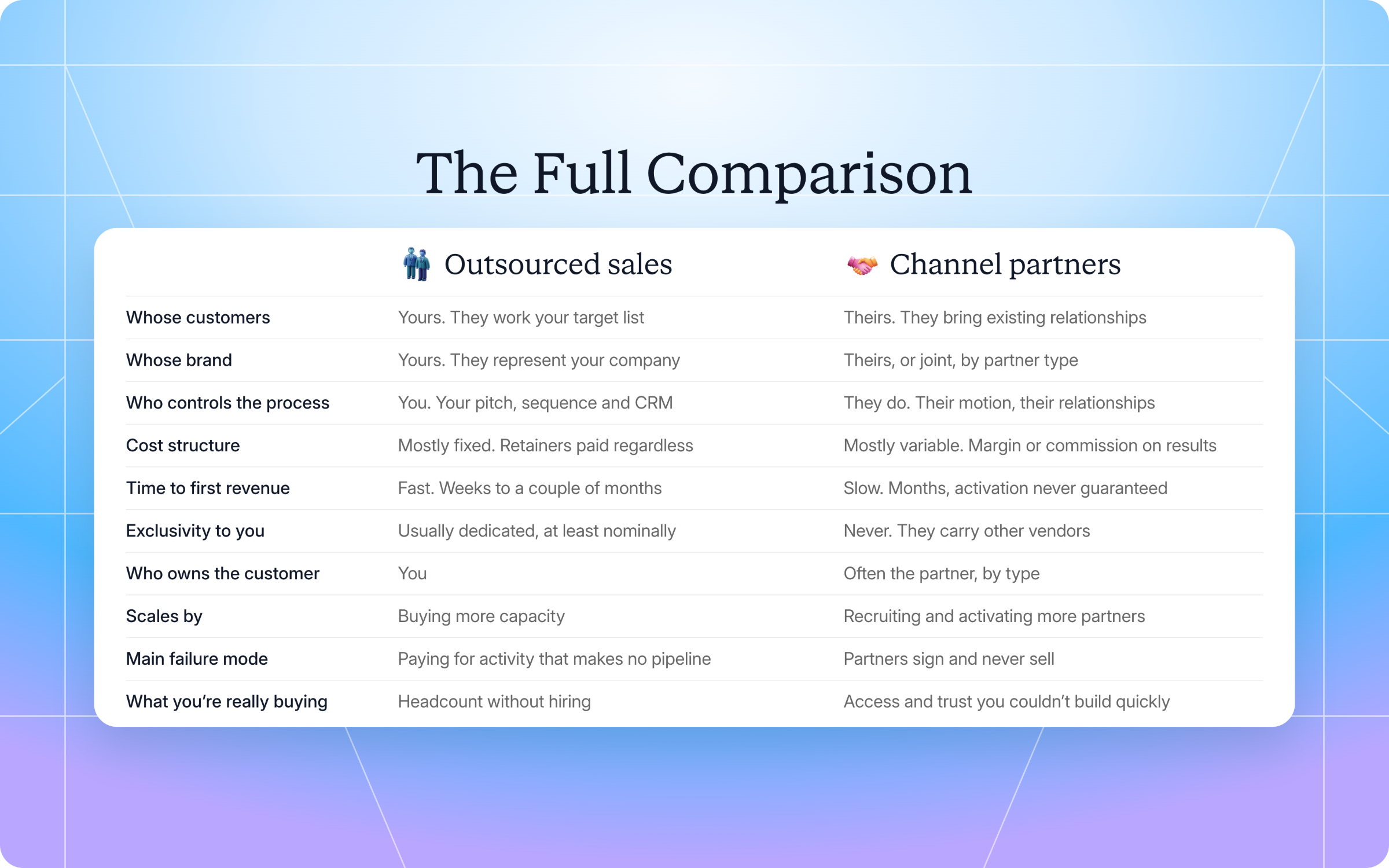
| Dimension | Outsourced sales | Channel partners |
|---|---|---|
| Whose customers | Yours. They work your target list | Theirs. They bring existing relationships |
| Whose brand | Yours. They represent your company | Theirs, or joint, depending on partner type |
| Who controls the process | You. Your pitch, your sequence, your CRM | They do. Their motion, their relationships |
| Cost structure | Mostly fixed. Retainers paid whether or not they sell | Mostly variable. Margin or commission on results |
| Time to first revenue | Fast. Weeks to a couple of months | Slow. Months, and activation is never guaranteed |
| Exclusivity to you | Usually dedicated, at least nominally | Never. They carry other vendors |
| Who owns the customer | You | Often the partner, depending on type |
| Scales by | Buying more capacity | Recruiting and activating more partners |
| Main failure mode | You pay for activity that produces no pipeline | Partners sign and never sell |
| What you are really buying | Headcount without hiring | Access and trust you could not build quickly |
Outsourced sales gives you speed and control, but the cost is fixed whether the team produces or not. Channel partners give you reach and shared risk, but you trade control and timeline for it. If the table leans clearly one way, trust that. If it splits, you are probably in the middle, and the next two sections will help you sort out which factor should break the tie.
The economics of each model
Outsourced sales is mostly a fixed cost with a short payback expectation. On the other side, a channel is mostly a variable cost with a long payback.
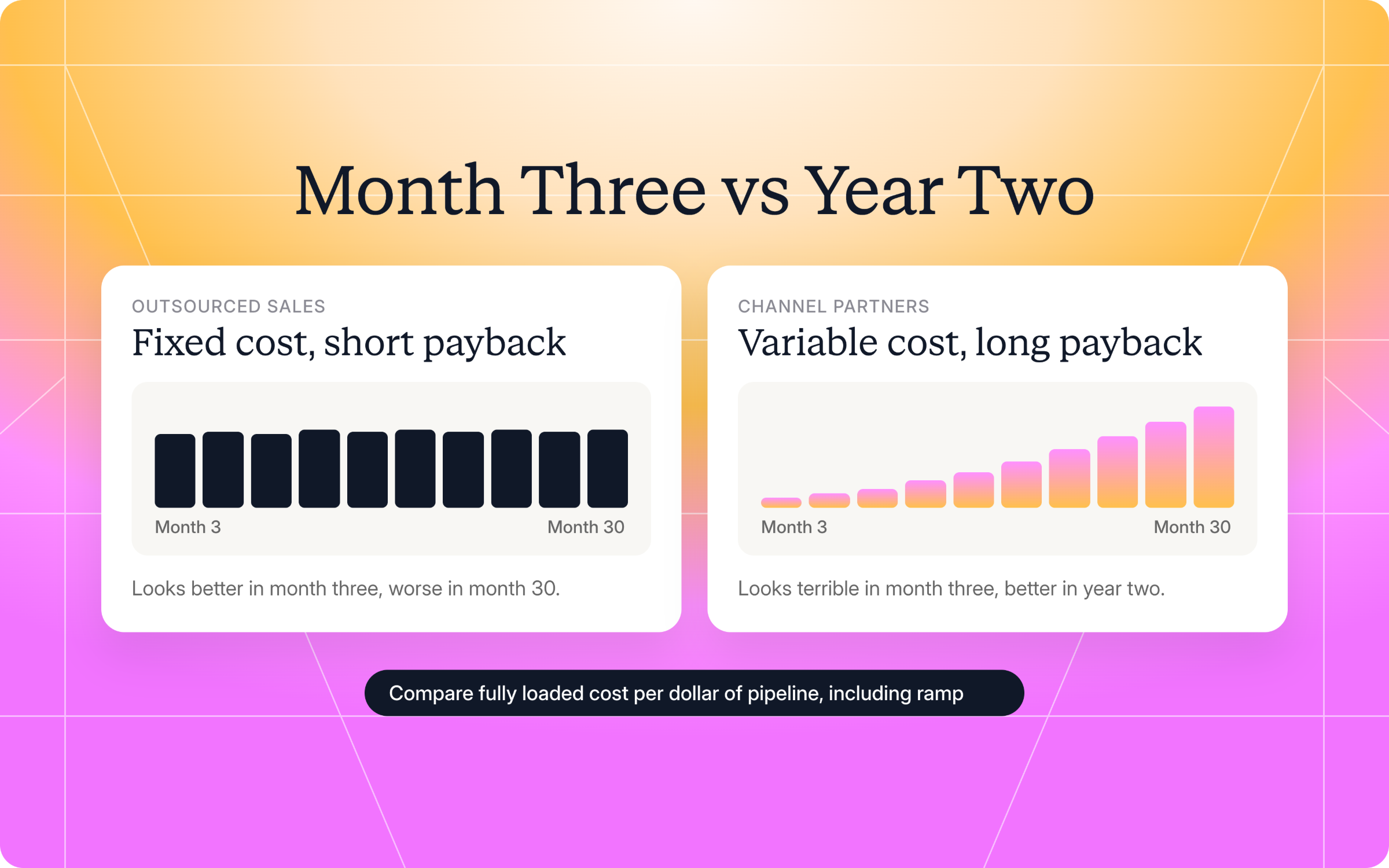
Think in terms of fully loaded cost per dollar of pipeline, measured over a long enough window to include ramp. Outsourcing usually looks better in month three and worse in month 30. A channel usually looks terrible in month three and better in year two.
Outsourced sales also isn’t necessarily cheaper than hiring once you count management overhead and the quality gap on a complex product. A channel isn’t cheap either. You don’t pay for headcount, but you do pay for margin share plus program cost. The sales function you outsource still needs managing, and that management costs time.
Don’t base your decision on someone else’s numbers. Use the shape to make your decision. If you want quick results and front-loaded costs, outsourcing delivers that. Channels start slow, then compound. At first, the contribution is small because partnerships take time to build. As programs mature, channel revenue grows and close rates approach what a direct team produces.
Figure out which cost structure matches your stage, don’t focus on which might be cheaper. Companies often skip structured pilots before long-term contracts, which is the fastest way to commit to a cost structure you’ve never tested.
When outsourced sales is the right call
Outsourced sales works when you already have a machine and need more of it. But it can’t run a machine that doesn’t exist. Here’s when it fits:
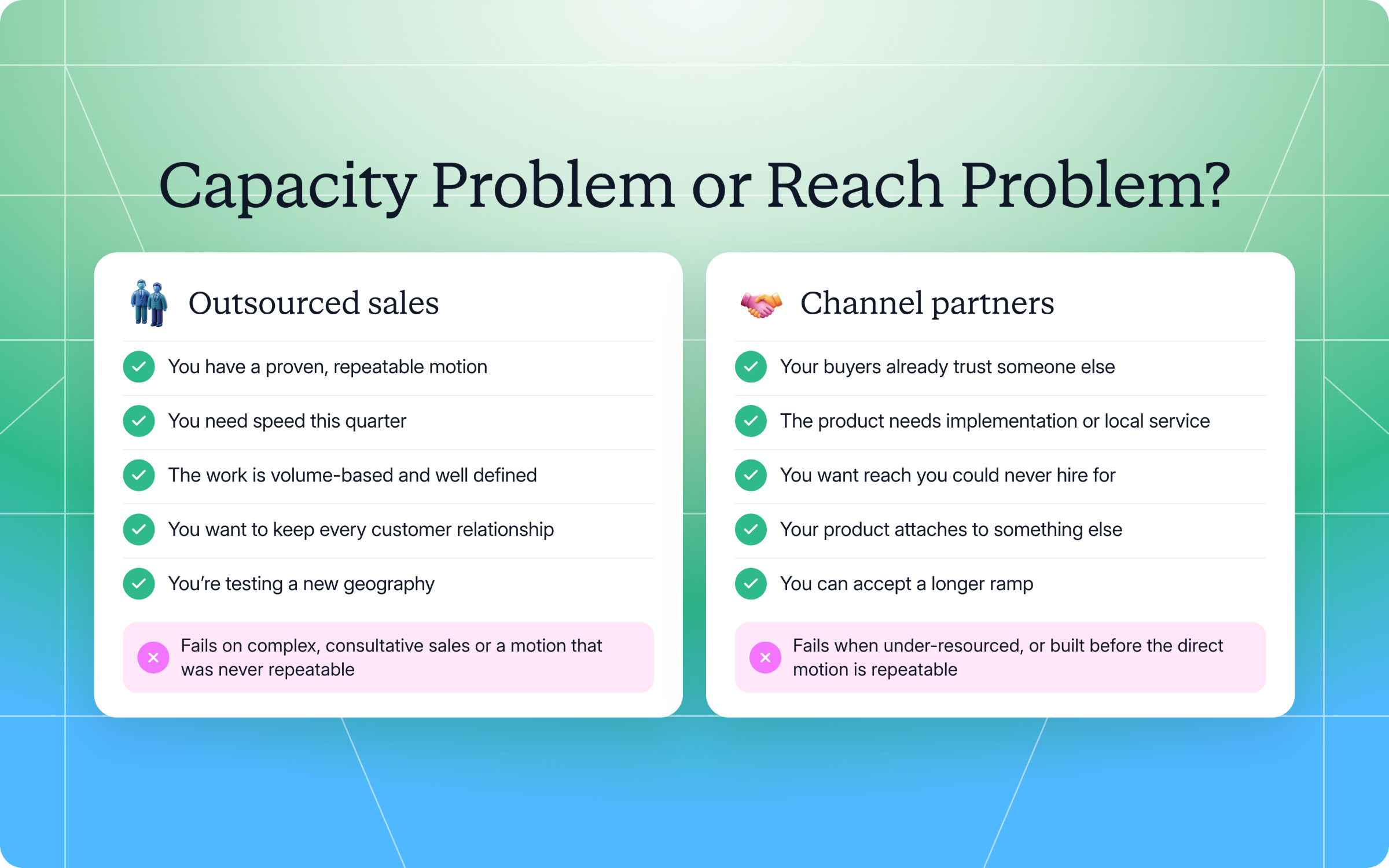
- You have a proven, repeatable motion: Outsourcing scales what works. If your direct team is already hitting quota, an external team can copy that playbook and produce similar results fast.
- You need speed: Maybe you’re entering a new market segment this quarter, covering a hiring gap, or testing a market before committing headcount. Sales reps from an external team can be live in weeks, not the months it takes to hire and ramp a dedicated team.
- The work is volume-based and well-defined: This is why outsourced sales development and top-of-funnel prospecting is the most successful version of this model. Done well, the payoff results in better lead quality, not just more volume.
- You want to keep the customer relationships: Outsourcing adds capacity without giving anyone else ownership of your accounts.
- You’re testing a geography: You want local language or timezone coverage before you commit to an office.
Sales outsourcing companies work best when the scope is clear, the sales funnel stages are defined, and the handoff to your closers is clean. The best sales outsourcing companies take your playbook and run it. Most sales outsourcing companies focus on sales activities like cold outreach and appointment setting, and that’s where they shine.
Outsourced sales fails most often when the product is complex, the sale is consultative, or the motion was never repeatable in the first place. An external team can’t learn a sale that your own team hasn’t yet figured out. Beyond a broken motion, most sales outsourcing failures stem from weak collaboration between the external team and the internal one, not from the talent of the sellers.
When a channel is the right call
A channel works when the problem is reach, not capacity. Here’s when it fits:
- Your buyers already trust someone else: If customers in your category buy through consultants, implementation firms, or platforms, a channel meets them where they already are.
- Your product needs implementation or local service you cannot staff everywhere: Partners become a delivery solution as much as a sales one, and it’s where outside sales through partners outperforms hiring.
- You want reach you could never hire for: This might be across geographies, verticals, or segments where a partner already has credibility. International firms already have the relationships that would take your core team years to build.
- Your product attaches naturally to something else: A partner can sell it alongside what they already provide.
- You can accept variable cost in exchange for a longer ramp: You have the capacity to enable and support partners properly.
52% of partnership professionals say activation is their top bottleneck, and 83% still run partnerships through spreadsheets. A channel fails when it’s treated as cheap revenue and under-resourced, or when it’s built before the direct motion is repeatable. Partners cannot be taught to sell something you have not learned to sell yourself.
Learn more about partner activation here.
The blurry middle: External teams paid on results
Don’t make the mistake of thinking there’s a clear binary on which choice to make. The real market is messier, and the messier part is where this gets interesting.
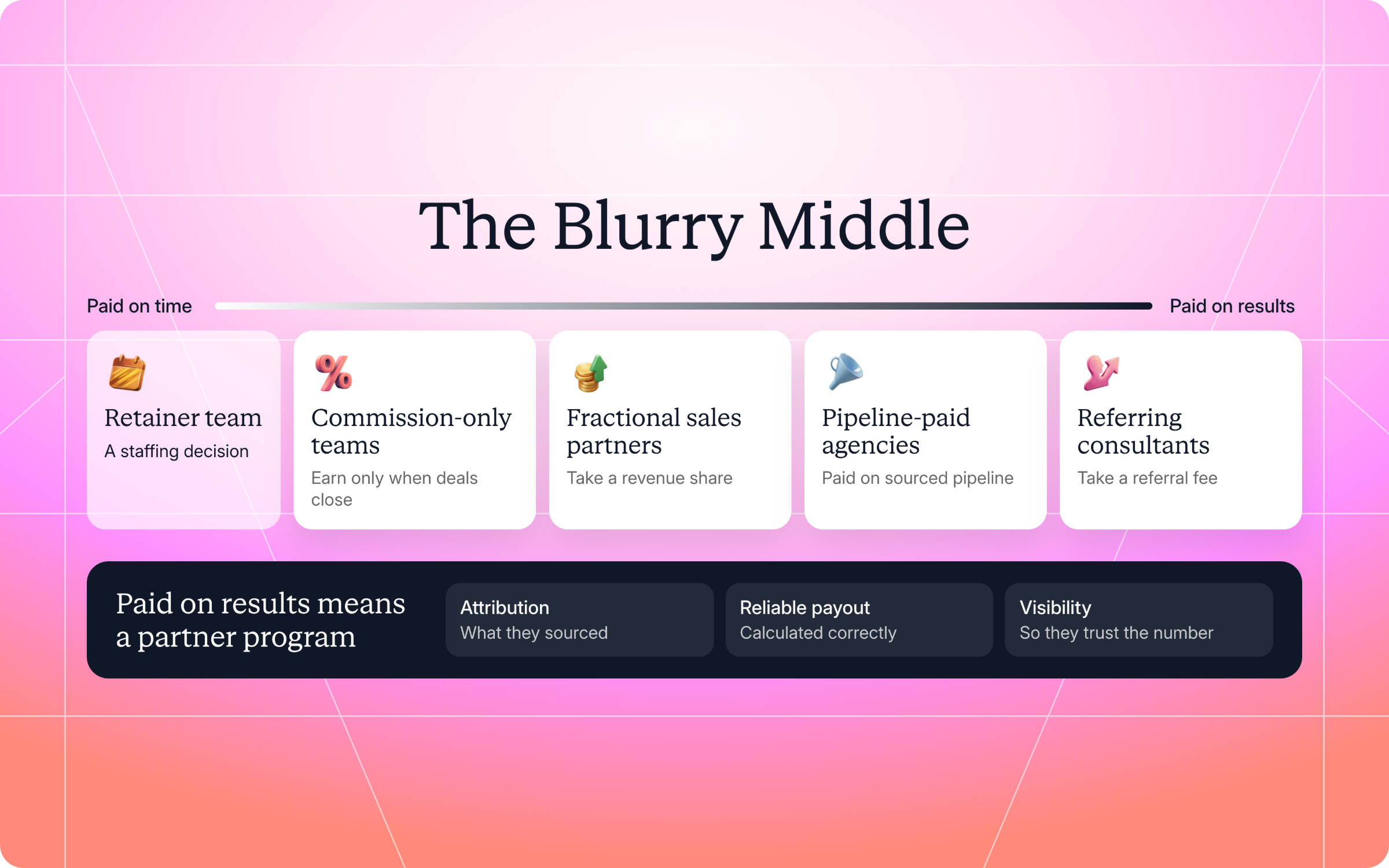
Several arrangements, for example, sit between the two models:
- External teams paid only on commission, no retainer, so they only earn when deals close
- Fractional sales partners taking a revenue share
- Agencies compensated on sourced pipeline rather than retainer
- Consultants who introduce clients and take a referral fee
The moment you pay an external seller on results instead of time, they start behaving like a partner. Reps focus on what pays. They work the accounts most likely to close. They expect credit for what they source, not just sales goals you set. Closing deals becomes their priority, which makes business development done this way look like a partner program in everything but name.
Whatever you call the arrangement, it creates the same three requirements:
- You need attribution so you know what they sourced
- You need a payout mechanism that calculates reliably
- You need visibility so they trust the number
You also need rules of engagement. External sellers working your accounts alongside your direct team create the same conflict risk partners do, and rules of engagement are not optional once more than one party can touch the same account.
None of that works in spreadsheets and email. Run attribution, conflict detection, and payout from your CRM, and let AI handle the mechanics so partner managers focus on the relationships that produce pipeline. Sales outsourcing works when the tooling handles the mechanics. Retainer-based capacity is a staffing decision. Results-based external selling is a partner program, whatever the contract calls it.
How to decide
The decision framework below maps your situation to the model that fits. Find the row that describes your condition, and the right column tells you which way to lean.
| If this is true | Lean toward |
|---|---|
| Your direct motion is repeatable and you need more volume of it | Outsourced sales |
| Your motion is not yet repeatable | Neither. Fix the motion first |
| You need pipeline this quarter | Outsourced sales |
| You need reach into markets you cannot staff | Channel |
| Your buyers already purchase through intermediaries | Channel |
| The product needs implementation or local service | Channel |
| You must keep ownership of every customer relationship | Outsourced sales |
| Margins can’t absorb a partner share | Outsourced sales, or direct hiring |
| You have no capacity to enable and support partners | Not a channel, not yet |
| You want a cost base that flexes with results | Channel |
Many companies use both models, but not at the same time. They start with outsourced sales development to prove and scale the motion, then add a channel to reach markets the motion cannot.

⚠️ If you run both at once, there is a warning. If outsourced teams and partners can both touch the same accounts, you have created channel conflict between parties who do not know each other exist. Rules of engagement and deal registration are required, not optional.
What both models need to work
Whether you choose channel sales or outsourced sales, you need to make sure you do these six things:
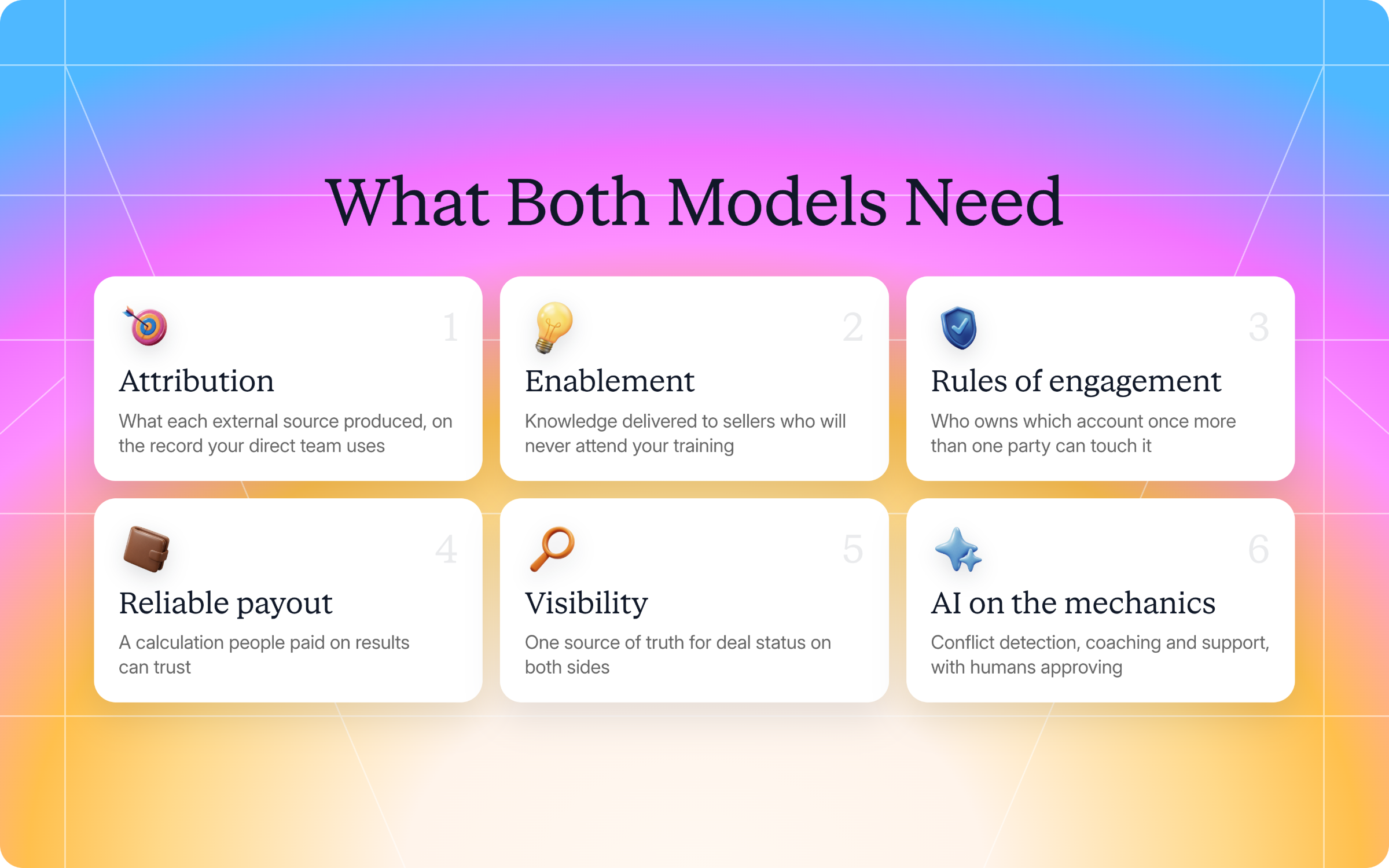
- 1. Attribution: You need to know what pipeline each external source produced, on the same record your direct team uses. Without it, you can’t compare models or pay people correctly.
- 2. Enablement for people who do not work for you: External sellers, whether outsourced sales reps or channel partners, will never attend your training. You need to get knowledge to them where they already work.
- 3. Rules of engagement: Once more than one party can touch the same account, you need clear rules about who owns what, submitted when, and credited to whom. This is not optional, and account management gets messy fast without it.
- 4. Reliable payout: If you pay on results, the calculation has to be trustworthy. Partners and external sellers who don’t trust the number stop producing.
- 5. Visibility: External sellers need to see deal status without calling your team. Your team needs to see external activity without chasing it. Both sides need the same source of truth. You also need to track performance across sources, so you can compare what each one produces on the same record.
- 6. AI doing the mechanical work: Conflict detection, deal coaching, activation monitoring, and partner support are mechanical tasks. They should run themselves, with humans approving, so your team focuses on the relationships that produce pipeline. Your sales operations team should not be doing this by hand.
How Introw helps
Introw is a partner platform that supports the channel answer, and it supports any external seller compensated on results. It’s not the tool for managing an outsourced sales team on a monthly retainer. If that’s what you need, you need a staffing tool rather than a PRM.
Three things make Introw different:
- CRM-native: HubSpot and Salesforce are the system of record. Partner-sourced and partner-influenced revenue stays on the deal record, not in a separate spreadsheet. Partner management runs inside the CRM you already have.
- AI-native and headless: Partners register deals, get coached, and track status from their own CRM, Slack, Teams, WhatsApp, or AI assistant via MCP. Partner Connect makes the portal optional, not the center of gravity. AI handles conflict detection, deal coaching, and partner support so your team focuses on relationships.
- Enterprise-grade: SSO, role-based access, SCIM, SOC 2 Type 2, and ISO 27001. Introw is built for programs running hundreds to thousands of partners across multiple partner types.
It works with your existing tech stack, not against it. Partner attribution keeps sourced and influenced revenue on the deal record.
The decision between renting capacity and building a channel is a strategy question, and no tool answers it. What a partner platform does is make the channel answer operable, and make any results-based external relationship measurable enough to judge.
If the answer is a channel, see how Introw runs it. Book a demo or start from the beginning with our explainer on what channel sales is.
Still curious? Here are some quick answers to help clear things up
The internal vs external sales question sounds simple, but the two models solve different problems. An outsourced sales team extends your reach inside markets you already target, selling under your name. Channel sales partners sell to customers they already have, under their own brand, and you pay them for results. One adds hands. The other adds doors.
It’s faster and lower commitment, not necessarily cheaper. Sales outsourcing means hiring an outside team instead of adding headcount, which gets you live in weeks instead of months. But once you count management overhead and the quality gap on a complex product, the cost saving often disappears. The advantage is speed and flexibility, not a lower bill.
When to outsource sales is a question of timing, not preference. It fits when your direct motion is already producing and you need more of it, faster than hiring allows. It also fits when you’re testing a new segment or geography before committing permanent headcount. The sales outsourcing cost is a lower commitment than a full-time hire, which makes it useful for momentum during internal transitions, like covering a vacancy or bridging a ramp period.
The challenges of managing external sales teams are control, quality, attribution, and conflict. You don’t control how the external team represents your brand, and quality slips on complex products. Attribution is hard without CRM data tying sourced pipeline to the right seller. Conflict arises when external sellers and your direct team touch the same accounts. And because external sellers don’t attend your training, sales expertise has to be packaged and delivered where they already work. Your sales manager still needs to manage the relationship, and that management overhead is real.
You gain speed, access to experienced sales talent with specialized expertise, and the ability to enter new markets faster without a larger permanent payroll. You give up control, quality consistency on complex products, and direct oversight of your brand. B2B sales outsourcing can combine outbound and inbound follow-up, and full sales outsourcing covers the entire sales operation with both SDRs and closers, while hybrid sales outsourcing keeps closers internal and outsources the sales development representative function. Partially outsourced sales focuses on early pipeline stages only. Software sales outsourcing and outsourced SaaS sales work best when the motion is repeatable.





See AI-Native PRM in Action
Book a demo with one of our partner program experts, or explore Introw on your own time.