
Channel margin is the share of the selling price each partner in your supply chain keeps, and margin erosion is what happens when discounts, incentives, and exceptions quietly stack on the same deal until your net price is far below what you planned. This guide explains margin vs markup with a simple calculation, shows how channel margin stacks in two tier distribution (vendor, distributor, VAR), gives typical reseller discount and distributor margin ranges with honest caveats, and walks through how to design tiered discounts, deal registration discounts, and guardrails that protect deal margin without making partners feel shortchanged.
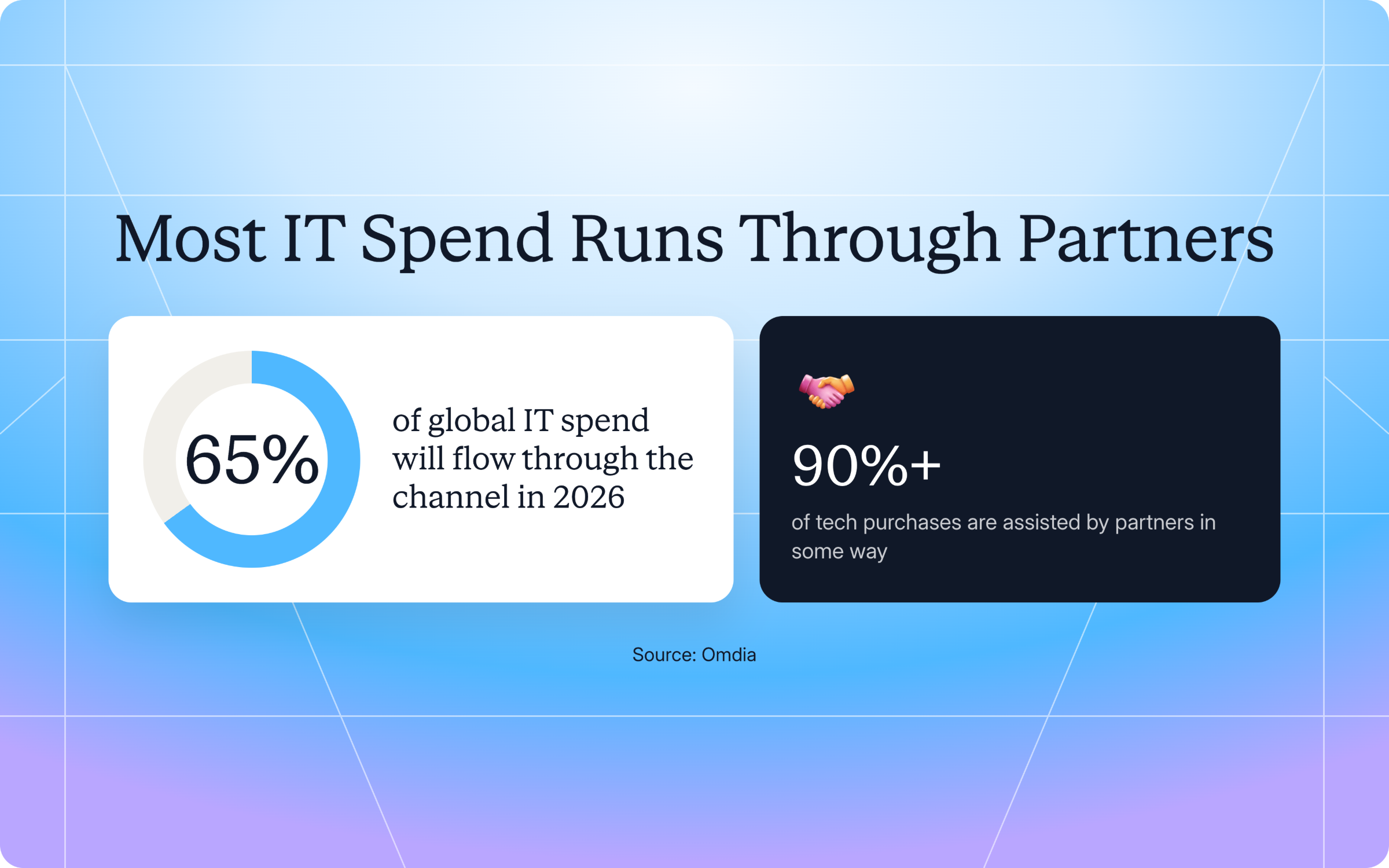
Partners don't just influence technology buying, they carry it. Omdia estimates that 65% of global IT spend will flow through the channel in 2026, and that well over 90% of tech purchases are assisted by partners in some way. If you're a B2B SaaS or tech vendor selling through resellers, distributors, or VARs, a big chunk of your revenue probably passes through someone else's hands before it reaches you.
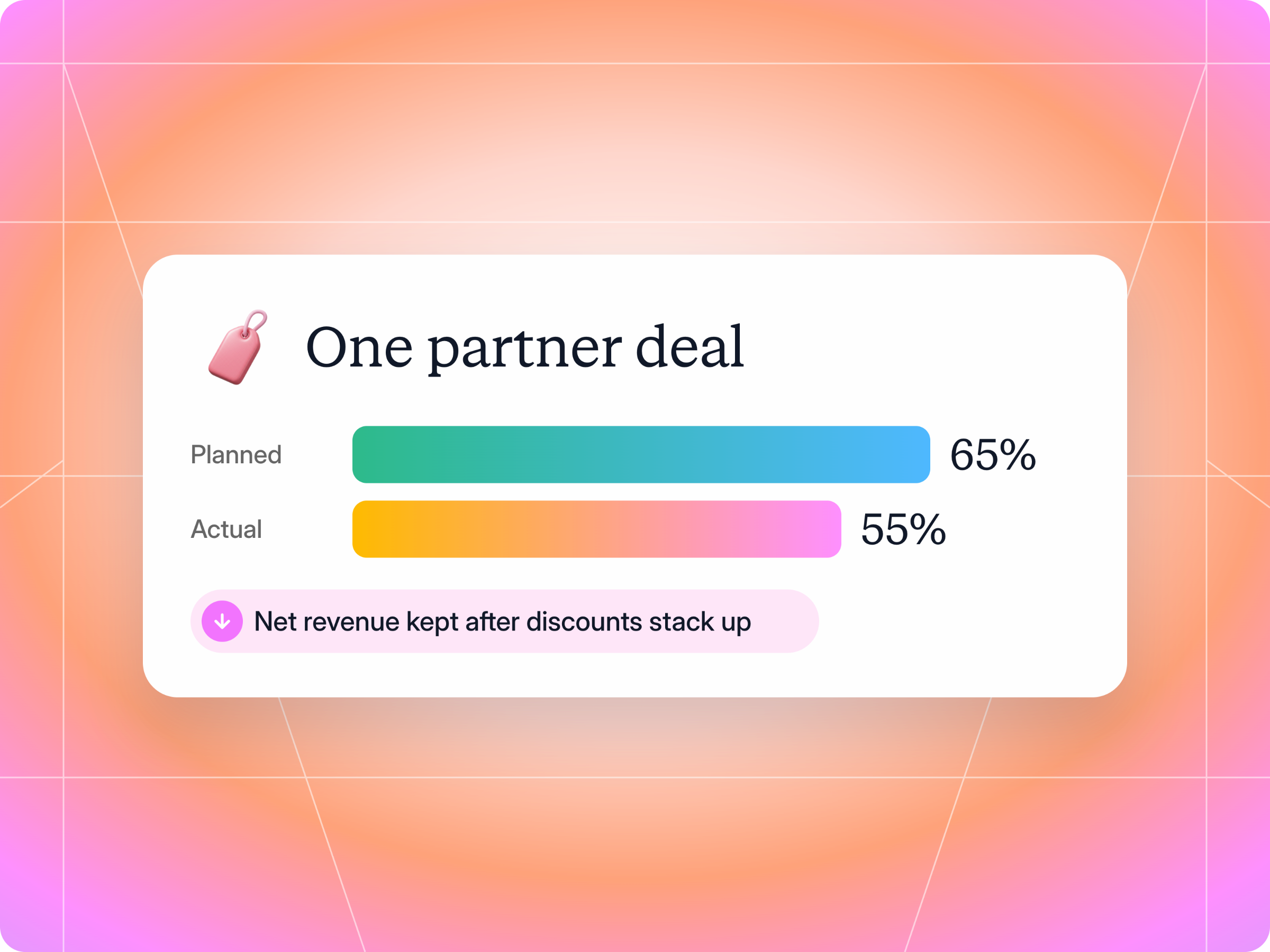
Here's how margin erosion usually starts. Your reseller program launches with a clean 25% discount off list. Then a big partner asks for 30% to stay competitive. Sales approves an extra 5% to close a quarter end deal. Marketing funds a joint campaign. A rebate kicks in at year end. Nobody did anything wrong, but when finance runs the numbers, your effective discount on partner deals is closer to 45%, and some deals are losing money once you count support and onboarding cost.
Sound familiar? The problem isn't that you pay partners. It's that nobody owns the full picture of what each deal actually costs.
This guide is written for channel chiefs, partner managers, and RevOps leads designing a partner discount structure. It covers how to structure channel margin and partner discounts so partners earn enough to sell your SaaS product, and you keep enough to run a profitable business.
What is channel margin?
Channel margin is the portion of the final selling price that a channel partner keeps for the value they add. It's the gap between what the partner pays you (their purchase price) and what they charge the customer, expressed as a percentage of the selling price.
You'll hear the same idea under a lot of names, depending on who's in the deal:
- Reseller margin: What a reseller keeps on each sale. Our glossary entry on reseller margin covers the basic definition.
- VAR margin: The margin a value added reseller earns on your product, usually on top of the services revenue it earns for implementation and support.
- Distributor margin: What a distributor keeps between buying from you and selling to resellers.
- Wholesale margin: The older, inventory based term for the same thing, common in physical goods and retail.
- Partner margin: The catch all for whatever any partner keeps, whether it's a discount, a commission, or a revenue share.
- Deal margin: Your own margin on one specific deal, after every discount, rebate, and incentive tied to it.
Here's the key point. Most partner discounts are set once, at the program level. Deal margin is decided one deal at a time. Margin erosion lives in the gap between the two.
Why margin erosion matters more than it looks
Margin erosion is the gradual decline in your company's profitability over time, usually because costs, discounts, and incentives grow faster than revenue. It rarely shows up as one bad quarter. It shows up as a profit margin that slips a point or two every year while revenue keeps growing, so nobody panics.
The damage compounds, though. Less margin means less cash to invest in strategic hires, product, and growth. Investors tend to penalize persistent margin erosion with lower valuations. And thin margins leave your business more exposed to market changes, from a new competitor to a slower buying cycle. A partner pricing strategy that protects margin isn't just a finance concern. It decides how much room you have to maneuver.
Margin vs markup: the simple calculation that trips people up
Margin and markup describe the same dollar amount from two different starting points. Margin divides the profit by the selling price. Markup divides it by the cost.
- Margin formula: (Selling price minus cost) divided by selling price.
- Markup formula: (Selling price minus cost) divided by cost.
- Converting margin to markup: Margin divided by (1 minus margin).
- Converting markup to margin: Markup divided by (1 plus markup).
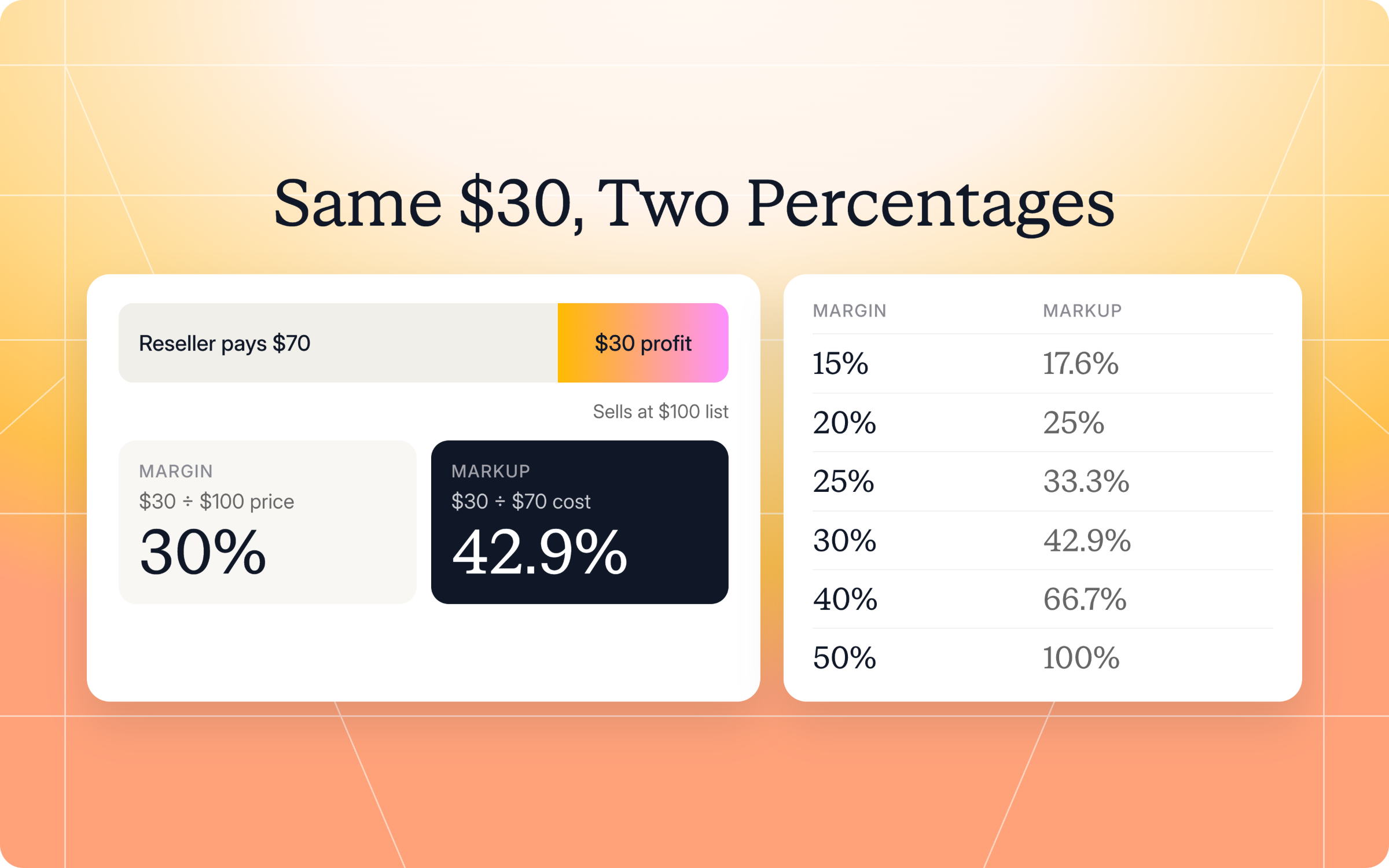
Let's make it concrete. Your software lists at $100 per seat. You give a reseller a 30% discount off list, so their purchase price is $70. They sell to the customer at the full $100.
- Reseller profit: $100 minus $70 = $30.
- Reseller margin: $30 divided by $100 = 30%.
- Reseller markup: $30 divided by $70 = 42.9%.
So is a 30% markup the same as a 30% margin? No. A 30% reseller markup on a $70 cost gives a selling price of $91, which is only a 23.1% margin. It works the other way too: a 50% markup gives you a 33.3% margin, and a 100% markup gives you a 50% margin. That gap is why pricing decisions go wrong when one team talks in margin and the other talks in markup.
| Margin | Equivalent markup | |
|---|---|---|
| Example 1 | 15% | 17.6% |
| Example 2 | 20% | 25% |
| Example 3 | 25% | 33.3% |
| Example 4 | 30% | 42.9% |
| Example 5 | 40% | 66.7% |
| Example 6 | 50% | 100% |
One more distinction worth keeping straight. A partner's gross margin is the money left after their cost of goods sold, which for a reseller is mostly what they paid you. Their net profit margin is what's left after their own expenses, like sales salaries, marketing, and support. A reseller with a 30% gross profit margin might run a single digit net profit margin. Keep that in mind when a partner tells you your discount "doesn't work." Often they're right.
And for you as the vendor, a reseller discount is a reduction in your selling price, not an expense line. It hits your gross profit directly. That's exactly why discount creep is so hard to see in a P&L.
How channel margin stacks in two tier distribution
In a direct sale, there's one margin to think about: yours. In two tier distribution, there are three. The vendor sells to a distributor, the distributor sells to a value added reseller (VAR), and the VAR sells to the customer. Each layer needs enough margin to cover its cost and still make money.
If you're still deciding which model fits, our guide to direct vs indirect distribution channels covers the tradeoffs.
A worked example of channel margin stacking
Say you sell a $100,000 annual subscription at list price.
| Buys at | Sells at | Keeps | Margin on its sale | |
|---|---|---|---|---|
| Vendor (you) | n/a | $65,000 | $65,000 net revenue | 35% total channel discount |
| Distributor | $65,000 | $70,000 | $5,000 | 7.1% |
| VAR | $70,000 | $100,000 | $30,000 | 30% |
| Customer | $100,000 | n/a | n/a | n/a |
You give the distributor 35% off list. The distributor passes 30% off list to the VAR and keeps the difference. The VAR sells at list and keeps 30%.

Now watch what happens when the VAR discounts 10% to win against competitive pricing from a rival. The customer pays $90,000. The VAR's margin drops to $20,000, or 22.2%. Very often, the VAR then comes back to the distributor, and the distributor comes back to you, asking for more discount on this one deal. If you give another 5 points, your net revenue drops to $60,000. That's margin erosion in one deal, and it started with a price war you weren't even part of.
Distributor markup vs distributor margin
How much margin does a distributor really need? Less than most vendors expect, because distributors live on volume. TD SYNNEX, one of the largest IT distributors, reported $4.37 billion of gross profit on $62.5 billion of revenue for fiscal 2025, a gross margin of roughly 7%.
That's a blended number across hardware, software, and services, so don't read it as a software benchmark. But it tells you something useful. In IT distribution, the typical distributor markup is small on each deal, and the distributor's business model depends on credit, logistics, billing, and scale, not on fat per deal margin. If you're working with software distributors, expect conversations about volume, payment terms, and services, not just points off list.
Other industries look different. In general wholesale supply chains, where manufacturers sell physical goods through distributors to retail, you'll often see an average distributor markup quoted at 20% to 40%, with specialty items earning more and commodity categories much less. Distributors also adjust markups based on customer relationships and industry and market conditions.
The cash side matters too. A distributor that extends credit to hundreds of resellers carries real financial risk. In physical goods, it also carries inventory and shipping cost. Software removes most of the inventory problem, but billing and collections still cost money.
Typical reseller discounts and distributor margins (with honest caveats)
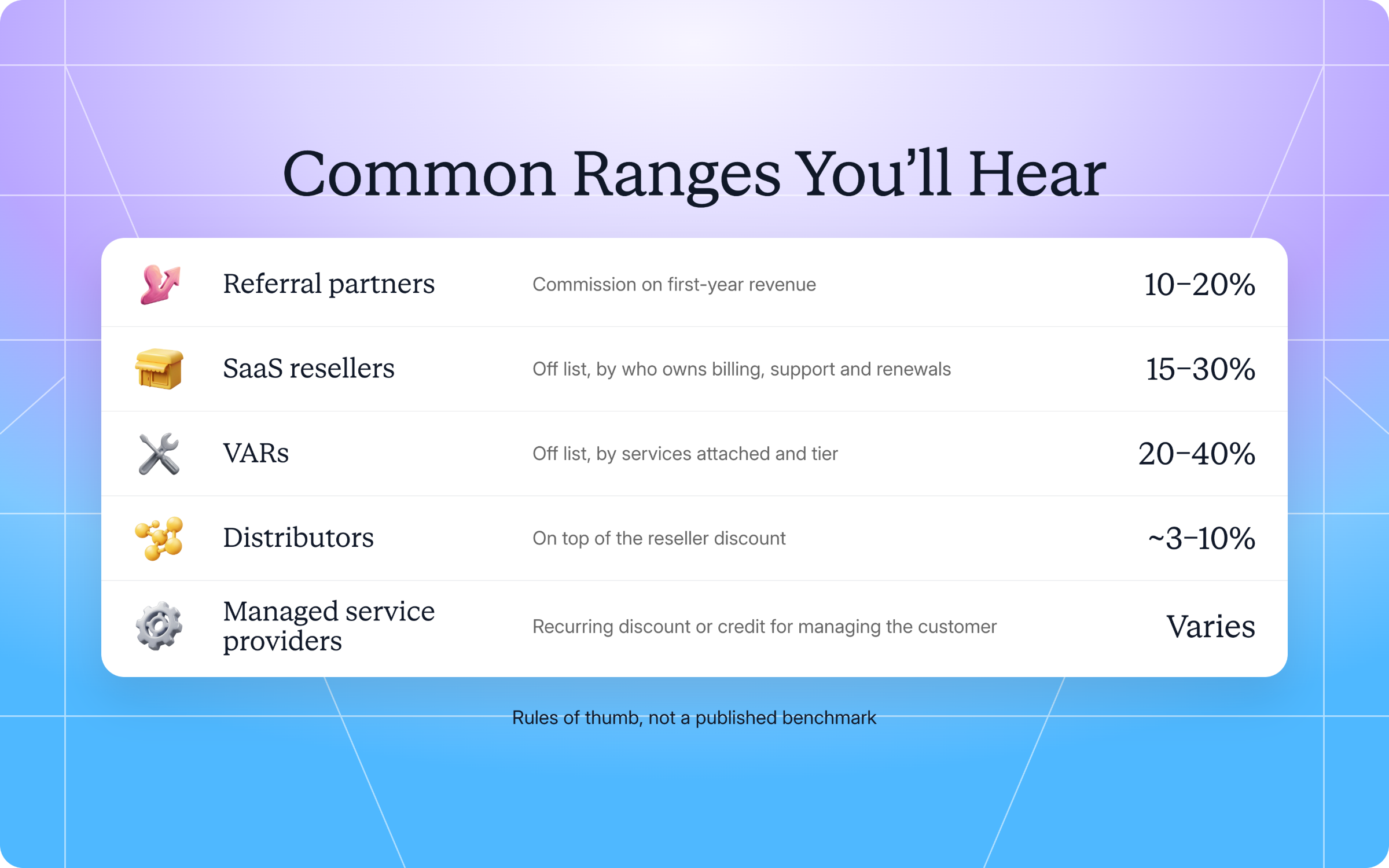
Let's be honest up front: there's no authoritative public benchmark for SaaS reseller discounts. Most numbers you'll find online are rules of thumb from consultants and vendors. The ranges below are what you'll commonly hear in practice. Treat them as a starting point for your own math, not a standard.
| Common range you'll hear | What pushes it up or down | |
|---|---|---|
| Referral partners | 10% to 20% of first year revenue, as a commission | Deal size, whether the partner helps close, recurring vs one time |
| SaaS resellers | 15% to 30% off list | Who owns billing, first line support, and renewals |
| VARs | 20% to 40% off list | Services attached, implementation complexity, partner tier |
| Distributors | Roughly 3% to 10% on top of the reseller discount | Credit, billing, logistics, and scale they provide |
| Managed service providers | Often a recurring discount or credit for managing the customer | Ongoing management and support responsibility |
Two real examples show how established programs anchor these numbers.
HubSpot's deal based commission model pays Solutions Partners a 20% revenue share for up to three years on eligible deals. Notice the condition: partners must register a shared deal and HubSpot must accept it, or there's no credit. The margin is tied to registration, not just to the partner's status.
Microsoft takes a different approach for Azure in its Cloud Solution Provider program. Partner earned credit rewards partners who actively manage a customer's Azure environment, and Microsoft's own docs use a 15% credit as the worked example. Microsoft describes the goal as uniform pricing that "helps eliminate competition on margins." In other words, it pays for value added services, not for discounting.
So what's a good profit margin for a reseller? It depends on how much work they do. Many resellers treat anything under 10% as risky, because it barely covers the cost of selling. Most resellers who own billing, support, and renewals need more margin than a partner who passes a lead and walks away. Many resellers also earn their real profit on services, not on your license. Several factors decide the right number: your own gross margin, your direct cost of sale, the partner's role, and the market conditions in your category. If you're comparing discount, commission, and revenue share models, our guide to revenue share vs commission vs profit share goes deeper.
Partner pricing strategy: key considerations for your discount structure
Your partner pricing strategy has to balance two goals: give partners enough margin to maximize their selling effort, and keep enough for yourself to fund growth. A good discount structure is boring in the best way. Partners know exactly what they'll earn, your sales team knows what they can approve, and finance can forecast margin before the deal closes. Here's how to build one.
Start every discount from list price (MSRP)
Anchor every discount to one published list price, your MSRP. A clear msrp discount, like "Gold partners buy at 30% off list," is easy to explain, easy to audit, and easy to compare across deals.
The alternative is negotiating each partner's purchase price from scratch. That gives you dozens of price points, nobody can tell whether a deal is profitable, and partners compare notes. If you hold the list price steady and only vary the discount, every pricing decision can be measured against the same baseline.
Put the discount terms in writing, too. A clear reseller agreement should state the base discount, how tiers work, what deal registration adds, and who can approve exceptions.
Tie your channel discount to partner tiers
A flat discount for every partner sounds fair, but it rewards your least engaged partners as much as your best ones. A tiered structure links the channel discount to what partners actually contribute.
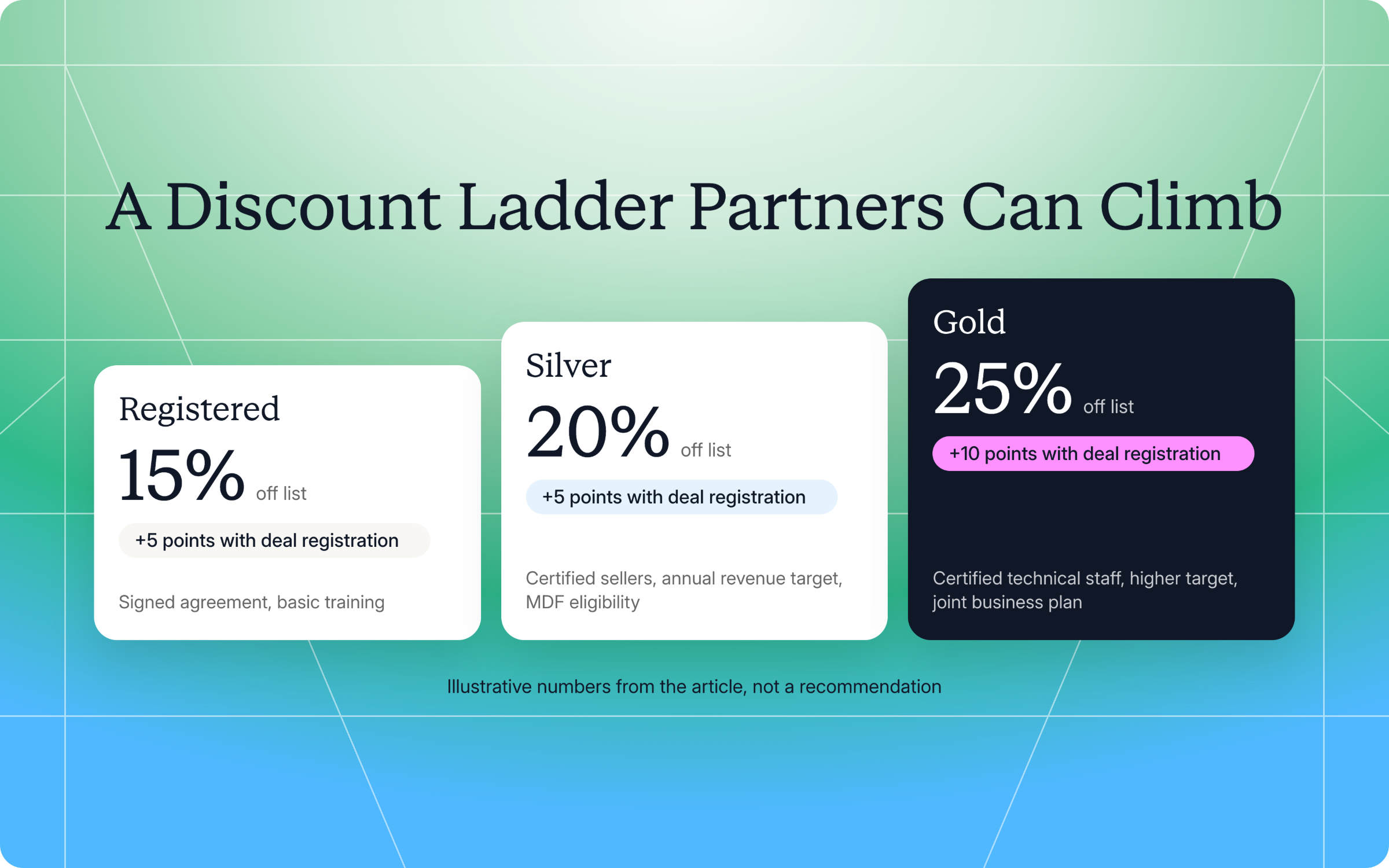
| Registered | Silver | Gold | |
|---|---|---|---|
| Base discount off list | 15% | 20% | 25% |
| Deal registration uplift | +5 points | +5 points | +10 points |
| Typical requirements | Signed agreement, basic training | Certified sellers, annual revenue target | Certified technical staff, higher target, joint business plan |
| Other benefits | Portal access | MDF eligibility | MDF, co selling support, priority leads |
The numbers here are an illustration, not a recommendation. The point is the shape: a clear ladder, requirements partners can see, and a reason to move up. Our guide to partner tiers covers how to set requirements, and a tiered commission structure works the same way for referral partners who don't take a discount.
Here's what building a tier program with requirements and benefits looks like in Introw:
Add a deal registration discount
Deal registration is the single best tool you have for protecting margin, because it pays partners extra for doing something you want: bringing you new deals early and claiming them before anyone else does.
The mechanic is simple. A partner registers an opportunity, you check it against your pipeline, and if it's approved, the partner gets an extra discount on that deal, usually 5 to 10 points. Unregistered deals get the base discount only. That rewards the partner who found the deal and removes the reason for two partners to undercut each other on the same customer. Learn more about how deal registration works.
Keep incentives separate from margin
Discounts are front end margin, paid at the moment of sale. Rebates, SPIFFs, and market development funds (MDF) are back end margin, paid later for specific behavior. Keep them in separate buckets with separate budgets.
When incentives blur into discounts, you lose track of what each deal costs. A good channel incentive program pays for outcomes like new logos, certifications, or a new product line. And MDF should fund activity with a measurable result, as our guide to marketing development funds explains. For more ideas, see our roundup of channel partner incentive programs.
How margin erosion happens: common pitfalls
Margin erosion rarely comes from one bad decision. It's the result of small, reasonable exceptions that nobody adds up. These are the common pitfalls.
- Discount creep: One exception becomes the new normal. A partner who got 35% once expects 35% every time, and the rest of your partners hear about it.
- Stacked discounts: The tier discount, deal registration uplift, a promotional discount, and a special approval all land on the same deal, because each one was approved in isolation.
- Channel conflict: Two partners, or a partner and your own direct rep, chase the same customer and compete on price. Channel conflict turns into price wars, and the customer wins every round. Horizontal channel conflict between partners at the same level is especially costly.
- Overlapping incentives: A deal earns a discount, a SPIFF, a volume rebate, and MDF, and nobody checks whether all four were meant to apply.
- Rebates on unverified volume: Year end rebates paid on numbers nobody reconciled against the CRM.
- MDF without ROI: Funds approved for activity that never produced pipeline.
- Custom pricing with no floor: Partners or reps can type in any price, so they do.
Market changes make this worse. When demand slows or a competitor cuts prices, every deal starts to look like an exception. That's exactly when you need guardrails most.
A worked example of margin erosion
Here's how one $100,000 deal can erode, step by step.
| What gets applied | Discount or cost | Your net revenue |
|---|---|---|
| List price | n/a | $100,000 |
| Gold tier discount | 25% | $75,000 |
| Deal registration uplift | 10 points | $65,000 |
| Quarter end special approval | 5 points | $60,000 |
| Year end volume rebate | 3% of list | $57,000 |
| MDF tied to this deal | 2% of list | $55,000 |
Your planned partner cost on this deal was 35%. The actual cost is 45%. If your fully loaded cost to serve the customer is $25,000, your deal margin just dropped from about 62% to about 55%, and on a smaller deal with heavier onboarding, you'd be close to losing money. Multiply that across a year of partner deals, and you can see how a channel that looks healthy on revenue can quietly drag down profitability.

How to protect deal margin
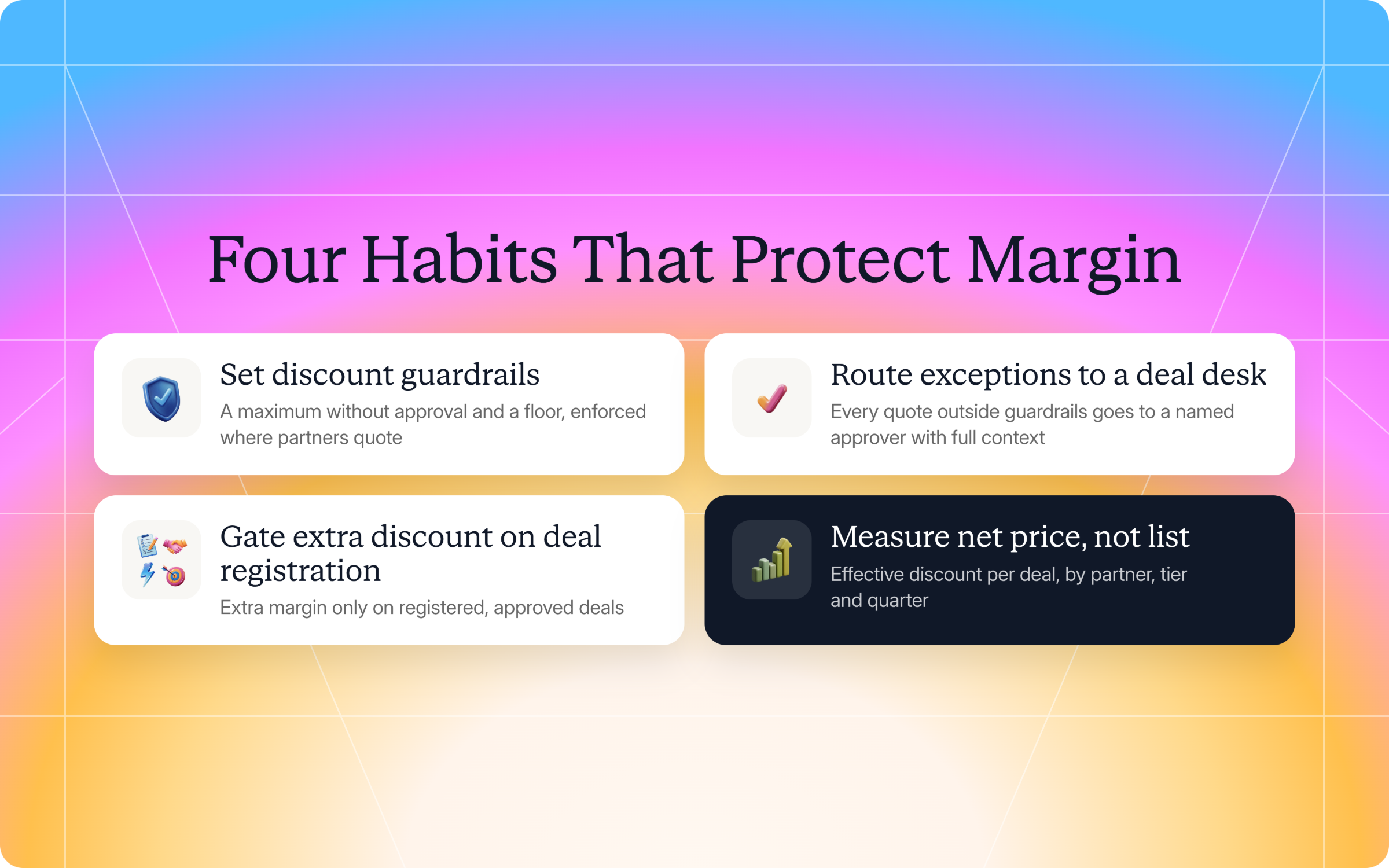
Protecting margin isn't about paying partners less. It's about making every dollar of discount and incentive intentional. Success hinges on four habits.
Set discount guardrails
Write down, for each product and tier, the maximum discount a partner can apply without approval, and the floor below which no deal goes. Then enforce it in the tools partners actually use to quote, not in a PDF nobody reads.
Product visibility is a guardrail too. If a partner shouldn't sell a product, or shouldn't sell it below a certain tier, don't let them see it in the quote builder at all.
Route exceptions through approval workflows and a deal desk
Exceptions will happen, and that's fine. What matters is that they're visible. Any quote outside the guardrails should go to a deal desk, or at least a named approver, with the full deal context: the partner, their tier, the discounts already applied, and the incentives attached.
That's where configure, price, quote software helps. If you're evaluating tools, our guide to the best CPQ software compares the main options.
Make deal registration the gate for extra discount
Extra margin should only come through a registered, approved deal. That one rule removes most of the incentive for partners to fight on price, and it gives you a record of who sourced what. Check each registration against existing direct and partner pipeline before you approve it, so you don't pay twice for the same customer.
Measure net price, not list price
Track the effective discount on every partner deal: list price minus every discount, rebate, and incentive tied to it. Then look at it by partner, by tier, and by quarter. A partner who sells a lot at a 50% effective discount may be worth less to you than a smaller partner at 28%.
This is where clean partner performance data matters. When discounts, commissions, and deal registration all live in the same CRM records, you can see deal margin instead of guessing at it. You stay competitive on price where it matters, and you stop giving margin away where it doesn't.
How Introw helps you price for partners without eroding margin
Introw is a CRM first partner relationship management platform, which means it builds on top of your existing HubSpot or Salesforce setup rather than replacing it. Partner pricing, deal registration, tiers, and incentives all sit on the same CRM records your sales and finance teams already use.
- Governed partner pricing in CPQ: Your product catalog syncs from the CRM, and you set a discount method per product: no discount, partner based (read from a property on the partner's CRM record), tier based, custom price, or custom discount. Partner based and tier based discounts are calculated server side when line items are added.
- Product visibility as a guardrail: Segments and deal filters control which products each partner can see, so partners can only build quotes for what they're allowed to sell.
- Quote approvals: You decide whether partners can publish a quote themselves or whether it needs approval first. In HubSpot, quotes and line items are created as native objects on the deal, so there's nothing to reconcile.
- Deal registration with conflict checks: Every registration is screened against existing deals, contacts, and companies, then held behind an approval gate with ordered approvers and optional AI validation. On approval, Introw creates or links the CRM deal and attributes the partner, including both reseller and distributor in two tier deals.
- Tiers that drive pricing: Partner tiering maps tiers to a CRM property that syncs both ways, and lets you tie commission rates, HubSpot CPQ discounts, MDF budgets, and content access to each tier.
- Incentives in their own bucket: Commission plans cover revenue shares, fixed fees, and one time bonuses, with commission lines you can review, decline, or adjust before payout. MDF runs from request through approval, claims, and ROI reporting, and partner incentives stay visible to partners.
Here's how a tier based discount is set on a product, so every partner in a tier gets the same percentage off list automatically:
And if you've negotiated individual rates with specific partners, a partner based discount reads each partner's rate straight from their CRM record:
That's what healthy channel margin looks like: partners who know exactly what they earn, exceptions that are visible and approved, and deal margin you can see before the deal closes, not after. See how Introw keeps partner pricing and deal registration in your CRM. Book a demo or explore Deal and Lead Registration.
Still curious? Here are some quick answers to help clear things up
Margin erosion is the gradual decline in your profit margin on sales, usually caused by discounts, incentives, and pricing exceptions that stack up over time. In a partner program, it often comes from discount creep, channel conflict, and overlapping rebates or MDF on the same deal.
No. Margin is profit divided by the selling price, and markup is profit divided by cost. A product that costs $70 and sells for $100 has a 30% margin but a 42.9% markup. A 30% markup on that same $70 cost only gives you a 23.1% margin.
Subtract what the distributor pays you from what it charges the reseller, then divide by what it charges the reseller. If a distributor buys at $65,000 and sells to a VAR at $70,000, its distributor margin is $5,000 divided by $70,000, or about 7.1%.
There's no universal number. SaaS resellers are commonly offered somewhere between 15% and 30% off list, and VARs who deliver services often get more. The right discount depends on how much of the sale, support, and renewal the reseller owns, and on your own gross margin.
Anchor every discount to list price, tie discounts to partner tiers, offer extra margin only on registered and approved deals, and route anything outside your guardrails to a deal desk. Then track the effective discount on every partner deal, not just the list price.




See AI-Native PRM in Action
Book a demo with one of our partner program experts, or explore Introw on your own time.