

Your closed lost partner deals already tell you what your partners need to learn next. The Micro Courses from Closed Lost Patterns skill runs a win loss analysis on lost partner deals, clusters them by lost reason, diagnoses the gap behind each pattern, and drafts a targeted micro course for the partners who need it most. You approve the courses and targets before anything goes out. The full SKILL.md is below, free to copy.
Here's a number every enablement team should sit with. Introw's training playbook notes that up to 70% of training content is forgotten within 24 hours, and 87% within a week, without reinforcement. Most partner training is delivered once, at onboarding, and never touched again.
Meanwhile, your partners keep losing deals. A reseller loses three healthcare deals in a row on a security question. Two agencies lose head to head against the same competitor. Each loss gets a reason in the CRM, and then nobody looks at the loss data together.
So what if your next course came straight from those lost deals, from the exact objections your partners couldn't handle last quarter?
This blog post covers how to run a win loss analysis on your partner pipeline, how to turn the loss patterns into micro courses, the Claude skill that does both, the full SKILL.md, and how to stay in control of what it sends.
What a good win loss analysis looks like for partner deals
Quick answer: what is a win loss analysis?
A win loss analysis is a structured review of why you win and lose sales deals, done often enough that the key findings change what your sales teams do next. It compares won deals with lost deals, looks for statistical patterns in your win loss data, and turns them into actionable insights for sales leadership, product teams and marketing.
In direct sales, it blends quantitative analysis of CRM data with direct buyer interviews, survey responses and one on one conversations with the decision maker. That direct buyer feedback shows how the buying process and final decision really played out. Most teams share the readout with key stakeholders, so a good program is cross functional by design.
For partner deals, add one question: was the loss a product problem, a market problem or a partner readiness problem? That third question is where most programs go blind, because nobody connects partner attached losses to what the partner was trained on.
Win rates, win loss data and improving sales performance
Start with the numbers. Your win rate is won deals divided by all closed deals (won plus closed lost) in the period. Your win loss ratio is won deals divided by lost deals. What counts as good depends on your market and deal size, so track it by partner, vertical and specific competitors to see where deals close and where they stall.
Win loss data tells you where to look. Customer feedback, buyer interviews and follow up questions to the partner tell you why. Most sales organizations stop at the dashboard. The ones that keep closing deals turn insights into sales training and sharper sales strategies, and they compare enterprise deals and SMB deals separately, because they rarely fail for the same reasons.
What a strong lost deal analysis includes
A strong lost deal analysis for your partner channel usually has five parts:
- A clear cohort: pick a window, like the trailing 90 days of closed lost deals with a partner attached, and stick with it so you can compare quarters.
- Clean closed lost reasons: use a short, consistent picklist (pricing, competitor, technical fit, timeline, champion, no decision, compliance) plus notes. That structured data collection is what makes pattern analysis possible.
- Context for every loss: vertical, deal size, product, stage at loss, competitor mentions and the partner's tier and certifications.
- Patterns, not anecdotes: identify patterns across clusters with volume and value, so one loud loss doesn't drive your whole curriculum.
- A next action per pattern: a competitive battle card, a talk track, a course or a coaching session, with an owner and a date to measure.
That last point usually breaks. To move your partner win rate, every pattern has to turn insights into something a partner can use on their next sales call. See also win loss attribution.
Which losses are training gaps, and which aren't
Some lost opportunities come down to other factors: a reorg, a vanished budget, a competitor who was in first. Feature gaps and a weak pricing structure are product problems, not partner problems. Don't train on those.
| Lost reason | Usually a training gap? | What tends to fix it |
|---|---|---|
| Pricing or packaging objection | Yes, often | ROI calculator skills and a pricing defense talk track |
| Competitor positioning | Yes | A current battle card and two or three fresh case studies |
| Technical fit | Sometimes | Deeper product training for that vertical |
| Implementation or timeline worry | Yes | Training on how to position deployment services |
| Champion loss or power gap | Yes | Champion development coaching |
| Compliance or security | Yes, with care | Vertical compliance positioning, reviewed by legal |
| No decision | Sometimes | Coaching on creating urgency, after filtering out reorgs |
| Customer reorg or budget freeze | No | Nothing to train on, filter it out |
The rule of thumb: if a better prepared partner could plausibly have changed the outcome, it's a training gap. If not, leave it out of the cluster.
Why micro courses beat another round of partner training
Once you know the gap, the instinct is to add a module to the big certification. That's slow, and it rarely reaches partners while active deals are still live.
A micro course is a short, focused lesson, usually 15 to 30 minutes, on one skill or one situation. It's microlearning applied to partner enablement, the same way sales enablement teams use it for sales reps: small, timely, and tied to something the learner is about to do.
| Aspect | Traditional partner training | Loss driven micro courses |
|---|---|---|
| Source | The roadmap and a content calendar | Your own closed lost reasons and deal notes |
| Length | Hours, spread over modules | 15 to 30 minutes |
| Time to ship | Weeks of instructional design | Under an hour, per Introw's training playbook |
| Who gets it | Every partner in a tier | Partners losing in that pattern, or working similar pipeline |
| Assessment | Multiple choice quiz | Open question scenario graded with a rubric |
| How you measure it | Completion rate | Win rate on the addressed pattern after 60 and 90 days |
That last row matters most. Completion rates tell you a partner clicked through. Win rates on the pattern you trained against tell you the course worked, and that's how you improve future win rates instead of guessing. The same playbook cites Whatfix research showing a 32% win rate lift from AI sales coaching within six months.
For more on course delivery, see our guides to channel partner sales training and how to evaluate partner training programs.
The skill to use: Micro Courses from Closed Lost Patterns
Micro Courses from Closed Lost Patterns is a vendor side skill from Introw's free Claude skill library. It runs a win loss analysis on your closed lost partner deals through Introw's MCP server, reading live CRM data, and turns the patterns into micro course outlines, a partner target list and a measurement plan.
| Detail | Micro Courses from Closed Lost Patterns |
|---|---|
| Built for | Partner enablement managers, partner program managers, channel chiefs and channel RevOps |
| Use it when | You want to know what partners are losing on and what to train on next |
| What it reads | Closed lost deals and notes, partner engagement on those deals, partner tiers and certifications, task history |
| What it writes | Course assignment tasks with due dates and a comment on each partner record, after you approve |
| Skill ID | vendor-microcourse-from-closed-lost |
Trigger it with prompts like "what are we losing on", "closed lost patterns" or "what should we train on next".
What makes it different from a dashboard of closed lost reasons is the last mile. It drafts the course, picks the partners and sets the date you'll check whether it worked. Of all the AI tools for partner teams, it's the one that closes the loop between loss analysis and partner training.
How the skill works, step by step
The skill runs in seven steps. Knowing them makes it easier to trust, and to challenge, what comes back.

Step 1: Define the loss cohort
By default, the skill looks at closed lost, partner attached deals from the trailing 90 days and confirms that with you. You can narrow it by partner type, region, product or specific competitors.
Step 2: Pull the CRM data
It reads the full record for every lost deal (vertical, deal size, products, stage at loss, lost reason, competitor), whether the partner was active late in the sales process, the partner's tier and certifications, stuck tasks and the deal notes.
Step 3: Cluster the loss data into patterns
The skill groups losses into patterns like pricing objections, competitive positioning, technical fit, implementation worries, champion loss, no decision, compliance and late stage discovery gaps. For each cluster, it captures volume, value lost, affected partners and verticals, and two or three sample deals with quotes from the notes.
Step 4: Diagnose the gap behind each pattern
For every cluster, it asks: what knowledge, skill, asset or motion would have changed the outcome? That separates execution gaps and process gaps from product problems. A pricing cluster might point to a stronger value proposition and a pricing defense talk track. A competitor cluster might need fresh competitive intelligence, a battle card and new case studies.
Step 5: Draft a micro course for each priority gap
For the clusters that matter most, the skill drafts a 15 to 30 minute course:
- Framing and content: two minutes on the pattern costing deals, five on the gap and how to close it.
- Worked example: a real or anonymized lost deal and the alternate path.
- Assessment: an open question scenario graded against a rubric, not a quiz.
- Asset bundle: the battle card, ROI calculator, case study or objection handling cheat sheet.
Content comes from your existing knowledge base, marketing materials and product docs, with a source cited for every section.
Step 6: Target the right partners
The skill picks the partners losing most often in each pattern, plus partners working live deals with the same profile. It tailors versions for resellers and systems integrators, and adjusts delivery by tier: a live walkthrough for top tier partners, the async course for the long tail.
Step 7: Distribute and measure
Once you approve, it creates a course assignment task with a due date for each partner and comments on each partner record explaining why. Then it re pulls win rates on similar deals 60 and 90 days after rollout, so you can see measurable improvements, or the lack of them.
Get the skill: the full SKILL.md
Here's the complete skill file. Copy it as is, or adapt the clusters, course structure and targets to fit your program.
---
name: vendor-microcourse-from-closed-lost
description: Use when a Partner Enablement lead, Channel Chief, or RevOps user wants to detect patterns in closed-lost partner deals, clustering by lost-reason and customer context, and generate / suggest targeted micro-courses that address the specific gaps the losses reveal. Trigger phrases include "what are we losing on", "closed-lost patterns", "training from losses", "micro-courses from lost deals", "what should we train on next", "closed-lost driven enablement".
---

# Micro-Courses from Closed-Lost Patterns (Vendor)

**Audience**: Vendor, **claude.ai Introw** MCP.
**Use case**: 05, Training.

## When to use this skill

Use when a Partner Enablement lead, Channel Chief, or RevOps user wants to detect patterns in closed-lost partner deals, clustering by lost-reason and customer context, and generate / suggest targeted micro-courses that address the specific gaps the losses reveal.

**Sample prompts that fire this skill:**
- "what are we losing on"
- "closed-lost patterns"
- "training from losses"
- "micro-courses from lost deals"
- "what should we train on next"
- "closed-lost driven enablement"

## Why this matters
Up to **70% of training content is forgotten within 24 hours, 87% within a week** without reinforcement (Ebbinghaus / industry consensus). Static training catalogs accumulate content nobody uses while real, current losses go un-addressed. The signal that matters most: **partners losing deals tells you exactly what they need to learn**.

Introw can generate and push a 15-minute micro-course to all enabled resellers in **under one hour**: vs. the typical multi-week instructional design cycle. SalesHood / Whatfix research shows AI-coaching delivers **38% skill improvement, 40% faster time to readiness, and 32% win-rate lift** within six months. The leverage move: drive the next micro-course from the gap a closed-lost cluster just exposed.

## Process

### Step 1: Define the loss cohort
Default: closed-lost partner-attached deals over the trailing 90 days. Confirm with the user. Optional scoping: by partner type, region, product, or specific competitor.

### Step 2: Pull the data
- `Introw:search_crm_objects`: closed-lost deals in scope, with full record (vertical, deal size, products, stage at loss, lost-reason, competitor, key contacts, last activity).
- `Introw:search_partner_engagement`: engagement on those deals (was the partner active or absent in the late stages?).
- `Introw:search_partners`: partner profile for each lost deal (tier, certifications held).
- `Introw:search_tasks`: task history (was anything stuck or skipped?).
- Comment history on each deal via `Introw:search_crm_objects` notes for objection / blocker context.

### Step 3: Cluster by failure pattern
Group losses into patterns rather than treating each as one-off. Common clusters:
- **Pricing / packaging objection**: partner couldn't defend price or pitched wrong SKU.
- **Competitor positioning**: partner lost head-to-head against a specific competitor.
- **Technical-fit / capability**: buyer concluded the product didn't fit; partner couldn't address technical objection.
- **Implementation / timeline**: buyer concerned about deployment risk; partner lacked services answer.
- **Champion loss / power gap**: internal champion left or never emerged.
- **No decision**: buyer stalled; partner couldn't drive urgency.
- **Compliance / security**: buyer concern partner couldn't address (HIPAA, SOC 2, GDPR).
- **Late-stage discovery gap**: discovery wasn't deep enough early on.

For each cluster, capture:
- **Volume** (how many deals).
- **Aggregate value lost.**
- **Affected partners** (which partners lost most often in this pattern; which partner types).
- **Affected verticals / regions / products.**
- **Sample evidence**: 2 to 3 representative deals with quotes from the lost-reason notes.

### Step 4: Diagnose the underlying gap per cluster
What knowledge / skill / asset / motion would have changed the outcome? Examples:
- Pricing objection cluster → partner needs ROI-calculator competency + pricing-defense talk-track.
- Competitor cluster → partner needs current battle card + 2 to 3 fresh competitive case studies.
- Technical-fit cluster → partner needs deeper product-architecture training for that vertical.
- Implementation cluster → partner needs deployment-services-positioning training.
- Champion-loss cluster → partner needs MEDDIC-style champion-development coaching.
- Compliance cluster → partner needs vertical-specific compliance positioning.

### Step 5: Generate the micro-course outline per gap
For each high-priority cluster, draft a micro-course that meets Introw's training model:
- **Length**: 15 to 30 min, deployable in under 1 hour.
- **Pulls from**: vendor's existing knowledge base (Notion, Confluence, product docs, asset library): don't fabricate content.
- **Structure**:
  - 2-min framing: the pattern that's costing us deals.
  - 5-min content: the gap and how to close it.
  - 5-min worked example: walk through a real (or anonymized) lost deal and the alternate path.
  - **Open-question assessment** (not multiple choice): partner answers a real scenario in their own words; rubric grades response.
  - Inline AI tutoring hook, partner can ask follow-ups during the course.
- **Asset bundle**: battle card / ROI calculator / case study / objection-handling cheat sheet attached.

### Step 6: Target the right partners
Per cluster, identify which partners benefit most:
- Partners with high concentration of losses in this pattern.
- Partners working pipeline that fits this profile (use `search_crm_objects` to find current active deals in the same vertical/competitive context).
- Partner-type-aware tailoring (the SI version vs. the reseller version).
- Tier-aware delivery (top tier may get a live walkthrough; long tail gets the async micro-course).

### Step 7: Distribute and track
- Push the course assignment via `Introw:add_task` per partner, with due-date.
- `Introw:add_comment` on each partner record explaining why this course was sent (refers to the loss cluster).
- Establish measurement: re-pull win-rate on similar deals 60 / 90 days post-deployment to validate impact (target: 32%+ win-rate lift on the addressed pattern, per Whatfix benchmarks).

## Output format
- **Loss cohort summary**: total deals, aggregate value, period.
- **Cluster table**: pattern, volume, value, affected partners/verticals, diagnosed gap.
- **Micro-course outlines** per priority cluster, title, learning objective, content sections, assessment scenario, asset bundle.
- **Distribution plan**: partner targets, channel, due-dates.
- **Measurement plan**: what to track, when, with what comparison.

## Guardrails & PRM best practice
- **Evidence-grounded.** Every micro-course traces to a specific cluster with sample lost-deal evidence. Generic "let's train on objection handling" without evidence misallocates effort.
- **Don't over-fragment.** If there's a dominant cluster (>40% of losses), focus there before fragmenting into 6 minor courses. Triage matters.
- **Open-question assessments only.** Multiple-choice quizzes get gamed (industry consensus); rubric-graded open-question assessments measure actual understanding.
- **Knowledge-base sourced.** Course content draws from existing vendor docs over MCP, not fabricated. Cite the source for every section.
- **Don't blame partners for ambiguous losses.** Some losses (no-decision, competitor pre-empted, customer reorg) aren't training gaps. Filter cleanly before clustering.
- **Tier and persona awareness.** A reseller and an SI losing the same way may need different versions of the course, generate variants.
- **Compliance-cluster sensitivity.** Compliance losses (HIPAA, SOC 2, GDPR) may need legal-team review of the course content before distribution, flag it.
- **Don't auto-distribute without human sign-off on first cycle.** Surface the courses + targets; get user approval before pushing tasks.
- **Measure impact.** Pair every course deployment with a post-period win-rate measurement on the addressed pattern. If the pattern's win-rate doesn't improve, the diagnosis or course was wrong, surface that loop.
- **Cross-skill handoff.** Pattern reveals a coaching gap on live deals → `vendor-deal-coach-from-similar-wins`. Pattern reveals a partner-fit issue → `vendor-training-gap-analysis` for tier-coverage view.
How to install and run the skill
Option 1: Claude Code
Create a folder called vendor-microcourse-from-closed-lost inside .claude/skills/ and save the file above as SKILL.md in it. Claude Code runs it whenever your prompt matches the trigger phrases.
Option 2: Claude (or any MCP client) with the Introw connector
You don't need to be technical for this one. Connect Claude to Introw once, and you can run the same play in plain language from Claude, ChatGPT, Slack, Teams or your CRM. Introw is in Claude's connector directory, so it's one click plus a sign in. Here's how connecting looks:
The step by step version lives in the Connect Claude guide, and the Claude integration page covers what you can do once you're connected.
Prompts to try
- "What are we losing on?" Runs the full win loss analysis on the last 90 days of closed lost partner deals.
- "Show me closed lost patterns for our EMEA resellers this quarter." Scopes the cohort to one region and partner type.
- "Why are partners losing to Competitor Y, and what should we train on?" Focuses on one head to head pattern.
- "Draft micro courses from lost deals, but don't assign anything yet." Gives you outlines and targets to review first.
What you'll get back
A typical run returns five things:
- Loss cohort summary: total lost deals, total value lost and the period covered.
- Cluster table: each pattern with volume, value, affected partners and verticals, and the diagnosed gap.
- Micro course outlines: title, learning objective, content sections, an open question scenario and an asset bundle per priority cluster.
- Distribution plan: which partners get which course, through which channel, and by when.
- Measurement plan: what to track, when, and against what baseline.
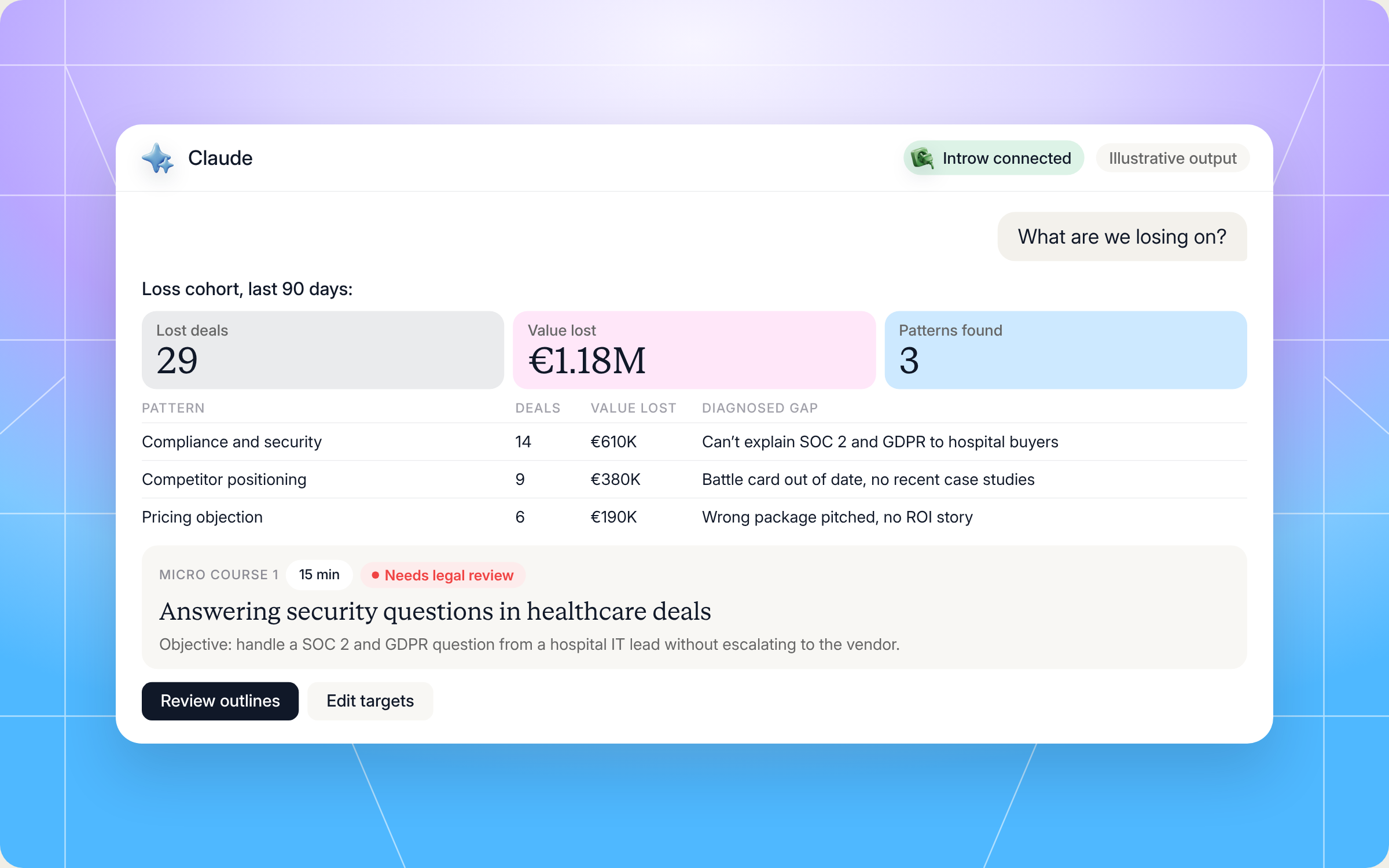
Here's an illustrative example of a cluster table for a 90 day cohort:
| Pattern | Deals | Value lost | Most affected | Diagnosed gap |
|---|---|---|---|---|
| Compliance and security | 14 | €610K | Healthcare resellers in DACH | Partners can't explain SOC 2 and GDPR posture to hospital buyers |
| Competitor positioning | 9 | €380K | Two Silver agencies | Battle card is out of date, no recent case studies |
| Pricing objection | 6 | €190K | SMB resellers | Pitching the wrong package, no ROI story |
The first course it drafts from the top cluster might be "Answering security questions in healthcare deals", with a CISO scenario as the assessment and a flag to route it to legal first.
Staying in control: what Claude can and can't do
- You approve the writes. The skill drafts courses, tasks and comments, and you sign off before anything is assigned or written to your CRM.
- It stays inside your access. Claude connects to Introw over OAuth as you, so it can only see and do what you can.
- It won't make up course content. Every section comes from your existing docs, with the source cited.
- It won't blame partners for losses they couldn't win. Reorgs, budget freezes and deals a competitor owned from day one are filtered out first.
- It flags compliance content. Courses built from HIPAA, SOC 2 or GDPR losses get flagged for legal review.
- It checks its own work. If win rates on the targeted pattern don't move, the skill tells you the diagnosis or the course was wrong.
Prefer to do this in the Introw app?
If you'd rather build the course yourself, Introw's course builder can draft one with AI from a short prompt and an optional deck or PDF. You refine it, set the passing score and make it available to the partners you picked.
The full walkthrough is in the generate a course with AI guide. See also Introw's partner LMS, how to build a partner course portal and how a partner certification program ties courses to tiers.
Pair it with other Claude skills
A loss pattern often points to more than a course. These Claude skills pick up where this one stops:
- Live deals at risk: Deal Coach from Similar Wins coaches a partner's open deal using your past wins in the same context.
- Quiet partners: Activate the Network with Personalized Campaigns sends a micro course nudge when a stalled partner has a capability gap.
- Course packaging: Agentic SCORM Course Builder turns a finished outline into a SCORM package for Introw.
- New partners: Personalized Onboarding Orchestrator from Transcripts builds a 90 day plan that can include these courses.
Find them all in Introw's skill library, see how they fit together in our roundup of Claude skills for partner teams, or read about AI sales coaching for partner teams.
Turn every lost deal into partner enablement with Introw
Introw is a CRM first partner relationship management platform, which means it builds on top of your existing HubSpot or Salesforce setup rather than replacing it. It's also headless by design: the partner portal is one surface, but you can run the same program in plain language from Claude, ChatGPT, Slack or Teams through Introw's MCP server, with every action written back to your CRM.
That's what makes a skill like this work. Your closed lost deals, partner engagement, tiers and tasks live in one place, so the win loss analysis runs on real pipeline data, not last quarter's export. Partners take the course in the hub they already use, with completions synced back to your CRM. Your partner knowledge base and enablement content become the raw material for every course, and your overall sales performance gets a feedback loop it never had.
Connect Claude to your partner program and run your first win loss analysis today. Connect Claude or book a demo.
Still curious? Here are some quick answers to help clear things up
It's a regular review of why your partner attached deals are won or lost, grouped into patterns with volume and value. The key extra step is separating losses caused by partner readiness from losses caused by product, pricing or market positioning, so you only train on gaps a partner could have closed.
No. Claude Code users can drop the SKILL.md into their skills folder. Everyone else can connect Claude to Introw through the connector directory and run the same play in plain language.
Not without you. It drafts the courses, targets, tasks and comments, and you approve them before anything is assigned or written to your CRM. Compliance courses also get flagged for legal review first.
Aim for 15 to 30 minutes: a short framing of the loss pattern, a few minutes on the gap, a worked example from a real deal, and an open question assessment the partner answers in their own words.
Yes. Copy it as is or adapt it, but it reads live deal and partner data through Introw's MCP server, so you'll need Introw connected to run it.





See AI-Native PRM in Action
Book a demo with one of our partner program experts, or explore Introw on your own time.