

A deal desk reviews, structures, and approves deals that fall outside standard policy so sales reps don't have to negotiate pricing and terms in a vacuum. For partner deals, the stakes are higher because the person waiting is a partner, not an employee, and they can take the next deal to a competitor. A well-run deal desk measures how many deals it keeps out of the queue, not just how fast it clears them, which is core to a sound sales strategy.
You’d think all the technological advancements of the last few years would have made B2B selling less complicated. It’s quite the opposite. Forrester’s 2026 State of Business Buying report found that the typical buying decision now involves 13 internal stakeholders and nine external influencers, and procurement is acting as a decision-maker in 53% of buying cycles.
When that many people are involved, it’s easy for approvals to slow, pricing to get contested, and more complex deals to stall in the queue. A deal desk is the function that keeps those deals moving, so non-standard deals get a fast, consistent answer instead of an ad hoc negotiation that goes nowhere.
The same technology that’s complicating buying can also simplify how deals get reviewed. Gartner predicts that organizations with AI-driven sales enablement will achieve 40% faster sales stage velocity by 2029. A CRM-native, AI-ready platform can automate the deal processes that used to require manual review, so the desk focuses on judgement instead of paperwork.
This guide covers what a deal desk is, what it does, and how to build one specifically for partner and channel deals, where the person waiting on your answer is not your employee and the sales cycle works differently. That difference changes everything about how the deal desk serves your program.
What is a deal desk?
A deal desk is a cross-functional team that reviews, structures, and approves non-standard sales deals. It brings sales, finance, legal, and operations together so that complex or exceptional deals get a fast, consistent answer instead of an ad hoc negotiation between a rep and whoever happens to reply.
Without a deal desk, every unusual deal becomes a one-off conversation. Approvals drag, they’re inconsistent, and they’re impossible to audit. A deal desk makes exception handling a process rather than a one-off.
These situations would all benefit from a deal desk looped in:
- Discounts beyond policy
- Custom contract terms
- Unusual payment schedules
- Multi-year contracts or multi-entity structures
- Bespoke bundles
- Anything with revenue recognition implications
These are the deals where a rep’s instinct to close and the company’s need to protect margin are in tension. The deal desk resolves these conflicting interests. Sales reps spend more time selling and closing deals instead of chasing approvals through email threads.
Don’t think of a deal desk as a rubber stamp, a second sales manager, or an extra team that reviews every deal. Sales operations still owns the sales process end to end. The deal desk owns the exception. If you apply the desk to everything, it becomes another bottleneck. The goal is to review the deals that truly need judgement, and let the rest flow through business as usual.
What a deal desk actually does
So what does a deal desk do day-to-day? The deal desk function covers six core areas, from pricing and discount approval through to process and audit. Here’s how they break down.
| Function | What it covers |
|---|---|
| Pricing and discount approval | Reviewing requests that fall outside standard pricing strategies, and deciding whether the margin trade is worth the deal |
| Quote review and structuring | Checking that quotes are accurate, compliant and configured correctly before they reach the customer |
| Contract and terms review | Coordinating legal teams on the contract process, and maintaining the fallback positions that avoid a legal review every time |
| Effective deal structuring | Helping shape a complex deal so it is both winnable and acceptable to finance |
| Policy ownership | Defining what is standard, what needs approval, and who approves it at each threshold |
| Process and audit | Keeping a record of what was approved, by whom and why, which is what makes pricing defensible later |
Take notice of the pattern: The best deal desks spend more time on policy than on approvals. Every exception handled the same way twice should become a rule that handles itself the third time. That is what turns a deal desk from a queue into a function, and what stops the deal approval process from swallowing every quote your sales team sends.

When to start a deal desk
Most companies don’t need a deal desk on day one. The deal desk depends on whether your sales pipeline has enough exceptions to justify a dedicated review function. You need one when exception approvals start costing you deals. That usually happens once discounting decisions stop fitting in one person’s head.
If you identify with any of these, you likely need a deal desk:
- Same deal, different price: If custom pricing changes depending on which rep submits the deal, your approvals are inconsistent.
- Nobody knows who can say yes: If deals stall waiting for someone with authority, you have a routing problem.
- Discounts depend on who’s online: If policy isn’t driving the discount, you have a coincidence, not a process.
- No record of what was approved: If you can’t show what was approved, by whom, and why, your pricing isn’t defensible.
None of this is about headcount or company size. A 20-person team drowning in one-off approvals needs a deal desk. A 200-person team with clean pricing rules and a simple discount matrix might not. Don’t base your decision off of scale, but rather inconsistencies and delays. As deal volume grows, bottlenecks can occur during high-volume periods when too many deals need manual sign off at once.
For partner programs specifically, the threshold is even lower. If partner registrations are sitting unread in someone’s inbox, or partners are emailing to ask where their quote stands, you’re already past the point where a defined process would help. The cost of a stuck internal deal is a slower close. The cost of a stuck partner deal is a partner who takes the next opportunity to a competitor instead.
Why a partner deal desk is a different job
A deal desk traditionally defaulted to direct sales. But 94% of sales teams now use partner selling, up from 86% the prior year. Partner sales isn’t a niche channel anymore. It’s time for the deal desk to evolve from a direct-rep-only design.
| Factor | Direct deal desk | Partner deal desk |
|---|---|---|
| Who is waiting | Your own rep, who has no alternative | A partner who carries other vendors and can sell something else |
| Cost of delay | A slower deal | A slower deal, plus a partner who stops bringing you the next one |
| Who built the quote | Someone trained on your pricing | Someone outside your company who quotes you occasionally |
| What is at stake on price | Your margin | Your margin and the partner's, which are in tension |
| Extra checks required | Policy and terms | Also registration validity, channel conflict and tier entitlement |
| Visibility of the process | Internal, rep can chase in person | External, silence reads as being deprioritized |
The worst-case scenario for a direct rep stuck waiting on the deal desk is that they complain. But a partner stuck waiting on the deal desk sells a competitor’s product instead. That’s because the opportunity cost of waiting is theirs, not yours.
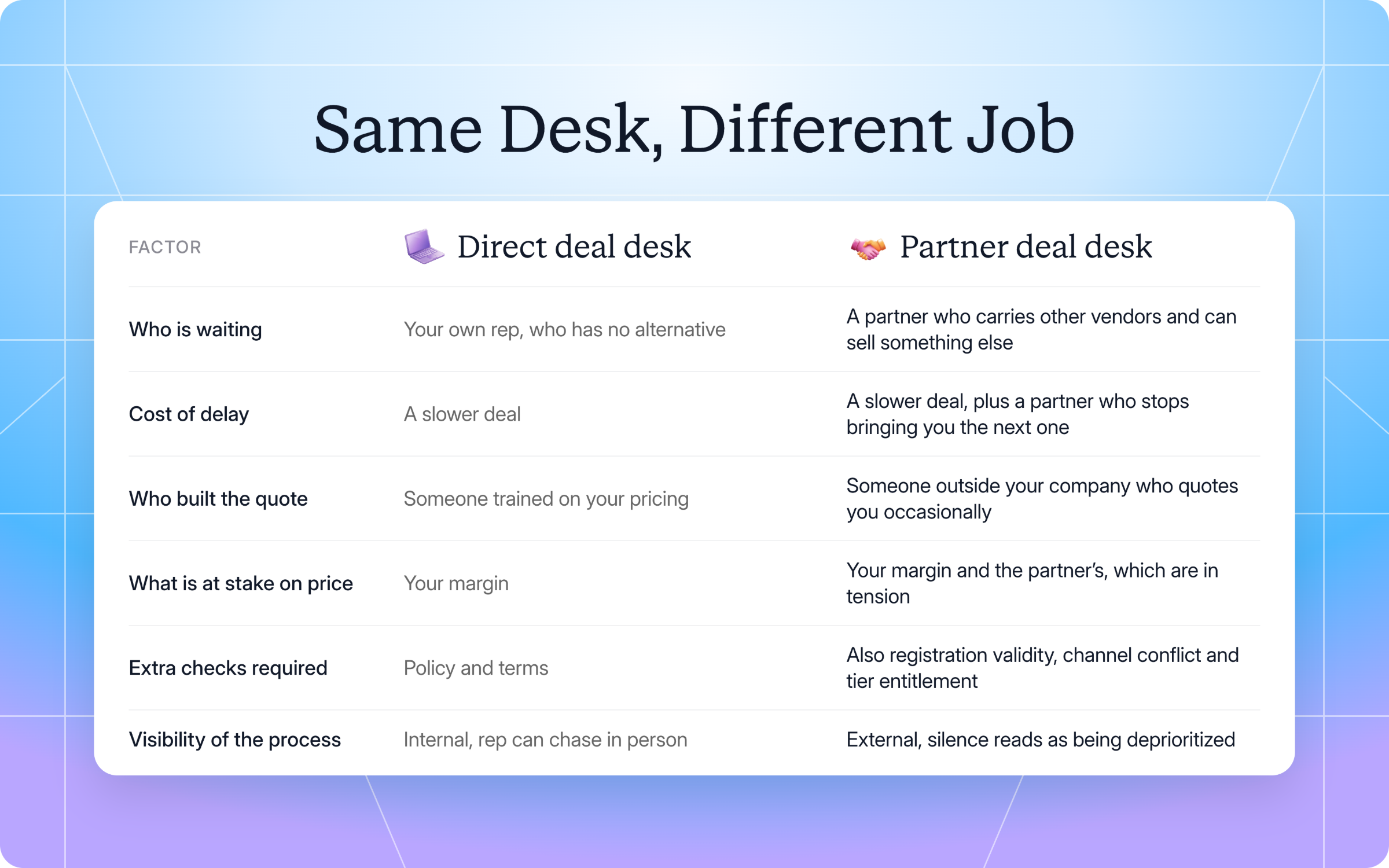
Partner deal desks also do more than approve price and margin. They’re implicitly confirming that the deal legitimately belongs to the partner, that there’s no channel conflict, and that their tier entitles them to the terms they're asking for. These are channel questions, not finance questions.
The deal desk serves the entire sales organization by protecting margin across different partner types, from value-added resellers to referral partners. When the deal making process crosses organizational boundaries, customer satisfaction depends on the partner’s experience of your process, not just the outcome.
Review less, not faster
One of the biggest shifts between a direct deal desk and a partner deal desk is review time. A direct deal desk is measured on how well it reviews exceptions. But a partner deal desk should be measured on how few deals reach it at all. Every deal desk review is friction applied to someone not working for you, so the goal is to reduce that friction as much as possible.
Reviewing less doesn't mean approving faster. It means not making wrong answers available upstream. If partners can only see products they’re authorized to sell, and pricing applies automatically from their tier, then most quotes are correct by construction and need no review.
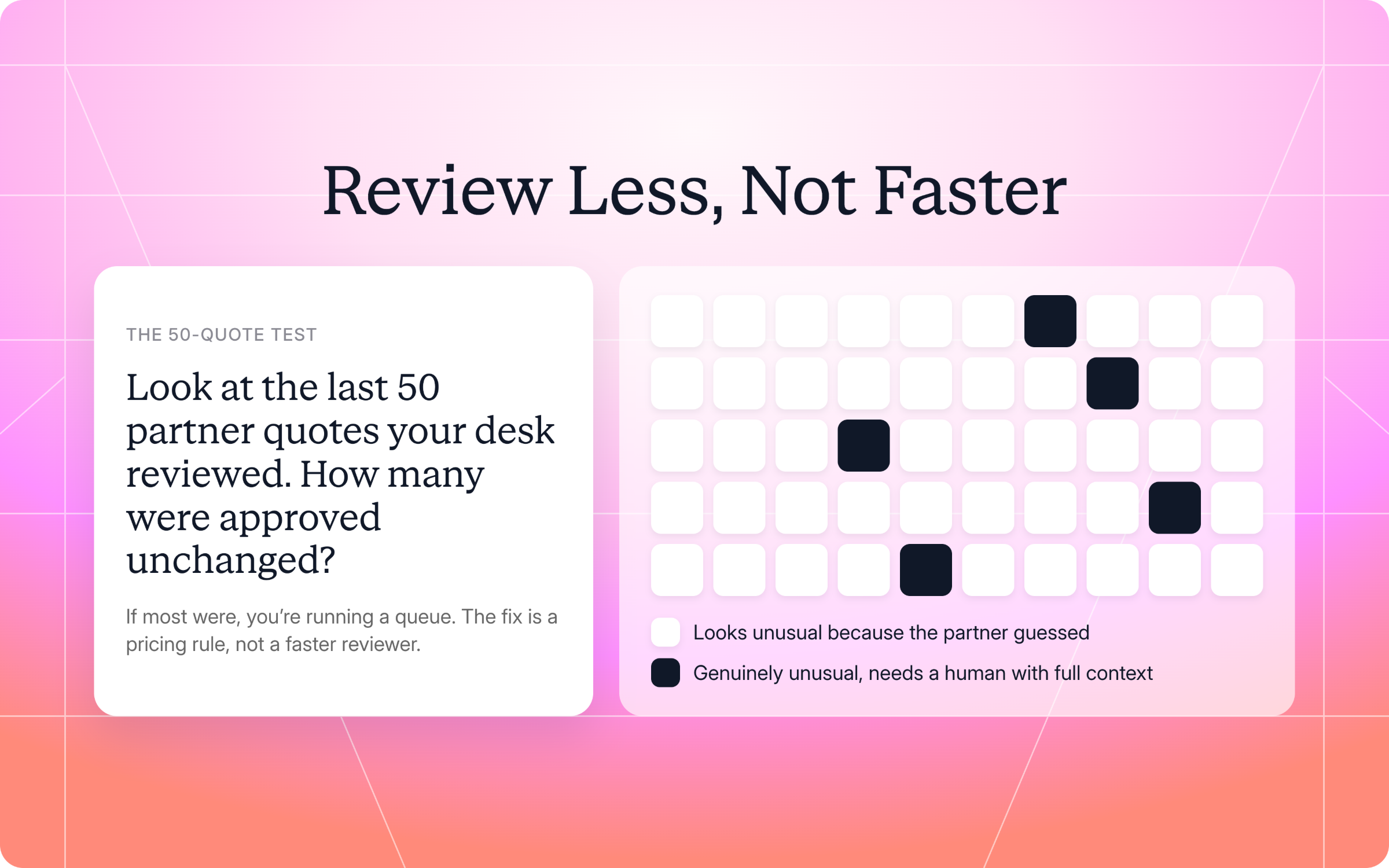
A partner deal can look unusual for two reasons:
- It’s genuinely unusual (discounts beyond policy, custom terms, multi-year deals, etc.)
- It appears unusual because the partner guessed when filling it out
If you auto-approve the straightforward majority, you can leave the true exceptions to a human with full context.
Look at the last 50 partner quotes your desk reviewed. How many were approved unchanged? If most were, you’re not running a deal desk, you are running a queue, and the fix is a pricing rule rather than a faster reviewer.
It’s the same logic as guided selling for partners. Guidance for external sellers has to live in the system, because you can’t train it into them. It’s not about giving partners less support. It’s to give them the kind of support that doesn’t require your team’s time. A modern deal desk understands that the entire sales cycle benefits when governance lives upstream, and an effective deal desk reviews fewer deals, not more.
Who sits on a deal desk team
The shape of your deal desk might have more sides depending on how large your company is. In smaller companies it’s usually one person inside revenue operations, and they often work part-time. But at scale it can look like a dedicated deal desk team with analysts, a manager, and standing representation from finance teams and legal teams.
Here’s what each role does:
- Deal desk analyst: Owns the day-to-day review, structuring, and quote checks.
- Deal desk manager: Owns policy, thresholds, and escalation.
- Finance: Owns margin and revenue recognition.
- Legal: Owns non-standard terms.
- Customer success teams: Own the post-sale relationship, ensuring approved terms don't create downstream friction for the customer or other teams.
- Channel/partner operations: Owns registration validity, conflict, and tier entitlement in the context of partner deals.

Someone suited for a deal desk role needs commercial judgement more than pure analytical skill. The best people can hold a margin line without killing a deal, and they can explain a no in a way that keeps the relationship intact.
If you’re staffing a partner deal desk, remember that the person waiting on the answer is a customer of your program, not a colleague. That changes the entire relationship. The people you put on a channel deal desk need to internalize that, because it changes how you negotiate, how fast you respond, and how you deliver a no.
How to build a partner deal desk
While the success of a partner deal desk requires knowledgeable people, it’s less about hiring people and more about designing the system around them. Effective deal desk operations require a deliberate order: Define the rules first, automate what you can, then gate only what remains. If you skip a step, the desk ends up reviewing deals it shouldn’t have to.

Step 1: Define what standard means, in writing
Deal desks establish processes for exception handling. That starts with setting clear expectations. Define standard pricing by tier, standard terms, standard deal shapes. Once it’s written, partners can self-serve the majority of quotes without ever involving your desk. A profitable deal starts with a clear definition of what standard means.
Step 2: Set approval thresholds, not approval habits
Your approval flow should be an approval matrix, not a guess. Map out what discount percentage, deal value, or term length calls for human intervention, and specify who that human is at each level. Publish it so partners don’t need to ask.
Step 3: Push governance upstream into the catalog and pricing
Scope which products each partner segment or tier can quote, and apply tier pricing automatically. If a gold partner can only see gold-tier SKUs at gold-tier prices, they simply can’t submit a quote that breaks your margin rules, because the system won’t let them build one.
The work happens in the catalog and the pricing configuration, not in the review queue. McKinsey found that companies using dynamic deal scoring with governed approval workflows achieve a typical 3 to 6% improvement in return on sales, by focusing approval processes on the most crucial deals while auto-approving others. The same principle applies here. Your pricing model should enforce company policies automatically, so deal desk involvement is limited to genuine exceptions.
Step 4: Gate only what needs gating
Don’t hand-hold where you don’t need to. Let partners publish standard quotes themselves. Hold for review only the quotes that truly sit outside policy.
The right tool makes this a toggle rather than a workflow. In Introw’s CPQ, turn off “Allow quote publishing” and partner quotes stay as drafts until an authorized reviewer publishes them. The partner still builds the quote, but it doesn’t go anywhere until your desk says yes.
Check out the 16 best CPQ software platforms.
Step 5: Make sure nothing arrives unseen
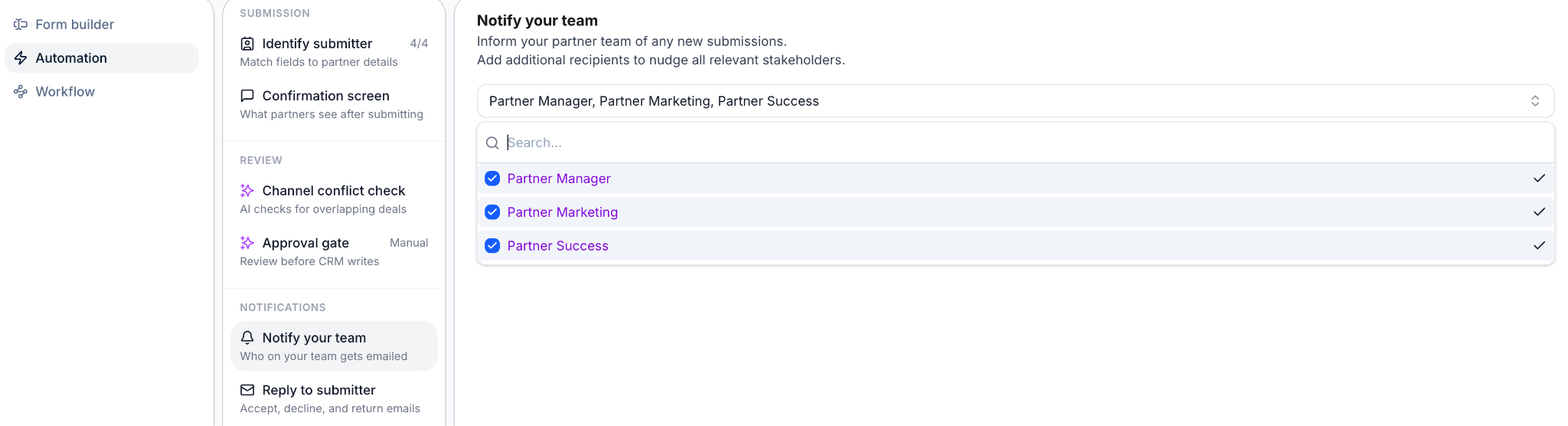
Route deal registrations and submissions to the desk as well as the channel team. That way, if someone's on holiday, someone else can act on it. You’d have a plan for OOO communications with customers, and that's how you should think of partners. The same automation that notifies your channel team can include the deal desk as an extra recipient. In Introw, that's the “Notify your team” automation, so no registration goes unseen.
Step 6: Commit to a response time and publish it
Partners can live with a no. It’s silence that turns a relationship sour. A stated SLA, even a modest one, is worth more to a partner than a faster unstated one, because an unstated SLA has no accountability. If the desk says “we respond within two business days,” the partner can plan around that. If the desk says nothing, every submission feels like it vanished into a black box, and the partner starts emailing the channel manager, the account owner, and whoever else they can find.
Step 7: Close the loop in the partner’s own view
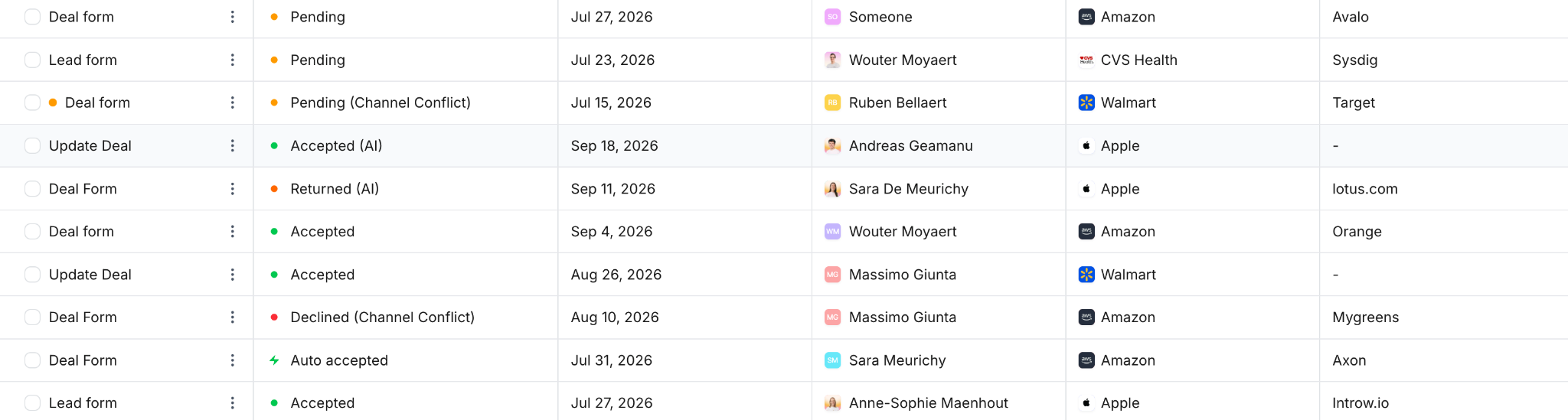
Even with a good SLA, the partner shouldn’t have to email to ask where things stand. Deal status should be visible in the partner portal. CRM-first platforms like Introw build that visibility in, so partners check deal status without chasing anyone.
Step 8: Convert repeat exceptions into rules
Review the exception log quarterly. If your desk keeps approving the same exception, the exception isn’t exceptional anymore. Anything approved the same way three times should become a pricing rule, a tier benefit, or a catalog change. Fixing it upstream means the next partner who asks for the same thing gets it automatically, and your desk never needs to see it.
Deal desk KPIs that matter
The right metrics for a partner deal desk don’t just look at how fast it reviews. They measure how much it has to review in the first place. Track both, and you’ll know whether your desk is efficient or just busy.
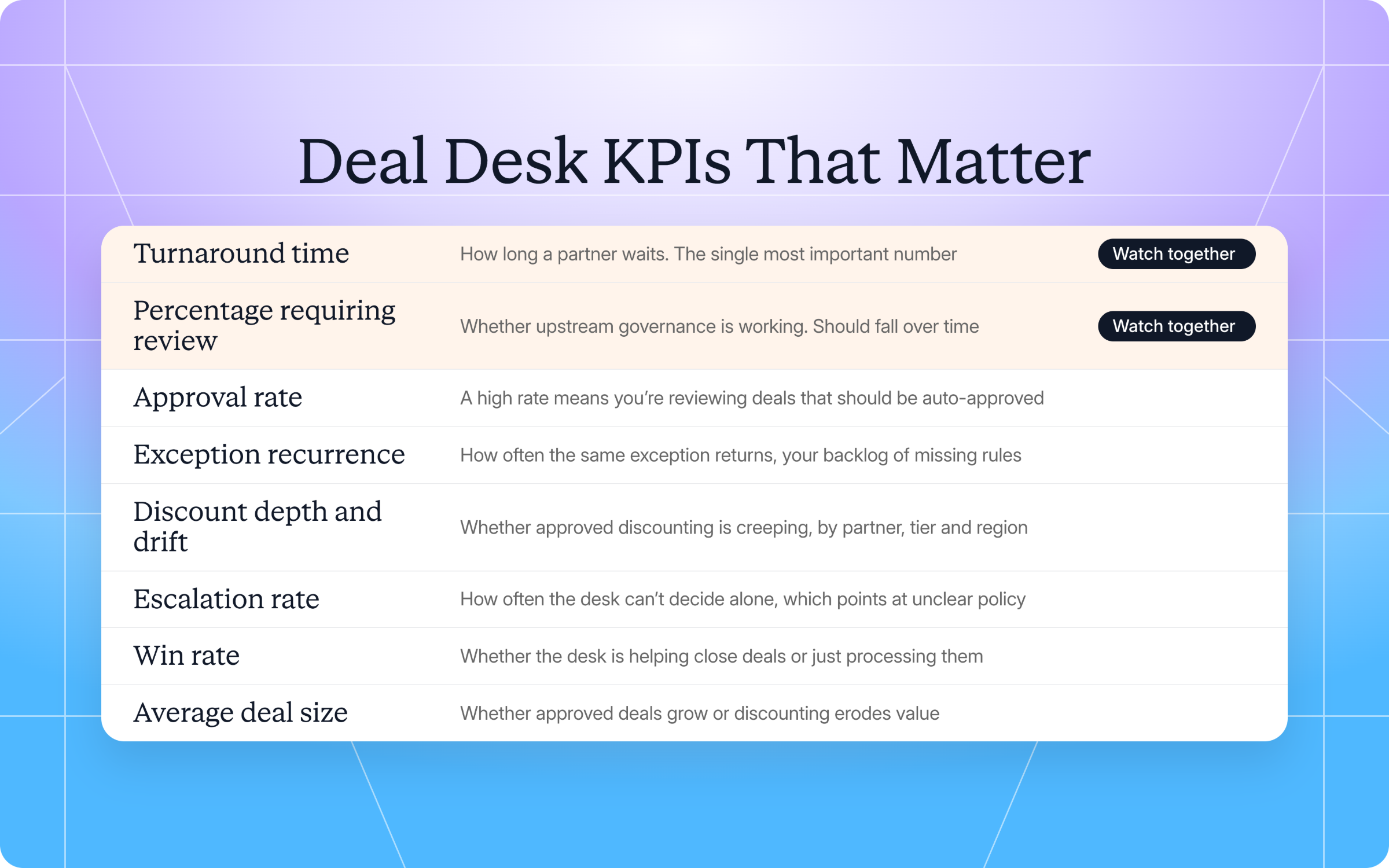
| Metric | What it tells you |
|---|---|
| Turnaround time | How long a partner waits. The single most important number in a partner deal desk |
| Percentage of deals requiring review | Whether your upstream governance is working. This number should fall over time |
| Approval rate | A high rate means you're reviewing deals that should be auto-approved |
| Exception recurrence | How often the same exception comes back, which is your backlog of missing rules |
| Discount depth and drift | Whether approved discounting is creeping over time, by partner, tier, and region |
| Escalation rate | How often the desk cannot decide alone, which points at unclear policy |
| Win rate | The percentage of deals converted to sales, which shows whether the desk is helping close high-value deals or just processing them |
| Average deal size | The typical value of closed deals, which tracks whether approved deals are getting larger or discounting is eroding value |
Turnaround time tells you how fast your desk moves. Percentage requiring review tells you how much work you’re creating for it in the first place. Tracking deal quality alongside speed is a better measure of deal desk performance. Sales efficiency improves and sales analytics should connect desk metrics to revenue outcomes, not just review speed. The deals managed by your desk should shrink over time if your upstream governance is working.
How Introw supports a partner deal desk
Introw is an AI-native, CRM-native PRM platform built for enterprise partner teams running hundreds of partners at scale. It sits on HubSpot and Salesforce as the system of record, and it’s headless, meaning partners can work from their own CRM, Slack, Teams, or an AI assistant like Claude or ChatGPT via MCP instead of logging into a portal.
While Introw doesn’t have an explicit deal desk module, it gives you the controls that decide how much work reaches a deal desk in the first place, plus the gate and the routing for what does. The deal desk software most teams need is the CPQ, approval workflows, and CRM they already have, configured to shrink the review queue.
It starts with the governed catalog. Partners only see products they’re authorized to quote, scoped by segment, tier, and deal criteria. If they can’t build an out-of-policy configuration, that quote never reaches the desk. Tier pricing applies the correct discount automatically, so the most common reason for review disappears.
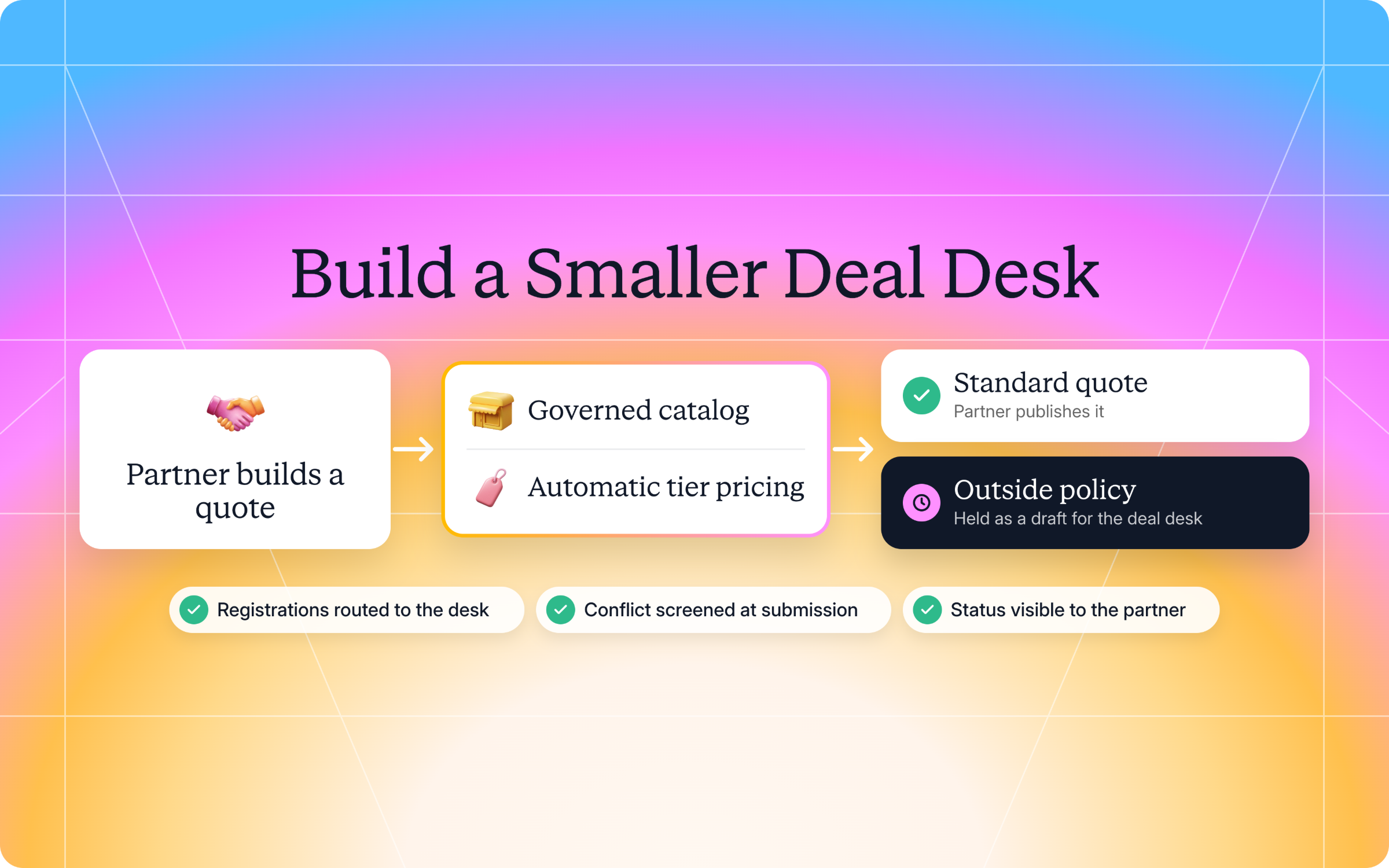
Then you can turn off quote publishing and partner quotes stay as drafts until an authorized reviewer publishes them. Standard quotes flow through. Only the ones that sit outside policy get held.
For deal registration, add the deal desk as an extra recipient on the notify-your-team automation so nothing goes unseen. Registrations are screened for channel conflict at submission, so by the time a deal reaches review, that question has already been answered. And partners see where their quote or registration stands in the partner portal without emailing to ask. Partner attribution also stays accurate because every registration is routed and recorded.
Don’t focus on making a faster deal desk. Build a smaller one. Govern the catalog and pricing properly and the review queue shrinks to the deals that genuinely need judgement.
Ready to shrink your review queue? Book a demo to see for yourself how Introw’s CPQ and partner management tools reduce what reaches your desk.
Still curious? Here are some quick answers to help clear things up
The deal desk process follows a consistent flow: A deal is submitted for review, triaged against policy to determine whether it needs human involvement, routed to the right approver based on threshold, reviewed for margin and terms, and decided with a recorded reason. The goal is to make exception handling repeatable and auditable rather than ad hoc. A well-defined deal desk process flow ensures that every approval is traceable and that repeat exceptions get converted into rules over time.
A deal desk job description should emphasize commercial judgement over pure analytical skill. The role requires pricing and contract literacy, cross-functional coordination with finance and legal, and ownership of policy thresholds. The best people can hold a margin line without killing a deal, and explain a “no” in a way that preserves the relationship. For a partner deal desk, add familiarity with registration validity, channel conflict, and tier entitlement, since those checks are part of every review.
Usually not as a standalone tool. Most of the job is done by the CPQ, approval workflows, and CRM you already have. The value comes from configuring those tools to govern pricing and approvals upstream so fewer deals reach the desk. AI-native platforms like Introw extend this further by making deal status, quote approval, and registration routing accessible through Claude, ChatGPT, or your CRM, so the desk and partners work from the same system of record without a separate tool to buy.
The person waiting on a partner deal desk doesn't work for you and has alternatives. If the review takes too long, they take the next deal to a competitor. A partner deal desk also does more than approve price: It confirms registration validity, checks for channel conflict, and verifies tier entitlement. The review includes channel questions that a direct deal desk never encounters, and the cost of delay includes relationship damage, not just a slower close.
The two most important metrics are turnaround time (how long a partner waits) and percentage of deals requiring review (whether your upstream governance is working). Track them together. If you only improve turnaround, you're hiring your way out of a problem that starts upstream. Other useful metrics include approval rate, exception recurrence, discount depth and drift, and escalation rate. The goal is a smaller review queue, not a faster reviewer.





See AI-Native PRM in Action
Book a demo with one of our partner program experts, or explore Introw on your own time.