Channel Partner Private Offers (CPPO): How to Source and Close Partner Deals Through Cloud Marketplaces in 2027
Learn what a channel partner private offer (CPPO) is, how CPPO deals flow on AWS and Azure, and how to run the partner program once the marketplace has closed the transaction.


A channel partner private offer lets you sell software through a reseller while the transaction settles on a cloud marketplace. It’s one of the few structures where the vendor, the channel partner, and the hyperscaler all touch the same deal. The marketplace handles the transaction but doesn’t tell you the details relevant to a partner program. Running the program around the CPPO, on the CRM you already trust, is what separates a marketplace deal from a partner program.
Enterprise software sales through hyperscaler cloud marketplaces are projected to surge from $30 billion in 2024 to $163 billion by 2030, driven in part by increasing enterprise adoption of marketplace procurement. By 2027, channel partners will be responsible for the majority of all spend through cloud marketplaces. For every dollar a customer spends on software solutions via Microsoft Marketplace, partners capture up to $6.26 in services revenue across the customer lifecycle.
That growth is thanks to the ecosystem around it. This includes the resellers who own the customer relationship, the hyperscaler sellers who co-sell, and the software vendors who need to close deals while keeping their channel intact. A channel partner private offer (CPPO) is the structure that makes all three parties work together on a single deal. But the marketplace only closes the transaction. Everything around it, the attribution, the collaboration, the commission, the relationships, is yours to run.
This guide covers what a CPPO is, how it works on AWS and Azure, how the deal flows, and how to run the program once the marketplace has closed the transaction.
What is a private offer?
A private offer is a custom deal on a cloud marketplace, negotiated directly between a software vendor and a customer, with custom pricing and terms that differ from the public listing. Marketplace public listings are standardized, but real enterprise deals rarely are. Private offers let the negotiated commercial reality settle through the marketplace itself. The value of that structure is that both sides get terms they agreed to rather than the public defaults.
One of the main reasons individual deals route through the marketplace is committed spend. Most large customers have a committed spend agreement with their cloud provider, a contractual commitment where the customer agrees to spend a specific amount on cloud services over a defined period in exchange for discounts or other benefits. On Amazon Web Services (AWS), this is an Enterprise Discount Program (EDP). On Microsoft, it’s a Microsoft Azure Consumption Commitment (MACC).
This is important for software vendors because purchases made through the marketplace count toward that commitment. So when a customer buys your software solutions on AWS Marketplace or Azure Marketplace, they’re effectively paying for it out of money they have already promised to spend.
From their perspective, it’s not new budget. It’s money they’re already obligated to spend, and marketplace purchases help them meet their commitment rather than letting it go unused. The procurement process is simplified for the customer, and the vendor gets to extend their reach into accounts where committed cloud money is the budget.

Private offers also support vendor-defined terms, a marketplace capability that lets the software vendor set custom commercial terms on an offer. This includes:
- Pricing plans
- End-user license agreements
- Renewal conditions
- Offer duration and end date
- Bundled services or add-ons
- Payment schedules
This is a feature of the marketplace itself, not of any partner program. It exists so that the negotiated terms between vendor and customer can be formalized within the marketplace transaction. This gives both parties access to a subscription with terms they agreed to, rather than the public listing defaults.
What is a channel partner private offer?
A channel partner private offer is a marketplace private offer where a channel partner, typically a reseller or value-added reseller, is included in the transaction. The vendor sells through the partner while the deal still settles on the marketplace and is eligible for the customer’s committed cloud spend.
CPPOs let you keep the benefits marketplaces and resellers have to offer. You don’t have to choose between selling through your reseller or selling through the marketplace. The reseller keeps the customer relationship and their margin, and the customer still gets the drawdown benefit. All three parties win.
This matters more than it might sound, because partners are becoming even more central to marketplaces. By 2030, partners will facilitate nearly 60% of all marketplace transactions, helping customers manage commitments, purchase across multiple cloud marketplaces, and provide expertise across the full customer lifecycle.
CPPO on AWS enables independent software vendors (ISVs) to authorize consulting partners to receive wholesale pricing on their third-party software or professional services. Channel partners create private offers with customized solutions, customized pricing, duration, end-user license terms, and additional services.
Microsoft’s multiparty private offers play the same role on Azure Marketplace, with MACC drawdown instead of EDP. The same process applies whether you’re an ISV based on AWS or Microsoft. The partner creates a reseller offer with tailored pricing and negotiated pricing, and the end customers accept through the marketplace.
The three parties and what each one wants
A CPPO is one of the few deals where three separate parties each have a legitimate claim on the same transaction. That’s what makes it operationally harder than a normal sale. The transaction is clean. The credit, the margin, and the relationships aren’t, and no marketplace can resolve those for you.
| Party | Role in the deal | What they want from it |
|---|---|---|
| You, the software vendor (ISV) | Owns the product and sets the offer | The deal closed, the channel kept whole, and marketplace revenue that counts toward your hyperscaler relationship |
| The channel partner or reseller | Owns the customer relationship and transacts the offer | Margin protected, credit for the deal, and no surprise that the vendor sold around them |
| The hyperscaler (AWS or Microsoft) | Operates the marketplace and often provides a co-selling seller | Committed spend consumed, and a co-sell win attributed to their seller |
The customer wants to pay from committed cloud money and receive a single bill with simplified procurement. When the three parties above also have their interests met, the customer gets what they want automatically.

Getting those interests aligned is where channel sales and co-sell comes in. The hyperscaler’s own seller is the connective tissue between the vendor, the partner, and the marketplace, and the results are measurable. Partners who co-sell with AWS sellers report software sales growth twice that of partners who do not participate. 75% of surveyed AWS Marketplace partners participated in co-selling, and partners report 41% faster growth of their marketplace business than their overall software business.
On the Azure side, Microsoft’s multiparty private offers are built around the same dynamic. Customers maintain their trusted partner relationships while counting the purchase toward their MACC, software companies unlock deals when the partner owns the customer relationship, and channel partners create personalized offers with custom payouts.
AWS and Azure: How the two compare
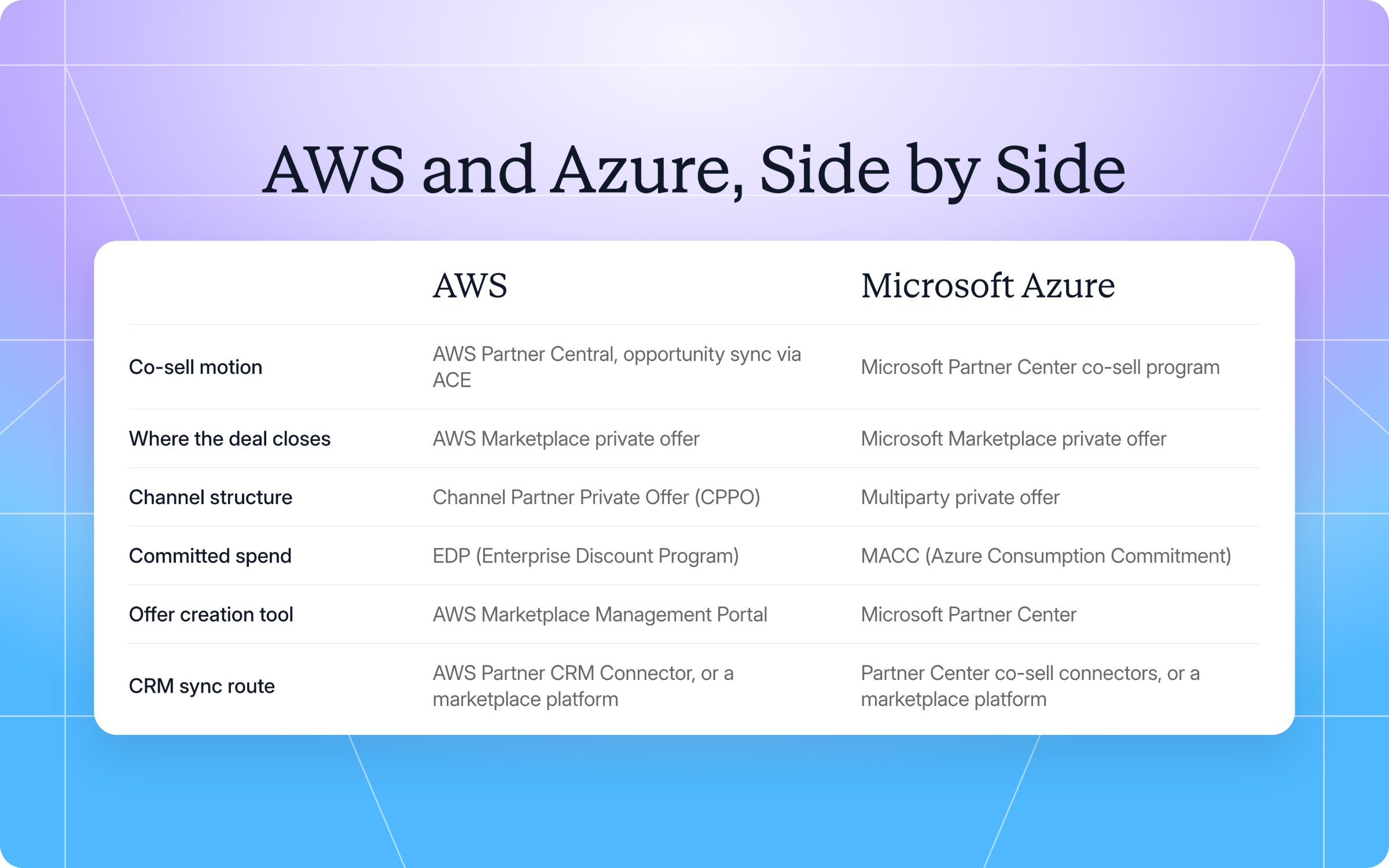
If you’re running marketplace deals, chances are you live on one hyperscaler and know its terminology well. But your partners and your customers are not all on the same one. A reseller who transacts on AWS today may need to close a deal on Azure tomorrow. The naming, tooling, and commercial details are different enough to trip you up if you’ve only learned one side. Google Cloud Marketplace private offers follow a similar pattern, but this guide focuses on the two marketplaces where most channel partner deals happen today. Here’s how the two compare side by side.
| AWS | Microsoft Azure | |
|---|---|---|
| Co-sell motion | Runs through AWS Partner Central, with opportunity sync via the ACE connector | Runs through Microsoft Partner Center co-sell program |
| Where the deal closes | AWS Marketplace private offer | Microsoft Marketplace private offer |
| Channel structure | Channel Partner Private Offer (CPPO) | Multiparty private offer |
| Committed spend drawdown | EDP (Enterprise Discount Program) | MACC (Microsoft Azure Consumption Commitment) |
| Offer creation tool | AWS Marketplace Management Portal (AMMP) | Microsoft Partner Center |
| CRM sync route | AWS Partner CRM Connector (Salesforce), or a marketplace platform | Partner Center co-sell connectors (Salesforce, Dynamics 365), or a marketplace platform |
The commercial details differ in ways that affect your margins and your reach. On Azure, Microsoft charges a 3% standard marketplace fee across all offer types, with a 50% reduced agency fee for customer renewals transacted via private offer. Since that renewal discount was introduced in October 2024, roughly half of renewals have come from new marketplace customers, suggesting the fee structure is actively pulling net-new buyers onto the marketplace rather than just simplifying existing ones.
On AWS, channel partners don’t pay transaction fees through CPPO, which preserves partner margins on resold deals. The ISV sets a wholesale cost through a selling authorization in AMMP, and the channel partner marks it up to create the buyer’s price. That wholesale cost can be set as a recurring discount for ongoing authorization or a non-recurring discount for a one-time deal to a specific buyer or specific customer.
Geographic reach is also expanding on both sides. Microsoft’s multiparty private offers expanded to 30 European countries as of May 2026, with further expansion to Australia, Japan, and South Africa in July 2026. On the AWS side, Partner Central now supports associating AWS Marketplace listings directly with co-sell opportunities as of July 2026, closing a gap that previously required partners to manage marketplace listings and co-sell solutions separately, according to AWS.
How a CPPO deal actually flows
A CPPO deal flow is similar on both marketplaces even if the terminology differs slightly. Whether you’re using AWS or Azure, every CPPO deal moves through the same five stages:
- 1. The ISV authorizes the channel partner to resell the product: On AWS, this is a selling authorization created in AMMP. On Azure, the software company creates a new private offer and sends it to the channel partner through Partner Center.
- 2. The channel partner creates and prices the offer for the buyer: The partner starts from a wholesale cost set by the ISV and marks it up to create the buyer’s price, with custom terms, duration, and any additional services bundled in.
- 3. The customer accepts the offer and subscribes: On AWS, the buyer accepts through AWS Marketplace. On Azure, the buyer accepts through Microsoft Marketplace. Customers use the marketplace to purchase solutions with a subscription that counts toward their committed spend.
- 4. The hyperscaler invoices the buyer and collects payment: AWS invoices the buyer directly to their billing account. Microsoft invoices the buyer according to their existing billing terms with Microsoft.
- 5. The hyperscaler disburses payment to both the channel partner and the ISV: The marketplace handles the split, so neither party has to chase the other for payment.

On paper, this workflow looks like a clean, easy process. But if you’ve run one of these deals before, you know the complications that show up at each step.
For one, eligibility rules determine which partners can transact, and those rules are not the same across marketplaces. The timing between offer creation and acceptance can stretch as well, especially when the buyer needs internal approval.
The biggest issue is that at acceptance you have a transaction. That doesn’t mean you have a program record. The marketplace doesn’t tell you who sourced the deal, who influenced it, which hyperscaler seller helped close it, or what your reseller is owed beyond the margin built into the offer. The transaction is done. The program around it hasn’t even started.
What the marketplace doesn’t do
Cloud marketplaces let you reach potential buyers who want to use their committed cloud money, and the marketplace handles contracting, billing, and payout well. However, they don’t have a partner program built-in. That’s still yours to run. If you don’t build a partner program, that absence comes with real consequences, especially at enterprise scale where you are managing hundreds of deals across multiple hyperscalers, resellers, and territories.
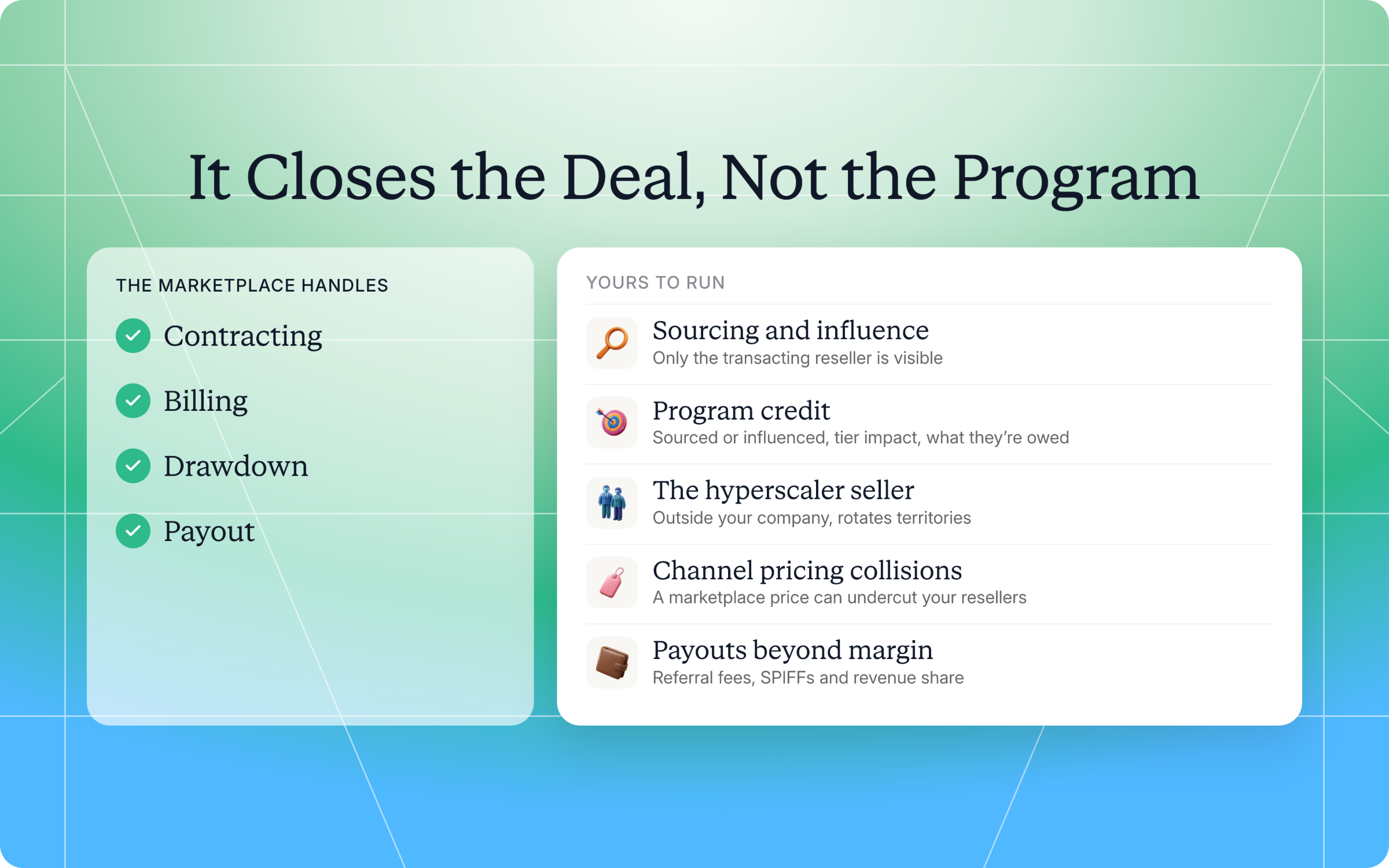
Sourcing and influence are invisible
Inside the marketplace you can see that the transaction happened, but not who brought it to the table. You only see the reseller that transacted. The AWS or Microsoft field seller who helped is recorded in the co-sell system, not in the marketplace transaction. The partner rep who first identified the need doesn’t appear at all.
Co-sell is deepening, which makes this lack of visibility worse. Cloud partner-influenced pipeline is expected to climb from 22% to 30% of net-new deals, and companies are backing that with serious investment, expanding their cloud GTM teams by 37% on average. 80% of organizations are already co-selling with multiple clouds. All of that activity runs through your deals, and almost none of it shows up in your marketplace records.
That invisibility can impact your partner relationships. Companies that extensively use market data see 36% of their sellers close at least one marketplace deal, compared to just 24% at companies that have not adopted market intelligence. The data is what unlocks broader seller participation. Without it, you’re essentially asking your team to co-sell blind, and your partners to trust a program where they can’t see their contribution.
Partner credit isn’t a program credit
A closed marketplace deal means one of your partners transacted. But it doesn’t help you figure out whether the deal was partner-sourced or partner-influenced, two categories that mean very different things for how you credit and reward partners.
Your program still needs to know whether that counts as sourced or influenced, how it affects their tier, and what they are owed beyond marketplace margin. The marketplace settles the transaction credit. The program credit, the stuff that determines tier progression, MDF eligibility, and payout, is yours to figure out.
The hyperscaler seller isn’t in your system
The AWS or Microsoft field seller who helped move the deal is outside your company. They won’t ever log into your portal, they work from their own CRM, and they rotate territories on a schedule you don’t control. At enterprise scale, territory changes happen constantly across large organizations.
That means when a seller moves, the relationship, the deal history, and the momentum move with them, or they don’t. If your only record of that seller’s involvement lives in someone’s inbox, you lose it every time a territory shifts. The marketplace doesn’t maintain that relationship for you. It’s yours to track, and at scale, it’s equally yours to lose.
Pricing can collide with your channel
The partner sets the price the customer sees, not you. That price can undercut what your other resellers are quoting for the same product, or conflict with pricing you have agreed elsewhere in your channel. So, if you’re running enough volume across multiple partners and marketplaces, channel conflict happens regularly, and it erodes trust with the partners who feel undercut.
The marketplace has no visibility into your broader channel pricing, so it can’t “warn” you. Detecting a collision means checking every marketplace offer against your live partner pipeline, which is impossible to do manually once you’re operating at scale.
Payouts beyond marketplace margin are yours to run
The marketplace handles its own transaction and disbursement. If your program pays referral fees, SPIFFs, or revenue share on top, the marketplace can’t calculate that for you.
If your program pays partners anything beyond marketplace margin, and most enterprise programs do, you’re running that calculation yourself. At enterprise scale, this means reconciling marketplace statements from multiple hyperscalers and resellers, each with its own format and cadence, against your payout rules.
Why the program layer matters
For enterprise teams running hundreds of CPPO deals, the disconnect between what the marketplace does and what the program needs is where deals stall, partners go unpaid, and credit gets lost. That’s why the market is moving toward purpose-built ecosystem management tools.
Gartner explains that AI-enhanced PERM applications can scale, accelerate, and automate partner efforts to expand market reach and orchestrate collaborative revenue models. This all points to the fact that the program layer needs to live where the rest of your partner data already lives, which is the CRM where your sales team already works.
Getting marketplace deals into your CRM
Before you can run a program around a marketplace deal, the deal has to reach your CRM. That happens through a few well-established routes:
- On AWS, the AWS Partner CRM Connector syncs co-sell opportunities and private offer records into Salesforce.
- On Microsoft, the Partner Center co-sell connectors do the same for Salesforce and Dynamics 365.
- If you’re transacting across both hyperscalers or working with multiple resellers, a marketplace platform such as Tackle, Clazar, WorkSpan, or Suger can centralize listing, offer creation, and then sync into your CRM.

These tools handle listing operations, offer creation, and sync with your CRM. But once the record arrives, a different set of questions begins.
Who sourced the deal? Which seller influenced it? What does the reseller earn beyond marketplace margin? Does the price the customer was quoted conflict with what your other partners are quoting for the same product? These answers belong to the layer that runs on top of the CRM, not the layer that feeds it.
That layer is partner relationship management (PRM). PRM platforms like Introw read the CRM as it is and turn the marketplace record into a program deal the moment you attribute it to the hyperscaler partner.
Once the deal is in the CRM, the program doesn’t require anyone to log into a portal. Introw reads the CRM record as it is, and the work of attribution, collaboration, conflict detection, and commission can be done from Claude, ChatGPT, or any assistant that supports MCP, with the same permissions as the portal.
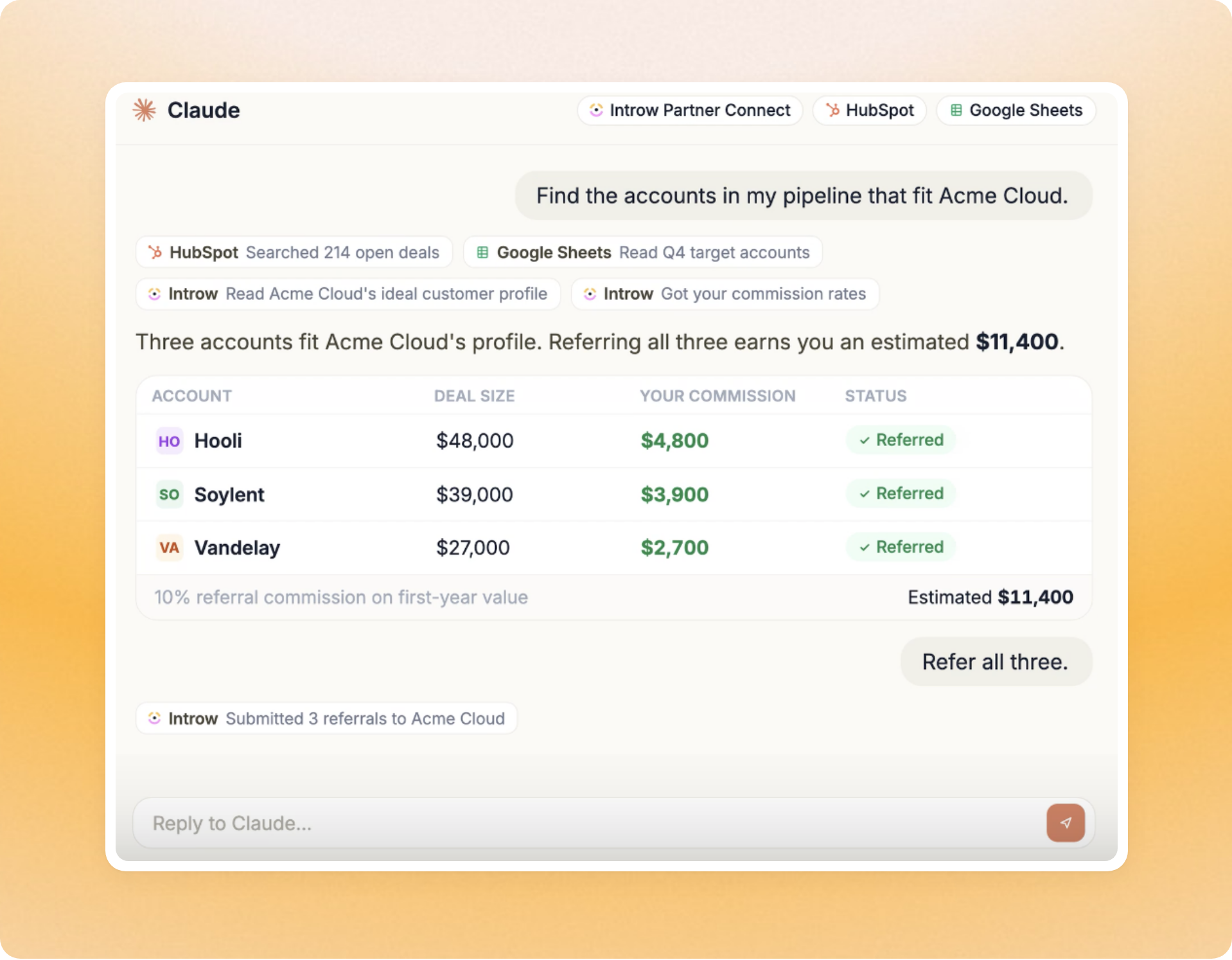
For an enterprise team running hundreds of marketplace deals across multiple hyperscalers, that means no second database to maintain, no portal to force sellers into, and no manual reconciliation between what the marketplace closed and what the program needs. The PRM handles the program, headlessly.
Running the program once the deal is in the CRM
Once the marketplace record lands in your CRM and gets attributed to a hyperscaler partner, it becomes a program deal. It needs the same things every partner deal needs: attribution, collaboration, enablement, conflict detection, and commission.
The difference is that a CPPO deal carries more parties and more complexity than a typical referral. The reseller transacted. The hyperscaler seller likely influenced. Your own team may have sourced or co-sold. Each has a claim, and the marketplace record doesn’t resolve any of them. That work happens here, on the CRM record, in the program layer:

- Three-party attribution: The reseller and the hyperscaler sit on the same CRM deal, each attributed as sourced or influenced, just like the multi-party model that applies to two-tier distribution. When a QBR asks who drove what revenue, the answer lives on the deal, not in a spreadsheet someone maintained by hand.
- Seller collaboration without a login: The AWS or Microsoft seller who helped move the deal will never log into your portal. Introw adds them to the shared deal record, and they get status updates by email, Slack, or Teams, with replies tracked on the record.
- Rotation-proof relationships: When a hyperscaler seller changes territory, swap the contact on the deal. The history stays intact, the new seller picks up where the old one left off, and there is no re-onboarding.
- Enablement for sellers you don’t employ: Announcements and the content library push battlecards and joint pitch decks to hyperscaler and reseller sellers based on tier, region, or deal context. Every asset view is tracked back to the partner and the deal in the CRM.
- Conflict detection across channels: Submissions are checked against live CRM and partner pipeline, where marketplace-versus-reseller pricing collisions surface. The detection runs continuously, not as a manual review step.
- Commission on marketplace revenue: Marketplace statements arrive as files, and a commission plan can use file upload as its data source so each row earns on your usual rules. Statements from multiple hyperscalers and resellers need a single commission engine that can handle all of them. Finance pays one invoice, and Introw pays every partner in the ecosystem in their currency.
This is where Introw runs the program. It’s CRM-native, working on the HubSpot or Salesforce record as the single source of truth. It’s enterprise-grade, with SSO, SCIM, and the ability to scale to tens of thousands of partners without breaking down. And Introw is AI-native, headless and agentic, so the same program work that happens in the portal can also happen through Claude, ChatGPT, or any MCP-compatible assistant, with no separate login required.
The marketplace closes the transaction. The program runs on the CRM you already trust.
If you’re running CPPO deals across AWS and Azure and still tracking the program in spreadsheets, book a demo to see how Introw runs the program layer on your CRM. Or explore partner types and program setups for hyperscaler and reseller channels.
Still curious? Here are some quick answers to help clear things up
A channel partner private offer (CPPO) is a marketplace private offer where a channel partner, typically a reseller, is included in the transaction. The vendor sells through the partner while the deal settles on the marketplace and draws down the customer’s committed cloud spend. CPPO, in this context, is always about channel partner private offers that let you sell through a reseller on AWS Marketplace or Microsoft Marketplace.
The AWS marketplace channel private offer CPPO workflow moves through five steps. First, the ISV authorizes the channel partner to resell through AMMP. Second, the partner creates and prices the offer for the buyer. Third, the customer accepts and subscribes through AWS Marketplace. Fourth, AWS invoices the buyer and collects payment. Fifth, AWS disburses payment to both the channel partner and the ISV. The AWS CPPO process is the same whether you’re selling third-party software or professional services. The AWS CPPO partner list includes consulting partners authorized by the ISV through the AWS partner network.
An AWS marketplace private offer is a custom deal negotiated directly between a software vendor and a customer, with custom pricing and terms that differ from the public listing. A channel partner private offer includes a reseller who transacts with the customer. A standard AWS private offer is vendor to customer. A CPPO adds the reseller to the transaction, so the partner keeps the customer relationship and their margin while the deal still settles on the marketplace. Private offers work the same way on both AWS and Azure, with the reseller creating the reseller offer at a markup from the ISV's wholesale cost.
Yes. Marketplace pricing can undercut what your resellers quote for the same product, which is a real multi-channel conflict, not a theoretical one. The marketplace has no visibility into your broader channel pricing, so it cannot warn you. The marketplace itself has no view into the prices your other partners are quoting, so it will never flag a collision for you.
Enterprise teams running hundreds of marketplace deals across multiple hyperscalers and resellers need a program layer that handles multi-party attribution on one CRM record, seller rotation without re-onboarding, and commission on marketplace statements via file upload, all on the CRM record they already trust. At scale, manual tracking and spreadsheets break down, which is why enterprise teams need a purpose-built, CRM-native, AI-native program layer that runs headlessly from Claude, ChatGPT, or any MCP-compatible assistant.





See AI-Native PRM in Action
Book a demo with one of our partner program experts, or explore Introw on your own time.