
What is a partner portal?
A partner portal is a secure, branded, self-service space where external partners access deals, training, content, and the data they need to sell with you while your CRM remains the source of truth.
A partner portal platform gives resellers, distributors, affiliates, and referral partners instant access to relevant sales content and marketing materials. Unlike customer-facing self-service portals designed around customer satisfaction and customer interactions, it supports indirect sales, partner collaboration, partner interactions, and partner relationships without exposing sensitive customer data. As partner relationships grow, the portal provides one controlled workspace.
What a partner portal platform should include
The key features should support the complete partner lifecycle while keeping everyday work simple:
- Deal registration and partner-safe pipeline views. Self-service deal registration protects sales opportunities, shows deal progress, and minimizes channel conflict through clear ownership.
- Sales enablement and content management. A searchable library should give partners 24/7 access to current sales assets, marketing resources, and trackable, co-branded marketing materials with version control and clear resource management.
- Partner onboarding, training, and certification. Embedded training programs or an integrated LMS should automate enrollment, deliver partner training, and manage certifications and recertification.
- Secure, branded access. Look for SSO, white-label design, mobile access, and granular permissions by role, tier, region, or partner type to maintain brand consistency.
- Communication tools partners will use. Announcements through the portal, email, Slack, or other communication platforms help improve partner engagement without requiring constant logins.
- Incentives and funds. Complete partner relationship management software may include commission, rebate, incentive management, and MDF workflows.
- CRM integration and performance analytics. Bidirectional Salesforce or HubSpot synchronization should connect partner activity, deal tracking, attribution, and partner performance to your existing business systems and reporting tools.
Partner portals vs. CRMs, PRMs, and marketplaces
Is a partner portal the same as a CRM?
No. Customer relationship management software is the internal system of record for sales teams, account management, customer data, and business processes. A partner portal is the controlled external layer where channel partners see and act on only the deals, training resources, and marketing content relevant to them. They connect, but a CRM is not a partner portal.
What is the difference between a partner portal and a PRM?
The portal is the experience layer partners log into. Partner relationship management (PRM) covers the broader program management around it, including partner onboarding, rules, tiers, incentive management, performance analytics, and managing partner relationships across the partner lifecycle. Most partner relationship management software includes a portal, but not every partner portal is a full PRM.
Partner portals vs. marketplaces and affiliate networks
A reseller or co-sell portal supports lead management, pipeline access, and controlled partner collaboration. A partner ecosystem marketplace or affiliate network focuses more on partner recruitment, referrals, conversion tracking, and payouts. Both can support revenue growth, but they solve different problems.
Who uses partner portal software for indirect sales, and when do you need it?
Channel leaders, partner managers, marketers, sales teams, and operations teams use portals across software companies, manufacturing companies, and other businesses with indirect sales channels. If you're asking how many partners justify one, a few dozen active partners is a useful warning point, not a rule. Complex partner relationships, low partner engagement, scattered content, and unreliable spreadsheets often matter more than headcount when companies scale partner programs.
Compare the best partner portal software for channel sales
This table compares integration capabilities, deal registration, training, and cost. G2 ratings and review counts were checked in September 2026 and can change.
The shortlist: 11 partner portal software platforms for 2026
Each option has a different balance of partner relationship management, enablement, marketing, CRM depth, and operational complexity.
1. Introw
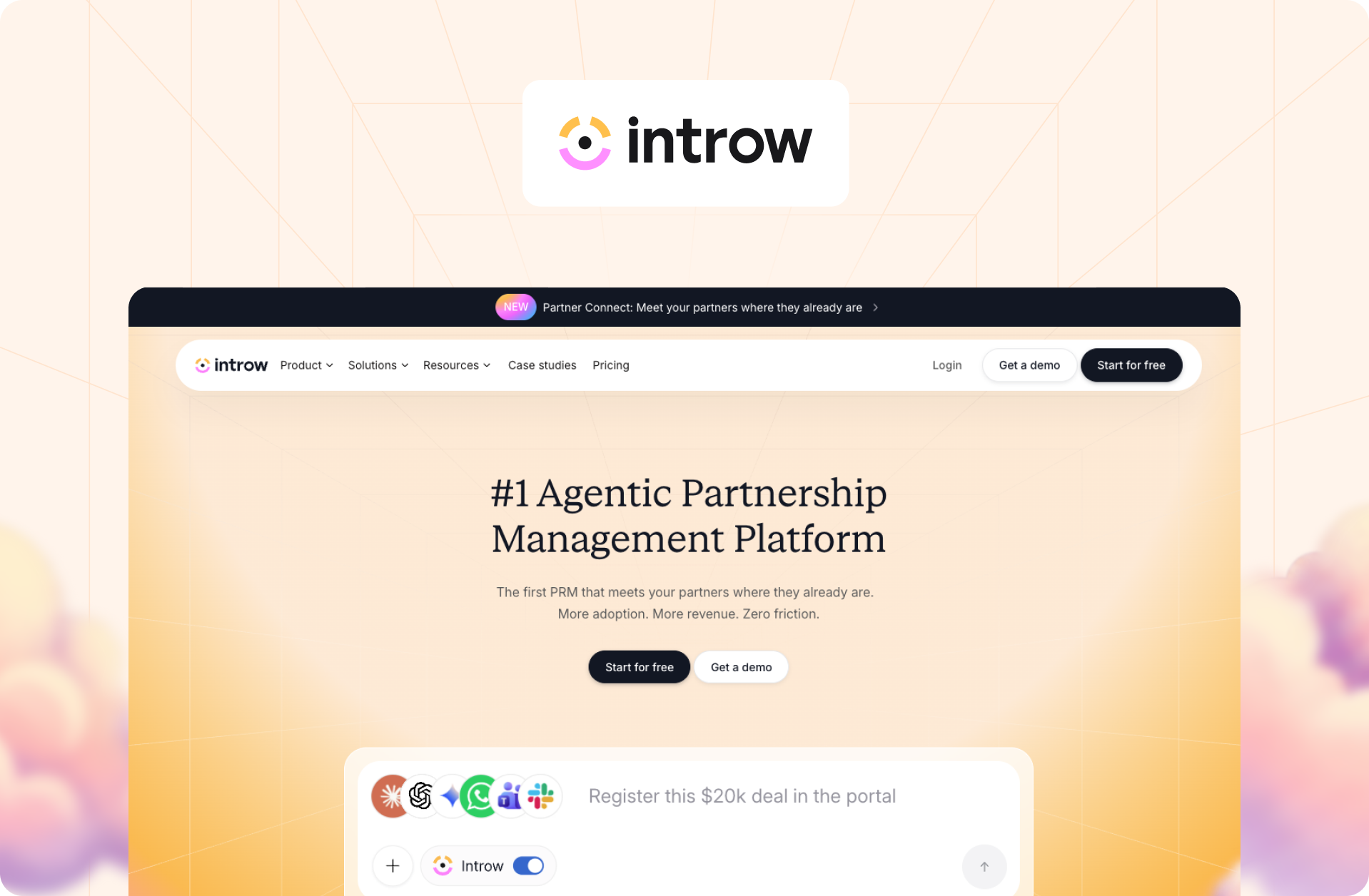
Introw is a CRM-native partner relationship management (PRM) platform for B2B SaaS companies that want fast adoption and trustworthy attribution. It connects portal activity directly to revenue data. Introw has a 4.8/5 G2 rating from 98 reviews.
How Introw approaches partner portals
The partner portal lets external partners register deals, access content, and complete onboarding while Salesforce or HubSpot stays authoritative. Partners can engage through email and Slack instead of logging in for every interaction.
Highlights
- Partner-safe pipeline views and frictionless deal registration
- Native Salesforce integration and HubSpot integration
- Trackable content, announcements, and optional Partner LMS
Considerations
Advanced LMS, MDF, CPQ, affiliate, and Power BI capabilities are paid add-ons.
Pricing
Starter is free for one partner; Pro, Scale, and Enterprise use custom partner-based pricing.
Who is Introw best for?
Mid-market and enterprise SaaS teams building partner relationships that want partner success, partner satisfaction, cleaner business outcomes, and less CRM reconciliation.
2. Impartner
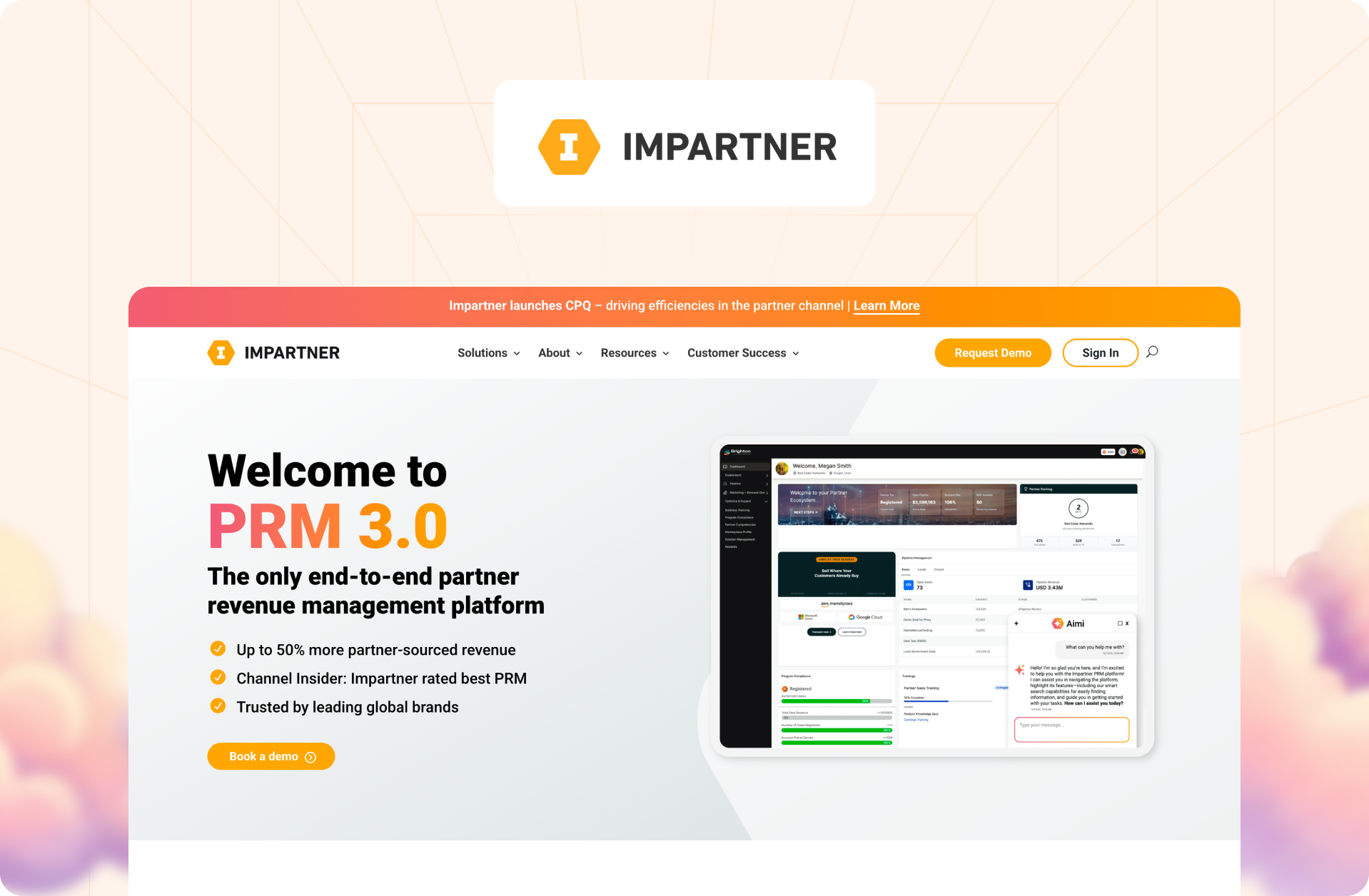
Impartner is an enterprise partner relationship management (PRM) suite for multi-region, multi-tier programs. It emphasizes governance, partner lifecycle automation, and broad program management. Impartner has a 4.4/5 G2 rating from 571 reviews.
How Impartner approaches partner portals
The partner portal supports partner onboarding, deal registration, content, incentives, and personalized access for channel partners. Native bidirectional connections cover Salesforce, HubSpot, and Microsoft Dynamics 365.
Highlights
- Role-based portals with SSO and approval workflows
- SCORM training programs and certifications
- Tiers, incentive management, and partner performance tools
Considerations
Its breadth can require more implementation and specialist administration than a focused portal.
Pricing
Custom/demo required for Emerge, Ignite, and add-on packages.
Who is Impartner best for?
Enterprises and manufacturing companies managing complex partner relationships across regions and partner types.
3. Channeltivity
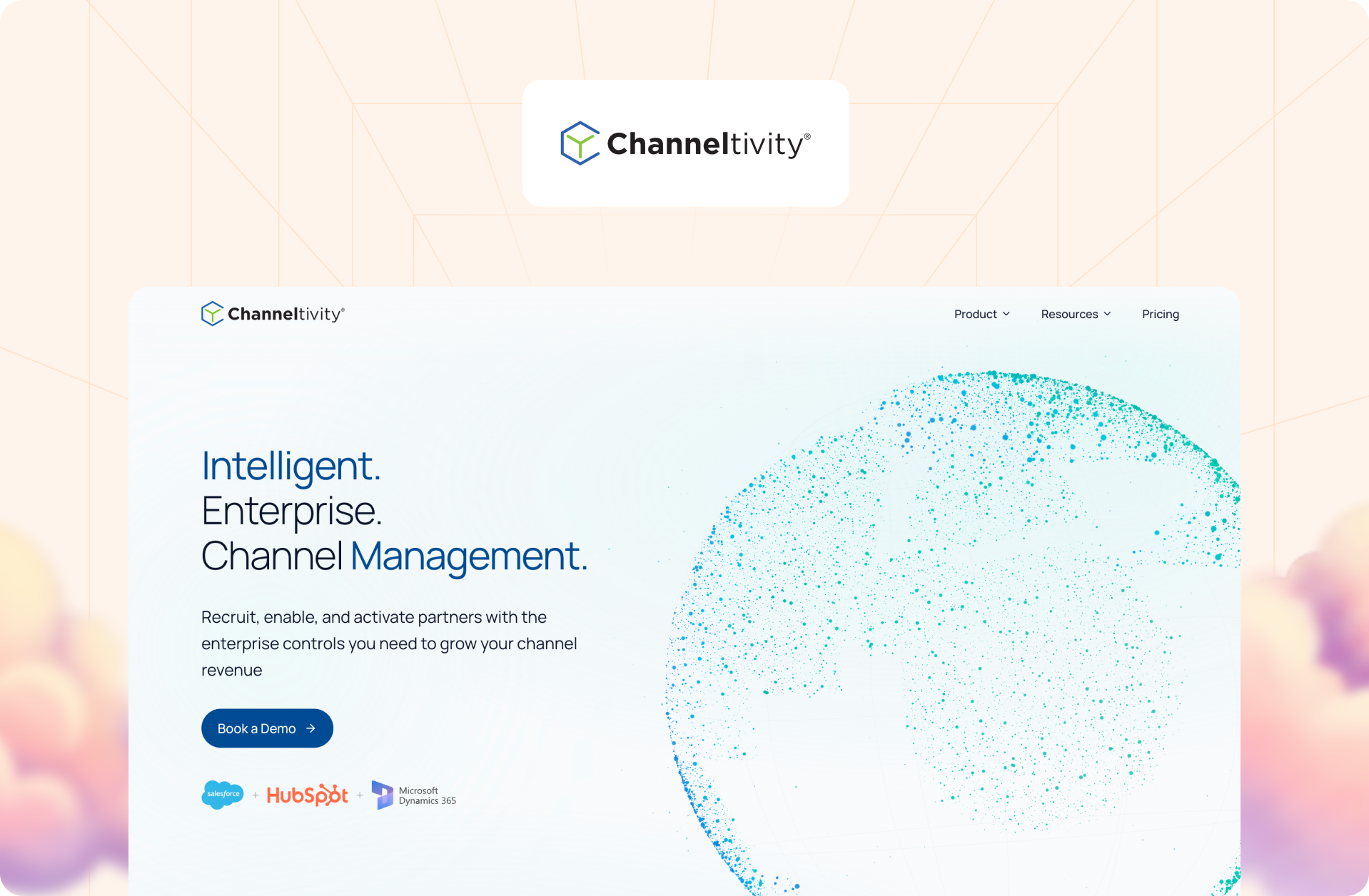
Channeltivity is configurable partner relationship management software for growing and global channel programs. It combines core workflows with an accessible administrative experience. Channeltivity has a 4.7/5 G2 rating from 56 reviews.
How Channeltivity approaches partner portals
The partner portal brings deal registration, lead distribution, content management, and partner onboarding together. Native integrations are available for Salesforce, HubSpot, and Dynamics, subject to packaging.
Highlights
- Configurable deal and lead management workflows
- Integrated LMS supporting SCORM, AICC, cmi5, and xAPI
- Segmented communications and resource libraries
Considerations
Confirm integration packaging and required modules during evaluation.
Pricing
Custom/demo required; current official pricing does not publish dollar amounts.
Who is Channeltivity best for?
Growing channel teams that need full partner relationship management capabilities without the overhead of the broadest enterprise suites.
4. Magentrix
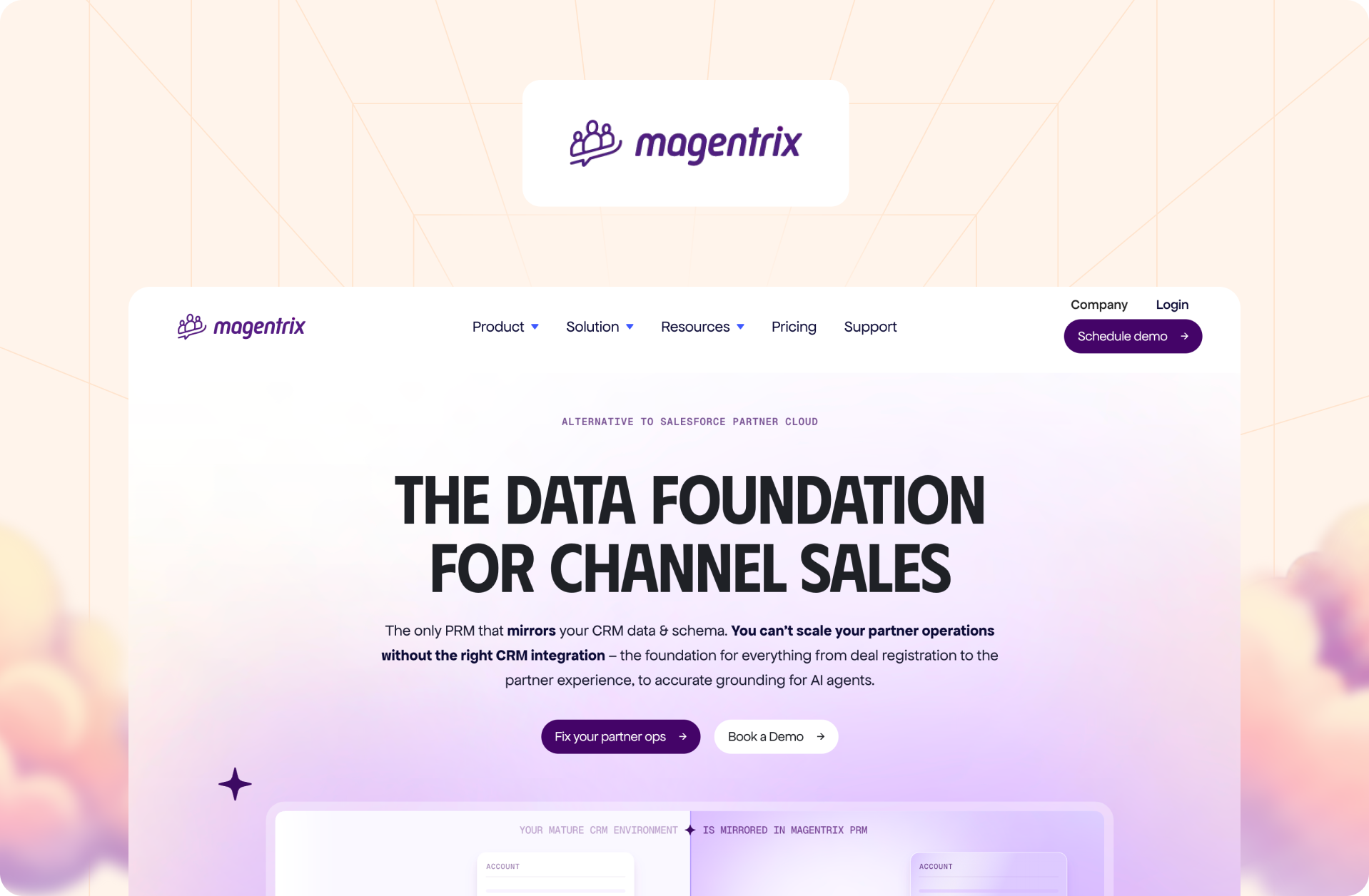
Magentrix is an independent, configurable partner relationship management software with native CRM connections and built-in learning. It is not built on Salesforce Experience Cloud. Magentrix has a 4.6/5 G2 rating from 126 reviews.
How Magentrix approaches partner portals
The partner portal mirrors relevant CRM records and supports account management, deal registration, training, and dashboards. It connects with Salesforce, Dynamics 365, and HubSpot to organize partner relationships.
Highlights
- Flexible layouts, permissions, workflows, and mobile access
- Native LMS included from Essential
- CRM-connected forms, objects, and sales opportunities
Considerations
Salesforce and Dynamics custom objects require Advanced or Unlimited, increasing configuration needs.
Pricing
Essential costs $1,500/month, Advanced $3,000/month, and Unlimited is custom.
Who is Magentrix best for?
Teams that need a highly customizable portal and deep integration capabilities across established business systems.
5. Salesforce Partner Cloud
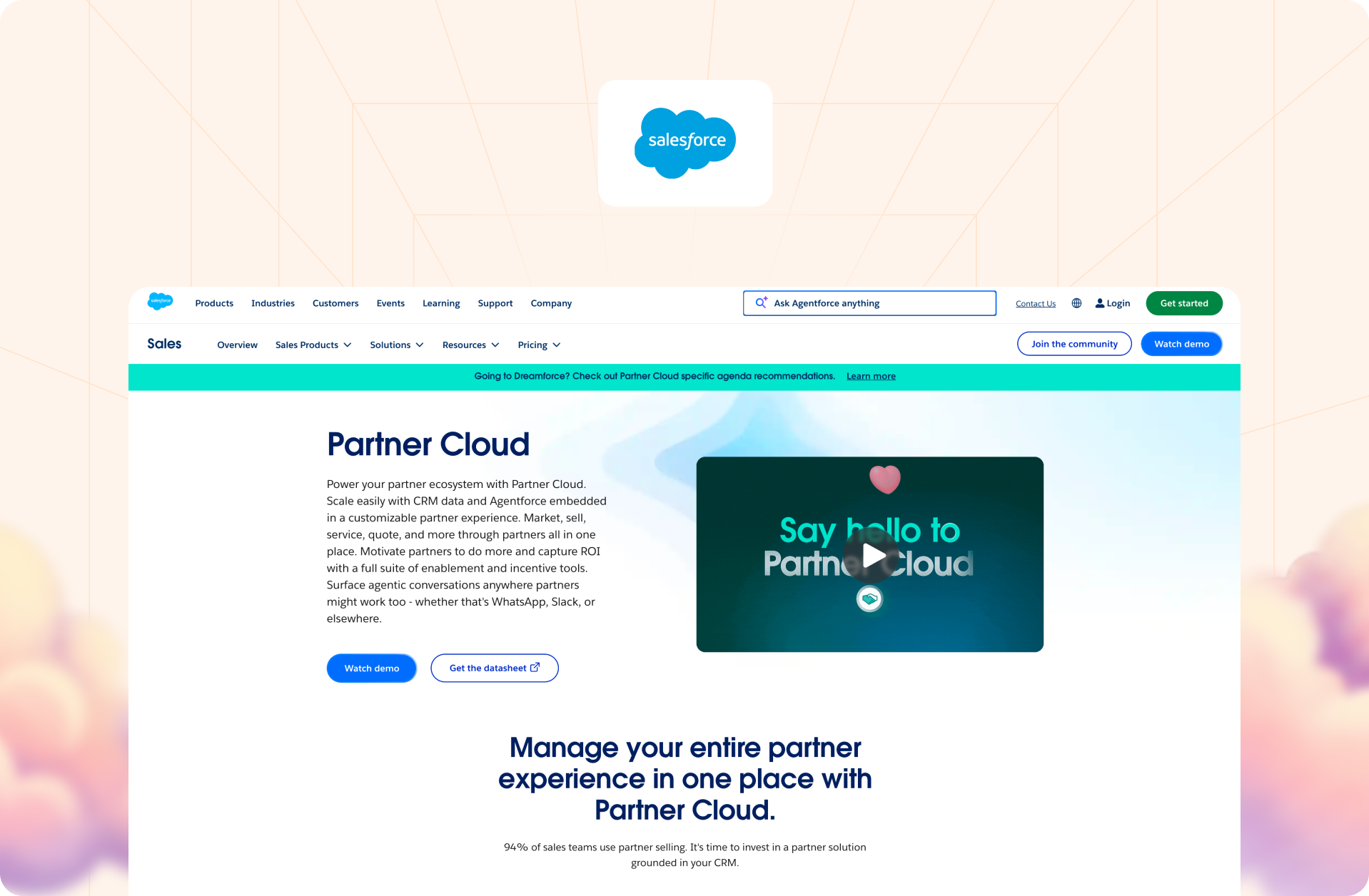
Salesforce Partner Cloud, formerly Salesforce PRM, is a Salesforce-native portal and partner relationship management (PRM) option built on Experience Cloud. It has a 4.4/5 G2 rating from 275 reviews.
How Salesforce Partner Cloud approaches partner portals
The partner portal extends Salesforce data, permissions, business processes, and reporting into a controlled partner experience. Sales teams can manage partner relationships and indirect sales without another core database.
Highlights
- Native deal registration and lead sharing
- Granular access and Salesforce reporting tools
- Partner Tracks for enablement and learning
Considerations
Implementation, administration, and licensing can demand substantial Salesforce expertise.
Pricing
PRM starts at $25/member/month and Partner Ecosystem Management at $50, billed annually with qualifying Salesforce products.
Who is Salesforce Partner Cloud best for?
Salesforce-first organizations that want partner relationship management and native control over channel partners.
6. ZINFI
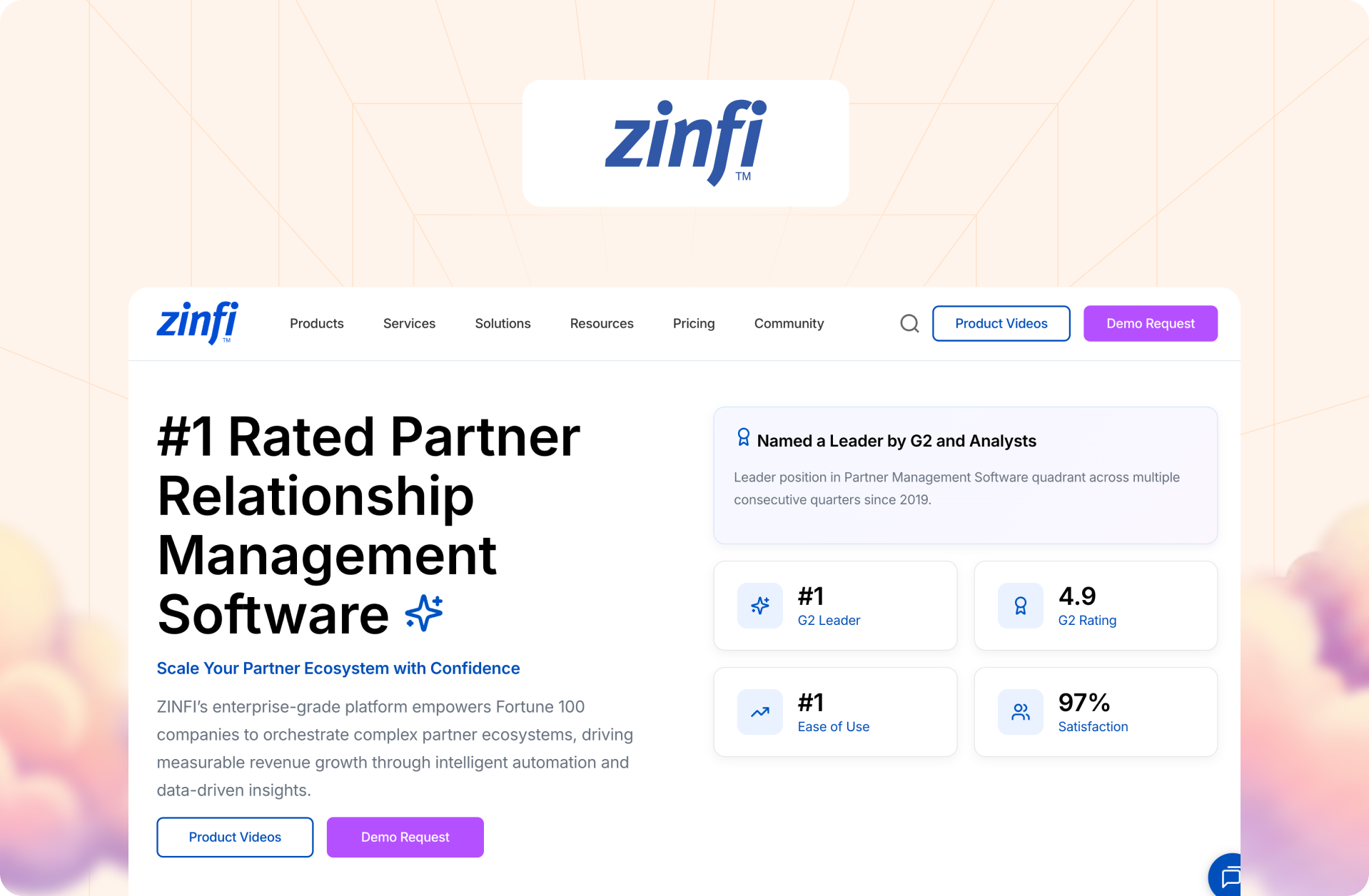
ZINFI is modular partner management software for complex indirect sales channels and global partner networks. Its partner relationship management suite spans recruitment through performance. ZINFI has a 4.9/5 G2 rating from about 735 reviews.
How ZINFI approaches partner portals
The partner portal combines partner relationship management (PRM), through-channel marketing, incentives, training, and automation. Prebuilt bidirectional connectors cover Salesforce, HubSpot, Dynamics, Zoho, Pipedrive, SugarCRM, Oracle, and NetSuite.
Highlights
- Structured onboarding and deal registration workflows
- Native SCORM LMS and certification
- Performance analytics, compliance, and incentives
Considerations
Its modular breadth can create a larger implementation and administration project.
Pricing
Custom/demo required based on selected zones, applications, and scale.
Who is ZINFI best for?
Global channel programs managing partner relationships that need lifecycle depth and complex operational controls.
7. Unifyr

Unifyr, the current brand for Zift Solutions and ZiftONE, combines partner relationship management (PRM), LMS, and through-channel marketing automation. It focuses on coordinated partner marketing at scale. Unifyr has a 4.4/5 G2 rating from 506 reviews.
How Unifyr approaches partner portals
The partner portal gives channel partners campaigns, co-branded marketing materials, training, and deals in one hub. Bidirectional connectors support Salesforce, HubSpot, Pipedrive, Dynamics, and other CRMs.
Highlights
- Distributed campaigns and marketing resources
- Learning in Activate; certifications in Grow and above
- Deal workflows plus partner activity analytics
Considerations
Teams focused mainly on CRM-native co-selling should validate attribution depth and administration.
Pricing
Custom/demo required with per-partner Activate, Grow, and Scale packages.
Who is Unifyr best for?
Vendors and distributors that want partner relationship management and coordinated through-channel marketing in one platform.
8. Mindmatrix Bridge
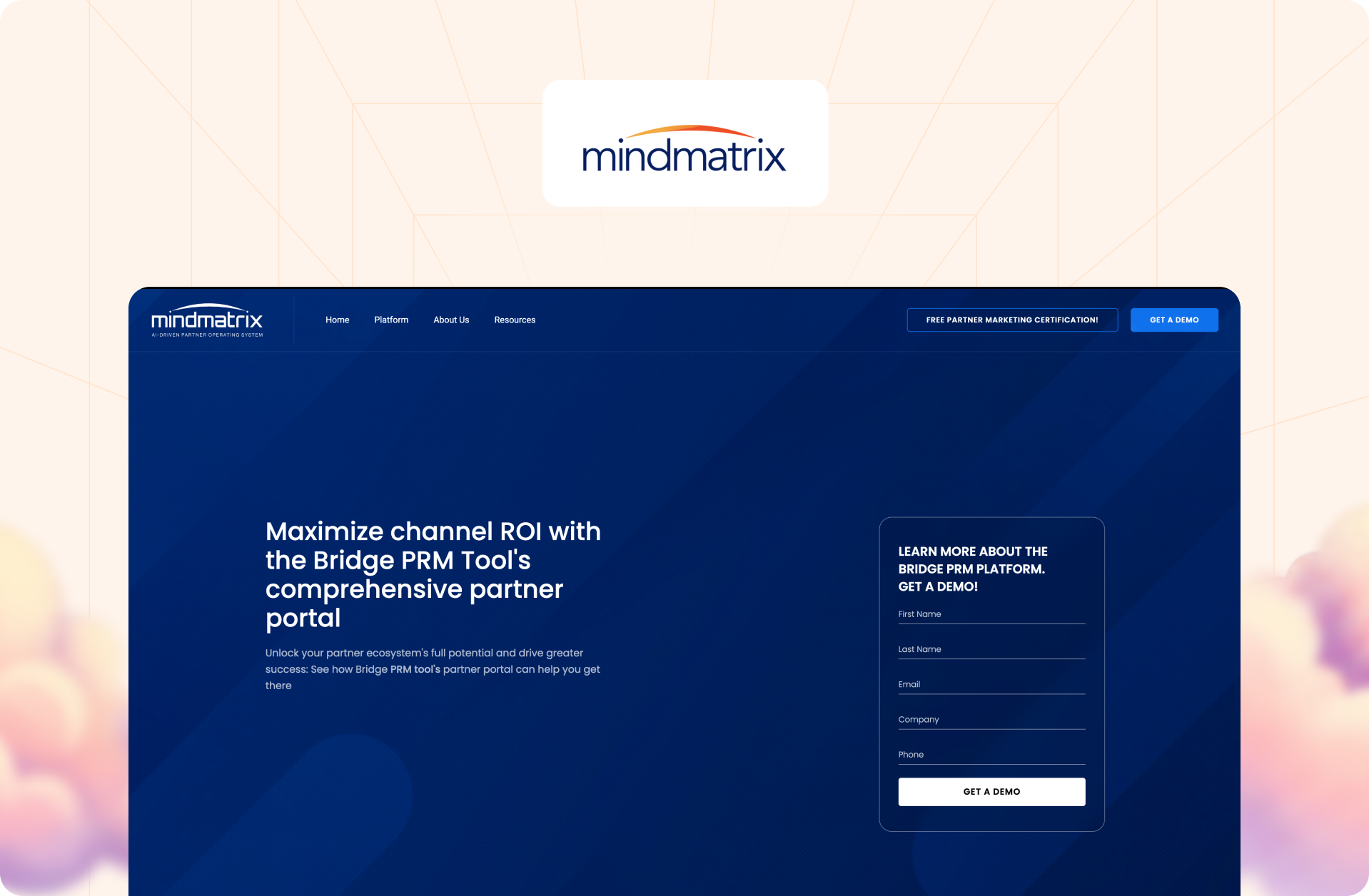
Mindmatrix Bridge combines partner relationship management (PRM), a marketing platform, sales enablement, and ecosystem orchestration. Bridge remains its portal experience. Mindmatrix has a 4.7/5 G2 rating from 108 reviews.
How Mindmatrix approaches partner portals
The partner portal centralizes guided selling, sales assets, training, and marketing tools. It documents bidirectional CRM connections for Salesforce, HubSpot, Dynamics, and other systems while coordinating partner relationships.
Highlights
- Built-in LMS, certifications, and training programs
- Co-branded campaigns and content libraries
- Deal registration and guided selling
Considerations
The wider suite and CRM setup may require specialist support.
Pricing
Custom/demo required; a free proof of concept is not a continuing free tier.
Who is Mindmatrix best for?
Organizations that want partner enablement, partner relationship management, and through-channel marketing in one system.
9. PartnerStack
PartnerStack is a B2B SaaS partner ecosystem platform for partner recruitment, referrals, reseller deals, payouts, and marketplace discovery. Its partner network is a key differentiator. PartnerStack has a 4.7/5 G2 rating from 906 reviews.
How PartnerStack approaches partner portals
The partner portal supports referral partners, affiliates, agencies, and resellers with links, leads, deals, resources, and rewards. Salesforce and HubSpot use an integration suite rather than CRM-native architecture.
Highlights
- Marketplace-led recruitment and onboarding
- Automated commissions and payout workflows
- Litmos-powered LMS on Growth and above
Considerations
Deal registration and training depend on plan, and the model is less centered on shared CRM pipeline views.
Pricing
Custom/demo required; an official SMB offer starts at $6,000 for the first year.
Who is PartnerStack best for?
B2B SaaS programs growing partner relationships and a partner network across referrals, affiliates, and reseller motions.
10. Channext
Channext is a partner marketing and engagement platform for distributing campaigns through resellers and distributors. It is closer to a distributed marketing layer than a full PRM. Channext has a 4.5/5 G2 rating from six reviews.
How Channext approaches partner portals
The partner portal helps resellers activate marketing materials, social content, and campaigns. Current public documentation does not establish broad native CRM synchronization or mature protected deal registration.
Highlights
- Co-branded campaign distribution
- Centralized marketing content and social publishing
- Engagement and program performance analytics
Considerations
Its limited documented CRM, LMS, and deal-management depth may rule it out as a complete PRM.
Pricing
Who is Channext best for?
Vendors prioritizing partner engagement and distributed content activation over full partner relationship management.
11. Kiflo
Kiflo is a partner revenue platform for smaller SaaS programs formalizing referrals, reselling, co-selling, and commissions. It combines PRM with account mapping and attribution. Kiflo has a 4.7/5 G2 rating from 123 reviews.
How Kiflo approaches partner portals
The partner portal lets channel partners submit leads, register deals, access resources, and follow deal progress. Native bidirectional HubSpot and Salesforce synchronization supports lead management; other connections use Zapier or API access.
Highlights
- Deal workflows, account mapping, and attribution
- Commission and partner performance tracking
- Certification tracking with expiry dates
Considerations
Kiflo tracks certifications but does not document native course delivery as an LMS.
Pricing
Core costs $399/month for 25 active partners; Plus and Premier are custom, with a 10% annual discount.
Who is Kiflo best for?
Growing software companies formalizing partner relationships without enterprise-suite overhead.
Main takeaways: key features and business outcomes
Choose for fit, not feature volume. Enterprise suites suit complex partner programs; ecosystem platforms support recruitment and payouts; marketing-led tools distribute campaigns. To support business growth, prioritize a modern partner portal that aligns partner relationships with your CRM and gives partners a reason to return.
Implementation playbook: Launch a modern partner portal for business growth in 30-60 days
A focused launch can improve partner engagement, partner success, and partner relationships while reducing administrative work. Align the rollout with your partner management CRM before adding complexity.
Use CRM reporting for tracking partner performance and managing relationships after launch.
Why Introw is a top pick for partner portals (quick proof)
You've seen the landscape. Now here's the difference. Introw is built around one idea: adoption drives revenue.

Adoption-first design
Partners don't have to log in for every interaction. Announcements go out through email or Slack, and partners can reply by email. Their activity is logged automatically, so engagement happens where they already work.
Enablement built in
Create training with the AI course builder, issue certificates, enroll cohorts in bulk, and set recertification windows. Partner onboarding and partner enablement stay inside the portal instead of being scattered across disconnected tools.
Revenue visibility
Completions, certifications, and content influence write back to Salesforce or HubSpot. Your CRM remains the single source of truth, giving sales teams and internal stakeholders a clearer view of partner activity and impact.
Partner-safe execution
Make deal registration easy to find and use. Partners can register deals and collaborate through shared pipeline views, while field-level safelists, granular permissions, and SSO controls protect sensitive data.
What you can do next
- Audit your current portal against the 30–60 day playbook
- Identify where adoption breaks down
- Decide whether your current partner portal software supports CRM-native visibility
If you want to see how Introw can help enable your partners, request a demo today. Because the best partner portal software is the one your partners actually use.
Still curious? Here are some quick answers to help clear things up
Pricing ranges from free entry plans to hundreds or thousands of dollars per month and custom enterprise quotes. Partner count, modules, CRM requirements, implementation, and add-ons usually determine the total cost.
A focused portal can launch in days or weeks. Complex enterprise deployments may take months when they involve multiple integrations, data migration, regions, permission models, custom workflows, or extensive content migration.
Look for SSO or MFA, granular role-based access, audit logs, encryption, data controls, and current penetration test information. Enterprise buyers often request SOC 2 Type II and/or ISO 27001 evidence and appropriate data-processing terms.
Make the portal easy to access, personalize content by partner role, and bring announcements into email or Slack. Clear onboarding, useful training, current resources, and simple deal registration give partners practical reasons to return.




See AI-Native PRM in Action
Book a demo with one of our partner program experts, or explore Introw on your own time.