

AWS Marketplace selling works because buyers have committed spend to use, procurement trusts the billing path, and AWS sellers have quota tied to deals that flow through it. The listing itself is the easy part. Revenue comes from routing deals you already have through the marketplace, training your sellers to propose it, co-selling with AWS through ACE, and closing most enterprise deals as private offers.
AWS Marketplace gets called a storefront. But buyers don’t browse it the way they do an app store or a SaaS vendor directory. Instead, they use it because their AWS cloud budgets are committed and their procurement teams trust the simplified billing path.
Think of the marketplace as a sales channel that can shorten cycles and bring AWS field teams into your deals. If you approach it from the lens of customer acquisition, your listings sit idle and collect virtual dust. This guide covers how to increase your revenue as an AWS Marketplace seller, how the economics work, and how the marketplace fits alongside the rest of your partner program.
Why SaaS vendors sell through AWS Marketplace
SaaS vendors don’t list on AWS Marketplace for increased visibility. They list because buyers already use it to draw down committed spend, AWS sellers get paid to push deals through it, and the fee costs less than the procurement cycle it replaces.

The committed spend driver
Large customers have committed spend agreements with AWS, and purchases made through the marketplace use up that commitment. Procurement often moves faster through cloud marketplaces because of this. The customer is spending money they’ve already promised to spend on AWS cloud services.
The vendor side
Purchases made in the AWS Marketplace are also advantageous for vendors:
- Standardized terms reduce legal back-and-forth
- Procurement cycles shorten because the buyer is using a purchasing path they already trust
- AWS field sellers get involved when there’s a better-together story
- Their engagement can accelerate deals that would otherwise sit in your pipeline
AWS Marketplace reduces enterprise deal timelines by more than half. AWS sellers retire quota on marketplace selling deals that are co-sell transactions, so they do have a personal stake in pushing your deal through the marketplace when it grows AWS consumption. In her 2024 keynote, AWS VP Ruba Borno shared just how widespread marketplace adoption has become among AWS's biggest customers: “In 2024, over 99% of AWS' top 1,000 customers have at least one active subscription on the AWS Marketplace.”
For software companies that want to sell software through the AWS Partner Network, the marketplace is where committed spend and co-sell incentives converge.
What the listing gets you
The listing fee is a distribution cost. It buys a faster procurement cycle, and the vendors who get value from the marketplace are the ones who treat it that way. That’s money well spent when it shortens a procurement cycle by weeks.
Nobody browses AWS looking for your category. The vendors who generate real marketplace revenue route deals they already have through it, give their own sellers a reason to propose it, and make themselves easy for AWS sellers to work with. The AWS Marketplace listing is the easy part, and it’s the part AWS teams tend to over-plan.

Here’s an example of Introw’s AWS listing.

Listing types and pricing models
When you list a SaaS product on AWS Marketplace, you choose a pricing model. This decision impacts how you meter usage, how customers buy, and what your engineering team has to build. For SaaS companies, AWS offers four pricing models.
| Pricing model | How it works | What it suits |
|---|---|---|
| SaaS subscriptions | Buyers billed for hourly usage, can unsubscribe anytime | Variable usage, POCs, anything without a fixed contract |
| SaaS contracts | Buyers pay upfront or on a flexible pricing schedule for a set term | Predictable usage, annual deals, committed pricing |
| SaaS contracts with pay-as-you-go | Contract price plus a metered rate for usage above it | Committed minimum plus variable overage |
| SaaS free | All dimensions set to $0.00 | Free tiers, open source products |
Once you publish your listing to limited, you can’t change the pricing model. You can adjust prices later, but the model itself is locked. So, start with the simplest model that matches how you already sell. Trying to replicate complex pricing at launch usually delays the listing by months, for revenue that would have arrived through a private offer anyway.
How metering works
If you charge on usage, your product has to report that usage to AWS so the customer gets billed correctly. Your product has to call the AWS Marketplace Metering Service API to send records hourly, and that requires code written by your engineering team.
For SaaS subscriptions, you meter all usage. For contracts, you only meter usage above the contract. Once you report a buyer’s usage for a dimension, you can’t amend it. AWS tests your integration before allowing you to publish, so it has to work.

Free trials and private pricing
All four models support free trials. You can create one per public SaaS product, lasting 7 to 90 days. Trials don’t auto-convert to paid, and each AWS account can only use one per product.
Private pricing is separate. An AWS Marketplace private offer lets you set custom terms visible only to specific buyer AWS account IDs, with their own pricing, duration, and legal terms. Most enterprise transactions end up as private offers.
How AWS Marketplace fees and payouts work
Understanding how money moves through the marketplace matters more than most vendors expect. The fee is small, but the payout timing and the committed spend mechanics on the buyer’s side shape how deals close and when you see cash.
The fee structure
AWS takes a percentage of every transaction. Public SaaS offers carry a 3% fee. Private offers are tiered by pre-tax total contract value:
- 3% under $1M
- 2% between $1M and $10M
- 1.5% at $10M and above.
All renewals get 1.5%. If a channel partner is involved, add 0.5% on top of the base fee. AWS charges a 0.5% listing fee for professional services private offers. Listing fees vary by deployment method and region for AWS Marketplace. There’s also an additional regional listing fee for transactions with buyers in certain jurisdictions.

When you actually get paid
AWS disburses funds only after the buyer pays their invoice. Choose a daily or monthly disbursement schedule. Once AWS disburses, the payment takes one to two business days to reach your bank. If a buyer closes a deal on November 1 with Net 30 terms and pays on time, you’re looking at 30 to 35 days from transaction to cash. If the buyer pays late or the deal has Net 60 terms, you could wait 60 to 100 days.

As of May 2025, AWS supports partial disbursements. If a buyer pays part of an invoice, you receive that portion on your regular schedule instead of waiting for the full payment. It helps, but the underlying delay between transaction and collection still exists.
Tax and billing consequences
Marketplace transactions also create tax and revenue recognition questions. AWS handles billing and collection, but how that revenue shows up in your financial statements depends on whether you’re acting as principal or agent under ASC 606 or IFRS 15. Involve finance before the first deal closes, because the answers affect how marketplace revenue reports alongside everything else.
The committed spend connection
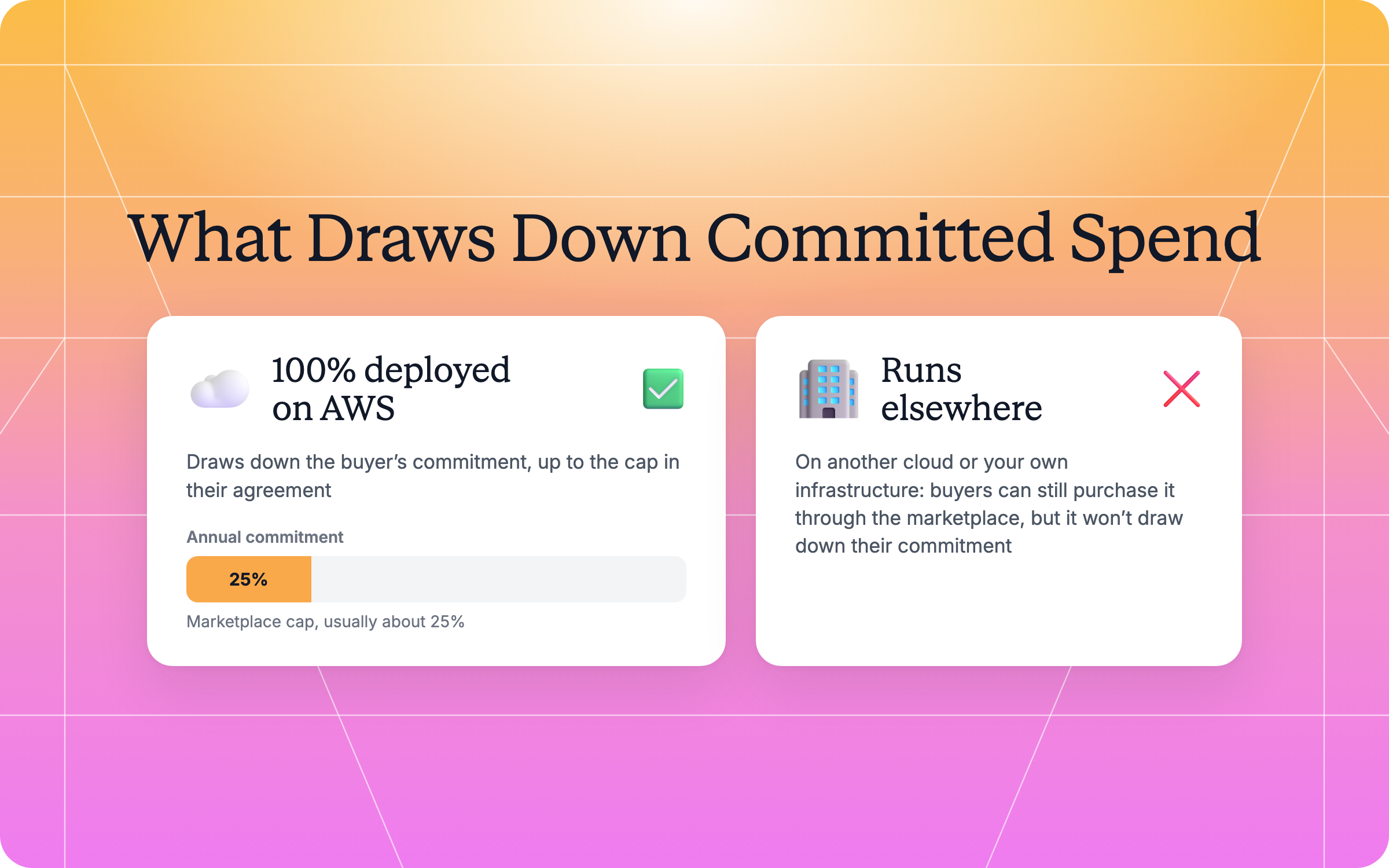
Large AWS customers sign Private Pricing Agreements (formerly known as Enterprise Discount Program agreements) that commit them to a certain level of spend over one to three years. Marketplace purchases can draw down against that commitment, up to a cap that’s negotiated in each customer’s agreement, usually 25% of annual commitment.
Only SaaS products that are 100% deployed on AWS infrastructure qualify for drawdown. If your product runs on another cloud or your own infrastructure, buyers can still purchase it through the marketplace, but it won’t draw down their commitment.
Private offers: When the listing is not enough
Public listings are standardized, yet enterprise transactions are custom. To solve this, an AWS Marketplace private offer carries the negotiated pricing and terms within the marketplace, visible only to the specific buyer. Most deals transact in a few steps:
- You create the offer for a specific customer
- They accept it through the marketplace
- The purchase uses their committed spend

Most marketplace revenue flows through private offers, which is why it matters that you can produce one quickly. If creating an offer takes a week, you’ll lose deals that were ready to close.
For vendors who sell through resellers, read about how channel partner private offers work.
Co-selling with AWS through ACE
ACE, or APN Customer Engagements, is how you co-sell with AWS. You share opportunities with AWS through the ACE Pipeline Manager in AWS Partner Central, and AWS routes AWS-originated referrals back to you. The referrals are where AWS field teams bring you into deals they’re already working on.
Co-sell and marketplace aren’t separate sell motions. The co-sell deal frequently closes as a marketplace private offer, because that's what counts toward the AWS seller's quota and uses up the customer's committed spend. The marketplace transaction is the payoff for the co-sell relationship.
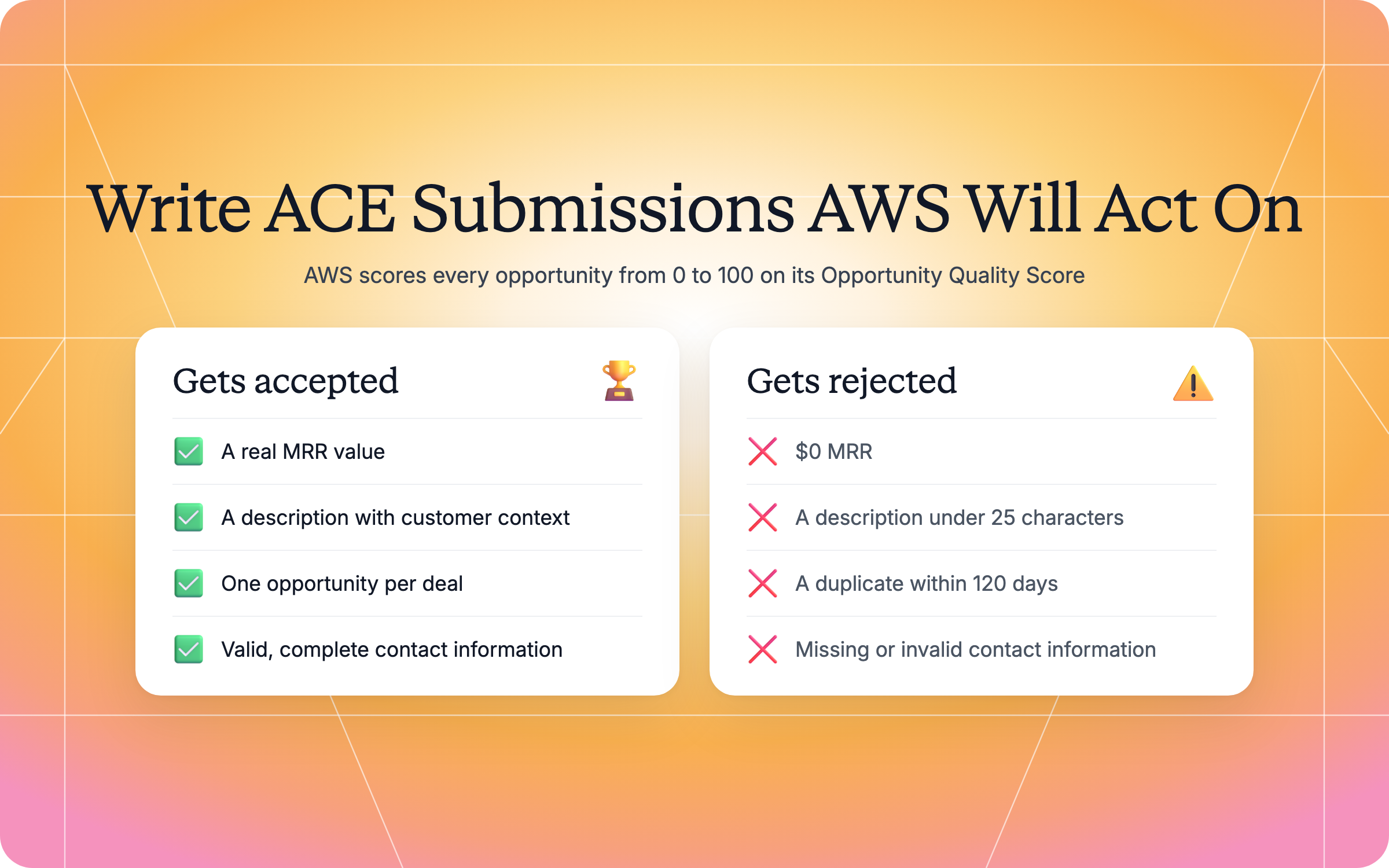
On the practical side, ACE submissions need real detail to be accepted and actioned. AWS scores every opportunity on an Opportunity Quality Score from 0 to 100, and thin records get rejected. Common rejection triggers include:
- $0 MRR
- Descriptions under 25 characters
- Duplicate opportunities within 120 days
- Missing or invalid contact information
A one-line description with no customer context is the most common reason co-sell stalls. AWS sellers can’t bring a deal to their leadership without enough detail to justify the engagement.
How to grow marketplace revenue
If you want to increase marketplace revenue, you need to understand that most deals are premeditated. It’s very rare that a customer stumbles upon your page and makes a purchase. Here’s how to actually turn your listing into revenue.
Route deals you already have
Start by asking any enterprise deals you’re working on whether they have committed AWS spend. Many will, and many will prefer that route because they can use their committed spend. This way, you route deals through the marketplace rather than waiting for your listing to generate them.
Train your own sellers
An untrained sales team is one of the most common reasons a listing sits idle. Luckily, it’s an easy fix. Reps avoid the marketplace because it’s unfamiliar and they fear it complicates the close. Give them a one-page explanation of when to propose it and what it does to procurement timelines.
Make yourself easy for AWS sellers to work with
AWS field sellers engage when there’s a better-together story and real AWS consumption attached. A deal that doesn't grow AWS spend won't attract field attention, no matter how good your listing looks. Sellers can leverage AWS’s sales force to enhance their marketing strategies. To bring an AWS seller into your deal, make sure you have:
- Clear positioning
- A named alliance contact
- Responsive ACE submissions
Build the private offer muscle
The improved private offer creation experience in AWS Partner Central helps with save-and-resume drafts and bulk pricing, but the bottleneck is usually internal. Who creates the offer, who reviews the terms, and how many days that takes is what determines whether you close deals or lose them. Repeatable execution is what separates vendors who close private offers in days from those who take weeks.
Bring channel partners in where resellers already serve the customer
If a reseller already has a relationship with a customer you’re trying to reach, a channel partner private offer lets that reseller transact the deal through the marketplace with you. The reseller can set their own margin, the customer uses their committed spend, and you still get the marketplace transaction.
Measure it as a channel
Marketplace-sourced revenue (deals that started on the marketplace) and marketplace-transacted revenue (deals you brought to the marketplace to close) are different numbers. If you treat them the same, the channel will look stronger than it should in year one, when most volume is deals you routed through. By year three, when organic marketplace-sourced deals start arriving, it’ll look extremely weak.

If your marketplace revenue sits in a spreadsheet or a separate portal and can’t be compared to your direct pipeline by stage, source, or ARR, you can’t tell whether the channel is working.
Reporting marketplace revenue alongside the rest of your channel
AWS owns the listing, the metering, and the transaction. What it doesn’t do is tell you how marketplace revenue compares to your direct and partner pipeline. Those records live in your CRM and marketplace records don’t arrive there by themselves. A hyperscaler is the one partner type that never logs into your portal, because they run their own. So the relationship is managed in AWS Partner Central while every other partner motion is managed in your CRM, and the two never reconcile.
The AWS Partner CRM Connector gets Partner Central data into Salesforce, but it’s Salesforce-only. If your team runs on HubSpot, or you need to reconcile marketplace revenue with other partner motions in one place, the connector doesn’t cover it.
This is where Introw, a partner relationship management software, comes in. Once marketplace and co-sell records reach your CRM, through the AWS Partner CRM Connector or a marketplace platform, Introw treats them as program deals attributed to the hyperscaler partner. This way, marketplace-sourced revenue reports next to direct, reseller, and referral revenue rather than in a separate spreadsheet. Introw has no marketplace connector. It’s the reporting layer that makes marketplace a comparable channel.

If you’re running marketplace alongside resellers, referrals, and other partner motions and can't compare them in one place, see how Introw handles different partner types or book a demo.
Still curious? Here are some quick answers to help clear things up
You register as an AWS Marketplace seller through AWS Partner Central using your AWS Account ID, and provide tax and banking information during seller registration. Independent software vendors (ISVs) and consulting partners can both register, as long as they meet eligibility requirements and operate in an approved geography.
A simple SaaS listing with straightforward pricing options can go live in a few weeks. A complex model with custom metering can take two to three months, because the pricing model you choose determines how much engineering work is involved. AWS Marketplace learn has more resources about the onboarding process.
SaaS products are the most common type sold on AWS Marketplace. AMI products are virtual machine images for deployment on Amazon EC2. Container products deliver Docker images for Amazon ECS, EKS, or Kubernetes. AWS Marketplace offers machine learning models for deployment in SageMaker. Sellers can also list data products through AWS Data Exchange, and data providers can sell alongside third party software. Professional services like training, onboarding, and implementation are also supported. These AWS Marketplace features give software companies a single place to sell software to existing customers and new buyers.
AWS Marketplace supports four AWS Marketplace pricing models for SaaS products: subscriptions, contracts, contracts with pay-as-you-go, and free. You can also offer bring your own license (BYOL) terms and usage credits. Each model supports free trials, and you can create AWS Marketplace private offers with custom commercial terms for specific buyers.
To maximize revenue potential, treat the marketplace as a sales channel, not a storefront. Route deals you already have through it, train your sellers to propose it, and co-sell with AWS account managers through ACE. If your GTM is product-led growth, make sure buyers can find the marketplace path alongside self-serve. Closing deals faster comes from private offers and committed spend, not from listing optimization. The AWS Marketplace benefits compound when you measure revenue alongside every other partner motion.





See AI-Native PRM in Action
Book a demo with one of our partner program experts, or explore Introw on your own time.