

System integrator partners play two roles: co-selling during the deal and implementing afterwards. Most vendors manage only the first half, and the handoff is where problems pop up. To win and keep SIs, you need a product worth their practice, a services boundary in writing, certification that lets them bill for the skill, and a governed library so they can deliver without waiting on you. Track delivery, not just the close, and close the loop into expansion.
System integrator (SI) partners are on your biggest deals right now, influencing architecture and delivery before the contract is even signed. Yet most vendors treat the SI relationship as a single moment, the deal, when it’s actually two: the co-sell motion that wins the work and the implementation that follows it. The handoff between those two is where relationships can start developing cracks. That’s because your CRM tracks the deal through close-won and then stops, and the SI is left working from whatever context they caught during the sale.
If you get the handoff right, the SI comes back for the next deal with their own practice built around your product. If you don’t, they deliver the one project, collect their fee, and you never hear from them again. This article covers what system integrator partners actually want, how to build a program that keeps them engaged, and how to stop losing them at the handoff.
What is a system integrator partner?
A system integrator is a firm that designs and builds working systems for a customer out of multiple technologies, including yours. Unlike tech partners who refer business, SIs are the ones doing the implementation. They get paid for the outcome rather than the software, so their incentive is billable delivery work and a happy reference customer.
A global system integrator (GSI) is a sub-set of SIs that operates at the enterprise level. GSIs run across regions and industries, with practice areas, alliance teams, and formal vendor tiering. Procurement and governance around them are heavier than with standard SIs, and their time to first revenue is much longer.
SIs don’t fit neatly into a single partner type. They can lead the deal and own the services scope, deliver after someone else closes, or advise without building. That breadth of activity is what makes SIs hard to slot into your program, and it’s why a one-type approach rarely works.

The two roles an SI plays
A system integrator plays the role of two partners inside one relationship. During the deal, they act as a solution architect who scopes the work, designs the solution, and lends credibility that makes the customer comfortable buying. After the deal, they’re the delivery firm whose work decides whether the customer ever goes live.
| During the deal: Solution architect | After the deal: Delivery partner | |
|---|---|---|
| What they do | Scope the work, design the solution, size the effort | Deploy, integrate, migrate data, onboard users |
| Value to you | De-risks the purchase in the customer’s eyes | Decides whether the customer goes live and renews |
| What they need from you | Deal context, technical answers, a say in the solution | A clean handoff, runbooks, certified people |
| Measured on | Influence and the services scope they win | Go-live and adoption, not the signature |
| How vendors get it wrong | Treating them as a post-sale supplier and bringing them in too late | Handing over a closed-won record with no context and going quiet |
NVG8’s analysis of 65 SIs that appeared on deals from 2023 to 2025 found that 60 of them showed up on exactly one deal, and only the busiest appeared on three. Deals with a partner on them won 80% of the time in 2023, against 61% without. An SI on the deal clearly helps. It just rarely leads to a second one, because nobody circles back to the SI once the first deal wraps.

If you have an SI on your biggest open deal right now, you probably don’t know what that firm expects from you or how to keep them engaged after it closes. You’re not alone in that, and it’s what makes SI relationships harder to run than other partner types.
What SI and GSI partners actually want
An SI partner prefers a vendor that understands their business model. Their revenue comes from billable delivery and a referenceable customer. When you understand what drives an SI, you build a partnership that lasts beyond the first deal. Here’s what system integrator partners actually want:
- Billable work: If your product deploys in a week and needs no integration, there’s no services revenue in it for an SI, and you should be honest about that before you build a program around one. Managed services delivered through the channel are projected to reach $595 billion in 2025, growing 13% year over year, which means SIs are investing where the services opportunity is real.
- Early visibility of pipeline: SIs need to see deals before they’re closed so they can staff a practice. A firm can’t justify hiring consultants for an engagement they first hear about after the contract is signed.
- Technical depth and certification: Partner credentials are now basic requirements, necessary for participation but irrelevant for differentiating services. What sets a vendor apart is going further with validated, repeatable solutions, and that’s what lets an SI’s consultants stay authorized, credible, and able to price their expertise at a premium.
- A predictable, documented product: SIs are the ones doing the hands-on implementation work, and they need your product to behave the way the documentation says it will. Runbooks, solution docs, architecture guidance, and a release cadence they can plan around let the SI be self-sufficient instead of queuing behind your solutions engineer.
- Not being undercut: The professional services boundary is the most common silent killer of SI relationships. If your own services team bids against your SI on the same deal, the partnership rots from the inside.
- Referenceable outcomes: A good customer experience is the SI’s second revenue stream, because every new engagement is sold on the back of the last one. SIs want to be associated with deployments that go live on time and adoption that sticks.

For GSIs specifically, the wants shift at scale. A global SI expects formal tiering and alliance status, and they build practice-level business cases rather than deal-level ones. IDC found that in Asia/Pacific, GSI partnerships aren’t won through global programs but through local credibility and field relevance. So, expect a much longer time to first revenue and invest accordingly.
How to build an SI partner program
Building a systems integrator partner program is harder than building a standard partner program, because an SI’s incentives don’t line up with yours the way a reseller’s or affiliate’s do. A reseller sells your product and takes a margin. An affiliate sends you a lead and collects a referral fee. An SI sells their own services and uses your product to do it. That means your program has to work for their business model. These steps walk through what a structured SI program needs.
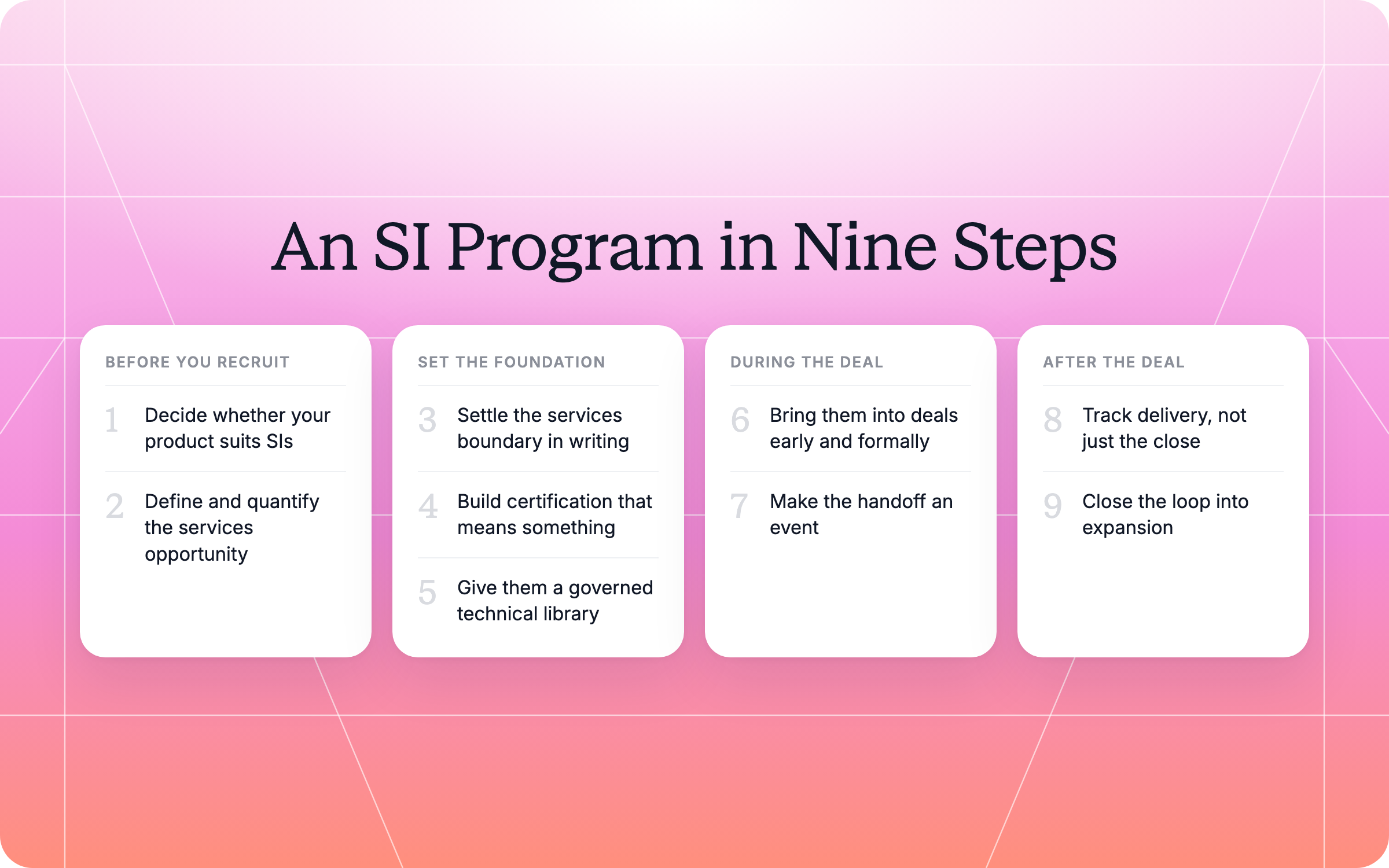
Step 1: Decide whether your product suits SIs
Not every product makes sense for an SI partnership. If your product is quick to set up and doesn’t need any integration, stop here. SIs won’t invest in certifying consultants for a product that doesn't generate billable work, and you shouldn’t spend time building a program no one will join.
The products that work for SIs are the ones with long implementation cycles, complex integrations, and enough configuration that a customer can’t go live without expert help.
Step 2: Define the services opportunity and quantify it
Before you recruit a single SI, you need to know how much billable work your product can actually create. That means estimating:
- The average implementation size
- The typical timeline
- The number of deals per year that need integration work
The number an SI cares about is the ratio of services revenue to license revenue. If that ratio is small, there’s not enough billable work to justify building a practice around your product. Generate a realistic number and that’ll help you figure out whether to invest in a full program or a lighter-touch referral model.
Step 3: Settle the professional services boundary in writing
If your own professional services team can bid against your SI partners on the same deal, the SI will find out, and the trust will disappear. Put the boundary in writing before you recruit anyone and spell out three things:
- What your team always does
- What the partner always does
- What’s contested

Broadcom did this with VMware, transitioning professional services from Broadcom-led engagements to partner-delivered services so their channel partners could lead implementation, consulting, and deployment work.
Their global channel chief said publicly: “We don’t want to compete with partners on professional services. We want our partners to take that over.” You don’t need to go that far, but you do need to be explicit about where your services team stops and the SI’s begins.
Step 4: Build certification that means something
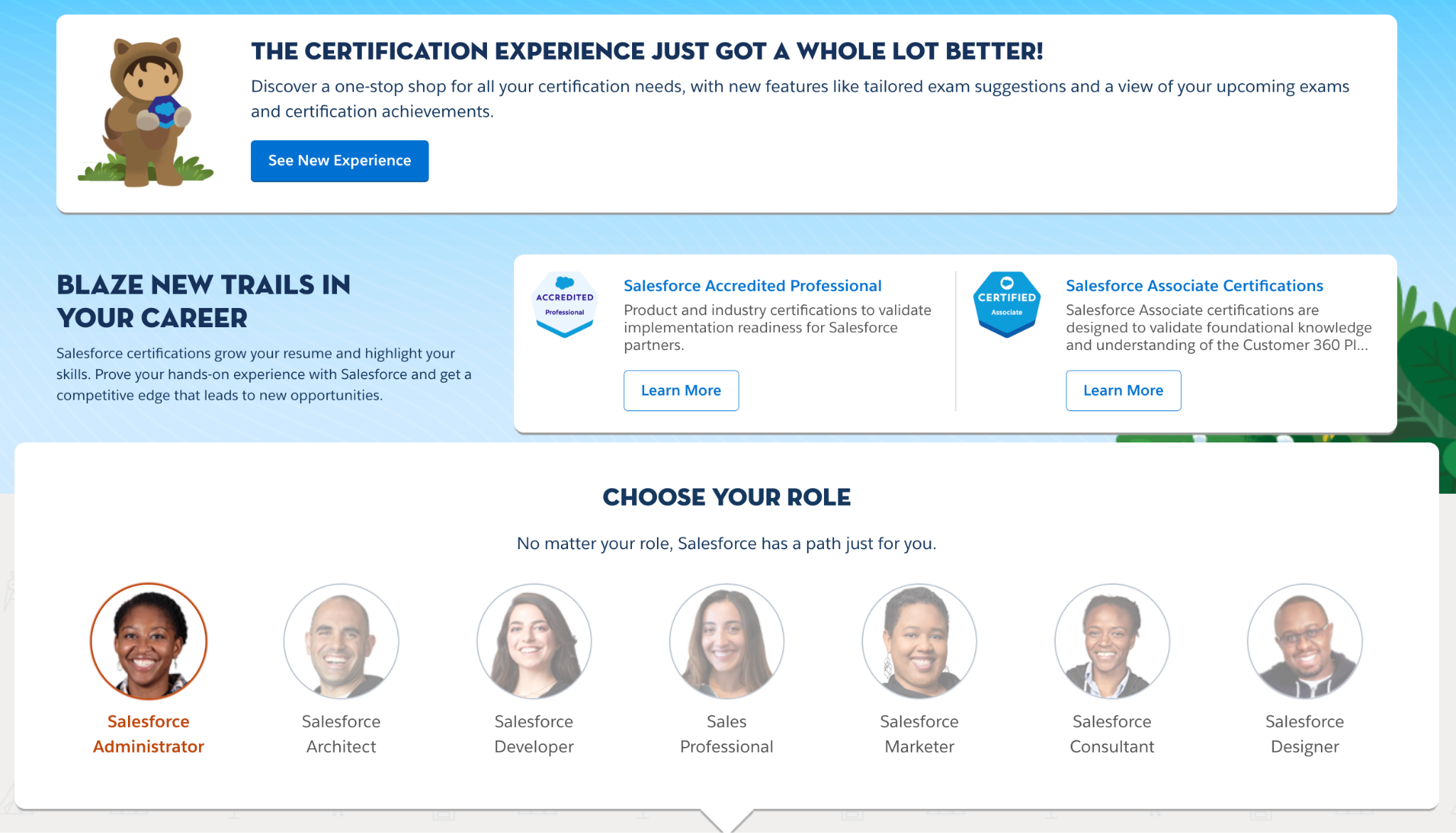
Certification has to signal something real to the customer and the market. What works is enough depth that the SI’s consultants are authorized to deliver your product and can bill for the expertise. Salesforce has over 272,000 consultants at partner firms who have completed AI certifications, and those consultants have built more than 18,000 agents. That’s what certification that means something can look like at scale.
Step 5: Give them a governed technical library
SIs need runbooks, solution docs, architecture guidance, and a release cadence they can plan around. A governed library lets them be self-sufficient, and it keeps the answers consistent across every firm you work with.
Step 6: Bring them into deals early and formally
An SI brought in at kickoff has no time to shape the solution or staff the engagement. Bring them in during the scoping phase, when they can still influence the architecture and size the effort. A teaming agreement that defines roles, ownership, and attribution up front makes this formal rather than ad hoc, and it gives the SI the confidence to commit resources before the deal is signed.
Download Introw’s free teaming agreement template
Step 7: Make the handoff an event
The handoff from sales to delivery is where threads often get dropped. A forwarded email with a few notes doesn’t give the delivery team what they need. The SI should get:
- Full deal context
- The scope as sold
- The customer’s expectations
- Account history
- Technical decisions that were made
- Named owner on both sides

Make it a structured handoff with registration that settles attribution before the work starts. That way, the SI knows who owns what and what they’re being measured on.
Step 8: Track delivery, not just the close
Most partner programs track deals through close-won and then go quiet. The delivery phase is where the SI’s reputation is on the line, so your partner management needs to follow the work past the signature. Track go-live, adoption milestones, and expansion signals on the same record. If you can’t see whether the SI’s implementation is on track, you can't help when it isn’t.

Step 9: Close the loop into expansion
The best SI relationships produce a second deal. Usually, the second deal is an expansion of the first. Deep integrations, migrated data, and trained users all raise switching costs, which makes delivery quality a renewal lever. When the implementation goes live on time and adoption sticks, introduce the SI to your product roadmap, to adjacent use cases, and to other accounts where they have relationships. Closing the loop means treating go-live as the start of the next conversation.
Where SI partnerships go wrong
The failures in SI partnerships come down to information. The SI sits outside your systems, so everything they need has to be deliberately sent, and most of it isn’t. Here’s where partnerships typically break down:
- Brought in too late: The SI joins at kickoff with no say in the solution, no time to size the effort, and no reason to feel invested in the deal closing.
- Channel conflict with your own services team: Your professional services group bids against the SI on the same engagement, so the SI stops trusting you.
- The handoff loses everything: Sales forwards a closed-won record with a few notes, and the delivery team starts from scratch with no account context, no scope as sold, and no idea what was promised.
- Certification that nobody maintains: The SI certified consultants two years ago, your product has changed since, and nobody told them, so they’re delivering against outdated knowledge.
- The SI can’t see anything: The partner has no visibility into the deal record, the project status, or the adoption data, so they’re working blindly on an engagement that affects their reputation.
- One champion, no practice: The entire relationship lives with one consultant at the SI, and when that person moves off the account or leaves the firm, the relationship goes with them.

None of these are hard to fix. They’re hard to notice, though, because most partner programs stop tracking at the signature and leave the SI to figure out delivery on their own. A partner program that tracks both halves of the relationship on the shared record, instead of handing off from one system to another, is what keeps the SI from starting over every time.
How Introw supports SI partnerships
Introw is a CRM-native, AI-native partner relationship management platform built for enterprise teams running complex partner ecosystems. An SI spans two partner types, co-selling during the deal and implementation after it, and Introw runs both on the same partner and deal records. This way, the SI never starts over when the deal moves to delivery.

Here’s what that covers:
- Co-selling on a shared deal record: Both sides read the shared record instead of reconciling status over email, with scoped views that give consultants the context they need without a CRM seat.
- Attribution settled up front: Registration settles credit before the work starts, so there’s no arguing about influence after the fact.
- A handoff that keeps everything: The implementation partner takes over with full deal and account context on the same record, with project and onboarding tracking on it.
- Certification that stays current: Courses and certifications authorize consultants to deliver and keep them current as the product changes.
- Technical self-sufficiency: A governed library means the SI can find answers on their own instead of waiting on your team.
- A relationship that survives rotation: The partner record persists as individuals change, allowing for a stronger relationship that stays with the firm rather than one person.
Introw works the way enterprise teams need it to. It’s CRM-native, sitting inside HubSpot and Salesforce so partner data lives where your sales data lives. It’s built for big teams running complex partner ecosystems. And it’s AI-native and headless, so everything can be done through Claude, MCP, or ChatGPT, not just through a UI.
An SI judges you on whether working with you is easy. Most of what they experience as difficulty is information they were never given. That’s a systems problem with a systems answer.
See how Introw runs co-sell and delivery on the same partner record. Book a demo or learn more about how Introw solves SI partnerships.
Still curious? Here are some quick answers to help clear things up
System integrator partners range from boutique SIs with as few as two to 100 employees to regional firms to large consultancies. Global system integrators (GSIs) have hundreds of thousands of employees and operate across multiple regions with global reach. A boutique SI focuses on niche specializations and personalized service, while a GSI brings global reach and the scale to handle enterprise-wide digital transformation. The trade-off for vendors is that GSIs can generate millions in revenue from a single client, so they expect a level of program support and deal infrastructure that a boutique SI doesn't need.
In business models, an SI is a firm that connects your product into a larger system within the customer’s environment. They handle custom solutions and customized solutions that tie together multiple vendors, legacy systems, and new technology. A major role of system integrators is to automate manual processes across business processes like data management, data engineering, and change management. Integration often requires ongoing maintenance and management for effectiveness, so the SI relationship is an ongoing relationship with ongoing support, not a one-time project.
You get an SI to recommend your product by giving them a billable scope, bringing them in at the early stages of the sales cycle, investing in certification courses so they have certified consultants, and making sure your vendor’s product is something their team can deliver without you holding their hand. SIs heavily influence what the client chooses, so your sales team needs to equip them, not compete with them. Keep SI partners updated on certification courses and resources, and track attributions to demonstrate SI impact on revenue so they see the partner influenced revenue they're generating. When an SI partner helps land a deal, share the success stories so they can build a practice around your product.
Evaluating financial stability is crucial when selecting a system integrator, so start there. Check whether they have a dedicated managing director or practice lead for your category, or whether you'd be their single client in your space. Ask about their experience with integrated solutions and custom development in clients' technology stacks similar to yours. Industry specific surveys and references can surface pain points and other business insights about how the firm operates. Look for evidence they've supported digital transformation and cloud migration projects end to end. A highly specialized firm may go deeper on your product, while a larger one brings additional value through broader reach.





See AI-Native PRM in Action
Book a demo with one of our partner program experts, or explore Introw on your own time.