

Affiliate fraud is any way an affiliate gets paid for a click, lead, or sale they didn't genuinely create. In B2B SaaS, the version that costs the most is brand bidding, where an affiliate buys ads on your own brand name and collects commission on buyers who were already looking for you. Most programs only notice once finance asks why affiliate revenue is up and new customers aren't. This guide covers the fraud types worth knowing, what brand bidding is and why it hurts, how to spot it, and how to set up your agreement, tracking, and payout review so fraud never gets paid in the first place.
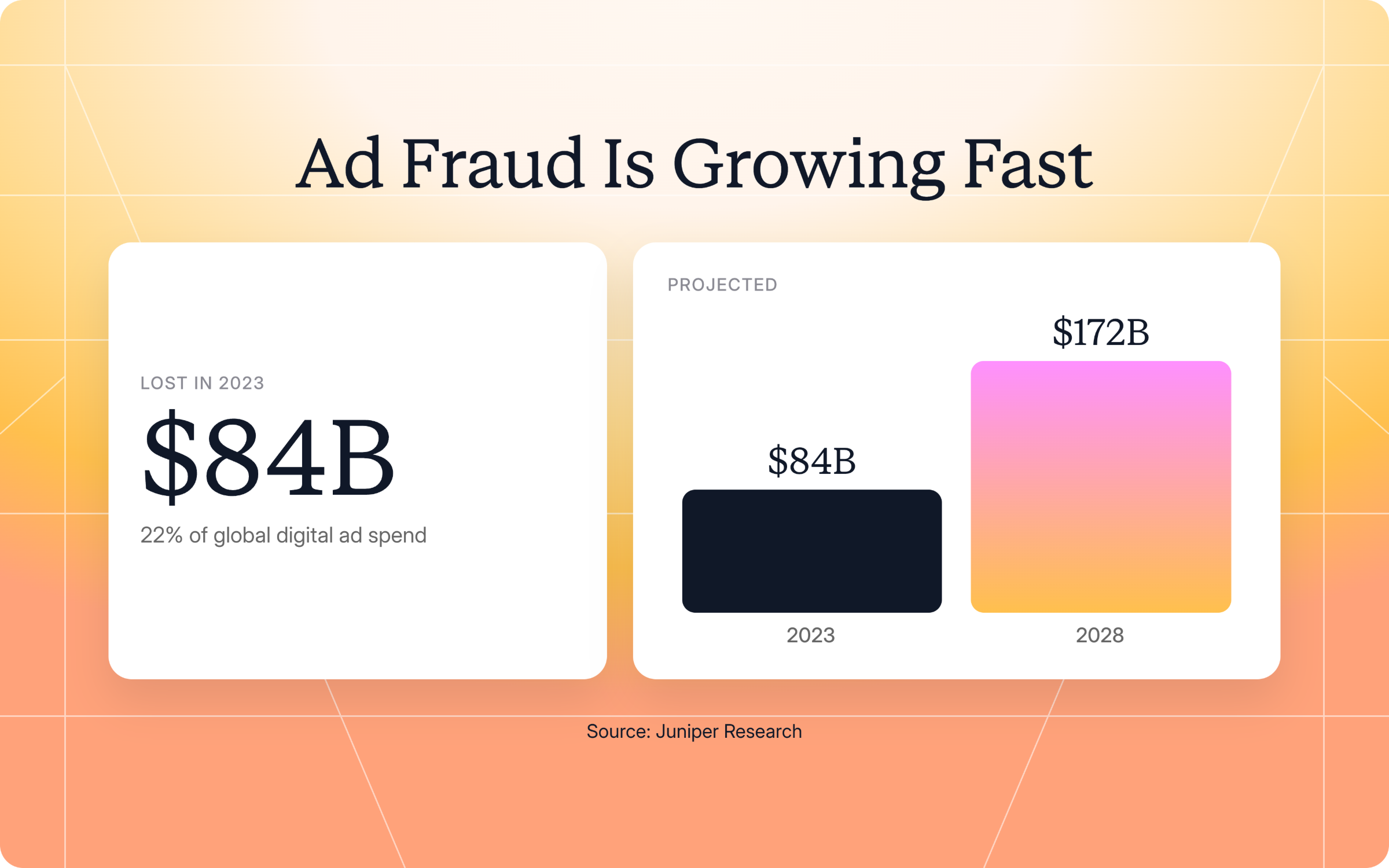
Advertisers lost an estimated $84 billion, or 22% of global digital ad spend, to ad fraud in 2023, according to Juniper Research, and that number is projected to reach $172 billion by 2028. Affiliate programs sit right in the middle of that problem, because they pay on a trigger that's easy to fake: a click on a tracking link, followed by a conversion.
If you run an affiliate program at a B2B SaaS company, your fraud probably doesn't look like a bot farm. It looks like one partner who quietly became your top performer last quarter. Their conversion rate is excellent, their customers close fast, and nobody can quite explain where their traffic comes from. Is that partner finding new buyers for you? Or are they standing between your brand and the people already searching for it?
This guide covers how to tell the difference. Whether you're launching your first affiliate program or cleaning up an existing one, it walks through the fraud types to watch, how brand bidding works, how to detect it, and the controls that stop fraudulent payouts before they happen.
What is affiliate fraud?
Affiliate fraud is any activity where an affiliate gets credit, and usually commission, for a click, lead, or sale they didn't genuinely generate. Either the conversion is fake, or it's real but would have happened without the affiliate.
Affiliate marketing fraud works because most affiliate programs pay on a simple rule. Someone clicked a tracking link, then converted within the cookie window. If a fraudulent affiliate can control either side of that rule, the click or the conversion, they get paid.
In consumer ecommerce, a lot of fraud involves stolen credit cards and fake orders. B2B SaaS looks different. Your conversion is a demo request, a trial signup, or a closed deal in your CRM, so fraud tends to show up as fake leads in your pipeline, stolen credit on customers who were already coming to you, and inflated clicks that make a partner look busier than they are.
Why affiliate fraud is a data integrity problem
The commission is the obvious cost. The bigger one is data integrity. Once fraudulent conversions sit next to real ones, you can't trust your partner revenue attribution, your partner rankings, or the numbers you hand to finance. You end up rewarding the wrong partners and underinvesting in the right ones, and you won't know it's happening.
The most common types of affiliate marketing fraud
Some of these tactics overlap with wider ad fraud, but the way affiliate marketing pays on attribution makes them easier to profit from. These are the ones affiliate fraud detection teams see most:
- Cookie stuffing: The affiliate drops their tracking cookie into a user's browser without the user ever clicking a real link, usually through hidden iframes, pop unders, or malicious software bundled into browser extensions. When that visitor later buys, the affiliate gets paid. It steals credit from your organic traffic and from legitimate affiliates who did the actual work.
- Click fraud and fake traffic: Bots, click farms, or scripts generate fake clicks on affiliate links. On pay per click programs that's direct theft. On pay per conversion programs, fake traffic is used to drop cookies at scale and catch a share of real buyers. The giveaway is tens of thousands of clicks and a conversion rate close to zero.
- Fake leads: If you pay per lead, someone will eventually generate fake leads, from crude scripts filling your form with made up names to real looking contacts built on scraped data and disposable email domains. You pay the commission, then your sales team burns hours qualifying people who don't exist.
- Self referrals: An affiliate signs up through their own link, or refers their own company, and collects commission on a purchase they'd have made anyway. It's often the first fraud a new program runs into, and it's just as common in B2B referral programs.
- Coupon and cashback hijacking: Coupon sites and cashback extensions pop up at checkout and swap in their own tracking link, even though the buyer came through a content partner. The same affiliate can take credit for hundreds of conversions it never influenced.
- URL hijacking: The affiliate registers lookalike domains (a missing letter, a different extension) and redirects that traffic through their tracking link to your site. The visitor was looking for you. The affiliate just stood in the doorway.
- Affiliate ad hijacking: The affiliate runs paid ads on your brand terms, often copying your ad copy and display URL so closely that searchers think it's your official ad.

That last one is the one B2B teams run into most, so it gets the rest of this guide.
What is brand bidding?
Brand bidding is the practice of bidding on a brand's name, or keywords that include it, in paid search platforms like Google Ads and Microsoft Ads. When someone searches for that brand, the bidder's ad shows up in the search engine results, usually above the organic listing.
Brand bidding isn't automatically bad. It depends entirely on who's doing the bidding.
| Who bids | Why | Is it a problem? | |
|---|---|---|---|
| Own brand bidding | You | Protect the top of the page, control the ad copy, send searchers to the right landing page | No, it's usually a smart defensive move |
| Competitor brand bidding | A competitor | Show up when buyers search for you | Annoying, but legal in most markets and common in SaaS |
| Affiliate brand bidding | One of your own affiliates | Intercept your brand traffic and route it through their tracking link | Yes, you pay commission on buyers you already had |
When people ask "what is brand bidding" in an affiliate context, they mean the last row.

Brand bidding vs trademark bidding
You'll see trademark bidding used almost interchangeably with brand bidding. Trademark bidding refers specifically to bidding on a registered trademark, and it's where people assume the platforms will protect them. They mostly won't.
Google's trademark policy is explicit that it does not restrict trademarks used as keywords. Trademark owners can file a complaint to restrict the trademark in ad text, but even then there are exceptions for resellers and informational sites. An affiliate whose landing page reviews or compares your product can sometimes keep running. That's why your affiliate agreement does more to stop affiliate brand bidding than any platform rule.
Why affiliates bidding on your brand name is a problem
At first glance, it can look harmless. The affiliate is spending their own money on paid ads, and the traffic still lands on your site. So what's the harm?
- You pay commission on customers you already had: Someone who types your exact brand name into a search engine already knows you. They were going to find you through your own brand ad or your organic listing. When an affiliate's ad sits in between, you pay commission on brand traffic that should have cost you nothing.
- Your own campaigns get more expensive: When an affiliate enters the same auctions as your brand campaign, you're bidding against your own partner. Your cost per click goes up, your impression share goes down, and your bidding strategies stop working the way you planned.
- Your attribution breaks: Paid search campaigns, organic traffic, and the affiliate channel all start claiming the same buyers. Affiliates divert traffic your SEO and PPC campaigns earned, and their paid traffic shows a suspiciously high conversion rate because those visitors were already looking for you.
- You lose control of the message: Affiliates write their own ad text. Some run misleading ads with discounts you never approved or language that makes them look like your official site.
- Your best partners lose out: Partners who write content, run webinars, and bring you genuinely new audiences end up competing for budget and credit with someone who simply bought your name. That's channel conflict in its purest form, and your good partners will notice.
Here's what it looks like in practice. Say a SaaS company pays affiliates 20% of first year revenue. A partner sets up a Google Ads campaign on "acme pricing" and "acme login" using phrase match, writes ad copy that says "Acme Official Site, Start Free," and points the destination URL at a redirect that bounces through their tracking link to acme.com. Every buyer who clicks lands on Acme's site carrying the affiliate's cookie. Acme's sales team closes the deal, and the affiliate earns 20% of first year revenue for a customer who typed Acme into Google.

Run that across a quarter on a high intent keyword, and the commission payouts add up to significant financial losses before anyone reviews them line by line.
How to detect affiliate brand bidding
The good news is that brand bidding leaves a trail. Fraudulent affiliates know you'll check, so they make it harder, but not impossible.

Search your own branded keywords on a schedule
Search your own brand name and its most common variations ("brand pricing," "brand login," "brand reviews," "brand discount code") in an incognito window, on desktop and mobile, in every region you sell. Note every ad above and below the organic results, its display URL, its ad copy, and where the landing page actually goes.
Do it at different times of day. Fraudulent affiliates often run brand ads outside office hours or exclude your head office location, precisely so you won't see them. Keep your search keywords in a simple sheet, so the check is the same every time and anyone on the team can run it.
Check Auction insights in Google Ads
If you run your own brand campaign, the Auction insights report shows which other domains compete with you in the same auctions. An unfamiliar domain with high overlap on your brand terms deserves a closer look, especially if it matches the domain of one of your affiliates.
Read the clicks behind the numbers
Your affiliate tracking systems hold more signal than most teams use. Look for partners whose affiliate traffic has a search engine as its referrer instead of their own website, an unusually high conversion rate, or a spike that lines up with your own campaigns. A partner with no content, no newsletter, and no social media presence who still sends a steady flow of high intent buyers is worth a conversation.
Use monitoring tools once you outgrow manual checks
Brand monitoring tools search your branded keywords continuously across locations and devices and capture a screenshot of every ad. You don't need one with ten affiliates. With a few hundred, they're the only realistic way to keep up, and the screenshots give you the evidence you'll need to enforce your policy.
How to prevent affiliate fraud and stop brand bidding
Detection tells you something already went wrong. Fraud prevention makes fraud unprofitable in the first place, and it comes down to four pieces: the agreement, the approval step, the tracking, and the payout review. Each one closes a gap the others can't.
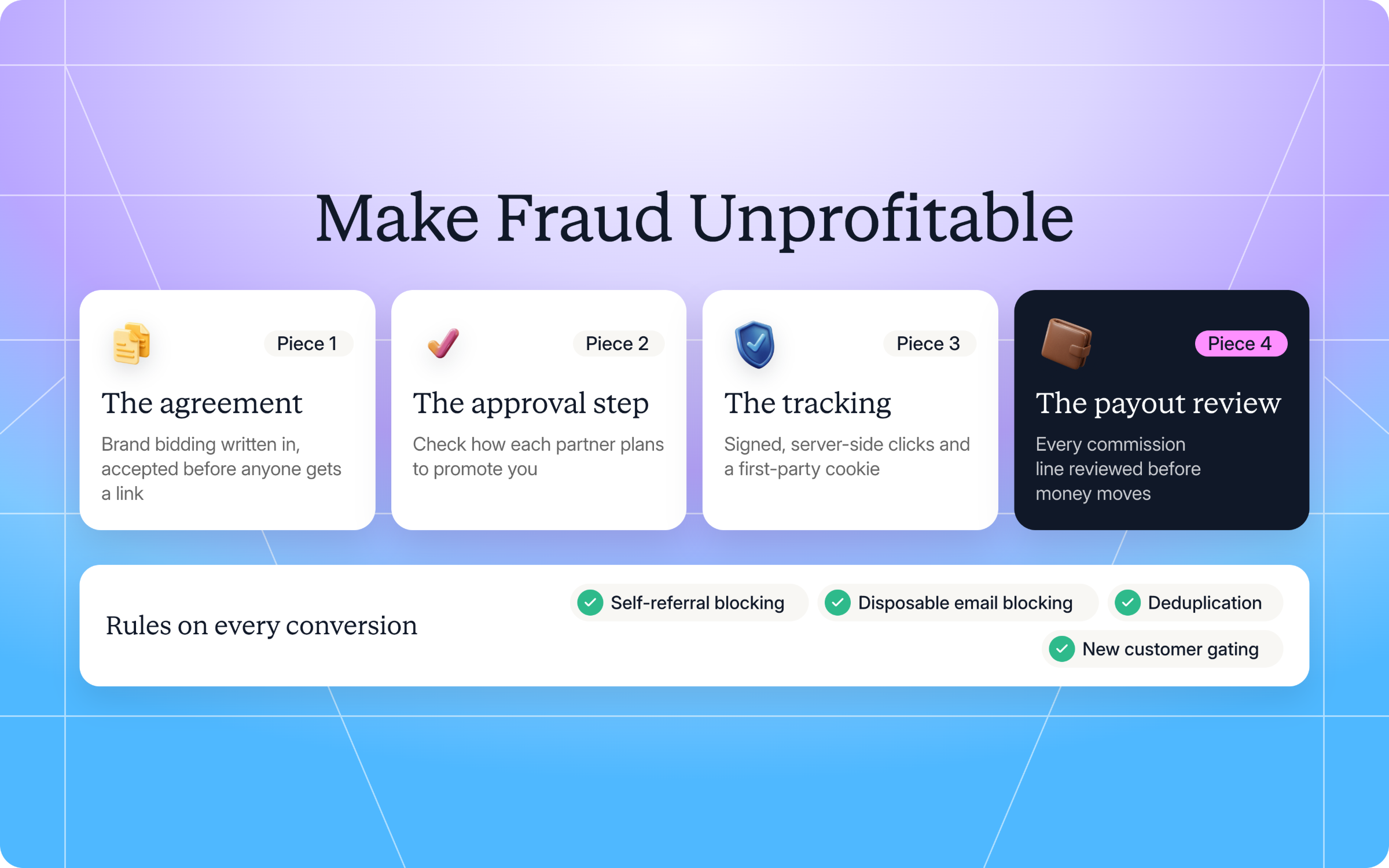
Piece 1: Write brand bidding into your affiliate agreement
Your affiliate agreement is the foundation. If it doesn't say brand bidding is off limits, you'll have a hard time reversing a commission when you find it. Spell out:
- Whether affiliates can bid on your own brand terms, and exactly which branded keywords, misspellings, and combinations are covered
- Whether they must add your brand terms as negative keywords in their own campaigns
- Whether they can use your trademark in ad text or a display URL
- Whether direct linking from paid ads to your site is allowed
- What happens when they break the rules, from commission reversal to removal from the program
Make acceptance mandatory before anyone gets a tracking link. No acceptance, no link. If you need a starting point, our affiliate partner agreement template includes clauses you can adapt.
Piece 2: Approve affiliates deliberately
Auto approving every application is how most fraudulent affiliates get in. Ask how a partner plans to promote you, check that their site and audience are real, and be cautious with anyone whose only stated channel is paid search.
There's a trade off. Every step you add to the signup flow also slows down legitimate partners. Settle on a practical middle ground. Maybe you auto approve partners with an established content site, but manually review anyone who mentions paid traffic. Most affiliate management software lets you build that kind of rule into the approval step.
Piece 3: Use tracking that can't be faked
Most cookie stuffing and click fraud depends on weak tracking. If a click can be forged, or a cookie can be dropped without a real click, fraud is cheap. Signed tracking fixes that. Each click is logged and signed on the server, so a forged click never credits anyone, and attribution lives in a first party cookie on your own domain rather than in a third party script.
Then layer automatic rules on top, running on every conversion rather than whenever someone remembers to check:
- Self referral blocking: Affiliates can't earn commission on their own signups.
- Disposable email blocking: Throwaway addresses, a common sign of fake leads, never trigger a payout.
- Deduplication: The same customer is never paid out twice.
- New customer gating: You only pay for genuinely new customers, not existing accounts.
Automated fraud detection tools handle the volume. Your team handles the judgment calls. Some fraud detection software adds device fingerprinting and machine learning models that score each conversion, but for most B2B SaaS programs, solid rules plus a monthly traffic quality review catch the majority of problems. Look at click to conversion ratios per affiliate, conversion to paid ratios, and how many referred accounts are still active after 90 days, ideally next to your wider partner performance data so outliers stand out.
Piece 4: Review commissions before they're paid
This is the single most effective way to prevent fraudulent payouts. Instead of paying automatically, every conversion becomes a commission line that someone reviews before money moves. A review window that matches your refund or trial period gives fraud time to surface.
It also changes the conversation. Reversing a commission before it's paid is a policy discussion. Clawing back money you've already paid is a much harder one. It works best when your commission structure is written down and your commission tracking runs in the same system as your affiliate data, so the reviewer can see the click, the conversion, and the payout in one place.
Protect your own brand campaign
Run your own brand campaign, even if you rank first organically. It keeps your official ad at the top, gives you Auction insights data, and makes it more expensive for anyone else to sit above you. Keep your ad copy and landing page tight so searchers recognize the official result, and treat a sudden drop in impression share on brand terms as an early warning sign.
Enforcing your policy without losing good partners
Finding brand bidding is one thing. Acting on it without damaging relationships with legitimate partners is another. Most violations aren't masterminds. Some are partners who didn't read the agreement, or who set up broad match campaigns that caught your brand by accident.
Enforce in clear steps:
- Capture evidence: Screenshots, dates, keywords, and the display URL.
- Notify the partner: Reference the specific clause in your affiliate agreement and ask them to add your brand terms as negatives.
- Reverse the commissions: Only on the conversions tied to the violating traffic.
- Remove repeat offenders: If it happens again, or they reappear under a new account, end the partnership.
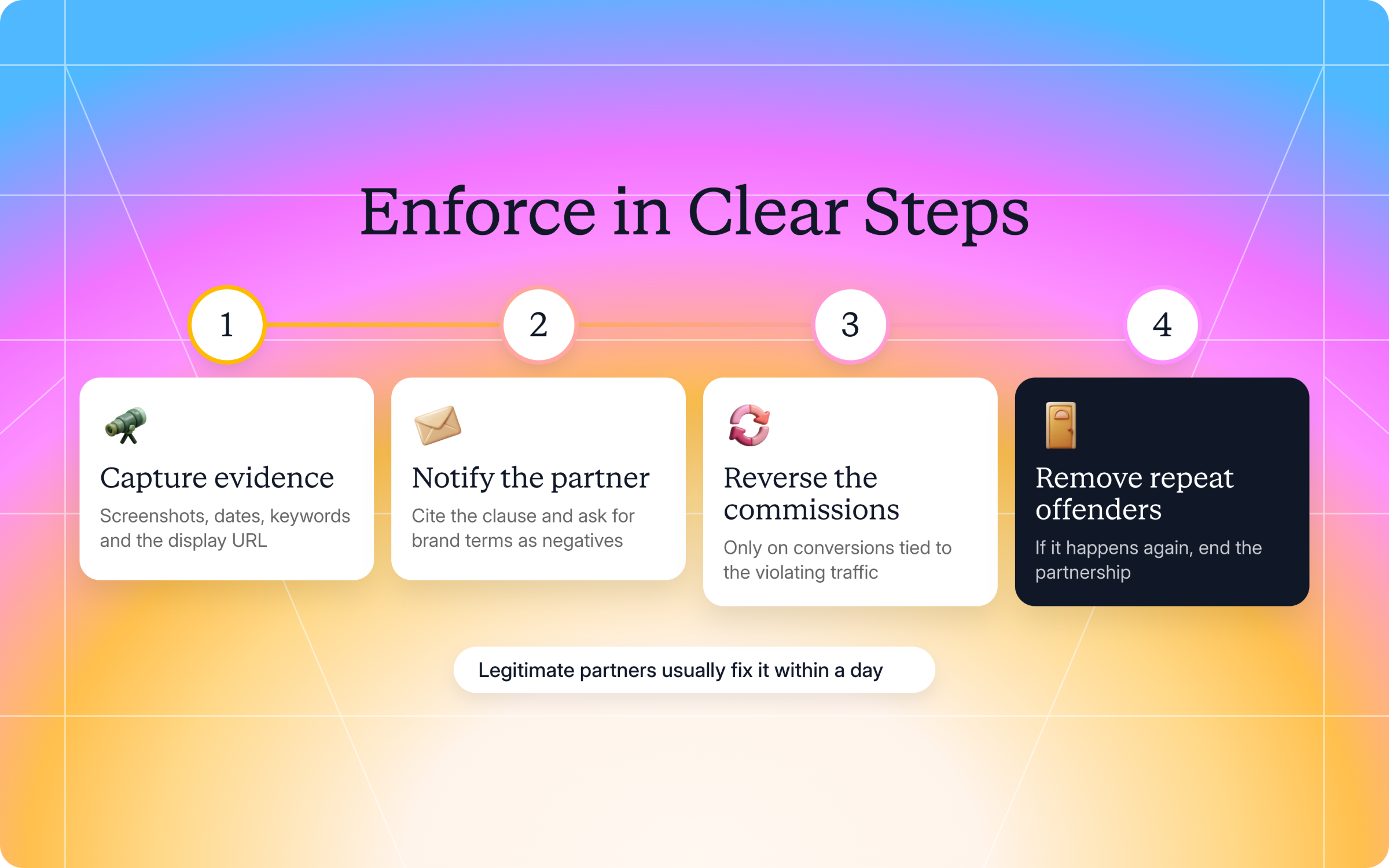
Legitimate partners usually fix it within a day. The ones who argue tell you what you need to know.
Don't think of this as a one time cleanup, either. New affiliates join, campaigns change, and a partner who was clean last quarter may not be this quarter. Rerun your brand searches and your traffic quality review on a schedule, the same way you'd review any other channel.
How Introw protects your affiliate program
Introw is a CRM first partner relationship management platform, which means it builds on top of your existing HubSpot or Salesforce setup rather than replacing it. That matters for fraud, because most affiliate fraud thrives in the gaps between a tracking tool, a payout spreadsheet, and a CRM that doesn't know which partner touched which deal.
Introw Affiliate Campaigns closes those gaps by running affiliates in the same program as your referral, reseller, and other partner types. Every affiliate link is signed and tracked server side, so a forged click never credits anyone. A first party cookie on your domain ties the visitor to the right partner, with an attribution window and first click or last click attribution model you set per campaign.
Self referral blocking, disposable email blocking, deduplication, and new customer gating run on every conversion, before anyone is paid. A traffic quality view flags patterns like clicks with no conversions. Each clean conversion becomes a commission line that's reviewed before it pays, so anything tied to brand bidding can be reversed while it's still a policy conversation. And because conversions land in your CRM and earned commission sits beside your other channels, you can see whether an affiliate is driving real pipeline or just intercepting it.
That's the difference between an affiliate program that grows your pipeline and one that quietly taxes it. See how Introw protects your affiliate program. Book a demo or explore Affiliate Campaigns.
Still curious? Here are some quick answers to help clear things up
It's when an affiliate bids on a merchant's brand name or branded keywords in paid search, then routes that traffic through their tracking link to earn commission. Most B2B affiliate programs prohibit it, because it means paying commission on buyers who were already searching for the brand.
Trademark bidding means bidding on a registered trademark as a keyword in paid search. Google doesn't restrict trademarks as keywords, and trademark owners can only restrict their use in ad text, with exceptions for resellers and informational sites. Your affiliate agreement is what actually stops affiliates from doing it.
Usually not. A few programs allow it under strict rules, for example only on specific non branded combinations or at a lower commission rate. For most B2B SaaS companies, banning brand bidding and requiring brand terms as negative keywords protects both margin and attribution.
It breaks the terms of virtually every affiliate program and affiliate network, and some large scale cases have led to civil and criminal action. Whether a specific case is illegal depends on the jurisdiction and the method, so check with legal counsel if the losses are significant. Either way, your tracking and your agreement should treat it as fraud.
Combine a clear affiliate agreement, deliberate affiliate approval, signed tracking with automatic fraud rules, and commission review before payout. No single tool catches everything, but together those layers make fraud unprofitable.





See AI-Native PRM in Action
Book a demo with one of our partner program experts, or explore Introw on your own time.