

An independent sales rep is a self employed sales professional who sells your product on commission, usually alongside other product lines, in a territory they already know. Independent sales reps (also called manufacturers' reps or commission based sales agents) give you territory coverage without a base salary, but only if your line is worth their time and the program around them works. This guide covers how reps differ from employees, resellers, and referral partners, how to find and hire them, typical commission rates, what belongs in the contract, and how to manage reps with deal registration and a portal so they never need a CRM seat.
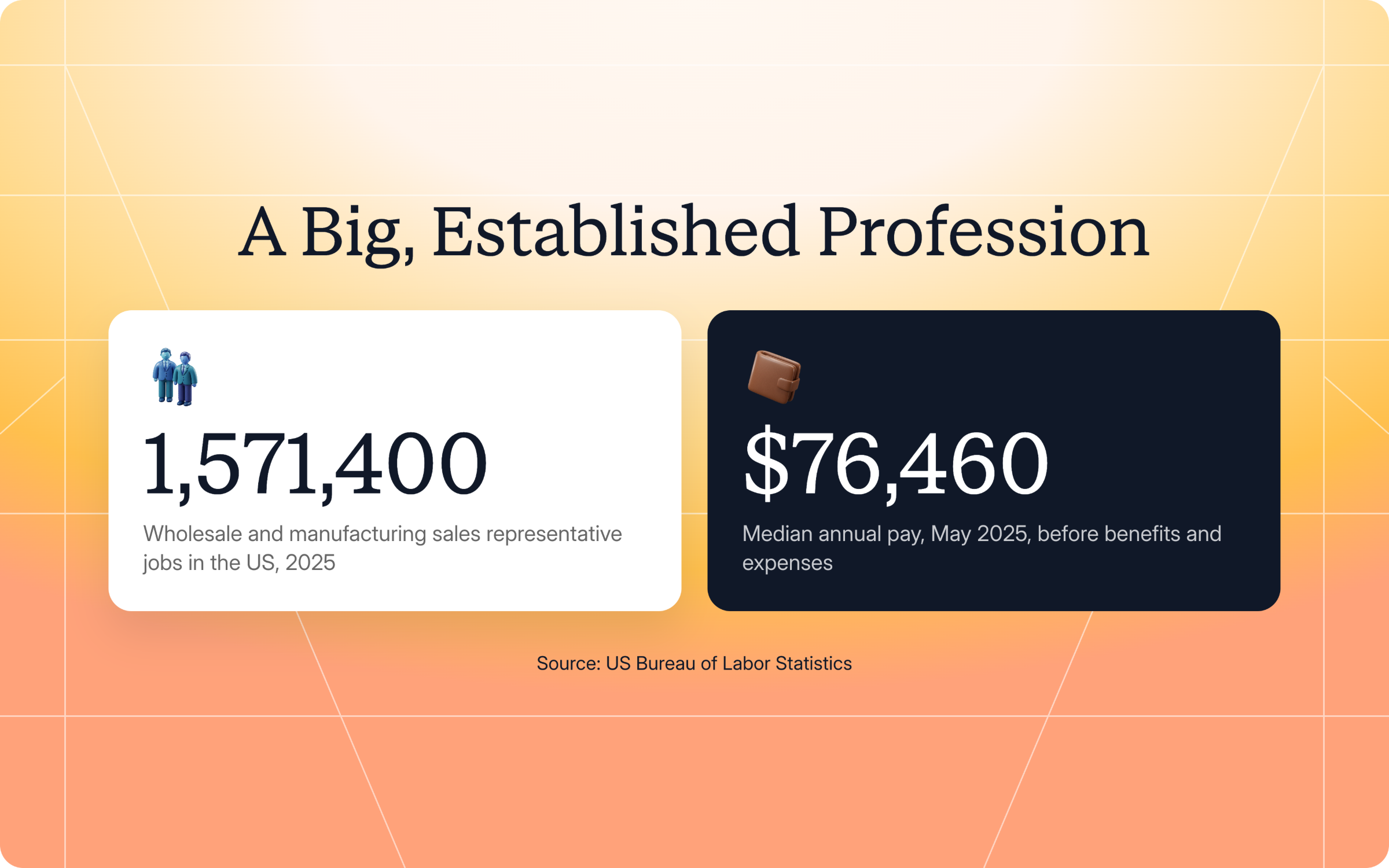
There were 1,571,400 wholesale and manufacturing sales representative jobs in the US in 2025, according to the US Bureau of Labor Statistics. BLS notes that some of these salespeople are "sometimes called manufacturers' representatives or manufacturers' agents," and that while some work for a single organization, others represent several companies and sell a range of products. That second group is the one this guide is about.
Here's how it usually starts. You want to break into a new region, but you can't justify another full time hire there yet. Someone says, "Why don't we just find a few commission only reps?" Six months later, you've signed five. One closed two deals. The other four went quiet after kickoff, and nobody knows whether they still mention you.
Sound familiar? The model isn't broken. The setup is.
This guide covers how to decide whether independent sales reps fit your business, how to find the right reps, how much commission to pay, what to put in the contract, and how to manage reps so they keep selling your product instead of the other lines in their bag.
What is an independent sales rep?
An independent sales rep is a self employed sales professional who sells a company's products or services on a commission basis, without being on the payroll. They're independent contractors, not employees. They set their own schedule, cover their own expenses, pay their own taxes, and usually carry several complementary product lines from multiple companies at once.
You'll see the role under a lot of names:
- Independent sales agents: The generic term, common in B2B services, software, and consumer goods.
- Manufacturers' representatives: The traditional term in industrial, electrical, building products, food service, and medical markets. A manufacturer rep (or "mfr rep") sells for several manufacturers whose products serve the same buyers.
- Commission only sales reps: Describes the pay model. They earn straight commission and no base salary.
- Rep firms or rep agencies: Several independent reps working together under one company, often with a principal who owns the customer relationships in a territory.
The Manufacturers' Agents National Association (MANA), a US non profit that has connected reps and manufacturers since 1947, describes manufacturers' reps as "independent sales professionals who operate on commission" and points out that they save employers Social Security and Medicare costs because they're paid for sales performance, not for showing up.
Independent reps vs employees, resellers, and referral partners
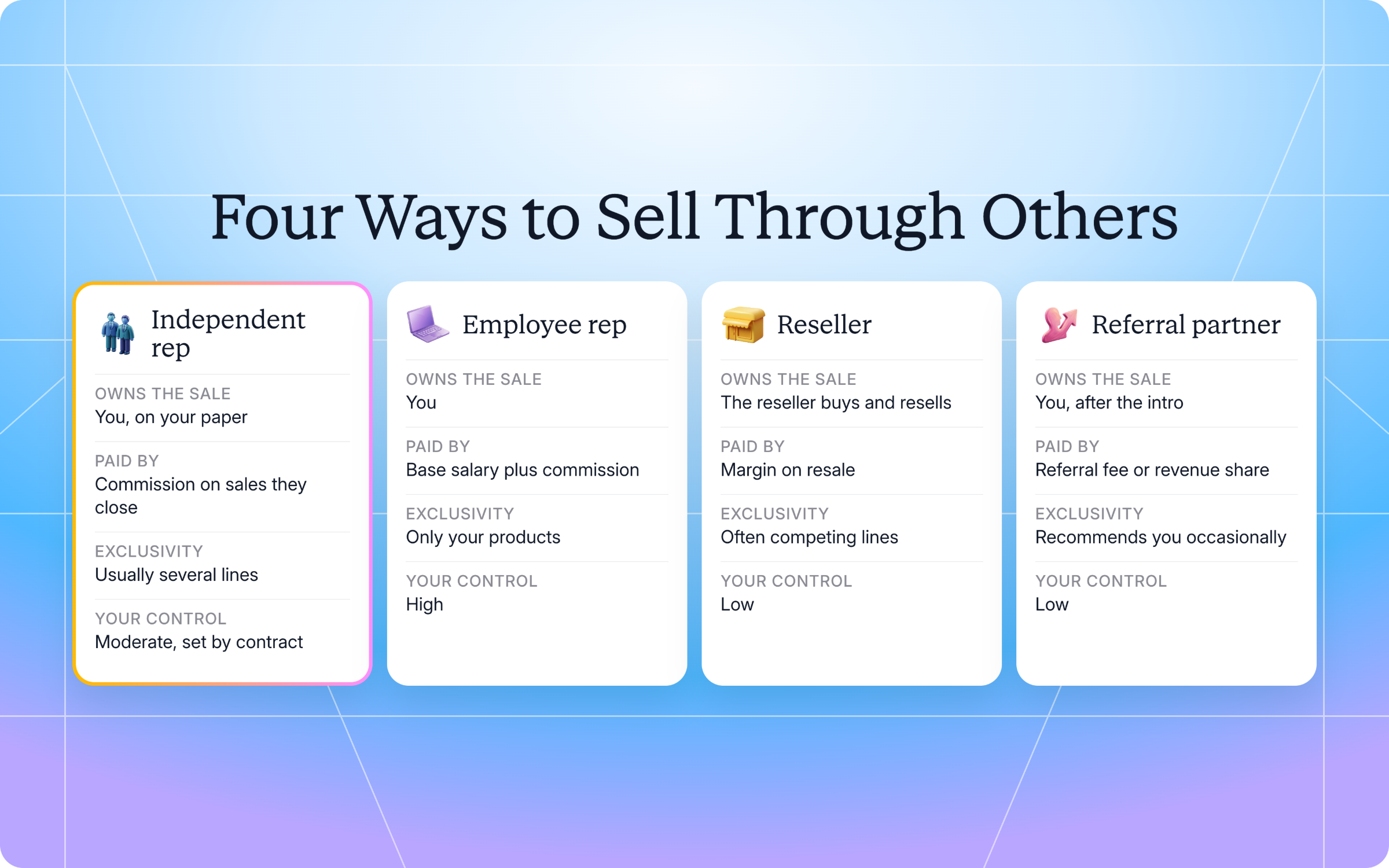
Independent sales reps sell like your sales team, get paid like a partner, and run their own business like a reseller. Mixing them up leads to the wrong contract and the wrong commission structure.
| Independent sales rep | Employee sales rep | Reseller | Referral partner | |
|---|---|---|---|---|
| Who owns the sale | You do, the rep sells on your paper | You do | The reseller buys and resells | You do |
| How they're paid | Commission on sales they close | Base salary plus commission | Margin on resale | Referral fee or revenue share |
| Exclusivity | Usually sells multiple product lines | Sells only your products | Often carries competing lines | Recommends you occasionally |
| How involved in the sales cycle | Prospects, demos, and closes | Full sales process | Owns the full cycle and the customer | Makes the introduction, your team closes |
| Your control | Moderate, set by the contract | High | Low | Low |
| Typical fit | New territories and verticals, field sales | Core markets | Markets where buyers want a local supplier | Warm introductions from trusted advisors |
If a rep only hands you warm leads and your team does the rest, you're really running a referral partner program. If they buy your product and resell it under their own contract, that's a value added reseller. Get this right first, because it decides how you pay them and what system you track them in.
What does an independent sales agent actually do?
A good independent sales agent handles their own lead generation and sales strategies. They prospect in their territory, get meetings through existing relationships, run demos, and work deals to close. Many stay on after the sale, a bit like account managers. Their biggest asset is their network: experienced sales professionals already know the buyers and who's planning to buy next quarter. That's what you're paying commission for.
When do independent sales reps make sense?
Independent reps aren't a cheap replacement for a sales team. They're a different tool, and for a business owner, they're often the fastest way to expand into new markets and new verticals. They work best when the following are true:
- You're entering new markets: A new region, country, or vertical where you have no relationships and can't justify a full time hire yet.
- Your product fits an existing rep's bag: The rep already sells complementary products to the same buyer, so adding yours makes their visits more valuable.
- The deal size is worth their time: A rep juggling several product lines will prioritize whatever pays best for the least effort. Small, complex deals rarely make the cut.
- The sales cycle is predictable: Reps carry the risk of unpaid time. Very long, unpredictable sales cycles push good reps toward more reliable lines.
- You can support them: You need clear messaging, sales materials, pricing, and someone who answers their questions quickly.
They're a poor fit when your product needs deep technical selling that only your team can do, when you need full control over every customer conversation, or when the deal is so small that no rep can make a living on it.
If you're still deciding between hiring external sales capacity and building a partner channel, our guide to outsourced sales vs channel partners compares the two models in depth. Independent reps sit in the blurry middle: external sellers paid on results.
How to find independent sales reps
So, how do you find independent sales reps who are actually worth signing? Partner recruitment for reps is about fit, not volume. One rep who already sells into your buyers beats ten who don't.
Start with rep associations
Rep associations are the most established place to start, especially for manufacturers. MANA runs a directory called RepFinder for manufacturer members, built to "connect with qualified independent sales reps who already know your market, territory, and customers." Many industries also have their own rep associations and trade groups, so check what exists for your vertical.
Use LinkedIn and your own network
Search LinkedIn for people with titles like "independent sales representative," "manufacturers' rep," or "principal" at a rep agency, then filter by industry and region. Ask your best customers which reps call on them. The answer often points to the right reps faster than any search.

Go to industry events
Trade shows and industry conferences are where independent reps go to find new product lines. Walk the floor, talk to the reps who stop by your booth, and ask distributors which reps they trust.
Use online marketplaces carefully
Marketplaces built for commission only sales give you volume, and some promise pre vetted independent sales agents, but quality varies. Expect to screen many profiles to find a few good reps, and watch for hidden fees.
Write a line card worth reading
Reps evaluate you as hard as you evaluate them. Summarize your offer up front: who buys, typical deal size, sales cycle, commission rate, territory, and the support you'll provide. If the numbers don't work for the rep, you'll find out fast.

How to hire independent sales reps
Hiring independent sales reps is closer to choosing a partner than filling a role. You're not their boss. You're one of their principals, competing for their time with every other line they carry.
Look for these signals when hiring reps:
- Relevant relationships: Can they name the buyers they already call on in your target market?
- Complementary lines: Do their other product lines sell to the same buyer, without competing with yours?
- A manageable bag: A sales agent carrying 20 or more lines may not have time for yours. Independent agents who are stretched thin rarely prioritize a new principal.
- A track record: Ask which products they launched in their territory and what results they got. Call references from other principals.
- How they work: Do they use a CRM, report pipeline, and show up to pipeline reviews? Or do they prefer to work in the dark?
Ask direct questions: what would make my line worth your time, and what do you need from me to close the first deal? The right reps answer with specifics. And start small. Two or three reps in different territories teach you more than signing ten at once.
How much commission do independent sales reps make?
This is the question everyone asks first, and the honest answer is: it depends on your product, your margins, and how much work the rep does. There's no single independent sales rep commission rate, but there are useful ranges.
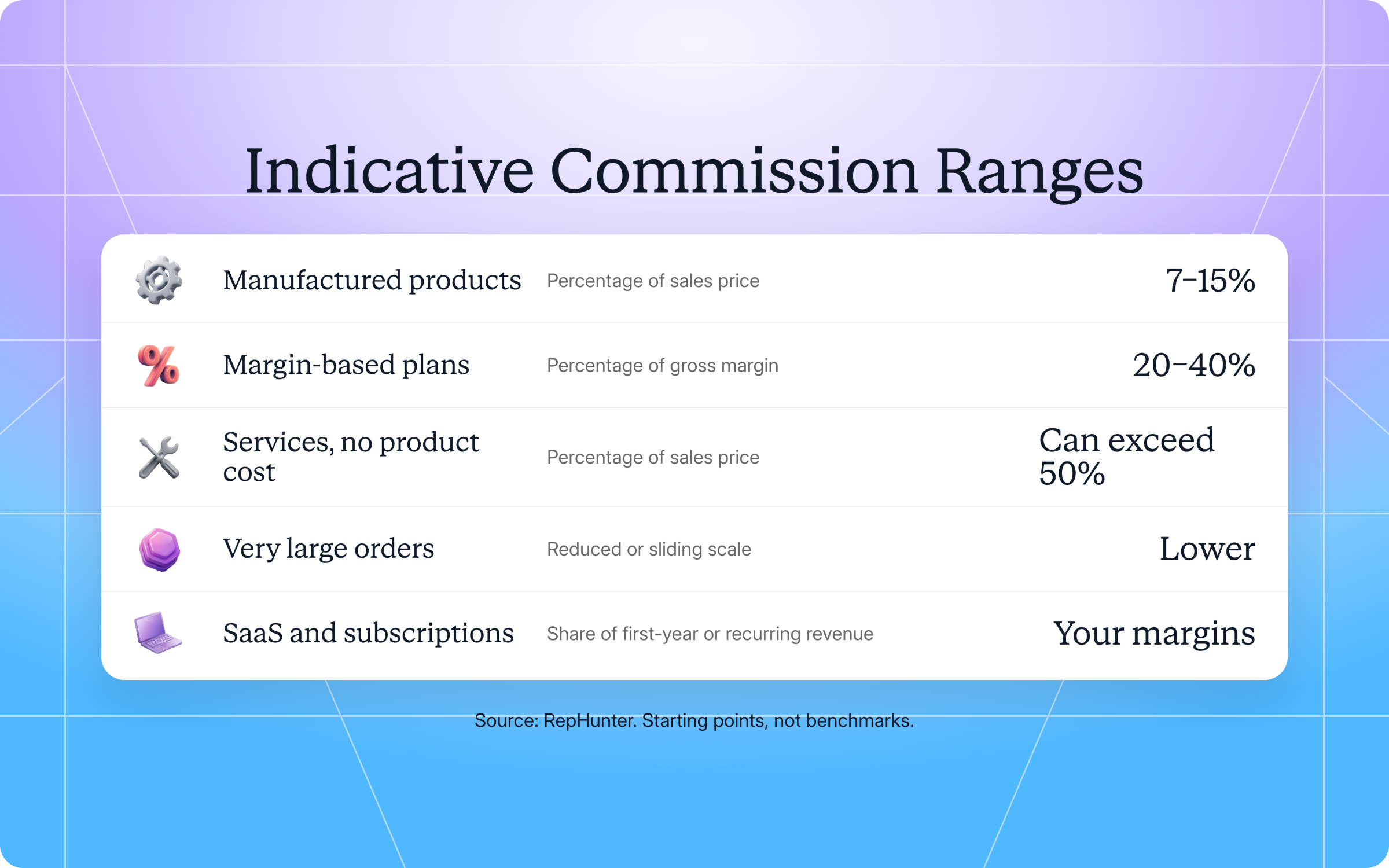
According to RepHunter, a long running marketplace for manufacturers' reps, commission on the sales price of manufactured products typically falls between 7% and 15%. When commission is calculated on gross margin rather than price, they cite a standard range of 20% to 40%, and service based products with no manufacturing cost can run upwards of 50%.
| Product or deal type | Typical commission basis | Indicative range |
|---|---|---|
| Manufactured products | Percentage of sales price | 7% to 15% |
| Margin based plans | Percentage of gross margin | 20% to 40% |
| Services with no product cost | Percentage of sales price | Can exceed 50% |
| Very large orders | Reduced or sliding scale | Lower than standard |
| SaaS and subscriptions | Percentage of first year or recurring revenue | Model from your own margins and payback |
Treat these as starting points, not benchmarks. A good commission structure for commission based sales agents depends on a few factors:
- Who closes: Reps who only generate leads earn less than reps who run the sales process and close deals.
- Service load: If the rep handles training or ongoing support, pay more.
- Repeat business: Recurring products can justify a lower rate.
- Volume: A tiered commission structure that rises with volume rewards your best reps and gives everyone something to aim for.
For SaaS, there's no reliable benchmark for commission only reps. Many companies pay a share of first year contract value, sometimes with a smaller recurring share on renewals. Work backward from your gross margin and payback target.
A worked example
Say you're a manufacturer and a rep's territory produces $500,000 in annual sales at an 8% commission. The rep earns $40,000 a year from your line. You pay nothing until orders come in, and you don't pay benefits, a base salary, or travel.
Compare that with an employee. BLS puts the median pay for wholesale and manufacturing sales representatives at $76,460 a year in May 2025, before benefits, payroll taxes, and expenses. To match that salary from commission alone at 8%, the rep needs to sell about $955,750 of your product a year.
Now flip it. If your line only produces $100,000 in their territory, the rep earns $8,000, which won't get your product into many meetings when other lines pay more. That's the real question behind how much commission to pay: is your line worth the rep's time?

For SaaS, a $24,000 annual contract at 15% first year commission pays the rep $3,600 per deal. Ten deals a year is $36,000, with no fixed cost to you until contracts are signed.
Pay on time, and make earnings visible
Commission based sales reps are running a business, and late or unclear payments are the fastest way to lose them. Pay on a predictable schedule, show which deals are pending and approved, and explain any adjustment. Clear commission tracking does more for rep loyalty than an extra point of commission nobody can verify.
What to put in an independent sales rep contract
Your contract sets the rules for every disagreement you'll ever have with a rep. Write it before the first deal, not after. A starting point like our channel partner agreement template helps, but rep agreements need a few clauses of their own.
- Territory: Define it clearly, by geography, vertical, named accounts, or a combination. Vague territories cause most disputes between reps in different territories.
- Exclusivity: Decide whether the rep is exclusive in their territory, and whether they can carry competing product lines. Many reps won't accept a non exclusive territory without a higher rate.
- House accounts: List any accounts you keep for your own sales team, and whether the rep earns anything on them. Some reps expect existing business in their territory to be turned over to them, so agree this up front.
- Commission terms: The rate, what it's calculated on (price, margin, first year revenue), when it's earned (order, shipment, invoice, or payment), and when it's paid.
- Post termination commissions: What happens to commission on orders and renewals after the relationship ends? This is one of the most common sources of disputes.
- Deal registration rules: How a rep claims a deal, and what happens when two reps, or a rep and your direct team, chase the same account.
- Expenses and independence: Who pays for travel, samples, and marketing, and confirmation that the rep is an independent contractor responsible for their own taxes.
- Term and termination: Notice periods, and how either side can end the agreement.
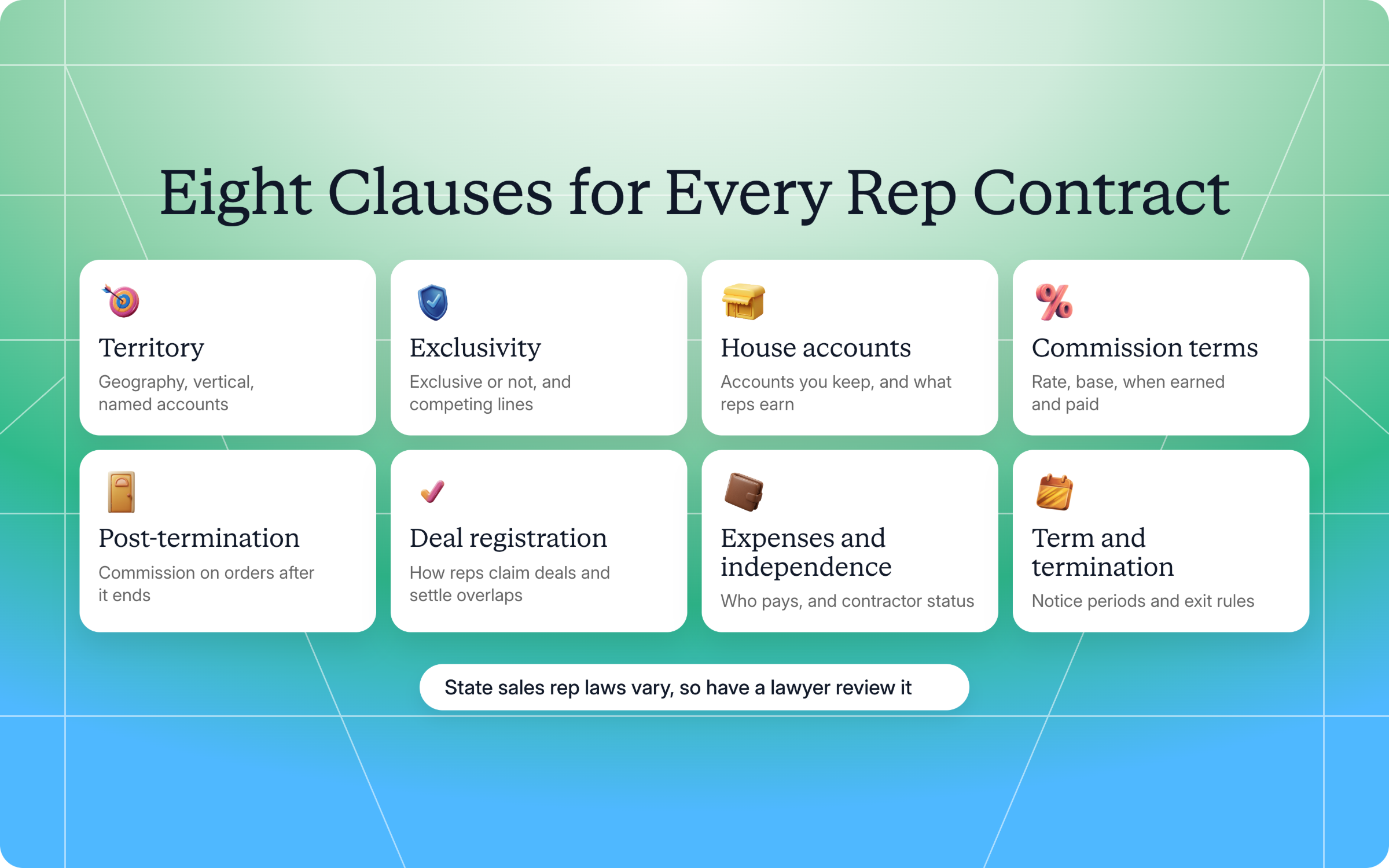
One more thing. Several US states have sales representative commission laws that apply to independent reps. Illinois, for example, has a Sales Representative Act that defines how commissions are determined when the contract is silent. These laws can affect when commissions are due after termination and what penalties apply for paying late, and they vary from state to state. This guide isn't legal advice, so have a lawyer review your rep agreement for every state you sign reps in.
Stop channel conflict before it starts
Mix independent reps with a direct sales force, resellers, or partners paid a referral fee, and sooner or later two of them chase the same account. Channel conflict is easier to prevent than to resolve, and deal registration is the standard fix: whoever registers a qualified deal first gets protection, as long as they keep working it.
Here's how channel conflict screening works in Introw, from turning it on for a registration form to resolving a flagged submission:
Onboarding and enabling independent sales reps
You sign a rep, send a price list and a deck, and wait. A week later, their other lines pull them back. Your partner activation rate, the share of reps who actually get a deal moving, is set in the first 30 days.
Give them a 30 day plan
Treat onboarding like a real hire. In the first month, a new rep should:
- Sign the agreement: Before anything else, so territory and commission terms are clear.
- Learn the product: A short product training and a demo they can run themselves.
- Get the sales materials: Your pitch, pricing, case studies, objection handling, and a competitor overview.
- Pick target accounts: Five to ten accounts in their territory they'll approach first.
- Register a first deal: The single best sign that a rep is going to work out.

Unlock more as they prove themselves
Don't hand a brand new rep everything on day one. Open up advanced training, better pricing tools, or higher commission tiers as reps hit milestones. It keeps the first week simple and gives reps a reason to keep going. Good partner onboarding makes this happen automatically, so no rep falls through the cracks because you had a busy week.
Here's what building a staged onboarding path looks like in Introw, where portal access unlocks automatically as partners reach each milestone:
Keep sales materials current
If your deck still shows last year's pricing, reps will stop using it, or quote the wrong number. Keep one place for current materials, training, and product updates. Partner enablement for reps works like it does for resellers: governed content, short courses, and certifications. Our roundup of partner onboarding software covers what to look for in a tool.
How to manage independent sales reps
Once reps are live, your job is to keep your line top of mind without micromanaging people who don't work for you. You get more control through structure than through check ins.
Run regular pipeline reviews
A short monthly call with each active rep keeps deals moving. Keep it about their pipeline: what's moving, what's stalled, and what do they need from you?
Track the right performance metrics
You can't manage independent reps like an internal sales team, but you can measure them:
- Registered deals: How many deals each rep registers per month or quarter.
- Win rate and sales cycle: How their deals convert, and how long they take compared to your direct team.
- Revenue by rep and territory: Where your territory coverage is strong, and where it's thin.
- Time to first deal: How long a new rep takes to register and close their first deal.
- Activity trend: A rep whose registrations drop to zero may have quietly moved on.
Feed all of it into your partner attribution reporting, so rep sourced revenue is measured the same way as every other channel, and use partner performance data to decide where to spend your time.
Reward your best reps
Your top reps have options, and the top companies they represent all want more of their sales efforts. Give them reasons to choose your line and bring you more deals and more business: higher commission rates, first look at new products, and quick answers. A short term SPIFF on a new product or a slow quarter is often the cheapest way to get your line back into a rep's meetings.
Not every rep will work out. If one hasn't registered a deal in two quarters, follow your termination terms and settle commission owed promptly. The rep community is smaller than you'd think.
Do independent sales reps need a CRM?
Here's where many rep programs fall apart. You want pipeline visibility. The rep wants to sell, not log into another system. Hand reps CRM seats and you pay for licenses, expose your data, and still chase updates by email. Skip it and you're running the program from spreadsheets.
Searches for a CRM for independent sales reps usually come from reps managing several principals. From your side, the better question is: how do you get rep deals into your own CRM without making reps work in it? The answer is a partner portal with deal registration that writes straight into your CRM. Reps register deals in a simple form, every registration is checked for conflict, reps see their own pipeline, and commission is calculated from the same CRM records your finance team already trusts. If you sell through several partner types, our guide to channel sales shows how independent reps fit alongside resellers and referral partners.
How Introw helps you manage independent sales reps
Introw is a CRM first partner relationship management platform, which means it builds on top of your existing HubSpot or Salesforce setup rather than replacing it. Independent reps run in the same program as your resellers, referral partners, and affiliates, so rep data sits next to the rest of your pipeline instead of in a separate tool.
- Deal registration from any channel: Reps register deals from the portal, a link, an embedded form, email, Slack or Teams, or an AI assistant. Every route runs the same checks and writes to your CRM, and partners never need a CRM seat.
- Channel conflict screening: Each registration can be screened against open pipeline in your CRM, direct or partner, before the rep is credited.
- Shared pipeline: Reps see the deals attributed to them, in your stages. You choose which fields they can see and edit.
- Commission plans that read your CRM: Revenue share, fixed fees, tiered rates, or one time SPIFFs, with recurring payouts and rates by tier, segment, or individual rep. Commission lines are created automatically as qualifying deals close.
- Payouts reps can see: Reps check forecasted, upcoming, and paid earnings in the portal. Introw Pay handles partner verification, tax forms and 1099s, and pays reps in their own currency.
- Onboarding that runs itself: An application form creates the rep in Introw and your CRM, agreements can be signed as an onboarding step, and the partner portal unlocks in stages.
Here's how a commission plan is built and launched in Introw, from connecting a data source to enrolling the partners who should earn:
That's what a working rep program looks like: reps who register deals in seconds, commissions they can check without emailing you, and every rep sourced deal sitting in your CRM. See how Introw helps you manage independent sales reps without adding another system. Book a demo or explore Deal Registration.
Still curious? Here are some quick answers to help clear things up
An independent sales rep is a self employed sales professional who sells a company's products on commission, without a base salary. They're independent contractors, often carry several complementary product lines, and cover a specific territory or vertical. In manufacturing, they're usually called manufacturers' representatives.
Most independent sales reps earn straight commission, a percentage of the sales they close or of the gross margin on those sales. They don't receive a base salary or benefits, and they pay their own taxes and expenses. When and how commission is paid should be defined in the rep agreement.
It depends on the product and how much work the rep does. RepHunter cites 7% to 15% of the sales price for manufactured products, 20% to 40% when commission is based on gross margin, and higher rates for services with no product cost. SaaS companies usually model rates from their own margins.
Start with rep associations like MANA, which runs the RepFinder directory for manufacturer members. Then search LinkedIn, ask customers and distributors which reps they trust, attend trade shows, and use online marketplaces with care. Look for reps whose other lines sell to the same buyers.
Yes, commission only arrangements with independent contractors are common and legal in the US, as long as the rep is actually independent and not an employee in disguise. Several states also have sales representative commission laws covering contracts and payment after termination, so have a lawyer review your agreement.





See AI-Native PRM in Action
Book a demo with one of our partner program experts, or explore Introw on your own time.