

Partner syndication puts your content in front of audiences who already trust the sender, which paid placements can’t replicate. The reason partners don’t share your assets isn’t effort or interest, it’s that making content usable costs more than it returns for them. Fix the adoption cost by delivering co-branded, ready-to-send campaigns where partners already work, keeping one current version, and closing the loop on results.
Content syndication is how you get your content in front of audiences you don’t own. For most B2B teams, that means paying third-party networks to place assets and sell you leads. That works, but it’s a rented audience, and you pay every time.
There’s a better version sitting right in front of you. Your partners already have audiences that trust them, and they already sell to the customers you’re trying to reach. When a partner sends your content to their audience, it lands with credibility you can’t buy.
Think of partner syndication as an adoption-cost problem. The issue typically isn’t content production. You already have the assets. The question is how much effort it takes for a partner to make them their own, and whether that effort pays off for them. The teams that solve this drive that cost close to zero, and AI is changing what that costs.
What is content syndication?
Content syndication is republishing your content somewhere other than your own site to reach an audience you don’t own. There are three main types of content syndication:
- Paid syndication: Third-party platforms place your assets and sell you the leads. Syndicated web content on news outlets and industry sites can build awareness, but every placement is a line-item cost.
- Self-syndication: You republish on channels you control, such as LinkedIn or Medium. This is organic content syndication through your owned channels, and it’s essentially free content syndication since you’re not paying extra for placement.
- Partner syndication: Your partners publish or send your content to their own audiences, under their brand or jointly. The right syndication partners who know their audience will always outperform a network that doesn't.
McKinsey projects that partner ecosystems will drive roughly one-third of the global economy by 2030, representing $80 trillion in annual revenue. Partner syndication is how content reaches that revenue engine. Partners’ audiences trust them, so your content will land better when they put it forward. The marginal cost is only the effort of making the asset usable.
Why the shift toward partner ecosystems changes the content game
With that much revenue flowing through partner ecosystems, the relevant content that reaches partner selling audiences is a pipeline lever. But partners can’t execute. Forrester found that nearly 70% of partners operate at low-to-medium levels of marketing and demand maturity. This makes scalable partner-led growth difficult. You might have stellar content, but can your partners use what you give them?
Why partners never distribute your content
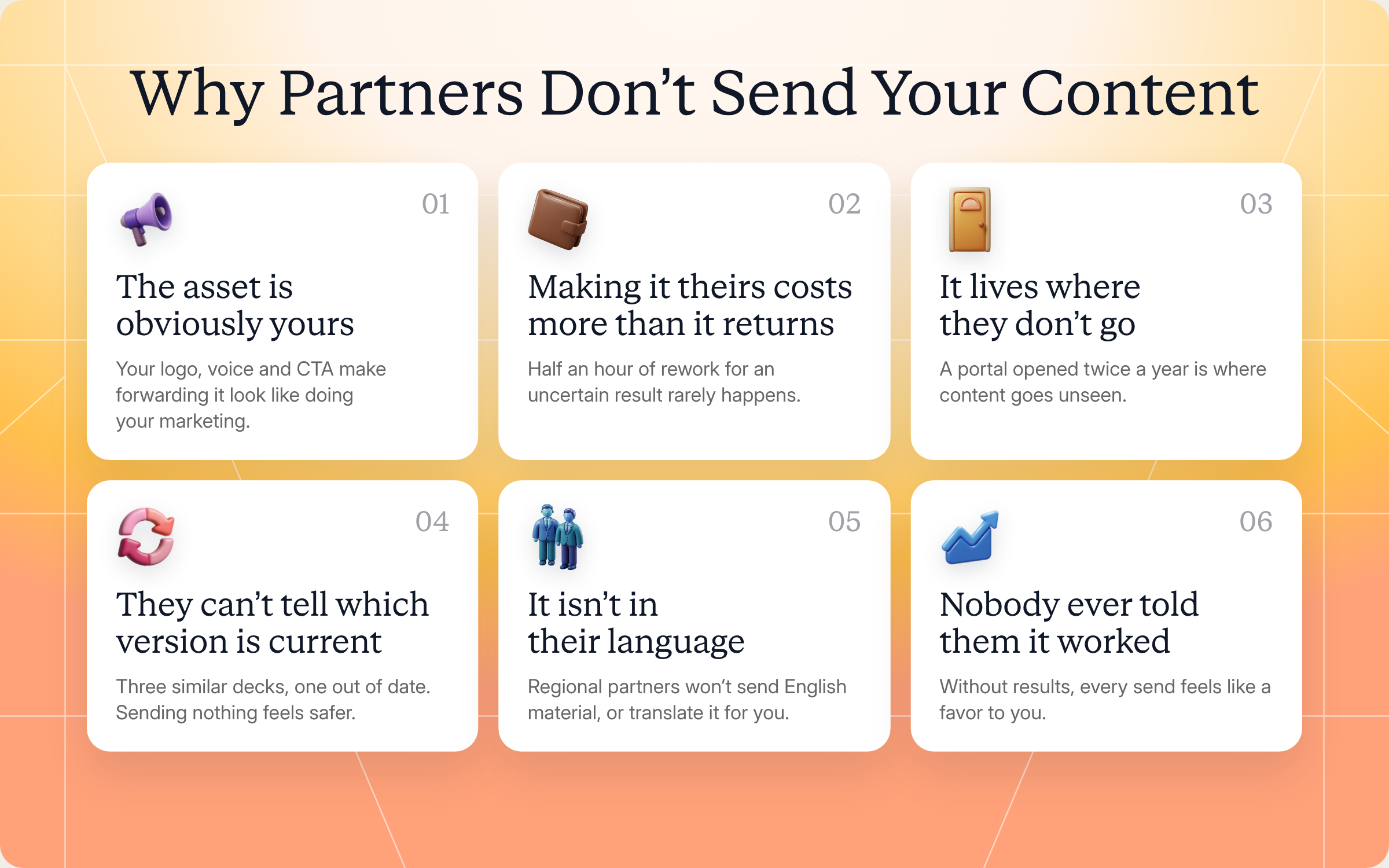
60% of partners say their marketing efforts fall short and are only somewhat effective or totally ineffective. You need to do as much of the legwork as possible if you want partners to share your content. Here’s why most partners don’t:
- The asset is obviously yours: If you don’t make any changes then the content has your logo, your voice, and your CTA pointing at your website. A partner forwarding it looks like they’re doing your marketing, not serving their customer.
- Making it theirs costs more than it returns: Rebranding a deck, rewriting an email, and swapping a CTA might only be 30 minutes of work. But it’s for an uncertain result, so it doesn’t happen.
- It lives where they don’t go: Partners aren’t going to share your content if they have to search for it. Maybe the asset sits in a portal they log into twice a year, or in a partner communications channel that expired.
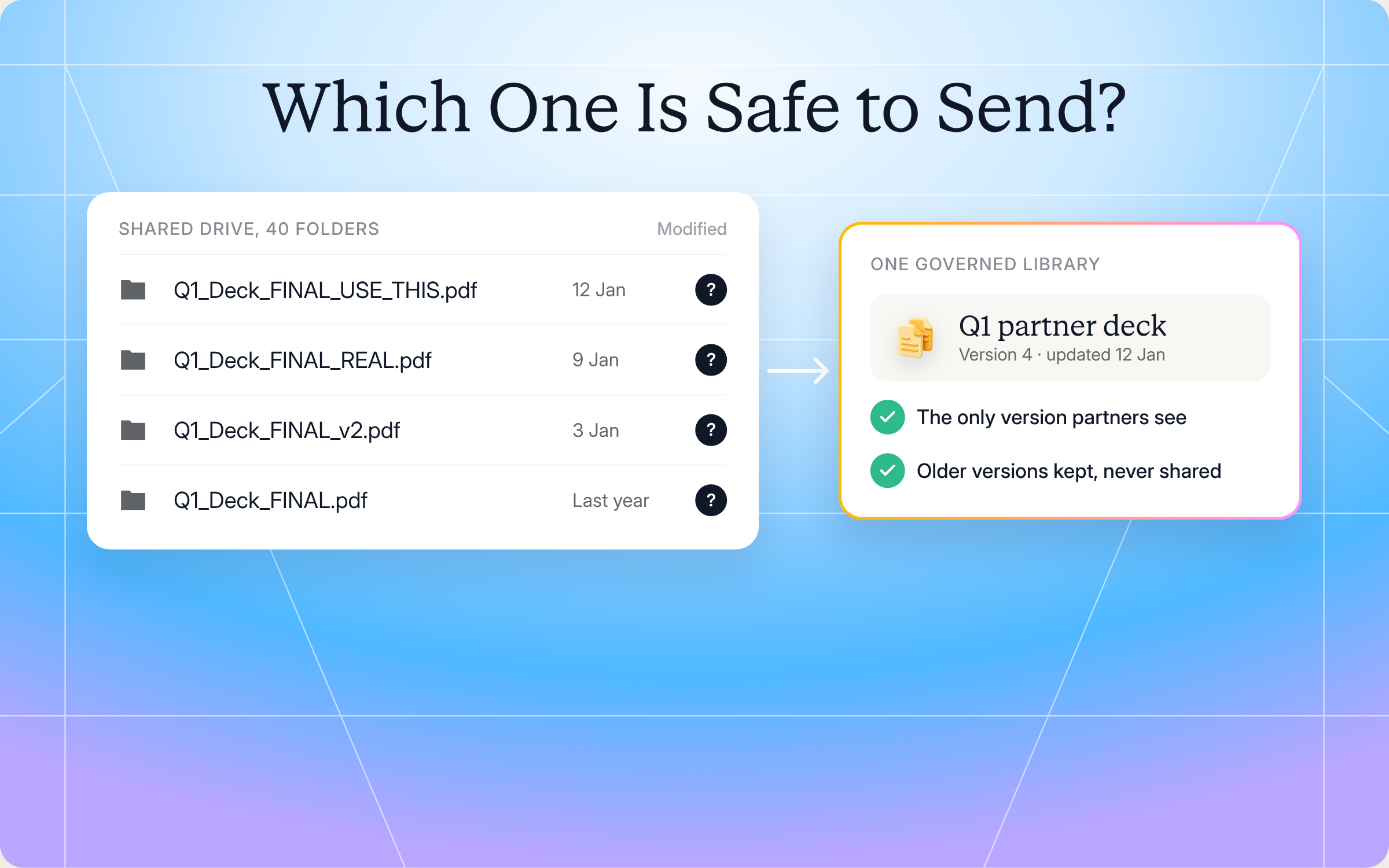
- They can’t tell which version is current: If there are three decks with similar names, one of them from last year, there’s no way to know which is safe to send.
- It isn’t in their language: A regional partner won’t send English material to a customer who can’t read it, and they’re not going to translate it for you.
- Nobody ever told them it worked: If there’s no feedback loop, distributing your content feels like a favor rather than something that produces partner marketing pipeline for them.
Don’t assume partners aren’t distributing your content out of laziness. They're making a rational cost decision every time. Only 22% of vendors provide “campaigns-in-a-box” to their partners. The vast majority hand over files, not campaigns, and the adoption numbers reflect it. Partner syndication works when you drive the cost of making an asset theirs close to zero.
What makes content actually get used
Giving partners content isn’t enough. The content has to be built for them to use. Here's what that looks like in practice:
| Property | What it means | What happens without it |
|---|---|---|
| Theirs, not yours | The asset carries the partner’s brand, or both brands, with no design request | It reads as vendor marketing and never gets sent |
| Editable at low cost | A template or kit they can adapt in minutes, not rebuild | The effort exceeds the expected return, so it gets skipped |
| Where they already work | Delivered to their inbox, Slack, or their own marketing tool | It waits in a portal nobody opens |
| Obviously current | One governed source with versioning, so the latest is the only one | Partners send last year’s deck, or send nothing to be safe |
| In their language | Translated versions available without a request | Whole regions of the channel go dark |
| Scoped to them | Visibility set by segment or tier, so they see what's relevant | A wall of assets, and choosing is harder than ignoring |
| Measurable | You can see who opened, used, and published what | You can't tell what works, so you keep making more of the wrong thing |
Every property in the table maps to a specific co-branded content barrier that prevents adoption. Once you remove the barrier, it’s more likely the partner marketing content gets used. A 2026 global survey found that 64% of channel partners report high or very high usage of co-marketing templates, placing co-marketing as the third most desired go-to-market asset in the entire partner enablement portfolio. When content is built for partners to adapt, they use it.
What to syndicate through partners
Certain types of content are going to be difficult to make work. Assets that involve pricing pages, product release notes, and anything heavy on your brand story won’t land well with your partner’s audience. Instead, focus on making these formats partner-friendly:
- Co-branded one-pagers
- Customer stories the partner can claim a role in
- Email sequences they send from their own tool
- Social posts written in their voice
- Webinar and event kits
- Battlecards for their sales team, which double as sales enablement content

These formats travel well for a reason. Blogs (84%), case studies (71%), and webinars (63%) are the most actively used content types among technology marketers. These are the same formats that work through partners, because they’re built around a customer story your partner can claim involvement in. Blog posts and case studies also double as thought leadership that strengthens both brands when distributed through partner sites and multiple channels.
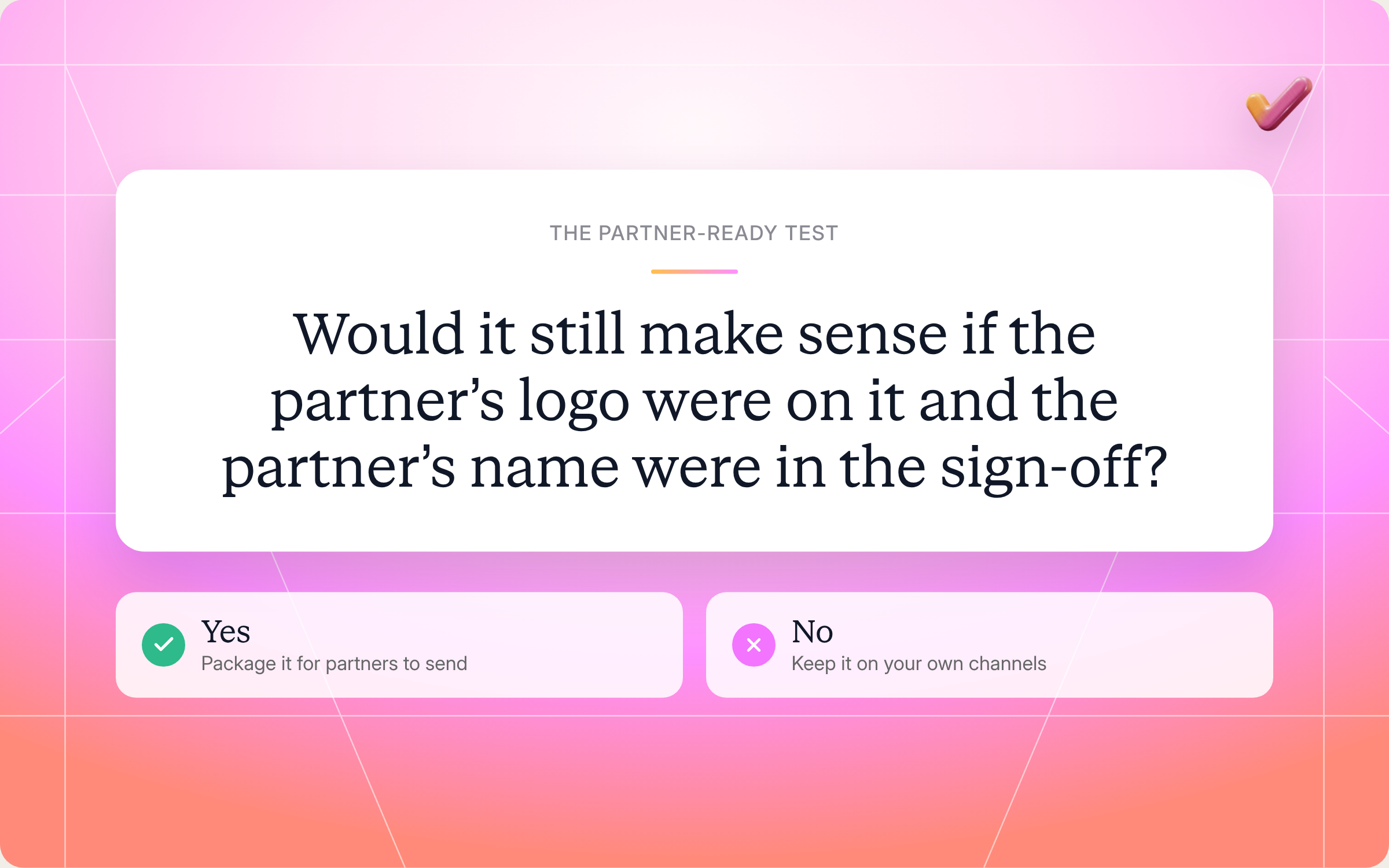
So, before you hand anything to a partner ask yourself one question: Would it still make sense if the partner’s logo were on it and the partner’s name were in the sign-off? If the answer is no, partners can’t realistically take advantage of your content marketing efforts. Quality content that reads as engaging content from the partner’s perspective is what gets sent.
Pay close attention to your CTAs specifically. If every syndicated asset drives to your demo form, the partner is effectively handing you their customer. To combat that, drive partner-syndicated content to a joint or partner-owned next step.
How to build a partner syndication program
Investing in a successful content syndication strategy can be one of the biggest ROI moves you make. You’re drawing from work you've already done and making slight adjustments that can result in more revenue and more customers. Here’s how to build it.
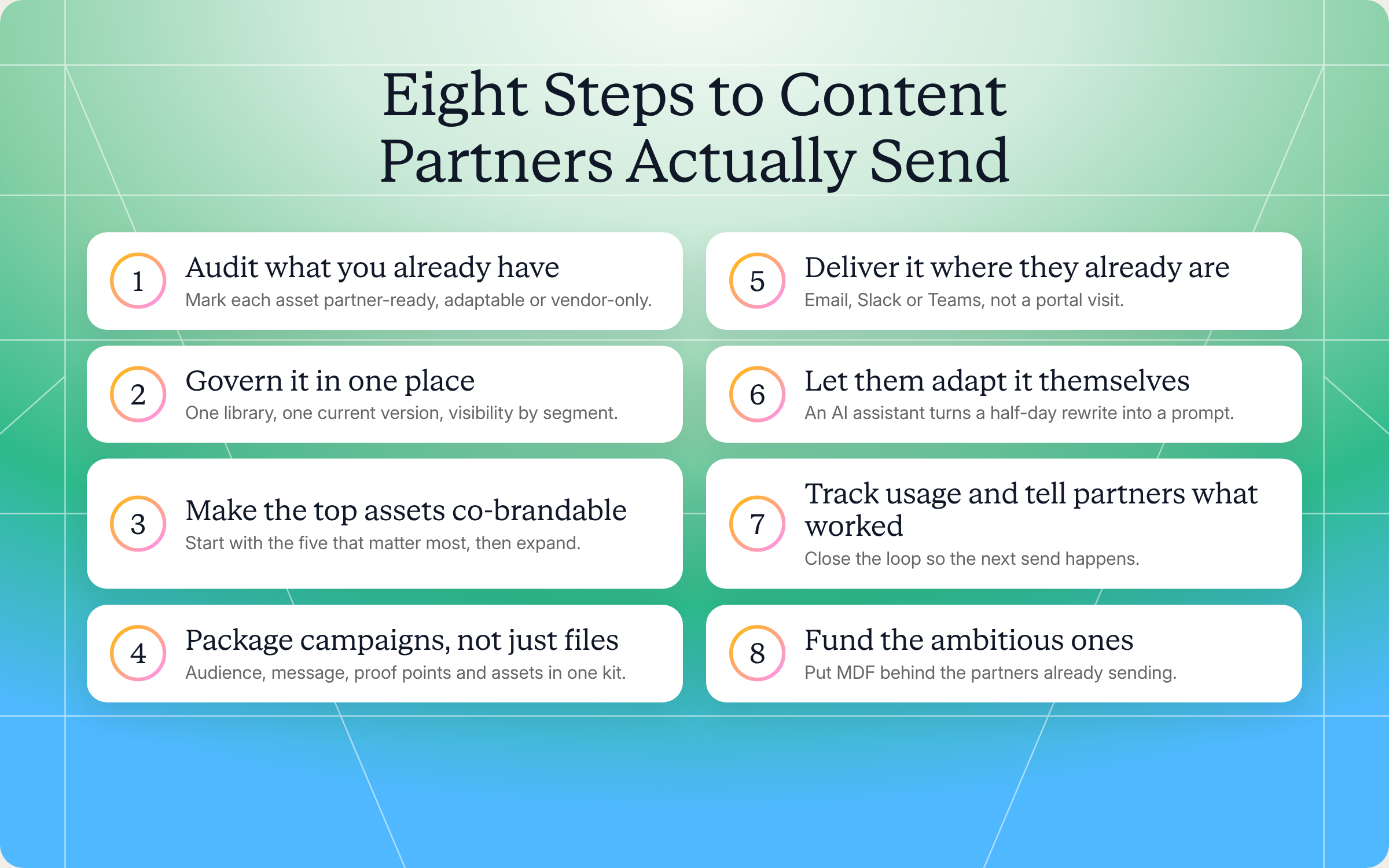
Step 1: Audit what you already have
You probably have more usable material than you think. The issue is packaging. Go through your library and mark each asset as partner-ready, adaptable, or vendor-only. Anything in the first two categories is a candidate. Anything in the third stays where it is.
Step 2: Govern it in one place
Create one library with one current version of each asset. Set visibility per asset so each partner enablement segment only sees what’s relevant to them. A shared drive with 40 folders and no version control doesn’t count as a library.
Step 3: Make the top assets co-brandable
Start with the five assets that matter most rather than trying to tackle the whole library. A co-branded template the partner opens as their own version removes the single biggest objection to sharing your partner enablement content. Once those five are done, expand from there.
Step 4: Package campaigns, not just files
A kit with the audience, the message, the proof points, and the assets is a campaign a partner can run. Make it easy for the partner to send something without having to figure out what to say or who to send it to.
Step 5: Deliver it where they already are
Push new campaign kits by email, Slack, or Teams rather than waiting for a portal visit. Partners live in their inbox, their chat tool, and their CRM. Meet them there through partner communications channels they already check daily.
Step 6: Let them adapt it themselves
This is where AI changes the economics. McKinsey’s 2025 State of AI survey found that 88% of organizations now report regular AI use in at least one business function, with marketing and sales leading adoption at 42% across industries. If partners have an AI assistant, make it so they can find a campaign kit, rewrite it in their voice, and register the campaign. A half-day rewrite is now a two-minute prompt.
Step 7: Track usage and tell partners what worked
Report which assets were opened and which campaigns ran, then close the loop with the partner. A partner who hears that their last send produced two meetings will be encouraged to send the next one. Silence works the other way. If partners don’t hear results, they assume there aren’t any.
Step 8: Fund the ambitious ones
Where a partner wants to run something bigger, MDF turns a willing partner into a funded campaign. The partners who are already distributing your content are your best candidates for more budget. They’ve proven they’ll do the work, so funding them is low-risk and high-return.
How to measure partner content syndication
You’ve got your foundation in place. Time to see if it’s working. Focus on a few metrics that truly mean something, because plenty of numbers won’t tell you anything about your content or your shareability efforts. Total asset views across the program, for example, can be misleading. A handful of engaged partners might carry the whole number while everyone else does nothing.
Pay attention to these metrics, in order:
- Asset-level views and downloads by partner
- How many partners used anything at all in a period
- How many ran a full campaign
- Clicks attributed to partner-sent content
- Pipeline or deals attributed to a campaign
The share of active partners who used any content in the last quarter gives you more information than any other number. If it’s low, then the problem lies with you. Reassess your content or your delivery, don’t blame the partners.
Before starting any partner content syndication program, make sure you can trace partner-sent content to clicks and deals. When you can track referral traffic and inbound leads back to specific partner sends, you have proof that content syndication B2B programs through partners produce qualified lead generation at a fraction of paid media costs. If you can’t, then syndication will always lose budget arguments to paid channels that can.
How Introw helps partners actually use your content
Introw is a CRM-native, AI-native PRM built for enterprise partner teams. It lives inside HubSpot and Salesforce as the system of record, so partners never need a separate portal. Introw is also headless, meaning partners can find content, adapt campaigns, and register deals from their own CRM, Slack, Teams, or AI assistant via Claude, ChatGPT, or Gemini.
Gartner predicts that 40% of enterprise applications will feature task-specific AI agents by the end of 2026, up from less than 5% in 2025. Introw’s MCP connector means a partner's AI assistant can find a campaign kit, rewrite it in the partner's voice, and register the campaign without anyone logging into a portal.
Here’s how Introw solves each barrier to partner content syndication:
| Barrier | What Introw does about it |
|---|---|
| The asset is obviously yours | Co-branded templates open as the partner’s own version, ready to use, with no design request to raise |
| Adapting it costs too much | Campaign kits carry the audience, message, and proof. A partner’s AI assistant can rewrite the kit in their voice and register the campaign via MCP, so you don’t have to write a version per partner |
| It lives where they don’t go | Partners launch from the tools they already pay for, such as HubSpot, Mailchimp, or LinkedIn, or from their AI assistant, rather than a campaign builder they have to learn |
| Nobody knows which version is current | One governed library with version history and restore, so there's one source and it's always the current one |
| It's not in their language | AI translates documents into partner languages, and Office files open in the browser with nothing to download |
| You can't tell what gets used | Views are tracked per asset, campaign kit usage is reported, and registered campaigns, attributed clicks, and the deals they produce land as CRM records |
Every one of these removes a reason a partner had for not sending your content. Syndication through partners is an adoption-cost problem, and the cost is something you control. Introw’s CRM-native architecture means it lives where your data lives. Its AI-native, headless design means partners can act without a portal. And its enterprise-grade governance means it scales whether you have 20 partners or 2,000.
See how Introw gets your content into partners’ hands and tracks what they do with it. Book a demo or explore further about how Introw enables partners with content.
Still curious? Here are some quick answers to help clear things up
Paid content syndication places your assets on third-party websites and sells you the qualified leads that come back. You’re essentially renting an audience and paying per contact. Partner content syndication reaches relevant audiences through someone who already has their trust. The cost isn’t a media buy, it’s the work of making valuable content usable for partners to send.
It’s a common concern when your same content appears on multiple sites. Use canonical tags to point search engines back to your original version, and wait for indexing before you syndicate. This matters for republished web pages on news sites and content syndication platforms. It matters far less for partner-sent email and social media platforms, where the content never lives on another page.
A campaign kit packages everything a partner needs to run a full campaign, including the target audience, the messaging, the proof points, and the co-branded content assets. It’s the difference between handing someone a ready-to-send campaign and handing them a folder of files they have to figure out. Through channel marketing only works when the distributing content step is already done for the partner.
Content syndication campaigns through partners put your existing content in front of new audiences who already trust the sender. That trust means higher audience engagement and better lead quality than cold content syndication services can deliver. The benefits of content syndication compound when partners send to potential customers who are actively researching relevant topics, because the content lands from a source they already rely on.
Start with a content strategy that treats content distribution through partners as a primary channel, not a side effort. Your marketing strategy should identify which assets generate leads best through a trusted sender, then package those assets for partners to adapt and send. The right content syndication partner already has the audience, so your content syndication efforts should focus on promoting content that’s ready to send, not raw files partners have to rebuild.





See AI-Native PRM in Action
Book a demo with one of our partner program experts, or explore Introw on your own time.