
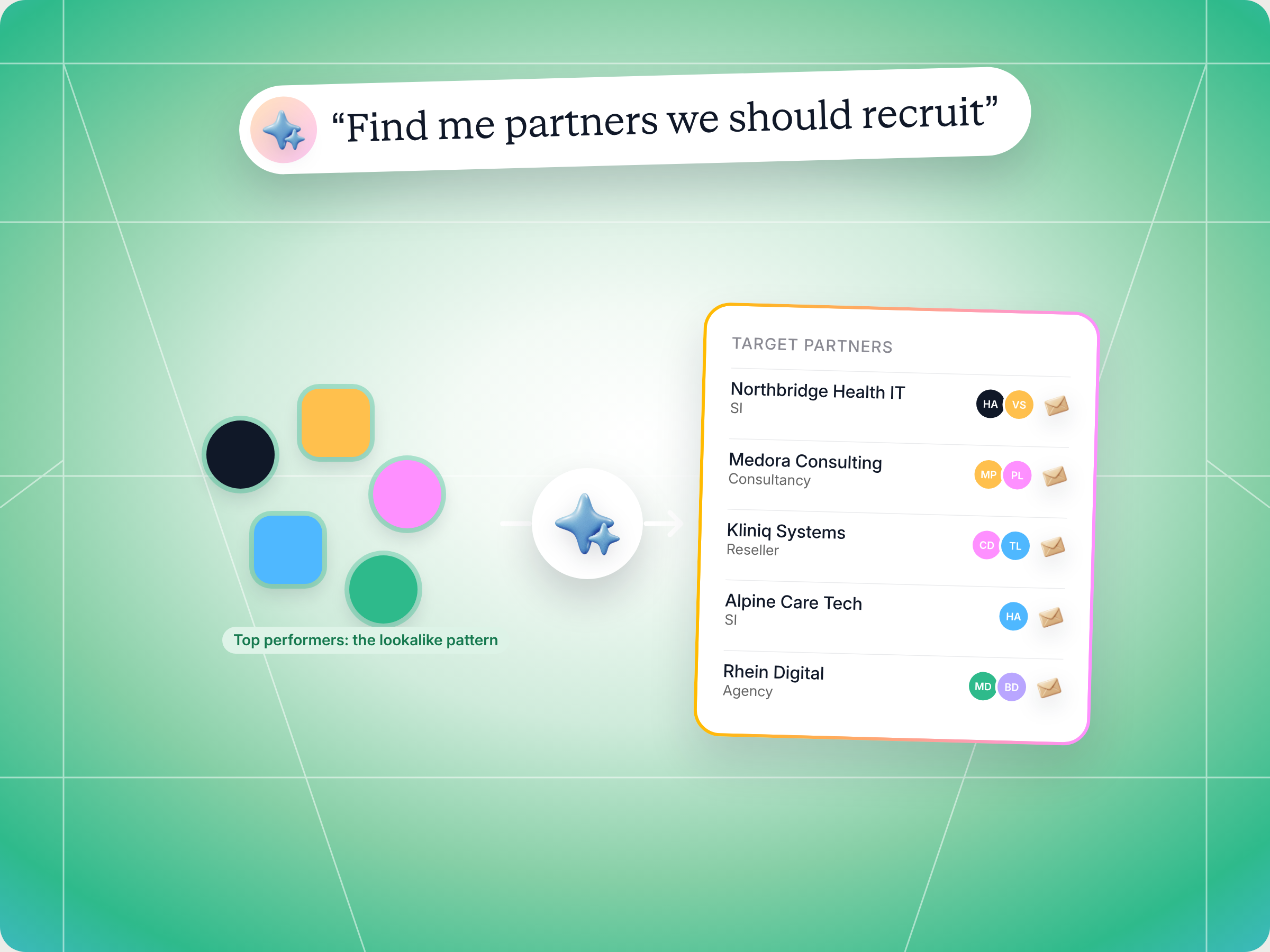
If your partner recruitment strategy still runs on inbound applications and gut feel, the Claude skill to use is Strategic Partner Acquisition: ABM Orchestrator. It studies your top performing partners (revenue plus Crossbeam ecosystem overlap), builds a lookalike profile, maps coverage gaps against your goals, finds the right stakeholders at target partner accounts, and drafts a joint value account based marketing campaign for each one, with a personalized portal landing ready for when they reply. You approve before anything goes out, and nothing gets created in your CRM without a human. The full SKILL.md is below, free to copy, along with install steps, prompts to try and what you'll get back.
Here's a number most channel leaders would rather not say out loud. Introw's partner acquisition playbook puts the typical activation rate for newly recruited partners at 30 to 50%, citing Unifyr's 2026 Channel Atlas, and below 20% for programs that don't manage it. At roughly €15K to acquire a partner, a program signing 100 partners a year can burn €750K on relationships that never produce pipeline.
You've probably seen it happen. A reseller applies through your website, gets a warm welcome, signs the agreement, and never registers a deal. Meanwhile the systems integrator that already serves 200 of your ideal customers never hears from you, because nobody knew they existed.
So what if you recruited partners the way your sales team goes after its best accounts, with a short list, real research and a message that only makes sense for that one company?
This guide covers what an ABM style partner recruitment strategy looks like, the Claude skill that runs it, the full SKILL.md you can copy, how to install and run it, and how to stay in control of every message it drafts.
Why most partner recruitment strategies miss the strategic partners
Most programs recruit whoever shows up. Inbound applications, a list of partners a competitor works with, a name a sales leader "has a good feeling about". None of that is evidence, and it's why so many new partners stall before their first deal.
The deeper problem is that recruitment is the least measured part of the partner motion. Onboarding has dashboards. Pipeline has forecasts. Recruitment is often someone scrolling LinkedIn and sending emails. If you want a full primer on finding, qualifying and signing partners, our guide to partner recruitment covers the whole funnel. This article zooms in on one play inside it: treating your most valuable future partners as target accounts.
Three things usually go wrong:
- Ranking partners by revenue alone: a partner with €100K in sourced revenue but 200 customers in your ICP isn't a low performer. They're under leveraged, and they're often the best template for who to recruit next.
- Recruiting where you already have coverage: new partners land in territories that are already crowded, which seeds channel conflict instead of growth.
- Sending generic outreach: "we'd love to partner" tells a busy alliances lead nothing about what's in it for them, so it gets ignored.
That's where account based marketing helps. ABM focuses your sales and marketing efforts on a small set of high value accounts instead of casting a wide net, and the same thinking maps neatly onto channel partner recruitment. In a customer ABM program, marketing warms up ABM accounts and sales reps step in once they show intent, so the sales process starts with context. Partner recruitment deserves the same treatment, because a strategic partner can bring you more key customers than any single deal.
What an account based marketing (ABM) strategy for partner recruitment looks like
Account based marketing (ABM) flips the funnel. Instead of generating demand broadly and qualifying later, you identify target accounts first, research them, and run personalized campaigns aimed at the buying committee inside each one. Sales teams and marketing teams work from the same target account list, so marketing and sales efforts point at the same specific accounts.
Where traditional marketing tries to reach as many people as possible, an account based strategy treats individual accounts as markets of one. Sales and marketing teams agree on the right target accounts, the account team researches each buying group, and both sales and marketing engage accounts with relevant content at every step of the customer journey.
Applied to strategic partners, the target accounts are prospective partner companies, and the buying committee is the alliances lead, the sales leader who'd run the joint motion and the technical lead who'd own the integration. Here's how the two compare:
| Element | Classic ABM for customers | ABM for partner acquisition |
|---|---|---|
| Who you target | High value customer accounts | Partner companies that look like your best partners |
| How you pick them | Firmographics, intent data, revenue potential | Lookalike profile, ecosystem overlap, coverage gaps against goals |
| Buying committee | Economic buyer, champion, end users | Alliances lead, partner sales leader, technical lead |
| Value proposition | What the product does for them | What the partnership earns them, in their own economics |
| Conversion point | Demo or pipeline | Signed partner who registers a first deal |
| Success metric | Pipeline and revenue growth from key accounts | Activation rate and sourced ARR per recruited partner |
A strong ABM strategy for partner recruitment usually rests on five pieces:
- An ideal partner profile built from data: your ideal partner profile should describe what your best partners actually have in common, not what you wish they had.
- Ecosystem reach as a signal: customer overlap from a tool like Crossbeam shows which partners already sit inside your ICP and your open pipeline. That's the core idea behind account based partnerships.
- A short, prioritized target account list: fewer, better targets beat a list of 500. If your list outgrows the pattern, segment harder.
- Stakeholder mapping: know the key decision makers at each target company before you write a word.
- Personalized messaging and a personalized landing: relevant content in the outreach, and a portal experience that picks up the same story when they click.
Account based marketing tactics and tools for your ABM strategy
Most ABM programs were built for customers, but a few account based marketing tactics carry over well to strategic accounts on the partner side:
- Tiered target accounts: split priority accounts into one to one (your top five strategic partners), one to few (a cluster sharing a vertical) and one to many. Each tier gets a different level of personalized content.
- Account based advertising: run LinkedIn ads only to the buying committee members at your target companies, so your name is familiar before the first email lands.
- Direct mail for the few: for high value target accounts, a short printed joint value brief beats another inbox message.
- Inbound marketing as a signal: when someone from a target partner reads your partner program page, that account engagement is a cue for your sales reps or recruiters to reach out.
- Industry events: meet target partners in person at the vertical events their buyers attend, and book the meeting before you fly, not after.
- Account based marketing tools: your CRM, an enrichment tool like Clay and an ABM platform help you track accounts and key prospects. The skill below can work with all three through MCP.
- Shared scorecards: align sales and marketing on one view of marketing qualified accounts and which target accounts are moving, so your ABM efforts and recruiters' outreach don't collide.
Measure ABM success the way you'd measure any partner program: activation, time to first deal and sourced ARR, not opens and clicks. Demand generation metrics tell you who noticed you. Partner revenue tells you who you should have recruited. Keep expectations realistic, too: a strategic partner can take a quarter or two to sign and another quarter to register a first deal, so judge the play on cohorts, not on week one replies.
Strategic ABM pays off later too. Partners recruited this way tend to already serve valuable customers in your ICP, which supports customer retention and helps you expand business into new markets without stretching your marketing resources. That's real business growth, not just more logos on a slide.
The hard part isn't knowing this. It's the account data work: pulling closed won deals by partner, matching overlap counts, checking territory coverage, researching stakeholders and writing a different message for every target. That's days of work, so most teams skip it. A Claude skill does the legwork in one run.
The skill to use: Strategic Partner Acquisition: ABM Orchestrator
Strategic Partner Acquisition: ABM Orchestrator is a vendor side skill from Introw's free Claude skill library. It runs an end to end partner acquisition play through Introw's MCP server, reading live data from your CRM, and, when connected, the Crossbeam integration for ecosystem overlap. If you use Clay or an ABM platform with an MCP connector, it can use those too.
| Field | Details |
|---|---|
| Built for | Partner program managers, VPs of partnerships, partner recruiters and RevOps |
| Use it when | You want to know which partners to recruit next and how to approach them |
| What it reads | Closed won deals by partner, partner tiers and engagement, commissions, goals and, optionally, Crossbeam overlap |
| What it writes | Comments on prospect records and follow up tasks, after you approve |
| What you get | A lookalike signature, a coverage gap map, a target list with stakeholders, ABM message drafts and a portal brief per target |
| Skill ID | vendor-acquisition-abm-orchestrator |
It fires on prompts like "find me partners we should recruit", "build a partner ABM campaign", "ecosystem coverage gap" and "high overlap low revenue partners". The thing that sets it apart from a prospecting list is relevance. Every target comes with a reason the partnership creates joint value, grounded in data the skill actually pulled.
How the skill works, step by step
The skill follows eight steps. You don't have to run any of them by hand, but knowing what happens helps you trust the output.

Step 1: Build the reference cohort
First, the skill works out who your best partners really are. By default that's your top 10 to 20 partners by sourced ARR over the last four quarters, enriched with tier, engagement and commissions.
When Crossbeam is connected, it adds a second dimension: ecosystem reach. For each partner it looks at total customer overlap, overlap with your ICP, overlap with your open pipeline, overlap with customers you've already won, and lapsed customers the partner still serves. Pipeline overlap counts most, because those are warm introductions sitting on the table.
Partners with strong reach but weak revenue land in a separate "under leveraged" bucket. They're your best lookalike templates and your most obvious activation candidates at the same time.
Step 2: Extract the lookalike signature
Next, it summarizes what the reference cohort has in common: vertical, geography, partner type, tech stack, headcount, deal size, sales cycle, win rate and time to first deal. With Crossbeam, it adds how efficiently each partner turns overlap into revenue.
Step 3: Map coverage gaps to your goals
The skill then checks your current partner footprint against your strategic goals. Maybe Germany produces three times the revenue but has half the partner bandwidth. Maybe you have heavy pipeline in healthcare and no partner with reach into it. The result is a ranked acquisition brief, not a generic prospecting list.
Step 4: Source net new targets
If Clay or an ABM platform is connected, the skill sources candidates that match the signature and the gap brief. If not, it gives you a ready to paste brief with firmographic filters and intent signals, so your recruiter can run it in whatever tool they use.
Step 5: Find the key stakeholders
For each target, it looks for the alliances or business development decision maker, the sales leaders who'd benefit from the joint motion, and a technical lead when an integration is involved. Without an enrichment tool, you get a stakeholder checklist for a human to fill in.
Step 6: Draft joint value ABM messaging
This is the part that makes the play work. Each message opens with a specific reason the partnership creates value for that partner, references their customer overlap with your top performers, puts a number on the typical joint outcome, and ends with one fitting call to action, like a pilot, a co selling motion, a lead share or a joint webinar. Tone adapts by region, so DACH drafts lead with compliance and US drafts lead with use cases. Every draft has to pass the "would I respond?" test.
Step 7: Pre configure the partner portal
When a target replies, they shouldn't land on a 14 field application form. The skill prepares a personalized landing brief for each one: why you reached out, the joint value framing, relevant case studies and prefilled application fields. It also recommends a first 90 day journey and logs the framing as a comment on the prospect record, so your channel manager has full context when the target engages.
Step 8: Hand off to outbound
If you have an outbound tool connected, the skill can queue the sequences. If not, it packages everything into an outbound brief your recruiter can run, and creates follow up tasks in Introw so engagement signals come back into your CRM.
Get the skill: the full SKILL.md
Here's the complete skill file. Copy it as is, or adapt the cohort rules, gap logic and messaging to fit your program.
---
name: vendor-acquisition-abm-orchestrator
description: End-to-end agentic partner acquisition. Use when a Channel Chief, VP Partnerships, Partner Recruiter, or RevOps user wants to (a) identify top-performing partners (combining revenue with Crossbeam-based ecosystem-reach signals, overlapping customers, customers in the vendor's ICP, customers in the vendor's pipeline), (b) surface ecosystem coverage gaps against strategic goals, (c) build a lookalike profile, (d) find key stakeholders at target partner accounts, and (e) launch a relevance-tight ABM campaign with joint-value messaging, while pre-configuring the Introw Partner Portal experience for incoming targets. Trigger phrases include "agentic partner acquisition", "build a partner ABM campaign", "find me partners we should recruit", "ecosystem coverage gap", "joint-value outreach", "lookalike + outbound", "ICP-overlap-driven partner recruitment", "find under-leveraged partners by Crossbeam overlap", "ecosystem-reach lookalikes", "high-overlap low-revenue partners".
---

# Strategic Partner Acquisition: ABM Orchestrator (Vendor)

**Audience**: Vendor, **claude.ai Introw** MCP + **optional claude.ai Crossbeam** MCP (+ optional Clay / ABM-platform MCPs if installed).
**Use case**: 01, Partner Acquisition.

## When to use this skill

End-to-end agentic partner acquisition. Use when a Channel Chief, VP Partnerships, Partner Recruiter, or RevOps user wants to (a) identify top-performing partners, combining revenue with Crossbeam-based ecosystem reach (overlapping customers, customers at the partner that match the vendor's ICP, customers at the partner that are in the vendor's open pipeline), (b) surface ecosystem coverage gaps against strategic goals, (c) build a lookalike profile, (d) find key stakeholders at target partner accounts, and (e) launch a relevance-tight ABM campaign with joint-value messaging, while pre-configuring the Introw Partner Portal experience for incoming targets.

**Sample prompts that fire this skill:**
- "agentic partner acquisition"
- "build a partner ABM campaign"
- "find me partners we should recruit"
- "ecosystem coverage gap"
- "joint-value outreach"
- "lookalike + outbound"
- "ICP-overlap-driven partner recruitment"
- "find under-leveraged partners by Crossbeam overlap"
- "ecosystem-reach lookalikes"
- "high-overlap low-revenue partners"

## Why this matters
Channel partner activation baseline sits at **30 to 50%**, with unmanaged programs **below 20%** (Unifyr Channel Atlas). At ~€15K effective cost-per-acquired-partner, a 100-partner-per-year intake at 50% activation **wastes €750K/year** on partners who never produce pipeline. Lifting activation 30% → 50% on the same intake = **67% more productive partners** ≈ **€10M incremental sourced ARR per 100-partner cohort**. Partner recruitment has been the least-instrumented part of the channel motion; this skill instruments it end-to-end.

**Ecosystem reach is a top-performer signal that revenue alone misses.** A partner with €100K in sourced revenue but 200 customers overlapping the vendor's ICP (per Crossbeam) is *not* a low performer, they're a massively *under-leveraged* one. The lookalike profile built from such a partner unlocks net-new recruitment that revenue-only ranking would never surface. When Crossbeam is connected, this skill weighs **revenue × ecosystem reach** rather than revenue alone, and explicitly surfaces high-overlap-low-revenue partners as both (a) lookalike templates for net-new recruitment and (b) activation candidates inside the existing base.

## What this skill orchestrates
1. **Top-performer pattern extraction**: what makes our best partners actually best, combining revenue and (when Crossbeam is connected) ecosystem reach into our ICP and pipeline.
2. **Under-leveraged-partner detection**: partners with high Crossbeam overlap but low realized revenue, who are both (a) the strongest lookalike templates and (b) activation candidates inside the existing base.
3. **Strategic-goal-aligned gap analysis**: where the ecosystem is short relative to revenue ambition.
4. **Lookalike candidate sourcing**: net-new targets matching the pattern.
5. **Stakeholder identification**: *which humans* inside those targets to engage.
6. **Joint-value ABM campaign generation**: relevance-tight messaging per target.
7. **Portal experience pre-configuration**: so when a prospect engages, they land in a fine-tuned Introw experience, not a generic application form.

## Inputs to gather first
- **Reference cohort scope**: top performers by what (sourced ARR, win rate, expansion ARR, certification depth)? Default: top 10 to 20 by trailing-4-quarter sourced ARR.
- **Strategic goals**: Net-new region coverage? Vertical penetration? Product-line attach? Pull from `Introw:get_goals` if encoded; else ask.
- **Geo / vertical / segment / partner-type constraints.**
- **Volume + cadence**: how many targets, what outbound cadence.
- **CTA**: deal-reg-eligible co-sell, joint webinar, pilot offer, lead share?

## Process

### Step 1: Build the reference cohort
**Revenue dimension** (always available):
- `Introw:search_crm_objects`: closed-won deals (trailing 4 quarters), grouped by sourcing partner.
- `Introw:search_partners`: enrich with tier, lifecycle, categories, contact info.
- `Introw:search_partner_engagement`: engagement intensity (comments, deal updates, asset views, form submits).
- `Introw:search_commissions`: commissions earned as a sustained-performance proxy.
- `Introw:get_tier_information`: tier rules if scoping to a specific tier.

**Ecosystem-reach dimension** (when Crossbeam MCP is connected, heavily recommended for this skill):
- `Crossbeam:*`: for each existing partner, pull customer overlap counts:
  - **Total overlap**: how many customers they have that exist in the vendor's CRM in any form.
  - **ICP overlap**: how many of their customers match the vendor's defined ICP (segment / vertical / size).
  - **Pipeline overlap**: how many of their customers are currently *open opportunities* in the vendor's pipeline (these are the highest-value overlap, they're warm-introduction opportunities sitting on the table).
  - **Closed-won overlap**: customers the vendor has already won where the partner is also present (validates partner-vendor compatibility).
  - **Lapsed-customer overlap**: vendor's churned customers the partner still serves (reactivation opportunity).
- Weight overlap *type* (pipeline > ICP > total > lapsed) and *recency* (last 90 days > older).

Build a unified score per existing partner: `(realized revenue) × (sustained-quarter weight) + (ecosystem-reach weight × overlap_score)`. Partners with strong ecosystem reach but weak revenue surface as a separate "under-leveraged" bucket, they're the highest-value lookalike templates.

### Step 2: Extract the lookalike signature
Across the reference cohort (now including the under-leveraged-but-high-overlap bucket), summarize:
- Vertical / segment / geography
- Partner type (SI, reseller, referral, MSP, marketplace)
- Tech-stack signals from CRM custom fields
- Headcount band
- Avg deal size, sales cycle, win rate
- Onboarding → first-deal lag
- Engagement intensity (activities per active week)
- **Customer-base composition** (Crossbeam): what segments / verticals dominate the partner's customer book? What % of their customers fall in our ICP? What's the typical *overlap-to-revenue ratio* (a partner with high ratio is converting overlap to revenue efficiently; low ratio is the activation gap).
- **Pipeline overlap density** (Crossbeam): partners whose existing customer base correlates with our open-pipeline accounts are the strongest co-sell-fit profile.

### Step 3: Map ecosystem coverage gaps to strategic goals
Cross-check the lookalike signature and current footprint against goals:
- `Introw:get_goals`: strategic goals (regions, verticals, products to grow).
- Compute coverage: do we have enough lookalike-pattern partners in each goal area?
- Surface gaps: e.g., "Germany generates 3× the revenue but has 50% of the partner bandwidth, or no partner at all in healthcare."
- **Crossbeam-driven gap**: cross-check the vendor's open pipeline + ICP target accounts against the existing partner base, are there segments / verticals where the vendor has heavy pipeline but no partner with overlap into it? Those are the highest-priority recruitment targets.
- The output of this step is a **ranked acquisition brief**, not a generic prospecting list.

### Step 4: Source net-new targets
- If a Clay / ABM-platform MCP is installed, use it to source firmographically-matched candidates against the lookalike signature + gap brief.
- If not, output a **directly-pasteable acquisition brief** (firmographic filters + intent signals) for the recruiter to feed into their tool of choice.

### Step 5: Identify key stakeholders at target accounts
For each target partner account:
- Look for the channel/alliances/business-development decision-maker.
- Look for sales leaders who'd benefit from the joint motion.
- Look for technical leads if the relationship requires integration.
- Use Clay/LinkedIn enrichment if available; otherwise output a stakeholder-role checklist for human enrichment.

### Step 6: Generate joint-value ABM messaging per target
The defining quality of this skill: messaging is **relevance-tight, not template-tight**. For each target:
- Open with a specific reason this partnership creates joint value (not "we'd love to partner").
- Reference the target's actual customer ICP overlap with our top performers.
- Quantify the joint outcome (typical sourced ARR per top performer of this profile).
- Tier-aware CTA, pilot, co-sell, lead share, joint webinar.
- Localize tone (DACH = compliance-forward, US = use-case-forward).
- Drafts should pass the "would I respond?" test before being sent.

### Step 7: Pre-configure the Introw Partner Portal experience
A target who engages should not land in a generic "fill out this 14-field form" experience. For each target, prepare:
- A **personalized landing brief**: why we reached out, the specific joint-value framing, the relevant case studies for their vertical/geo.
- Pre-filled application fields where data is already known.
- Recommended first-90-days journey aligned to their partner type (this hands off cleanly to `vendor-personalized-onboarding-orchestrator`).
- Use `Introw:add_comment` on the prospect record to capture the personalized framing so the CAM has full context when the target engages.
- If using `Introw:share_lead_or_register_deal` to nominate the target for outreach, attach the personalization payload in the comment.

### Step 8: Hand off to outbound execution
- If outbound execution MCPs are available, fire the sequences with the per-target messaging.
- Otherwise, package into an outbound brief the recruiter can run.
- Set follow-up tasks via `Introw:add_task` so engagement signals get captured back.

## Output format
- **Reference cohort summary**: top performers + revenue + engagement metrics + (Crossbeam) total / ICP / pipeline overlap counts.
- **Under-leveraged-partner list**: high-overlap, low-revenue partners surfaced separately as both lookalike templates AND activation candidates.
- **Lookalike signature**: 5 to 8 firmographic + behavioral + ecosystem-reach bullets.
- **Ecosystem coverage gap map**: gaps ranked by strategic-goal alignment + revenue impact + pipeline-overlap absence.
- **Target list**: accounts × stakeholders × match score × joint-value framing.
- **ABM message variants per target**: drafted, not sent.
- **Portal experience brief per target**: personalization payload ready for activation.
- **Suggested next actions** with owners + ETA.

## Guardrails & PRM best practice
- **Evidence-based, not vibes-based.** Every recommendation traces back to a tool call. CSO Insights: top-quartile programs outperform peers on win rate by **+17.9 pts**: this only holds if you recruit the right partners, not the loudest applicants.
- **Revenue ≠ performance when ecosystem reach exists.** A partner with €100K revenue and 200 ICP-matched customers is under-leveraged, not low-performing. Don't filter them out of top-performer ranking based on revenue alone, they're often the most informative lookalike template AND a high-priority activation candidate.
- **Crossbeam data has lag.** Overlap data refreshes typically run nightly or weekly; flag stale data and avoid acting on overlaps > 30 days old without confirmation.
- **Crossbeam respects data-sharing scope.** Only surface overlaps within authorized population groups / partner-data-sharing agreements. Never surface partner customer names outside the vendor-internal scope.
- **Territory check before outbound.** `Introw:search_partners` for existing coverage in the geo/vertical to avoid flooding territory and seeding channel conflict.
- **Don't auto-create partner records.** End at the brief + outbound. Partner record creation is a deliberate human action.
- **Joint value, not vendor benefit.** Messaging must articulate what the *partner* gets, framed in their economics, not what we get.
- **No spray-and-pray.** If the target list exceeds the lookalike pattern's natural population, segment harder; don't dilute relevance to hit volume.
- **Lookalike ≠ filter.** The signature frames the search; let the recruiter override on judgment.
- **Frame outcomes in expected ARR uplift.** A 1pt activation lift on a 100-partner cohort beats hiring 30 mediocre partners, keep the user honest about the math.
- **Capture decisions** via `Introw:add_comment` on the partner/prospect record so the audit trail survives reorgs.
- **Hand off cleanly**: when a target converts, the personalization payload feeds the onboarding orchestrator. No "what was that conversation about" gaps.
- **Cross-skill handoff.**
  - Under-leveraged partners (high overlap, low revenue) found in Step 1 → feed `vendor-activate-network-with-personalized-campaigns` to wake them up before recruiting their lookalikes.
  - Pipeline-overlap signals on existing partners → `vendor-pipeline-partner-influence-scout` to convert overlap into deal-registration opportunities now (don't wait for the recruitment cycle).
  - Target-account list with overlap signals on prospective partners → `vendor-crossbeam-cosell-finder` (proactive co-sell variant).
  - Once a target converts → `vendor-personalized-onboarding-from-transcripts` to pick up cleanly.
How to install and run the skill
You've got two ways to use it, depending on where you work.
Option 1: Claude Code
Create a folder called vendor-acquisition-abm-orchestrator inside .claude/skills/ in your repo, and save the file above as SKILL.md inside it. Claude Code picks it up automatically and runs it whenever your prompt matches the trigger phrases in the description.
Option 2: Claude (or any MCP client) with the Introw connector
You don't need to be technical for this one. Connect Claude to Introw once, and you can run the same play in plain language from Claude, or from ChatGPT, Slack, Teams or your CRM. Introw is listed in Claude's connector directory, so it's one click plus a sign in, with no server URL to paste. For the ecosystem reach part, connect Crossbeam as well. Here's how connecting Introw looks:
The step by step version lives in the Connect Claude guide, and the Claude integration page covers what you can do once you're connected.
Prompts to try
Once the skill is installed or Claude is connected, try any of these:
- "Find me partners we should recruit." Runs the full play, from reference cohort to ABM drafts.
- "Show me our high overlap, low revenue partners." Surfaces under leveraged partners you already have, before you recruit anyone new.
- "Where's our ecosystem coverage gap against this year's goals?" Returns the ranked gap map on its own.
- "Build a partner ABM campaign for healthcare systems integrators in DACH, 15 targets max." Scopes the play to one vertical, one region and a tight target account list.
- "Draft joint value outreach for the top five targets, but don't send anything yet." Gives you drafts to review.
What you'll get back
A typical run returns eight things:
- Reference cohort summary: your top performers with revenue, engagement and, with Crossbeam, total, ICP and pipeline overlap counts.
- Under leveraged partner list: high overlap, low revenue partners, flagged as both lookalike templates and activation candidates.
- Lookalike signature: five to eight bullets describing what your best partners share.
- Coverage gap map: gaps ranked by goal alignment, revenue impact and missing pipeline overlap.
- Target list: target companies with stakeholders, a match score and the joint value framing.
- ABM message variants: drafted per target, never sent automatically.
- Portal brief per target: the personalization payload for their landing experience.
- Next actions: with owners and dates.
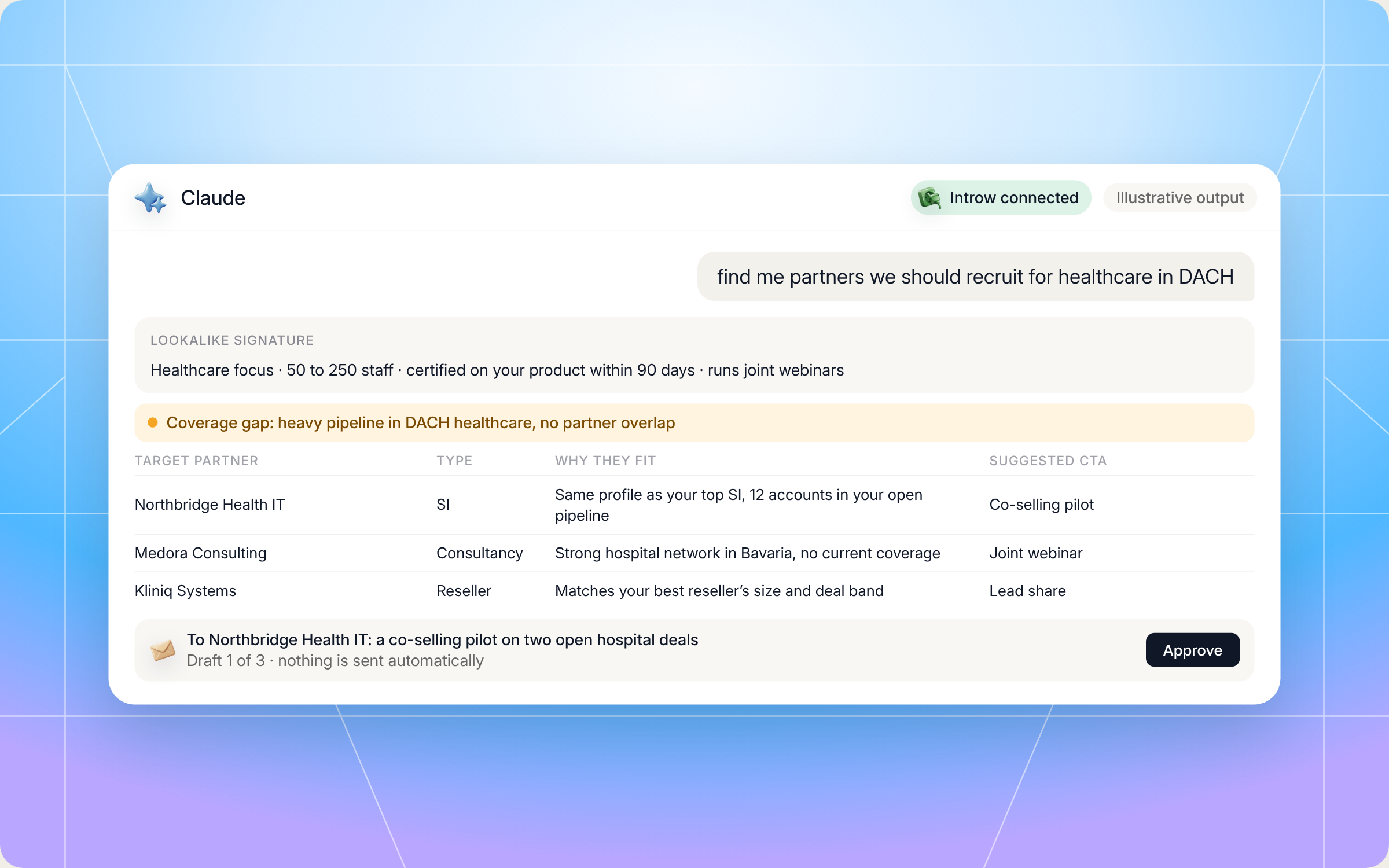
Here's an illustrative example of the target list for a vendor whose gap is healthcare in DACH:
| Target partner | Type | Why they fit | Key stakeholders | Suggested CTA |
|---|---|---|---|---|
| Northbridge Health IT | Systems integrator | Same profile as your top SI, 140 customers in your ICP, 12 in your open pipeline | Head of alliances, VP sales | Co selling pilot on two open deals |
| Medora Consulting | Consultancy | Strong hospital network in Bavaria, no current partner coverage | Managing partner, practice lead | Joint webinar on compliance |
| Kliniq Systems | Reseller | Matches your best reseller's headcount band and deal size | Channel director, technical lead | Lead share for one warm account |
And here's how that run looks in Claude, from the prompt to the lookalike signature, the coverage gap and the first ABM email draft:
Staying in control: what Claude can and can't do
Recruiting strategic partners is relationship building, so you want a human on every decision that matters. A few things are built in:
- You approve the writes. The skill drafts messages, comments and tasks, and you approve anything that touches your CRM or reaches a prospect.
- It stays inside your access. Claude connects to Introw over OAuth as you, so it can only see and do what you can.
- It won't create partner records. The play ends at the brief and the outbound. Signing someone up as a partner stays a deliberate human action.
- It checks territory first. Before outreach, it looks at existing coverage in that region and vertical, so it doesn't start a conflict with partners you already have.
- It respects data sharing. Crossbeam overlaps only show up within the sharing agreements you've authorized, partner customer names stay internal, and overlap data older than 30 days gets flagged.
- It won't spray and pray. If the target list outgrows the lookalike pattern, it segments harder instead of padding the list.
Prefer to do this in the Introw app?
The skill drafts the portal brief, but the landing experience itself lives in Introw. You can build a portal experience for incoming partners, structure it into tabs, add the content and calls to action that match your outreach, and assign it to the right partners before you publish.
Once recruits sign, Introw's partner onboarding and partner portal take it from there. And if you're designing the program itself, our guide on how to build a channel partner program covers tiers, incentives and structure.
Pair it with other Claude skills
Recruitment is one stage of a longer partner journey. The ABM Orchestrator hands off to these skills from the library:
- Activate the Network with Personalized Campaigns: wakes up the under leveraged partners from Step 1 before you recruit their lookalikes. Our partner activation guide explains why that comes first.
- Crossbeam Co Sell Partner Finder: matches your target accounts to the partner with the strongest overlap, for co selling right now.
- Pipeline Partner Influence Scout: turns pipeline overlap on existing partners into deal registrations, without waiting for a recruitment cycle.
- Personalized Onboarding Orchestrator from Transcripts: picks up the moment a target signs, using the personalization payload this skill created.
You'll find all of them in Introw's skill library, and our roundup of Claude skills for partner teams explains how they fit together.
Recruit partners from Claude with Introw
Introw is a CRM first partner relationship management platform, which means it builds on top of your existing HubSpot or Salesforce setup rather than replacing it. It's also headless by design: the partner portal is one surface, but you can run the same program in plain language from Claude, ChatGPT, Slack or Teams through Introw's MCP server, with every action written back to your CRM.
That's what makes a skill like this work. Closed won deals by partner, tiers, engagement, commissions and goals all live in one place, so the lookalike profile is built on real account data, not a spreadsheet someone exported last quarter. Add Crossbeam, and ecosystem overlap joins the picture. When a recruit replies, the portal experience, onboarding journey and partner activation rate tracking are already there.
Turn your partner recruitment strategy into an evidence based ABM play. Connect Claude or book a demo.
Still curious? Here are some quick answers to help clear things up
A partner recruitment strategy is your plan for finding, qualifying and signing the partners most likely to sell what you sell. The strongest ones start from data on your existing top performers, focus on gaps against your goals and approach each target with a reason the partnership pays off for them.
Regular recruitment often waits for applications or blasts a long list. Account based marketing picks a short list of high value target companies, maps the stakeholders inside each one and sends personalized messaging that only makes sense for that partner.
No. Claude Code users can drop the SKILL.md into their skills folder. Everyone else can connect Claude to Introw through the connector directory and run the same play in plain language. Crossbeam and Clay are optional but make the output sharper.
No. It drafts messages, portal briefs, comments and tasks, and you approve anything that reaches a prospect or touches your CRM. It never creates partner records, because signing a partner is a human decision.
Yes. The full file is in this article and in Introw's skill library. You can copy it as is or adapt it to your own program, but it reads live partner data through Introw's MCP server, so you'll need Introw connected to run it.





See AI-Native PRM in Action
Book a demo with one of our partner program experts, or explore Introw on your own time.