
Impact is one of the most established partnership marketing platforms on the market, used by leading brands and enterprise companies. It covers affiliate marketing, influencer marketing, customer referral programs, and B2B lead-based partnerships on a single platform, with strong tracking, reporting, and a large partner marketplace. But costs add up through transaction fees, setup fees, and higher tiers, and the platform takes time to learn.
Every program impact.com runs follows the same performance model: track an event, apply a contract, pay the partner. So the right platform depends on how your partnerships create revenue. Introw fits B2B teams whose referral, reseller, and co-sell partnerships run through HubSpot or Salesforce. The rest of this list covers affiliate networks, a creator platform, enterprise performance platforms, and self-serve affiliate trackers for teams that need a publisher network, creator management, more flexible tracking, or lower entry pricing.
What is impact.com?
impact.com is a partnership management platform for affiliate, creator, customer referral, and B2B lead-based programs, with tracking, contracts, campaign management, payments, and a partner marketplace in one system.
It is organized around three products: Performance for affiliate and publisher partnerships, Creator for influencer programs, and Advocate for customer referral programs. Brands can manage affiliates, influencers, and customer advocates from one dashboard. It also supports mobile app partnerships and B2B SaaS programs, where partners submit leads that sync to Salesforce or HubSpot.
What ties these together is a single performance model. Impact tracks a partner-driven event, such as a sale from affiliate links or promo codes, a lead, or an opportunity, applies the contract terms, and pays the partner. In this sense, "partnership management" means managing performance partnerships, not running a channel program with resellers.
The platform is genuinely good at what it was built for. Detailed tracking, reporting, automated payouts, and partner discovery are its core strengths, and its higher tiers add Data Lab for fully custom reporting. More than 4,000 brands use the platform, and it holds a 4.4/5 G2 rating from more than 2,400 reviews.
So why look elsewhere? Usually because of cost, complexity, or fit.
Why teams look for impact.com alternatives
G2 reviewers most often praise Impact for its ease of use, all-in-one platform, support, and detailed reporting. The same review base also shows clear, recurring friction points.
One thing to keep in mind: a large share of impact.com's reviews come from affiliates, influencers, and publishers, not from the brands running programs. The reasons below focus on what matters to the program owner.
1. Total cost is hard to predict
Impact.com publishes its entry tiers, but the headline price rarely tells the full story.
- The $30 Starter plan requires an e-commerce integration (Shopify, BigCommerce, WooCommerce, Adobe Commerce, or Squarespace), so most B2B SaaS teams start at Essentials ($500 per month).
- Data Lab, the custom reporting most teams want, sits on Pro at $2,500 per month.
- Every plan adds a 2.5% fee on partner-driven transactions and a one-time setup fee.
- Enterprise pricing is quoted.
Reviewers also describe pricing as high for early-stage teams and mention a yearly commitment. That gap between list price and real cost is the most common reason buyers start comparing.
2. The learning curve is steep
This is the most frequent complaint in the review data. G2's dislike themes include "not intuitive" (210 reviews), "steep learning curve" (194), and "complexity" (172). G2 reviewers report an average time to implement of around two months.
That depth is a strength once your team knows it, but it slows onboarding for smaller teams with limited internal resources.
3. Reporting is powerful but slow to customize
Reporting is one of Impact's most praised features. Still, reviewers say custom reports take time to build, finding specific data can take more clicks than expected, and large datasets can slow the platform down. Teams can end up wasting time on report building instead of acting on performance data.
4. Discovery, AI search, and recommendations need manual vetting
Some reviewers find in-platform search clunky and the AI-powered partner recommendations hit-or-miss. Most of this feedback comes from publishers, but the lesson applies to brands too: partner suggestions still need a human check.
5. Partner quality varies
The marketplace gives you reach, but reach doesn't guarantee high quality partnerships. Some brand reviewers are unsure whether the affiliates they attract suit their products. Affiliates also report friction around payment timing, advance fees, and rigid settings for affiliate payouts, which shapes how they feel about your program.
Performance partnerships vs channel partnerships
There's one more reason teams switch, and it isn't a criticism of impact.com. It comes down to the partnership types you run.
Performance partnerships reward a partner for a tracked event: a click that becomes a sale, a referred lead, or an opportunity that reaches a set stage. Traditional affiliate marketing, creator campaigns, customer referral programs, and many B2B referral partnerships fit this model, and impact.com handles it well.
Channel partnerships and other strategic partnerships work differently. Resellers, agencies, technology partners, and brand to brand collaborations source and influence deals alongside your sales team. That depends on deal registration with clear ownership, shared pipeline, account overlaps, and collaboration on live opportunities inside the CRM.
If your partner revenue comes from co-selling rather than pay-per-event, you need a different kind of tool. Both are forms of partnership management, but they need different tools. That's where a partner relationship management (PRM) platform fits better, which is why Introw is on this list.
How much impact.com actually costs
Here's the pricing picture in one place, based on impact.com's own pricing page:
| Plan | Starting price | Notes |
|---|---|---|
| Starter | $30/month | Requires an e-commerce integration |
| Essentials | $500/month | Adds Partner Marketplace access and unlimited event tracking |
| Pro | $2,500/month | Adds Data Lab, cross-device and API tracking, SAML, dedicated support |
| Enterprise | Custom | Adds fraud scoring, forecasting, benchmarking, attribution risk protection |
On top of the subscription, budget for the 2.5% transaction fee on partner-driven sales and a one-time setup fee based on your onboarding needs.
What do companies actually pay? Vendr's transaction data puts the average impact.com contract at around $190,000 a year, with deals ranging from about $2,500 to several million.
What an Impact alternative should have
Start with the partnership programs you actually run.
If you want an affiliate or partner marketing alternative, look for:
- Transparent entry pricing: published plans you can model without a sales process.
- Clear limits: check partner caps, revenue caps, payout fees, and percentage-of-sales fees at the entry tier.
- Flexible reporting: fast filtering, real time data, and custom views that track sales by partner, not only standard reports.
- Affiliate management basics: campaign management and payout automation, so your team isn't stuck with manual payouts.
- The right partner source: a network's publisher base, software that lets you recruit your own partners, or a creator platform with influencer discovery.
If your program has outgrown affiliate, look for:
- Native CRM integration with Salesforce or HubSpot, so partner data lives on live CRM records.
- Deal and lead registration with conflict checks and clear ownership.
- Co-selling workflows that give both sales teams the same deal context.
- Partner enablement and off-portal engagement through email, Slack, or Teams.
10 Best impact.com alternatives at a glance
Compare pricing models and CRM fit before you compare feature lists.
| Tool | Type | CRM (Salesforce / HubSpot) | Best for | Starting price | Free tier | Rating |
|---|---|---|---|---|---|---|
| Introw | PRM | Native | CRM-led referral, reseller, and co-sell programs | Free for one partner | Yes | G2 4.8/5 |
| Awin | Affiliate network | No | Retail, e-commerce, and travel brands | $49/mo + 3.5% tracking fee | No | G2 4.1/5 |
| GRIN | Creator platform | No | E-commerce brands running creator programs | Free; paid from $200/mo | Yes | G2 4.5/5 |
| Rakuten Advertising | Affiliate network | No | Enterprise brands wanting managed service | Custom | No | G2 4.3/5 |
| Everflow | Performance platform | Integration | Performance teams needing flexible tracking | Custom; 6-month minimum | No | G2 4.7/5 |
| Partnerize | Performance platform | Integration | Global enterprise affiliate programs | Custom | No | G2 4.3/5 |
| Tapfiliate | Affiliate software | No | SaaS and e-commerce SMBs | $89/mo ($74 billed annually) | No | Capterra 4.5/5 |
| Refersion | Affiliate software | No | Shopify and e-commerce brands | $39/mo + 3% of affiliate sales | No | G2 3.6/5 |
| Rewardful | Affiliate software | No | SaaS on Stripe or Paddle | $49/mo | No | G2 4.5/5 |
| Reditus | Affiliate software + marketplace | No | B2B SaaS affiliate programs | $149/mo ($99 billed annually) | No | G2 4.8/5 |
1. Introw - Best for CRM-Led Partner Revenue
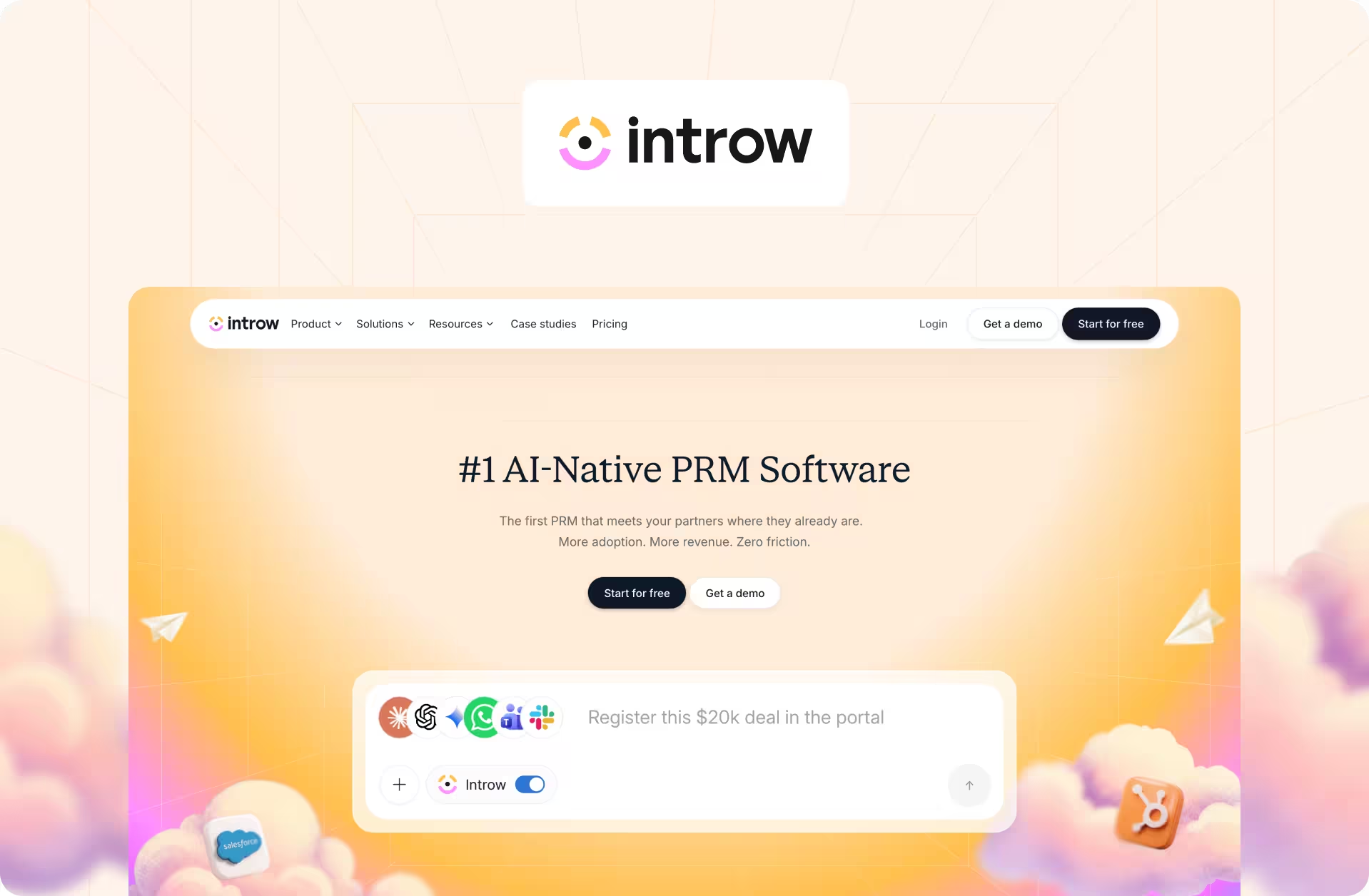
Introw is a CRM-native partner relationship management (PRM) platform for B2B referral, reseller, and co-sell programs. It adds partner workflows directly to HubSpot or Salesforce, so the CRM stays your single source of truth.
Introw also runs affiliate campaigns with unique, trackable links. It isn't an affiliate network or publisher marketplace, so if that's what you need, the other alternatives below are a better fit.
Key features
- Two-way HubSpot and Salesforce synchronization
- Deal and lead registration with CRM attribution and AI-powered channel conflict detection
- No-code branded partner portal and content library with usage tracking
- Partner collaboration through email, Slack, Microsoft Teams, or the CRM, without forcing portal logins
- Commission plans, partner goals, and tiering
- 24/7 AI partner support agent
- Affiliate campaigns, MDF, LMS, and CPQ as add-ons
Why consider Introw as an impact.com alternative
Introw is built specifically for the jobs affiliate platforms don't cover: shared pipeline, registered deals, and co-selling with partner sales teams. Partner activity and attribution live on live CRM records, so revenue teams see direct and partner-led pipeline in one place. And you can start for free.
Where Introw falls behind compared to impact.com
Introw doesn't offer a publisher marketplace for affiliate recruitment, and it isn't built for creator or e-commerce programs. If influencer marketing reach and network discovery are your priority, impact.com still leads.
Pricing
Starter is free for one partner and includes CRM integration, deal and lead registration, and a branded portal. Paid plans scale by partner count and require a demo. Salesforce is included on Scale and Enterprise.
Who is Introw best for?
Introw is best for B2B companies whose partnerships run through referrals, resellers, or co-selling in HubSpot or Salesforce. Explore Introw's partner management to see how it works.
2. Awin - Best Affiliate Network With Published Entry Pricing
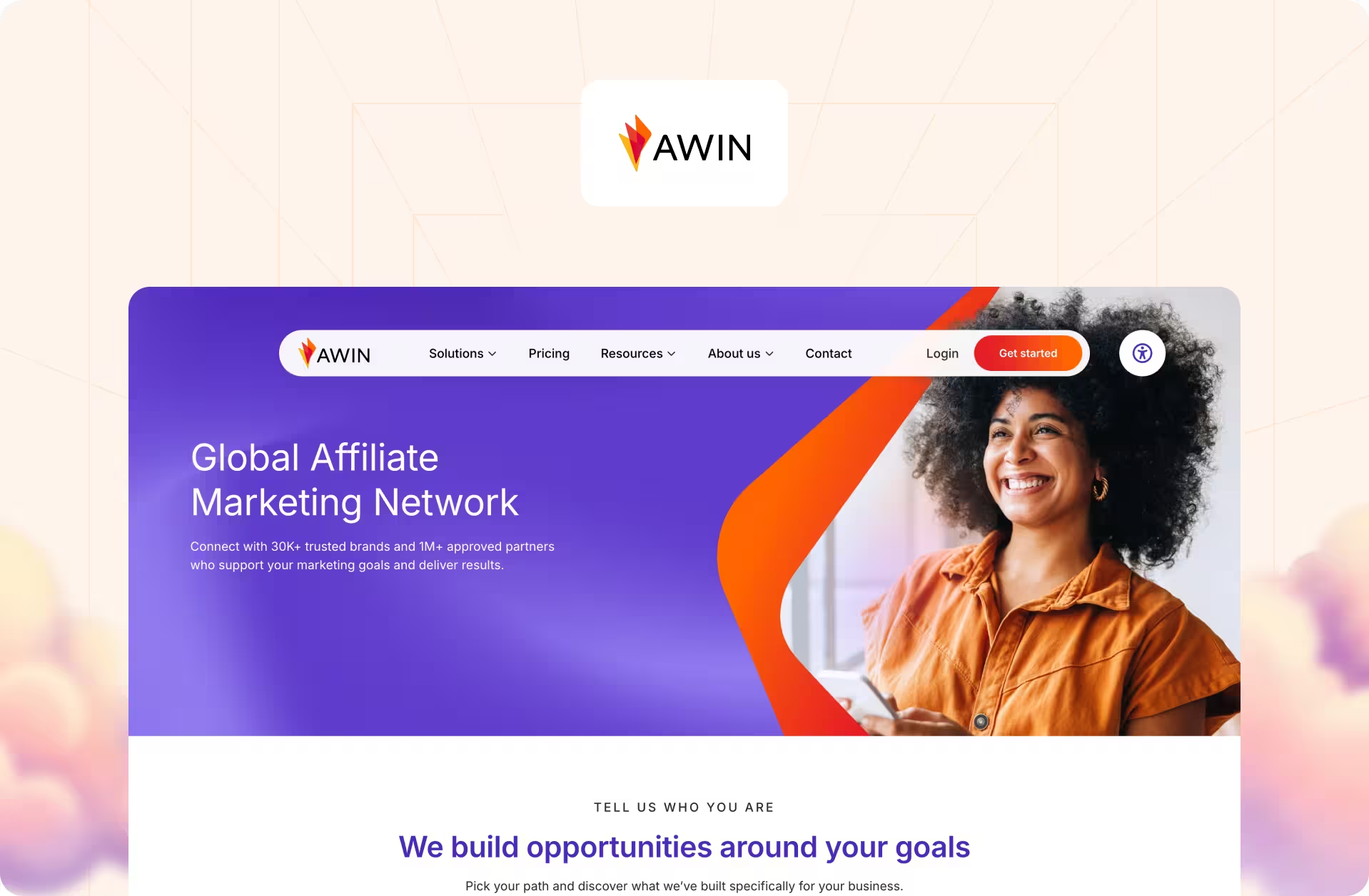
Awin is a global affiliate network that gives advertisers access to a large publisher base and self-serve or managed program options. Publishers join for free.
Key features
- Access to a large network of publishers (Awin reports more than 1M partners)
- Commission models for CPA, CPL, CPC, and CPS
- Link builder and deep linking tools
- Self-managed or account-managed plans
- Tracking, reporting, and partner payments
Why consider Awin as an impact.com alternative
Awin publishes its entry pricing and doesn't require a long contract on its Access plan. Teams get access to a global partner network without starting with an enterprise sales process.
Where Awin falls behind compared to impact.com
Awin's tracking fee grows with your sales, and deeper features sit on higher tiers.
Pricing
In the US, Awin Access has a $0 joining fee and a free first month, then costs $49 per month plus a 3.5% tracking fee on transaction value. Accelerate and Advanced are quoted.
Who is Awin best for?
Awin is best for retail brands, e-commerce stores, and travel companies that want a ready-made publisher network, especially in Europe.
3. GRIN - Best for Influencer Marketing and Creator Programs
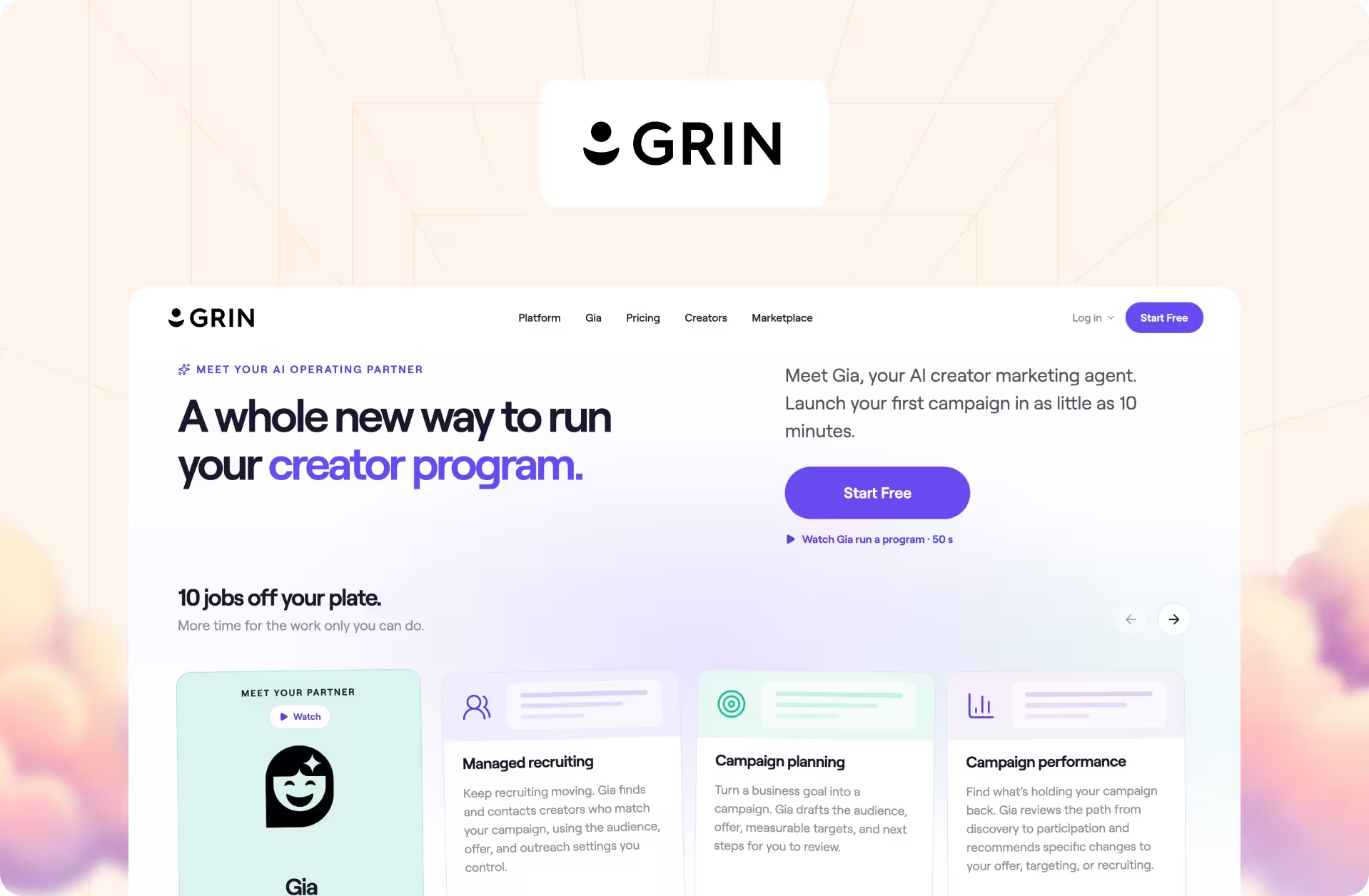
GRIN is a creator management platform for e-commerce and DTC brands. It helps teams discover social media creators, manage creators at scale, and run creator campaigns, covering relationship management, gifting, content tracking, affiliate links, and reporting. An AI agent called Gia automates day-to-day creator operations.
Key features
- Creator CRM with unlimited contacts and a marketplace of 700K+ creators (GRIN figure)
- All campaign types on every plan, including gifting and product seeding
- Affiliate links, discount codes, and GMV tracking
- Gia's Desk for automated outreach, creator matching, and reporting on paid plans
- One-click Shopify connection, plus a tracking SDK for other stacks
- Free migration from a CSV, another platform, or GRIN Classic
Why consider GRIN as an impact.com alternative
If creators are the core of your program, GRIN gives you a dedicated workflow for creator partnerships rather than a creator module inside a broader platform. It publishes its pricing, runs month-to-month with no required sales call, and doesn't take a percentage of the revenue your creators drive.
Where GRIN falls behind compared to impact.com
GRIN is built for creator programs, not publisher networks or B2B partnerships, so it won't replace impact.com's affiliate marketplace or lead-based tracking. Paid plans also meter work through credits, so heavy-touch programs need careful budgeting.
Pricing
Free costs $0 per month with 50 usage credits. Starter costs $200 per month, Growth $500, and Scale $1,000, with larger monthly credit allowances on each tier. Every new account gets a 30-day Starter trial, and creating commission payables uses credits.
Who is GRIN best for?
GRIN is best for e-commerce and DTC brands, especially on Shopify, that want to manage creators in always-on programs.
4. Rakuten Advertising - Best for Leading Brands That Want Managed Programs
Rakuten Advertising is the affiliate arm of Rakuten Group. It runs a curated network with managed services and AI-supported optimization.
Key features
- Curated publisher network
- Managed services team for day-to-day program support
- AI-supported optimization
- Performance reporting
Why consider Rakuten Advertising as an impact.com alternative
Rakuten suits teams that want expert help running their program. Its managed services team does much of the heavy lifting and offers strategic guidance. G2 reviewers praise its ease of use, support, and access to premium brands.
Where Rakuten Advertising falls behind compared to impact.com
Rakuten offers less self-serve flexibility, and G2 reviewers credit impact.com with more detailed performance reporting.
Pricing
Pricing is custom, with setup fees and ongoing network fees on commission spend.
Who is Rakuten Advertising best for?
Rakuten Advertising is best for large brands in retail and travel that want a curated network and hands-on support.
5. Everflow - Best for Tracking Affiliates, Influencers, and Referrals
Everflow is a partner marketing platform for brands, networks, and agencies. It focuses on tracking, attribution, fraud monitoring, and managing partnerships across many channels.
Key features
- Tracking across affiliate, influencer, referral, email, offline, and media buying channels
- Unlimited partners, conversions, and events
- Real-time reporting and postback tracking
- Fraud monitoring tools
- Full API access and GDPR and CCPA compliance
Why consider Everflow as an impact.com alternative
Everflow gives performance teams detailed, real-time tracking and flexible configuration. Its 6-month minimum is shorter than a typical annual contract, and a free trial is available.
Where Everflow falls behind compared to impact.com
Everflow's pricing is also quote-based, and reviewers mention a learning curve for advanced tracking setups and gaps in documentation. impact.com offers a broader all-in-one partnership suite, including creator programs.
Pricing
Everflow quotes pricing based on your monthly partner payout volume and business type, with a 6-month minimum commitment. Its Shopify App Store listing shows $1,495 per month plus a $500 setup fee.
Who is Everflow best for?
Everflow is best for performance marketing teams, networks, and agencies that need flexible tracking and strong fraud controls.
6. Partnerize - Best for Global Enterprise Affiliate Programs
Partnerize is an enterprise partnership automation platform for affiliates, influencers, and other performance partners. It covers discovery, tracking, commissions, and global payments.
Key features
- Partner discovery and recruitment
- Flexible first-party, server-to-server, and mobile tracking
- Dynamic commissions and performance incentives
- Real-time analytics and customizable reporting
- Brand safety, fraud prevention, and global payments
Why consider Partnerize as an impact.com alternative
Partnerize offers a different commercial model, with either a fixed license fee or a performance-based fee. That flexibility can suit enterprise brands running high-volume partnership programs across a broad range of partnership types, regions, and currencies.
Where Partnerize falls behind compared to impact.com
Partnerize doesn't publish pricing, so it isn't necessarily cheaper. Impact has a larger review base and broader creator and referral tools.
Pricing
Partnerize offers fixed-license or performance-based pricing. Exact rates require a quote.
Who is Partnerize best for?
Partnerize is best for mid-market and enterprise brands managing high-volume, multi-region affiliate and performance partnerships.
7. Tapfiliate - Best Self-Serve Affiliate Marketing Software for SaaS and E-Commerce
Tapfiliate is affiliate and referral software for SaaS, e-commerce, and subscription businesses. It focuses on fast setup, flexible commissions, and transparent plans.
Key features
- 30+ integrations, including Stripe, Shopify, WooCommerce, and BigCommerce
- Link, coupon, and deep link tracking
- Recurring and multi-level commissions
- Real-time reporting
- Automated affiliate payouts via Trolley on Scale
Why consider Tapfiliate as an impact.com alternative
Tapfiliate publishes its pricing, charges no setup fees, and lets you test each plan with a free trial. Teams can launch without a sales process or lengthy onboarding.
Where Tapfiliate falls behind compared to impact.com
Tapfiliate doesn't offer a comparable partner network, and its Launch plan caps programs, affiliates, clicks, and conversions.
Pricing
Launch costs $89 per month, or $74 per month billed annually, for one program and up to 50 affiliates. Scale costs $179 per month, or $149 billed annually, with unlimited affiliates and automated payouts. Enterprise is custom. Trials run 7, 14, or 30 days depending on the plan.
Who is Tapfiliate best for?
Tapfiliate is best for small and mid-sized SaaS and e-commerce teams that want to run their own affiliate program with predictable costs.
8. Refersion - Best for Shopify Brands Using Affiliate Links and Discount Codes
Refersion is affiliate, influencer, and ambassador management software built for e-commerce brands and merchants. It integrates closely with Shopify and other commerce platforms.
Key features
- Unlimited affiliates, clicks, and conversions from the entry plan
- First-party tracking domain plus link and coupon tracking
- Post-purchase widget that turns customers into affiliates
- AI-curated affiliate recommendations and a free marketplace listing
- Plug-and-play Shopify, BigCommerce, WooCommerce, and Magento integrations
- One-click payouts, including PayPal
Why consider Refersion as an impact.com alternative
Refersion publishes its pricing, starts at a low monthly fee, and sets up quickly on Shopify. Its fee applies only to affiliate-driven sales, not your whole store.
Where Refersion falls behind compared to impact.com
Refersion has a much lower G2 rating (3.6) and a smaller network. Its percentage-of-sales fee also grows with volume and is higher than Impact's 2.5% on the entry plan. As an e-commerce tool, it's a weak fit for B2B SaaS.
Pricing
A free marketplace listing lets affiliates discover your program, but running it requires a paid plan. Launch costs $39 per month ($29 billed annually) plus 3% of affiliate-driven sales. Growth costs $199 per month ($159 billed annually) plus 2%. Scale offers a flat monthly price for brands above $1M in annual GMV.
Who is Refersion best for?
Refersion is best for Shopify and DTC e-commerce brands launching or migrating an affiliate or influencer program.
9. Rewardful - Best for SaaS Companies on Stripe or Paddle
Rewardful is affiliate and referral software for subscription businesses. It connects to Stripe or Paddle so commissions follow recurring billing events.
Key features
- Stripe and Paddle billing integrations
- Recurring and one-time commissions
- Link and coupon code tracking
- Self-referral fraud detection
- PayPal, Wise, and managed payouts
Why consider Rewardful as an impact.com alternative
Rewardful is simple to set up, publishes its pricing, and charges no transaction fee on affiliate revenue. For SaaS teams on Stripe or Paddle, it handles recurring commissions without enterprise overhead.
Where Rewardful falls behind compared to impact.com
Rewardful has no marketplace for recruiting affiliates, and its plans are capped by monthly affiliate revenue, so growth moves you up tiers.
Pricing
Starter costs $49 per month for up to $7,500 in monthly affiliate revenue. Growth costs $99 for up to $15,000, and Enterprise starts at $149. All plans have a 0% transaction fee and a 14-day trial. Managed payouts cost 3% via ACH or 5% via card.
Who is Rewardful best for?
Rewardful is best for bootstrapped and mid-sized SaaS companies that bill through Stripe or Paddle.
10. Reditus - Best for B2B SaaS Affiliate Recruitment
Reditus is an affiliate and in-app referral platform with a built-in marketplace, built specifically for B2B SaaS companies.
Key features
- In-app referral program and full affiliate toolkit
- Marketplace of 28,000+ B2B SaaS affiliates (Reditus figure)
- AI-powered Affiliate Finder
- Multiple affiliate tiers and campaigns
- Automated payouts and free migration
Why consider Reditus as an impact.com alternative
Reditus combines self-serve affiliate software with a marketplace focused on B2B SaaS, so recruitment targets relevant partners instead of coupon sites. Pricing is published, and every plan includes free migration.
Where Reditus falls behind compared to impact.com
Reditus only serves B2B SaaS, so it doesn't suit consumer or e-commerce brands. Its marketplace listing also requires an annual Scale Up or Enterprise plan.
Pricing
Growth costs $149 per month, or $99 per month billed annually, for up to $60,000 in affiliate ARR. Scale Up costs $399 per month on an annual plan and adds the marketplace listing. Enterprise starts at $799 per month. Every plan starts with a 14-day trial, and payouts cost 5% by card or 2% by invoice.
Who is Reditus best for?
Reditus is best for B2B SaaS companies that want to recruit affiliates from a SaaS-focused network.
How to choose the right impact.com alternative
Five questions will narrow your shortlist across affiliate, creator, and channel partnerships.
1. Where does your partner revenue come from? If it flows through referrals, resellers, or co-selling in your CRM, start with a PRM like Introw. If it comes from creators and influencers, look at an influencer marketing platform like GRIN. If it comes from content, coupons, and publishers, compare affiliate tools.
2. Do you need a ready-made publisher network? Networks like Awin and Rakuten bring their own publishers. Software like Tapfiliate, Rewardful, and Reditus runs your own program, and you recruit partners yourself or through a smaller marketplace.
3. Which billing stack do you use? Stripe and Paddle users get the smoothest setup with subscription-focused tools, while Shopify stores benefit from commerce-native apps.
4. Can you accept a fee on partner-driven sales? Some platforms charge a flat subscription; others add a percentage of each sale. Model both at your expected volume.
5. How long can you commit? Terms range from month-to-month to six-month minimums and annual agreements.
Why revenue teams choose Introw
Performance and partner marketing platforms are built to track events and pay commissions. Introw is built for partnerships where partners source, influence, and close deals with your sales team. Here's what that means in practice.
Faster onboarding, without the manual work
Automated onboarding flows, tiering, and a branded portal give each new partner a clear route from signup to first deal, so your team isn't coordinating every step by hand.
Factorial went from kickoff to partners live in under four weeks. Quatt grew from 10 to more than 200 installer partners in a year without adding headcount.
More pipeline from the partners you already have
Deal and lead registration and partner quoting connect directly to your CRM, so every opportunity is tracked as it moves through your pipeline, with conflict checks before it reaches sales.
Partners don't need to log in to a portal every time either. They can register deals and follow updates through email, Slack, or Microsoft Teams, which keeps activity high. At Ringover, partner activity jumped from 20% to 70%, with more than 200 lead submissions. Factorial saw 3x more deal registrations per quarter and 6x more partner-engaged deals.
Attribution you can trust
Because partner activity, registrations, and engagement are recorded on live HubSpot or Salesforce records, your team can see which relationships contribute to pipeline and closed revenue without rebuilding the story in spreadsheets.
That visibility is what turns a partner program into a reliable revenue channel. Cumulocity reached 20% of revenue through partners in 15 months, and Aikido now runs more than 500 partner-sourced deals a quarter.
One system for direct and partner-led revenue
Your CRM stays the single source of truth for partnership management. Sales, RevOps, and partner teams work from the same data, partner managers get dashboards for QBRs and ROI decisions, and you can start free with one partner before scaling.
Want to see what CRM-connected partnerships look like for your team? Request an Introw demo and test it with your own CRM, partner types, and reporting needs.
Still curious? Here are some quick answers to help clear things up
impact.com plans start at $30 per month for e-commerce stores, $500 per month for Essentials, and $2,500 per month for Pro. Enterprise is custom. Every plan adds a 2.5% fee on partner-driven transactions and a one-time setup fee.
Yes, depending on your program. GRIN has a free plan for creator programs, and Introw's Starter plan is free for one partner if you need a PRM. Most affiliate tools on this list offer free trials rather than free plans, and Refersion offers a free marketplace listing.
An affiliate network such as Awin or Rakuten gives you access to its publisher base and charges platform, tracking, or network fees. Affiliate software such as Tapfiliate, Refersion, Rewardful, or Reditus runs your own program, and you recruit partners yourself or through a smaller marketplace.
Introw is the strongest fit for B2B SaaS teams running referral, reseller, and co-sell partnership programs through HubSpot or Salesforce. For affiliate programs, Reditus focuses only on B2B SaaS, while Rewardful and Tapfiliate suit SaaS companies that want simple self-serve tracking.
impact.com covers affiliate, creator, customer referral, mobile, and B2B lead-based partnerships, so it's broader than an affiliate tool. All of these run on a performance model that tracks an event and pays the partner. It isn't designed for channel programs built on reseller deal registration, account mapping, and co-selling, which is where a PRM fits.



See AI-Native PRM in Action
Book a demo with one of our partner program experts, or explore Introw on your own time.