
What is a B2B partnership?
A B2B partnership is a strategic relationship in which two or more businesses combine their strengths to achieve a shared goal.
That goal might be reaching a new market, creating a better product, generating leads, or helping customers get more value from what they already use. Each company brings something useful to the table, such as industry expertise, technology, services, distribution, or customer trust.
Successful partnerships depend on mutual value creation. Both companies know what they are working toward, what each side is responsible for, and how they will measure partnership success.
Here is the simplest way to separate three terms that are often used interchangeably:
- A B2B partnership is one collaborative relationship between businesses.
- A channel partner program is the structure a company uses to recruit, manage, and reward multiple partners.
- A B2B partner ecosystem is the wider network of referral, reseller, technology, service, and other partners creating value around shared customers.
Benefits of B2B partnerships
Why build with another company instead of doing everything yourself? Because the right B2B partner can bring reach, trust, or technical capability that would take years to develop alone. That can make business growth faster and less expensive for both sides.

Reach new markets and audiences
Partners can introduce your company to new markets, industries, regions, and customer groups. A reseller may already have the right audience. A consultant may have strong relationships inside your target market. An integration partner may put your product in front of customers who are already looking for a connected solution.
That access can create a steady stream of new leads without relying only on your existing sales and marketing activities.
Build on existing credibility
A recommendation from a trusted partner company carries weight. Potential customers don't have to assess your business in isolation because another company they know is willing to join forces with you.
This shared credibility can reduce perceived risk, improve customer confidence, and give both businesses a competitive advantage.
Lower acquisition costs and shorten sales cycles
Referral partners, affiliates, resellers, and service partners can help you reach qualified leads through channels that already exist. This can reduce customer acquisition and recruitment costs, lower your reliance on other channels, and give your sales team warmer conversations.
Partners can also help answer technical or industry-specific questions earlier. That often means less friction and faster sales cycles.
Improve the customer experience
Complementary products and services give customers a more complete answer to their problem. Technology partners can connect disconnected initiatives. Agencies and systems integrators can add implementation, migration, or ongoing support.
The result can be better customer satisfaction, stronger retention, and more room for expansion.
Share the cost and risk of growth
Businesses can share resources across product development, demand generation, partner marketing, delivery, and market expansion. That makes it easier to test a new offer or go to market without one company carrying the full investment.
Strategic alliances can also speed up innovation by combining capabilities that would be difficult or expensive to build independently.
Why this matters more in 2026
Buyers increasingly expect connected products and services, not a collection of tools that create more work. At the same time, partner ecosystems are moving from isolated co-marketing campaigns toward co-selling, shared customer success, and measurable revenue. That makes operational alignment, CRM-based attribution, and structured partner relationship management far more important.
If partner activity isn't connected to pipeline and closed revenue, it is difficult to know which relationships deserve more investment.
The 6 types of B2B partnerships
The type of partnership tells you how the companies create and exchange value. These are the six models most businesses encounter.
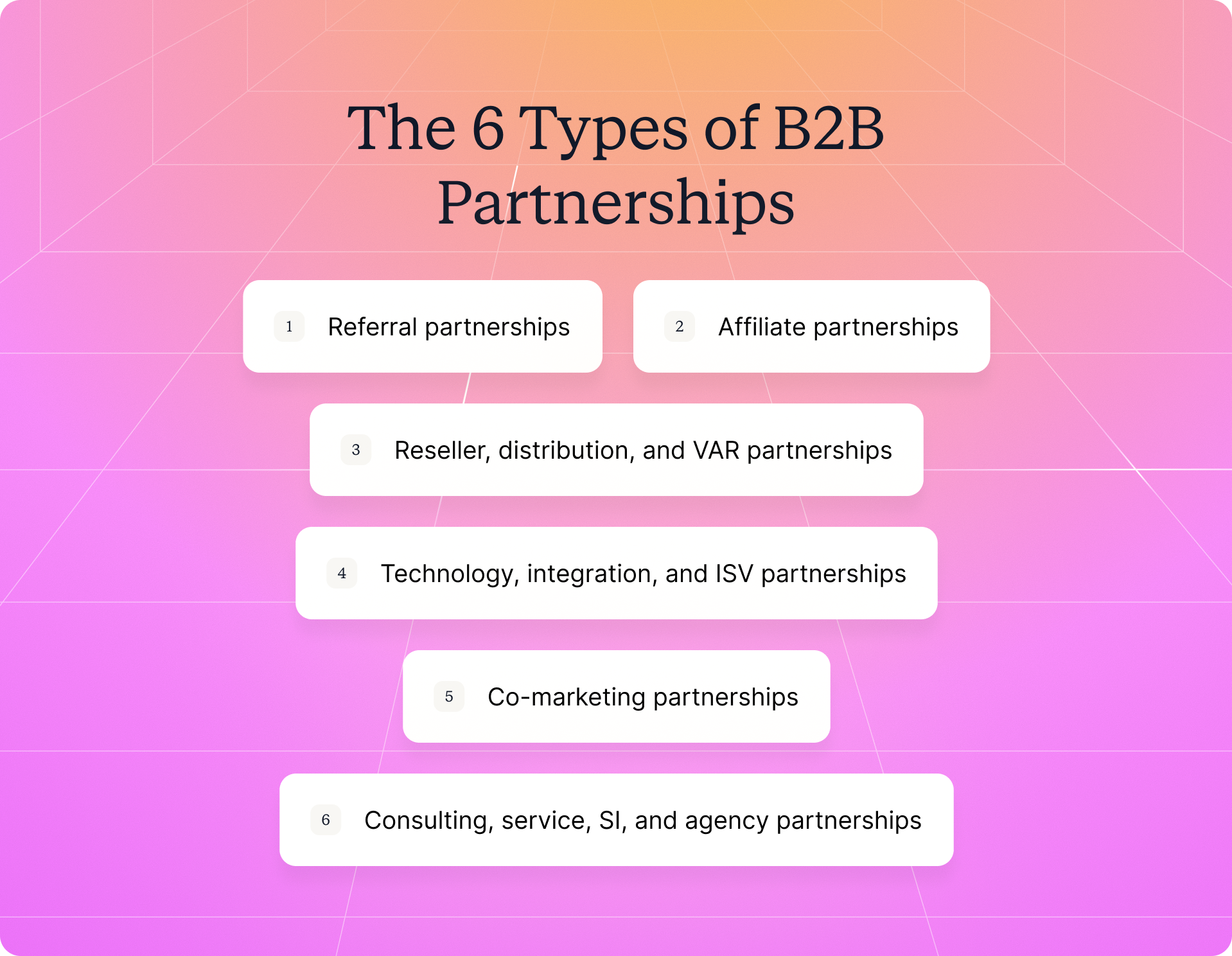
1. Referral partnerships
Referral partners introduce potential customers to a company for a fee, commission, discount, or reciprocal arrangement. The vendor usually owns the qualification and sales process after the introduction.
2. Affiliate partnerships
Affiliate partnerships use tracked links or codes to reward performance-based promotion. Most affiliates earn commission when someone completes an agreed action, such as booking a qualified demo or becoming a customer.
3. Reseller, distribution, and VAR partnerships
Resellers sell another company's product for a margin. Distributors connect vendors with a larger reseller network, while value-added resellers, or VARs, combine the core product with complementary products, implementation, or support.
4. Technology, integration, and ISV partnerships
Technology partners connect products to create a more useful combined solution. These partnerships may involve a simple integration, a jointly developed feature, or an offer that brings several product offerings together.
5. Co-marketing partnerships
Co-marketing partners create and promote joint content, webinars, research, events, or other marketing campaigns. By sharing production and distribution, both companies can improve brand awareness, cross-promotion, lead generation, and market reach.
6. Consulting, service, SI, and agency partnerships
Service partners help customers implement, migrate, customize, or get more value from a product. This group includes consultants, agencies, managed service providers, and systems integrators with specialist or industry expertise.
These types aren't mutually exclusive.
A B2B partner might begin by referring leads, then add co-marketing, co-selling, or implementation services as the relationship develops.
The next decision is how to structure that relationship. Partnership models define the level of commitment, coordination, and investment expected from both companies.
Common B2B partnership models
“Partner type” describes what a partner does. The partnership model describes how the relationship is structured.
- Transactional: A partner brings occasional referrals or deals without extensive joint planning.
- Strategic: The companies set shared goals, commit resources, and build long term partnerships.
- Tiered: A partner program changes benefits, incentives, or support based on performance, certification, or engagement.
- Ecosystem: Several partner types work together around a shared customer need or combined solution.
- Co-sell: Both sales teams collaborate on account selection, introductions, qualification, and deal progression.
A partnership can move between models. Referral relationships may become strategic partnerships after both sides prove demand. An integration partner may add co-marketing, then develop a formal co-selling motion. The model should follow the opportunity, not the other way around.
B2B partnership examples
Real partnerships rarely fit into one perfectly neat box, but these B2B collaboration examples show each primary type in action.
Notice how the strongest examples solve a clear customer problem. The partnership isn't the story. The better combined outcome is.
Which industries typically use B2B partnerships?
Almost any company can benefit from the right partnership. They are especially common in industries where no single business owns the whole customer journey.
How to build a B2B partnership strategy
A B2B partnership strategy helps you decide where partners can make a meaningful difference before you invest in a full partnership program. It should answer five questions.
1. What are we trying to achieve?
Start with the business goal, not a list of potential partners. Are you trying to enter new markets, generate qualified leads, increase revenue growth, improve retention, strengthen your product, or close a technical capability gap?
One clear goal makes every later decision easier. It also stops partnership development from becoming a collection of disconnected initiatives.
2. Who is our ideal partner?
Build an ideal partner profile in the same way you would define an ideal customer profile. Consider:
- The industry, company size, and geography the partner serves
- Its target audience and customer base
- Average deal size and sales motion
- Complementary products, services, and expertise
- Reputation and customer trust
- Commercial priorities and ability to execute
The ideal partner doesn't have to look like your company. It needs to bring something your customers value and offer a credible reason to work with you.
3. Why are we better together?
Your mutual value proposition should answer three direct questions: Why you? Why this partner? Why now?
Explain the customer problem you can solve together, what each company contributes, and what each side gains. That value might come from new revenue, a stronger offer, access to new audiences, implementation work, or a faster go-to-market strategy.
“Let's find ways to collaborate” is too vague. A strong proposition sounds more like this: “Our integration removes manual reporting for your finance customers, while your sales team gains a differentiated offer for a priority segment.”
4. Which partnership type and model fit the goal?
Choose the lightest motion that can test your idea. A referral partnership can validate demand before you invest in a reseller program. One co-marketing campaign can test shared audiences before both teams commit to an ongoing demand generation plan.
Deeper models need more alignment. A technology partnership requires product and engineering capacity. A reseller program needs commercial rules and sales enablement. A strategic alliance needs executive support, shared planning, and clear expectations on both sides.
5. How will we define success?
Clear goals help you select the best-fit key performance indicators. Choose measures that reflect the reason the partnership exists.
- Referral or affiliate: New leads, qualified leads, conversion rate, and closed revenue
- Reseller: Partner-sourced pipeline, win rate, average deal size, and revenue
- Technology: Integration adoption, active users, retention, and influenced pipeline
- Co-marketing: New audiences reached, engagement, leads generated, and opportunities created
- Service: Implementations, time-to-value, customer satisfaction, retention, and expansion
Agree on how data will be shared and reviewed. Formal agreements should also cover roles, responsibilities, commercial terms, brand use, and conflict resolution. Regular reviews and partner feedback help both companies assess whether the original goals and expectations still make sense.
When you are ready to turn the strategy into day-to-day processes, a structured partner program connects recruitment, onboarding, enablement, collaboration, attribution, and reporting.
How to find and qualify potential partners
The biggest logo isn't always the best partner. A smaller company with strong customer overlap, a committed owner, and a clear use case can create far more value than a famous name that never takes action.
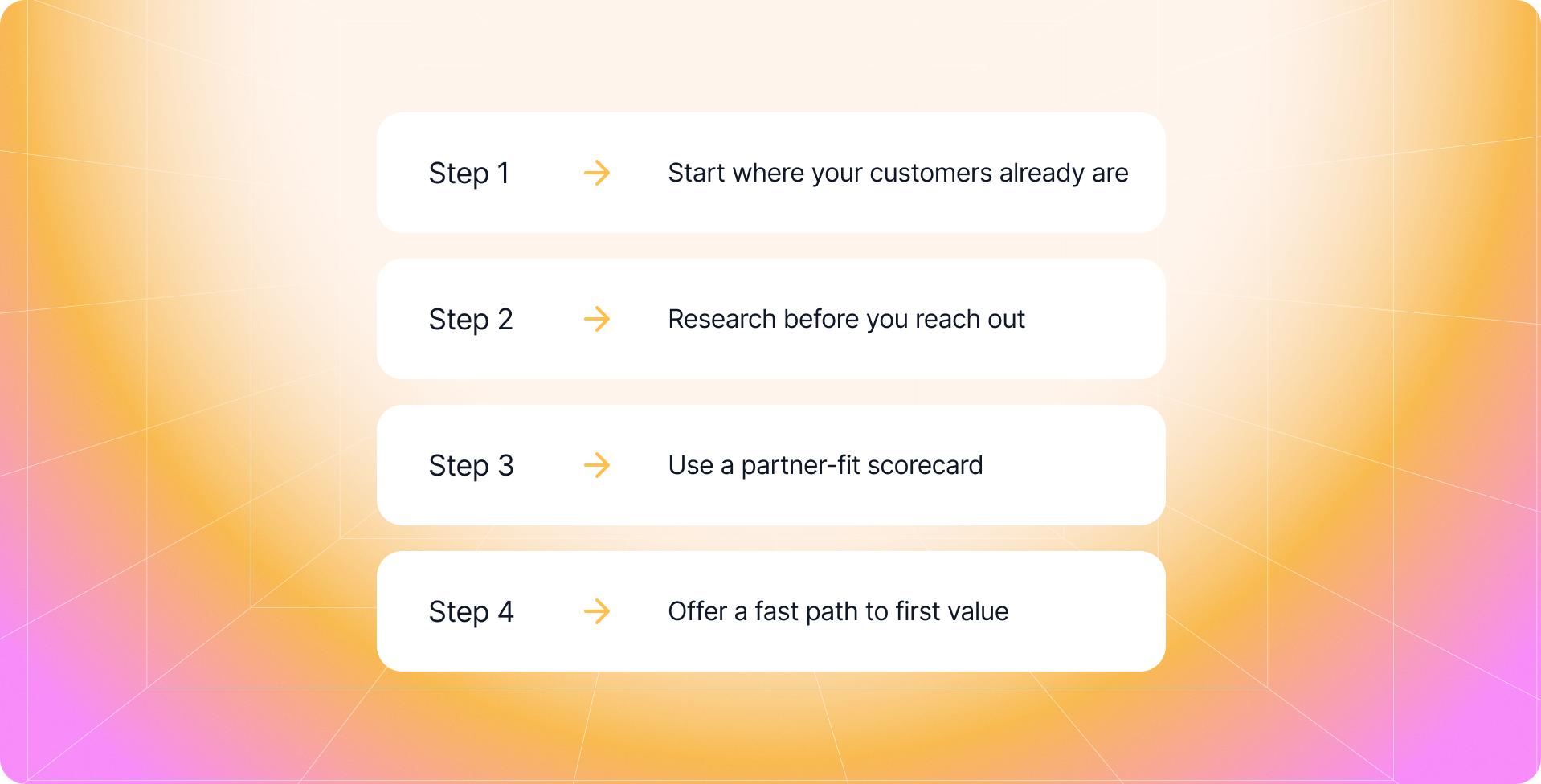
Start where your customers already are
Good partner discovery often begins with relationships that already exist. Ask your customers which products, consultants, agencies, and communities they rely on. Then look at the businesses that regularly appear beside you in sales conversations.
Potential partners may come from:
- Your customer, founder, investor, and sales team networks
- Complementary vendors and integration marketplaces
- Agencies, consultants, systems integrators, resellers, and distributors
- Industry events, professional communities, and associations
- Other partners in your wider B2B partner ecosystem
Research before you reach out
Check the company's partnership priorities, target market, current partner program, and likely timeline. Look for evidence that it can support the proposed motion.
An existing program can make collaboration easier because roles and processes are already defined. But it can also mean more competition for attention. Many channel partners represent several vendors, sometimes 5 to 10, so your offer needs enough customer relevance and commercial value to earn mindshare.
Use a partner-fit scorecard
B2B partner matching tools can help you discover companies, but they can't decide whether a partnership will work. Use a simple scorecard to evaluate potential partners objectively.
Score each company on:
- Customer and market overlap
- Complementary product offerings or services
- Strategic and commercial alignment
- Reputation and customer trust
- Technical or operational fit
- Executive support and day-to-day ownership
- Capacity to execute consistently
Set a minimum score before outreach. This keeps the team focused on the right partners instead of chasing logo value.
Offer a fast path to first value
The best strategies for recruiting B2B channel partners don't start with a huge commitment. They start with one useful next step.
That might be a joint account review, a referral pilot, an integration workshop, or a single co-marketing campaign. A focused first project lets both businesses test demand, communication, and follow-through.
Once new partners join, give them a clear first action and only the information they need to complete it. Effective onboarding reduces time-to-first-deal because partners aren't left searching through training, tools, and processes before they can contribute. An early win helps begin building momentum and gives both sides a reason to keep investing.
How Introw supports B2B partnerships
The strategy can be sound and still break down in execution. Partner information ends up in spreadsheets. Deals sit outside the CRM. Partners forget portal passwords. The sales team can't see the latest update. Then nobody can prove which relationships are producing revenue.
Introw is a CRM-native B2B partnership platform built to remove that friction.
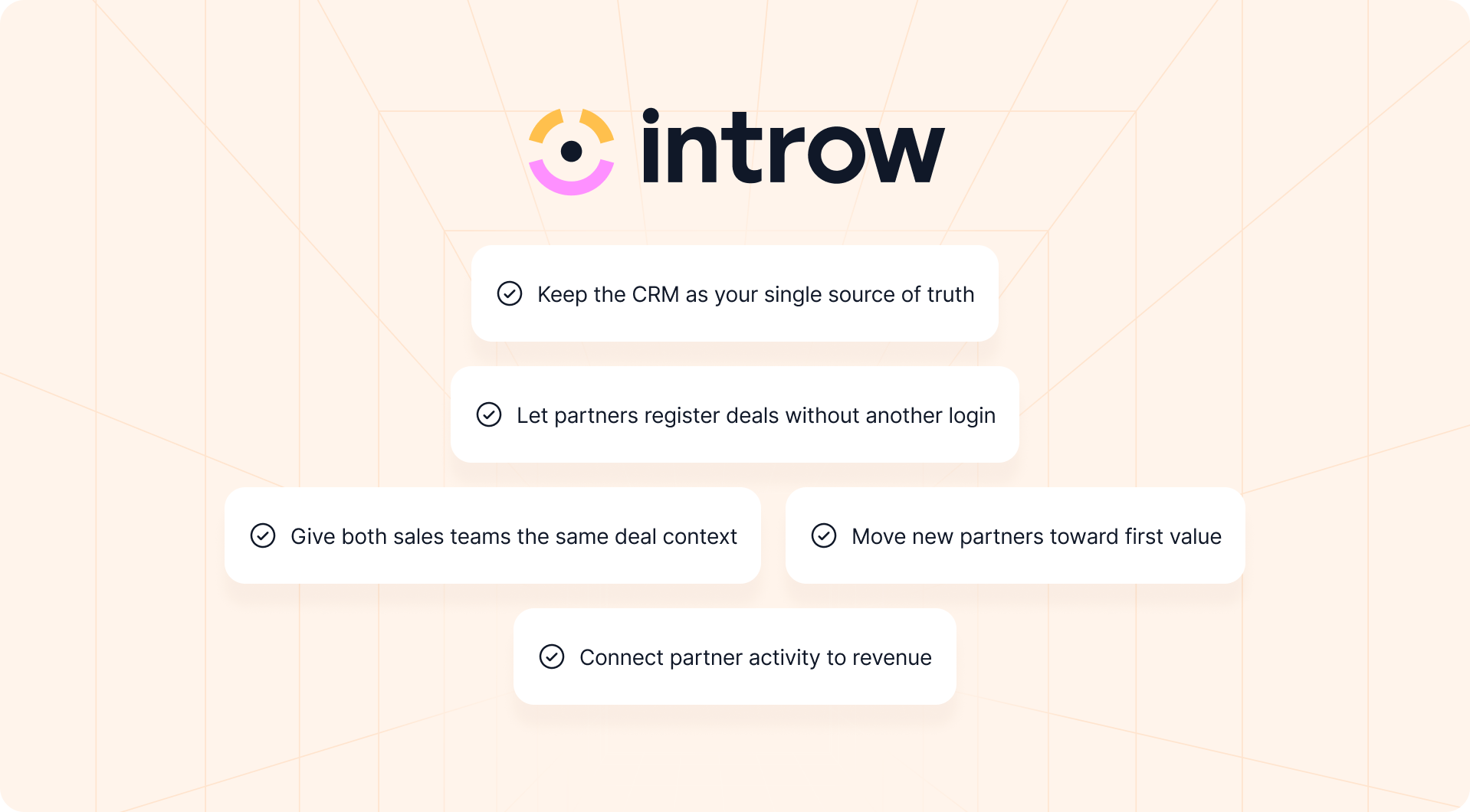
Keep the CRM as your single source of truth
Introw syncs partner data two ways with HubSpot and Salesforce. Partner records, activity, pipeline, and attribution stay connected to the customer and revenue data your teams already use.
Let partners register deals without another login
Referral partners, resellers, and other B2B partners can submit leads or register deals through the CRM, shared links, email, or Slack. They aren't forced to remember and revisit a separate partner portal every time they have an opportunity.
Give both sales teams the same deal context
Real-time embedded CRM cards keep comments, updates, and shared opportunities visible where sales teams already work. A shared asset library also gives partners access to current pitch decks, one-pagers, and co-marketing materials.
Move new partners toward first value
Automated onboarding flows give different partner types the right tasks, content, and milestones. That creates a clear route from signed agreement to first activity instead of leaving every new B2B partner to work it out alone.
Connect partner activity to revenue
Partner attribution, commission tracking, and real-time dashboards show which partners influence pipeline and closed revenue. Partnership teams can use the same data for performance tracking, QBRs, and ROI decisions instead of rebuilding the story in spreadsheets.
Turn partner activity into visible pipeline and measurable revenue with one CRM-connected system. Request an Introw demo to see how your team can manage and grow B2B partnerships without adding more disconnected tools.
Still curious? Here are some quick answers to help clear things up
B2B partnerships are strategic relationships in which two or more businesses share capabilities, resources, or market access to achieve mutually beneficial goals. They may support sales, marketing, product development, distribution, implementation, retention, or expansion.
The main types of B2B partnerships are referral, affiliate, reseller or distribution, technology or integration, co-marketing, and consulting or service partnerships. One relationship may combine several types as it develops.
A B2B channel partnership is a relationship in which another company helps market, refer, sell, deliver, or support a product. Common channel partners include referral partners, affiliates, distributors, resellers, VARs, agencies, and managed service providers.
A B2B partnership is one relationship between businesses. A channel or partnership program is the structured system used to manage multiple partner relationships. An ecosystem is the broader network of companies whose combined products, services, and expertise create value for shared customers.





See AI-Native PRM in Action
Book a demo with one of our partner program experts, or explore Introw on your own time.